
In my extensive experience with gear manufacturing, the skiving of hardened straight bevel gears represents a pivotal advancement in precision engineering. This process fundamentally addresses the manufacturing challenges posed by heat treatment distortion in straight bevel gears. Not only does it enhance the surface finish and meshing accuracy, but the induced cold-working hardening effect during skiving significantly improves the wear resistance of the tooth flanks, thereby extending the operational life of the gears. This article delves into the technical intricacies, process parameters, and practical considerations for successfully implementing hard skiving for straight bevel gears.
The core principle of skiving hardened gears involves removing a minimal amount of material from the carburized and hardened tooth surfaces using a single-point cutting tool on a gear planing or special skiving machine. This is not a mere finishing operation; it is a precision machining step that corrects geometric deviations and produces a superior functional surface. The success of this operation hinges on meticulous preparation, precise machine setup, and optimal selection of cutting parameters.
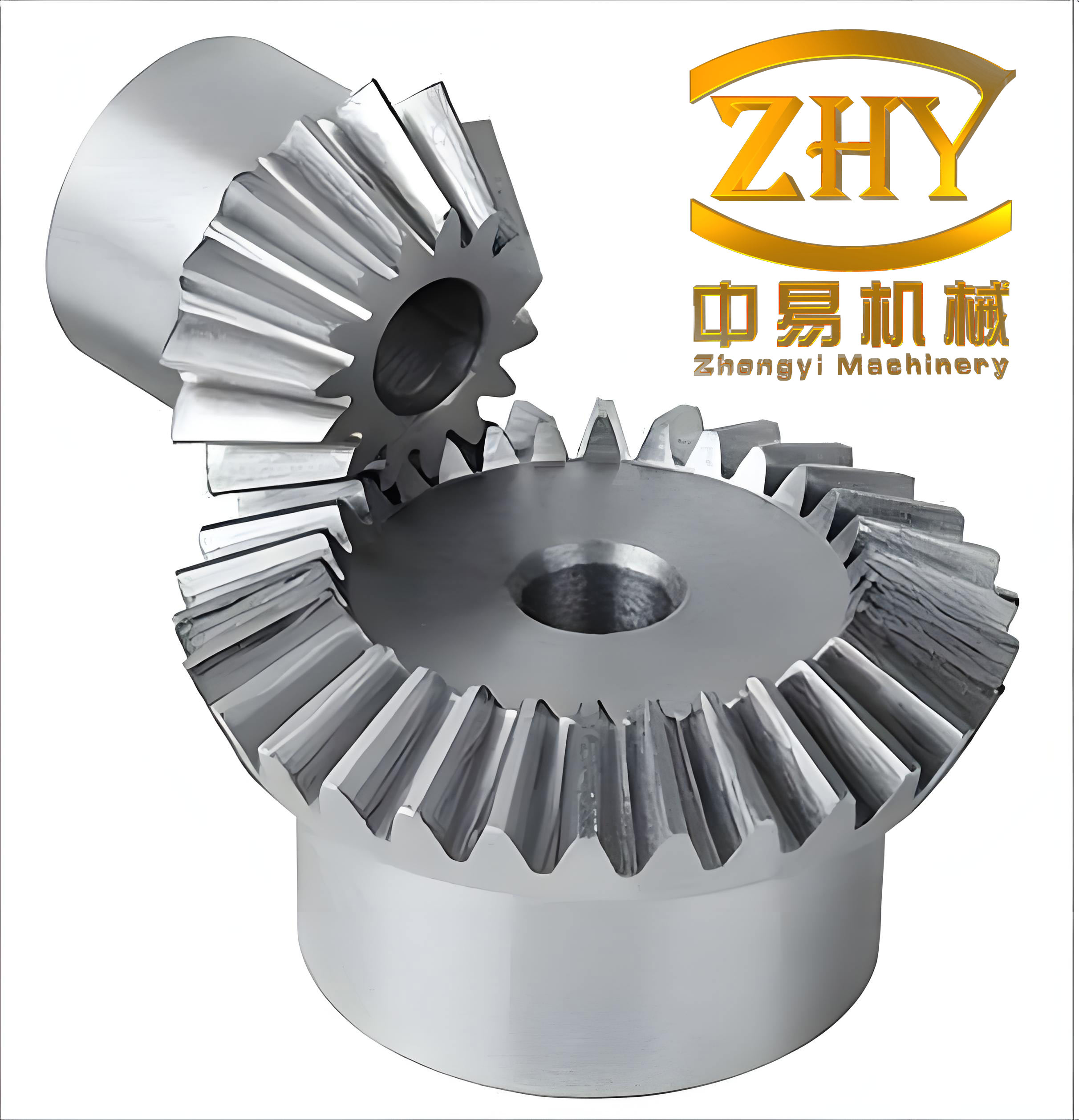
Before the skiving process can commence, critical preparatory steps involving the gear blanks are non-negotiable. For shaft-type straight bevel gears, the center holes must be re-ground after quenching using hard alloy centers. This ensures that the runout of the pitch cone during subsequent skiving is within strict tolerances, allowing for a minimal and consistent skiving allowance. For ring-type straight bevel gears, the internal bore must be ground post-heat treatment to serve as the primary datum for skiving. Due to their typically larger and thinner web, these gears exhibit complex and non-uniform distortion. The grinding setup must therefore be carefully aligned by indicating multiple datums. Based on my practice, the following runout tolerances should be achieved during internal bore grinding for a ring gear, as summarized in the table below.
| Indicated Surface | Tolerance (mm) | Description |
|---|---|---|
| Face Cone | 0.02 | Runout measured on the face cone surface. |
| Back Cone (Opposite Point) | 0.03 | Runout on the back cone at a point opposite the reference. |
| Back Cone (Adjacent Point) | 0.03 | Runout on the back cone at a point adjacent to the reference. |
| Pitch Circle at Large End (Opposite Point) | 0.08 | Runout on the large-end pitch circle diameter at an opposite point. |
| Pitch Circle at Large End (Adjacent Point) | 0.10 | Runout on the large-end pitch circle diameter at an adjacent point. |
The heart of the skiving operation lies in the meticulous adjustment of the gear planing machine and the scientific selection of process parameters. Machine condition directly impacts gear quality and tool life. Three key mechanical clearances must be minimized: the backlash in the change gears, the clearance in the worm gear pair driving the cradle, and the clearance in the planing tool slide. I have found that excessive clearance in the tool slide, in particular, can lead to chatter marks or waves on the tooth flank near the large end, severely compromising the surface integrity of the straight bevel gears. The clearance in the cradle’s dividing worm wheel and the segment gear should ideally be maintained below 0.03 mm to ensure positional accuracy during indexing.
Another practical consideration is pre-skiving chamfering. While it might seem trivial, applying a 45-degree chamfer at the large end of the gear tooth prior to skiving is crucial. Without it, the initial engagement is not a clean cut but an impact where the tool’s rake face contacts the workpiece first. With the chamfer, combined with the tool’s positive rake and inclination angles, the cutting edge engages smoothly, reducing shock loads and prolonging tool life—a vital factor when machining hard materials.
The selection of cutting speed (v) is a critical determinant of both tool durability and the final surface condition of the straight bevel gears. Excessive speed generates high cutting temperatures, increasing residual tensile stresses and potentially over-hardening the surface layer through excessive work hardening. This can make subsequent skiving passes difficult or impossible, as the tool may simply skid over an overly hardened surface. Through systematic trials, I have determined an optimal reciprocation rate for the planing tool. The cutting speed can be calculated using the following formula, which relates the skiving passes, tool strokes, and stroke length:
$$ v = \frac{z \cdot n \cdot L}{1000} $$
Where:
\( v \) = cutting speed in meters per minute (m/min),
\( z \) = number of skiving passes per tooth flank (typically 2),
\( n \) = tool reciprocation rate in strokes per minute (strokes/min),
\( L \) = tool stroke length in millimeters (mm).
For a specific application on medium-sized straight bevel gears, I settled on \( n = 97 \) strokes/min and \( L = 105 \) mm. Substituting these values yields:
$$ v = \frac{2 \times 97 \times 105}{1000} = 20.37 \text{ m/min} $$
This speed has proven effective in controlling heat generation while maintaining productivity. The time allocated per tooth for this setup was approximately 86 seconds, ensuring a stable and controlled material removal process.
Determining the total skiving allowance and the number of skiving passes is equally scientific. The allowance must be sufficient to clean up all heat treatment distortion and, importantly, to remove the brittle retained austenite and carbide network from the surface layer left by carburizing. If this layer is not fully removed, the core benefits of skiving the hardened straight bevel gears are negated, as the sub-surface material with optimal tempered martensite structure is not exposed. Empirical data from multiple production runs has established a reliable relationship between the module (m) of the straight bevel gear and the total skiving allowance per flank. This relationship is best applied in a two-pass strategy to balance efficiency and accuracy, minimizing tool pressure and heat concentration in a single pass.
| Gear Module (m) Range | Total Skiving Allowance per Flank | Recommended Number of Passes | Allowance as Function of Module |
|---|---|---|---|
| 3 – 6 mm | 0.045 – 0.15 mm | 2 (Roughing + Finishing) | \( (0.015 \text{ to } 0.025) \times m \) |
| 6 – 10 mm | 0.09 – 0.25 mm | ||
| 10 – 14 mm | 0.15 – 0.35 mm |
The formula for the total allowance \( A_t \) is:
$$ A_t = k \cdot m $$
where \( k \) is a coefficient ranging from 0.015 to 0.025, selected based on the observed distortion severity for the specific gear design and heat treatment batch. For the first (roughing) pass, approximately 60-70% of \( A_t \) is removed, with the remainder taken in the second (finishing) pass. This approach ensures stable cutting conditions and achieves the desired surface finish on the straight bevel gears.
Tooling is the final pillar of successful hard skiving. The planing tool, typically made of ultra-hard grades of cubic boron nitride (CBN) or advanced coated carbides, must withstand high intermittent cutting forces and abrasion. The tool geometry is paramount. A positive rake angle (\( \gamma \)) between 5° and 10° helps in reducing cutting forces, while a clearance angle (\( \alpha \)) of 6° to 8° prevents rubbing. An inclination angle (\( \lambda_s \)) of around 10° to 12° is incorporated to create a shear cutting action and improve chip flow away from the cutting zone. The relationship between cutting force (\( F_c \)), tool geometry, and material properties can be approximated for planning purposes, though actual forces are best measured dynamically. A simplified model considers the specific cutting pressure (\( k_c \)) of the hardened material:
$$ F_c \approx k_c \cdot A_c $$
where \( A_c \) is the cross-sectional area of the uncut chip, which varies along the tooth profile of the straight bevel gear. For case-hardened steel with a hardness of 58-62 HRC, \( k_c \) can range from 2500 to 4000 N/mm². Proper tool selection and maintenance are critical to achieving the required tool life, often measured in hundreds of gear sets before regrinding is necessary.
The benefits of implementing hard skiving for straight bevel gears are quantifiable. Beyond the obvious geometric corrections, the process induces a beneficial compressive residual stress layer and a work-hardened surface. The surface hardness can increase by 50-100 HV points within a shallow layer (20-50 microns), directly enhancing pitting and wear resistance. The improvement in surface finish is dramatic, typically achieving an Ra value below 0.8 μm compared to the 3-6 μm common after grinding, which reduces friction losses and noise in the final assembly. The contact pattern under load is more centralized and stable, leading to more predictable and reliable performance of the straight bevel gear drive.
In conclusion, the hard skiving of straight bevel gears is a sophisticated yet highly rewarding manufacturing process. It demands a holistic approach encompassing precise pre-machining, rigorously controlled machine tool conditions, optimized cutting parameters derived from fundamental principles, and specialized tooling. When executed correctly, it transforms the challenges posed by heat treatment of straight bevel gears into an opportunity for achieving superior gear quality, enhanced durability, and extended service life. The tables and formulas presented herein serve as a foundational guide, but successful implementation always requires adaptation to specific machine tools, gear designs, and material batches. The future of high-performance straight bevel gears undoubtedly lies in the continued refinement of such hard finishing technologies.