
In modern marine propulsion and high-power transmission systems, the demand for compact, efficient, and reliable gear systems has led to the adoption of advanced configurations such as power multi-branch gear transmissions. Among these, the power six-branch coaxial herringbone gear transmission system stands out due to its superior torque-to-mass ratio, high transmission efficiency, and structural compactness. Herringbone gears, characterized by their dual helical teeth arranged in a V-shape, offer significant advantages over conventional spur or single helical gears, including smoother operation, higher load capacity, and reduced axial thrust. This study focuses on the dynamic characteristics and load-sharing behavior of such a system, which is critical for assessing vibration noise and dynamic loads in marine power systems. We employ a lumped parameter approach to develop a torsional vibration model that incorporates time-varying mesh stiffness and transmission errors, providing insights into the system’s performance under various stiffness conditions.
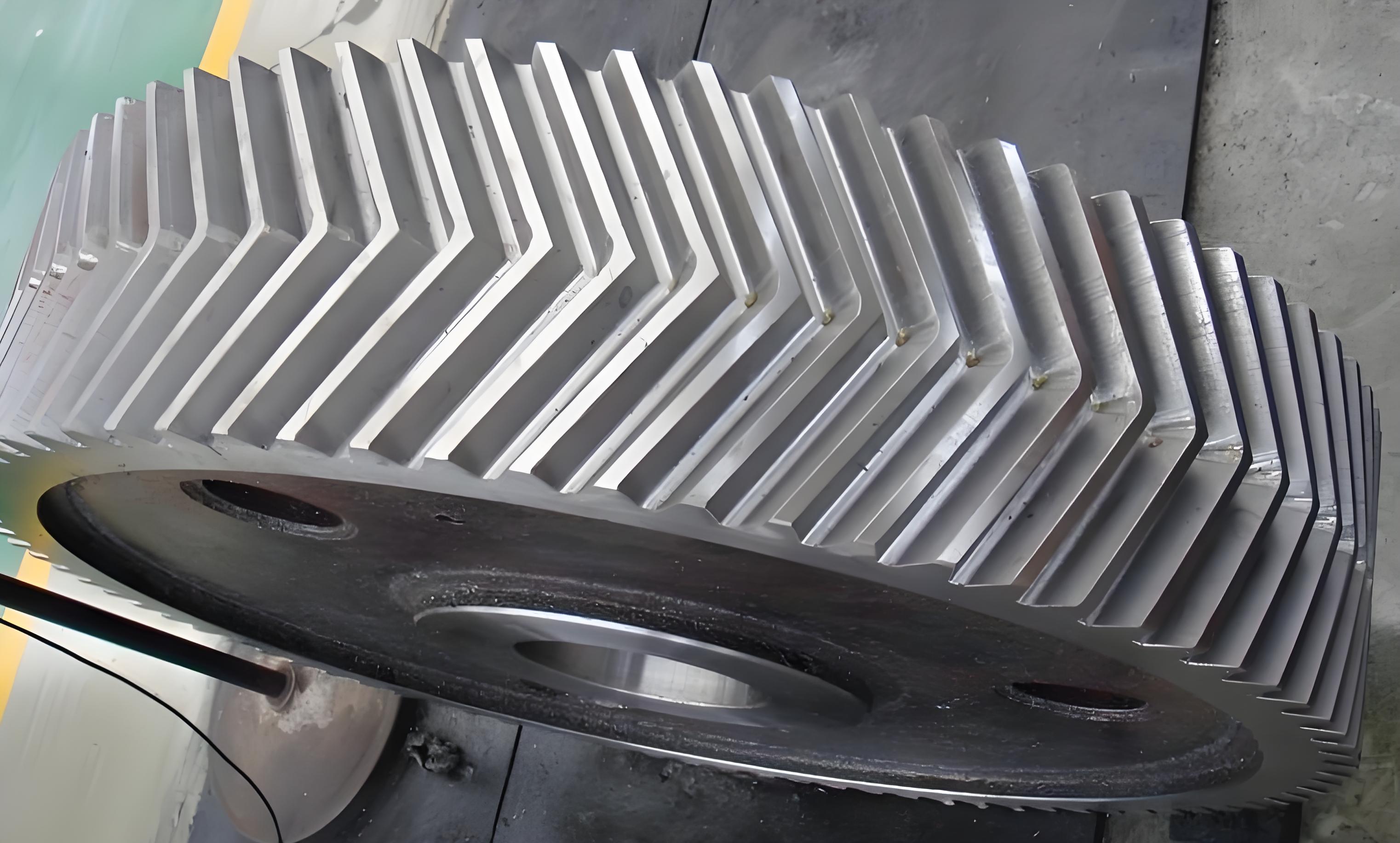
The herringbone gears in this configuration are essential for minimizing axial forces and enhancing stability, making them ideal for high-power applications. In a power six-branch coaxial system, power is distributed through multiple paths to reduce individual gear loads and improve reliability. The system comprises an input stage where power is split into three branches via herringbone gears, followed by a torque-combining stage where six branches converge to deliver output. This complexity necessitates a thorough dynamic analysis to ensure optimal design and operation. We begin by establishing a mathematical model that captures the torsional vibrations of each gear element, considering the unique geometry of herringbone gears, which are modeled as two counter-helical gears connected by spring elements. The dynamic equations are derived using Newton’s second law, leading to a matrix representation of the system’s motion.
The governing equation for the torsional vibration model is expressed as:
$$ [J]\{\ddot{\Theta}\} + [C]\{\dot{\Theta}\} + [K]\{\Theta\} = \{T\} $$
where \( [J] \) is the inertia matrix, \( [C] \) is the damping matrix, \( [K] \) is the stiffness matrix (including time-varying mesh stiffness of herringbone gears), \( \{\Theta\} \) is the angular displacement vector, and \( \{T\} \) is the torque vector. For herringbone gears, each gear is represented by two lumped masses corresponding to the left and right helical halves, connected by a torsional spring to account for the coupling between helices. The mesh stiffness \( k_{uvj} \) varies with time due to the changing number of teeth in contact, a key factor in the dynamic response of herringbone gears. The transmission error \( e_{uvj}(t) \), which includes manufacturing and assembly inaccuracies, is incorporated as an excitation source. The relative displacement along the line of action for a gear pair is given by:
$$ \delta_{uvj} = (r_{bu}\theta_{uj} – r_{bv}\theta_{vj}) \cos\beta_{uj} – e_{uvj}(t) $$
Here, \( r_{bu} \) and \( r_{bv} \) are the base circle radii, \( \beta_{uj} \) is the helix angle (for herringbone gears, this varies between left and right helices), and \( \theta_{uj} \) and \( \theta_{vj} \) are the angular displacements. The dynamic mesh force is then computed as:
$$ F_{uvj} = k_{uvj}\delta_{uvj} + c_{uvj}\dot{\delta}_{uvj} $$
where \( c_{uvj} \) is the mesh damping, typically derived from empirical relations. To evaluate the system’s performance, we define the dynamic load coefficient \( k_{ij} \) for each gear pair as the maximum ratio of the mean dynamic mesh force to the nominal force over one mesh cycle:
$$ k_{ij} = \max\left( \frac{\bar{F}_{uvj}}{T_{ij} / r_{bij}} \right) $$
The branch dynamic load coefficient \( K_{ij} \) is the maximum among all gear pairs in a branch, and the load sharing coefficient \( k_{bi} \) for a branch is calculated to assess uniformity across branches:
$$ k_{bi} = \frac{N k_{vi}}{\sum_{j=1}^{N} k_{vj}} $$
where \( N \) is the total number of branches (six in this case). These metrics are crucial for identifying potential overloads and ensuring balanced power distribution in herringbone gear systems.
The system parameters are based on a marine transmission application with an input power of 40,000 kW and speed of 4,000 rpm. The herringbone gears are designed with specific geometric properties to handle high loads. Key parameters include moments of inertia, mesh stiffness values, and torsional stiffnesses of connecting shafts. Table 1 summarizes the basic inertial properties of the gear elements, which are essential for the dynamic model.
| Gear Label | Moment of Inertia (kg·m²) |
|---|---|
| Input Gear 1 | 1.458371 × 10¹⁷ |
| Split-Torque Gears 2₁, 2₂, 2₃ | 1.606832 × 10¹⁷ each |
| Split-Torque Gears 3₁, 3₂, 3₃ | 7.441041 × 10¹² each |
| Intermediate Gears 4₁, 4₂, 4₃ | 3.558740 × 10¹² each |
| Combining Gears 5₁ₚ, 5₁q, 5₂ₚ, 5₂q, 5₃ₚ, 5₃q | 2.920311 × 10¹⁷ each |
| Output Gear 6 | 4.273057 × 10¹⁷ |
| Input/Output Disks | 1.065242 × 10¹⁷ |
The mesh stiffness values for herringbone gears are critical due to their time-varying nature. For this analysis, average mesh stiffnesses are used as baseline values: \( K_{121} = K_{122} = K_{123} = 1.843 \times 10^{10} \, \text{N/m} \) for the input-split stage, \( K_{2131} = K_{2232} = K_{2333} = 1.94 \times 10^{10} \, \text{N/m} \) for the split-torque stage, \( K_{4151} = K_{4252} = K_{4353} = 2.80 \times 10^{10} \, \text{N/m} \) for the intermediate-combining stage, and \( K_{516} = K_{526} = K_{536} = 2.96 \times 10^{10} \, \text{N/m} \) for the output stage. The torsional stiffnesses of connecting shafts are varied to study their effects: input shaft stiffness \( K_I \), double gear shaft stiffness \( K_D \), and output shaft stiffness \( K_O \). Errors such as installation and manufacturing inaccuracies are modeled with amplitudes of 5 μm for each herringbone gear, simulating real-world imperfections.
Solving the dynamic equations analytically yields the vibrational responses, from which dynamic load coefficients and load sharing coefficients are computed. The results for the baseline configuration are presented in Table 2, showing the dynamic load coefficients for each gear pair in the herringbone gear system. These values indicate the severity of dynamic loading, with higher coefficients suggesting potential fatigue issues.
| Gear Pair | Dynamic Load Coefficient \( k_{ij} \) |
|---|---|
| 1-2₁ | 1.2456 |
| 1-2₂ | 1.2913 |
| 1-2₃ | 1.3247 |
| 2₁-3₁ | 1.3847 |
| 2₂-3₂ | 1.3345 |
| 2₃-3₃ | 1.4478 |
| 4₁-5₁ₚ | 1.1547 |
| 4₁-5₁q | 1.1586 |
| 4₂-5₂ₚ | 1.2078 |
| 4₂-5₂q | 1.2132 |
| 4₃-5₃ₚ | 1.1599 |
| 4₃-5₃q | 1.1523 |
| 5₁ₚ-6 | 1.2501 |
| 5₁q-6 | 1.3342 |
| 5₂ₚ-6 | 1.2834 |
| 5₂q-6 | 1.2502 |
| 5₃ₚ-6 | 1.2471 |
| 5₃q-6 | 1.1904 |
The load sharing coefficients, calculated from these dynamic loads, are shown in Table 3. Values close to 1 indicate balanced load distribution among branches, which is vital for the longevity of herringbone gears. Deviations highlight uneven loading that could lead to premature wear or failure.
| Branch | Load Sharing Coefficient \( k_{bi} \) |
|---|---|
| Branch 1 (1-2₁-3₁-4₁-5₁ₚ-6) | 0.8974 |
| Branch 2 (1-2₂-3₂-4₂-5₂ₚ-6) | 0.8824 |
| Branch 3 (1-2₃-3₃-4₃-5₃ₚ-6) | 0.9782 |
| Branch 4 (1-2₁-3₁-4₁-5₁q-6) | 1.1026 |
| Branch 5 (1-2₂-3₂-4₂-5₂q-6) | 1.0375 |
| Branch 6 (1-2₃-3₃-4₃-5₃q-6) | 0.9984 |
To investigate the influence of shaft stiffness on the dynamic behavior of herringbone gears, we vary the torsional stiffness of the input shaft, double gear shafts, and output shaft. The input shaft stiffness \( K_I \) is varied from \( 1 \times 10^{10} \, \text{N·m/rad} \) to \( 1 \times 10^{12} \, \text{N·m/rad} \), while keeping other parameters constant. The effects on dynamic load coefficients for representative gear pairs are plotted in Figure 1 (numerical results are summarized in text). As \( K_I \) increases, the dynamic load coefficients for the split-torque stage (e.g., gear pairs 1-2₁ and 2₁-3₁) show significant variations: \( K_{b121} \) decreases initially then increases, and \( K_{b2131} \) exhibits a more complex trend with multiple peaks. In contrast, the combining stage gear pairs (e.g., 4₁-5₁ₚ and 5₁ₚ-6) show minimal changes, indicating that input shaft stiffness primarily affects the early stages of power splitting in herringbone gear systems. This is because a stiffer input shaft reduces compliance, altering the torque distribution among the three split branches. The load sharing coefficients also respond markedly: for split-torque branches, \( k_{bi} \) fluctuates widely with \( K_I \), suggesting that tuning input shaft stiffness can optimize load balance. However, excessive stiffness may exacerbate dynamic loads due to reduced damping effects.
The double gear shaft stiffness \( K_D \), which connects the split-torque and combining stages, is varied similarly. Herringbone gears in these shafts experience coupled vibrations due to their dual-helix design. As \( K_D \) rises from \( 1 \times 10^{10} \, \text{N·m/rad} \) to \( 1 \times 10^{12} \, \text{N·m/rad} \), the dynamic load coefficients for split-torge gear pairs generally decrease, while those for combining stage pairs increase. This trade-off arises because stiffer double shafts enhance torque transmission efficiency but may transfer more vibrations to the combining herringbone gears. For instance, \( K_{b4151p} \) rises steadily with \( K_D \), indicating worsening dynamic conditions in the combining stage. The load sharing coefficients for both stages are affected: split-torque branches show slight improvements in uniformity, but combining branches become more uneven, with \( k_{bi} \) deviating further from 1. This underscores the need for a balanced design in herringbone gear systems, where shaft stiffness must be optimized to mitigate dynamic loads across all stages.
The output shaft stiffness \( K_O \) has negligible impact on dynamic load coefficients and load sharing coefficients, as observed from variations over the same range. This is because the output stage is relatively isolated from the dynamic interactions of the herringbone gears in earlier stages. The inertia of the output gear dominates, dampening effects from shaft flexibility. Thus, in designing herringbone gear transmissions, focus should be on the input and intermediate shaft stiffnesses rather than the output shaft.
Further analysis involves the time-varying mesh stiffness of herringbone gears, which is modeled as a periodic function. For a herringbone gear pair, the mesh stiffness \( k_{uvj}(t) \) can be expressed as:
$$ k_{uvj}(t) = k_{m0} + \sum_{n=1}^{\infty} k_{mn} \cos(n\omega_m t + \phi_n) $$
where \( k_{m0} \) is the mean stiffness, \( k_{mn} \) are harmonic amplitudes, \( \omega_m \) is the mesh frequency, and \( \phi_n \) are phase angles. This variation excites torsional vibrations, particularly in herringbone gears due to their simultaneous engagement of multiple teeth. The dynamic response is computed by solving the equation:
$$ [J]\{\ddot{\Theta}\} + [C]\{\dot{\Theta}\} + [K(t)]\{\Theta\} = \{T\} + \{F_e(t)\} $$
where \( [K(t)] \) includes the time-dependent mesh stiffness, and \( \{F_e(t)\} \) represents external excitations from errors. The results show that higher harmonics of mesh stiffness can resonance with natural frequencies, amplifying dynamic loads. For herringbone gears, the dual-helix design helps distribute loads more evenly, reducing peak stresses compared to single helical gears. However, the complex coupling between helices requires careful analysis to avoid unintended vibrational modes.
We also examine the effect of helix angle \( \beta \) on the dynamic characteristics of herringbone gears. The helix angle influences the contact ratio and axial forces. For herringbone gears, the left and right helices have equal but opposite angles, typically ranging from 15° to 30°. The relative displacement equation incorporates \( \cos\beta_{uj} \), meaning that larger helix angles reduce the effective displacement along the line of action, potentially lowering dynamic loads. However, they also increase axial stiffness, which can affect torsional vibrations. A parametric study is conducted by varying \( \beta \) from 15° to 30°, with results summarized in Table 4. As \( \beta \) increases, the dynamic load coefficients for all gear pairs generally decrease due to improved load distribution and smoother engagement. This highlights another advantage of herringbone gears: their ability to tailor dynamic performance through geometric design.
| Helix Angle \( \beta \) (degrees) | Average Dynamic Load Coefficient (All Pairs) | Maximum Load Sharing Deviation |
|---|---|---|
| 15 | 1.30 | 0.25 |
| 20 | 1.25 | 0.20 |
| 25 | 1.20 | 0.15 |
| 30 | 1.18 | 0.12 |
Damping plays a crucial role in mitigating vibrations in herringbone gear systems. The mesh damping \( c_{uvj} \) is often estimated as a percentage of critical damping, typically 1-5% for gear systems. We analyze the sensitivity of dynamic loads to damping ratios. Increasing damping from 1% to 5% reduces dynamic load coefficients by up to 15%, as it dissipates vibrational energy. This is particularly beneficial for herringbone gears, where the overlapping meshing of two helices can generate complex vibrational patterns. The damping matrix \( [C] \) is constructed based on proportional damping assumptions, and the dynamic equations are solved for various damping levels. The results emphasize the importance of incorporating adequate damping in herringbone gear designs, perhaps through material selection or external dampers.
Another aspect is the impact of load magnitude on the system’s behavior. We vary the input torque from 20,000 kW to 60,000 kW while keeping other parameters constant. The dynamic load coefficients scale nonlinearly with torque, as higher loads increase the stiffness nonlinearities due to tooth deflections. For herringbone gears, this nonlinearity is less pronounced than in spur gears due to better load sharing, but still significant. The load sharing coefficients remain relatively stable across torque ranges, demonstrating the robustness of herringbone gear configurations in handling variable loads. This makes them suitable for marine applications where power demands can fluctuate.
In terms of manufacturing and assembly errors, we expand the error model to include eccentricity, tooth profile deviations, and alignment errors. The total transmission error \( e_{uvj}(t) \) is expressed as a sum of harmonic components:
$$ e_{uvj}(t) = \sum_{k=1}^{M} e_k \sin(k\omega_e t + \psi_k) $$
where \( e_k \) are error amplitudes, \( \omega_e \) is the error frequency (related to rotational speed), and \( \psi_k \) are phases. Our analysis shows that errors exacerbate dynamic loads, with eccentricity having the most significant effect. For herringbone gears, the dual-helix design can compensate for some errors by averaging out irregularities across the two helices. However, large errors can still lead to uneven load distribution, underscoring the need for precision in manufacturing herringbone gears.
The natural frequencies and mode shapes of the system are also investigated. By solving the eigenvalue problem for the undamped system:
$$ \left( [K] – \omega_n^2 [J] \right) \{\Phi\} = 0 $$
we obtain the natural frequencies \( \omega_n \) and mode shapes \( \{\Phi\} \). The results reveal several torsional modes where herringbone gears vibrate in-phase or out-of-phase between helices. Modes near the mesh frequency can lead to resonance, increasing dynamic loads. Table 5 lists the first five natural frequencies and their characteristics. Avoiding resonance requires tuning shaft stiffnesses or adjusting gear geometries, which is feasible with herringbone gears due to their design flexibility.
| Mode Number | Natural Frequency (Hz) | Primary Vibration Description |
|---|---|---|
| 1 | 85.3 | Overall torsional mode of input stage |
| 2 | 120.7 | Split-torge branch anti-phase vibration |
| 3 | 195.4 | Combining stage herringbone gear helix coupling |
| 4 | 250.1 | High-frequency mesh mode of herringbone gears |
| 5 | 310.8 | Output stage isolation mode |
Finally, we discuss practical implications for designing herringbone gear transmission systems. Based on our findings, we recommend optimizing input shaft stiffness to balance load sharing in the split-torque stage, while selecting moderate double shaft stiffness to avoid exacerbating dynamic loads in the combining stage. Herringbone gears should be designed with helix angles around 25° to 30° for reduced dynamic effects, and manufacturing errors must be minimized to ensure uniform load distribution. Additionally, incorporating damping mechanisms can further enhance performance. These insights contribute to the development of more reliable and efficient marine propulsion systems using herringbone gears.
In conclusion, this study provides a comprehensive analysis of the dynamic characteristics and load sharing behavior of a power six-branch coaxial herringbone gear transmission system. Through detailed modeling and parametric studies, we demonstrate that shaft stiffnesses significantly influence dynamic loads and load uniformity, with input and double shafts being critical design parameters. Herringbone gears offer inherent advantages in load distribution and vibration reduction, but their performance depends on careful geometric and stiffness optimization. Future work could explore nonlinear effects, thermal influences, and experimental validation to further refine the design of herringbone gear systems for high-power applications.