
As an engineer with extensive experience in heavy machinery, I have always been fascinated by the design and manufacturing of herringbone gears. These gears are renowned for their high load-bearing capacity and smooth operation, making them indispensable in large-scale equipment such as rolling mills. In this article, I will delve into the manufacturing and processing techniques for heavy-duty herringbone gear shafts, particularly those without relief grooves and with medium-hard tooth surfaces. The focus will be on optimizing工艺流程 to enhance durability and meet technical specifications. Throughout this discussion, I will emphasize key aspects like material selection, heat treatment, and precision machining, all while highlighting the importance of herringbone gears in industrial applications.
Herringbone gears can be classified based on structure—such as wide relief groove, small relief groove, and no relief groove types—and based on tooth surface hardness—including soft, hard, and medium-hard surfaces. The no-relief-groove medium-hard tooth surface herringbone gear shaft, as shown in the image below, is particularly challenging to manufacture due to its integrated design and demanding performance requirements.
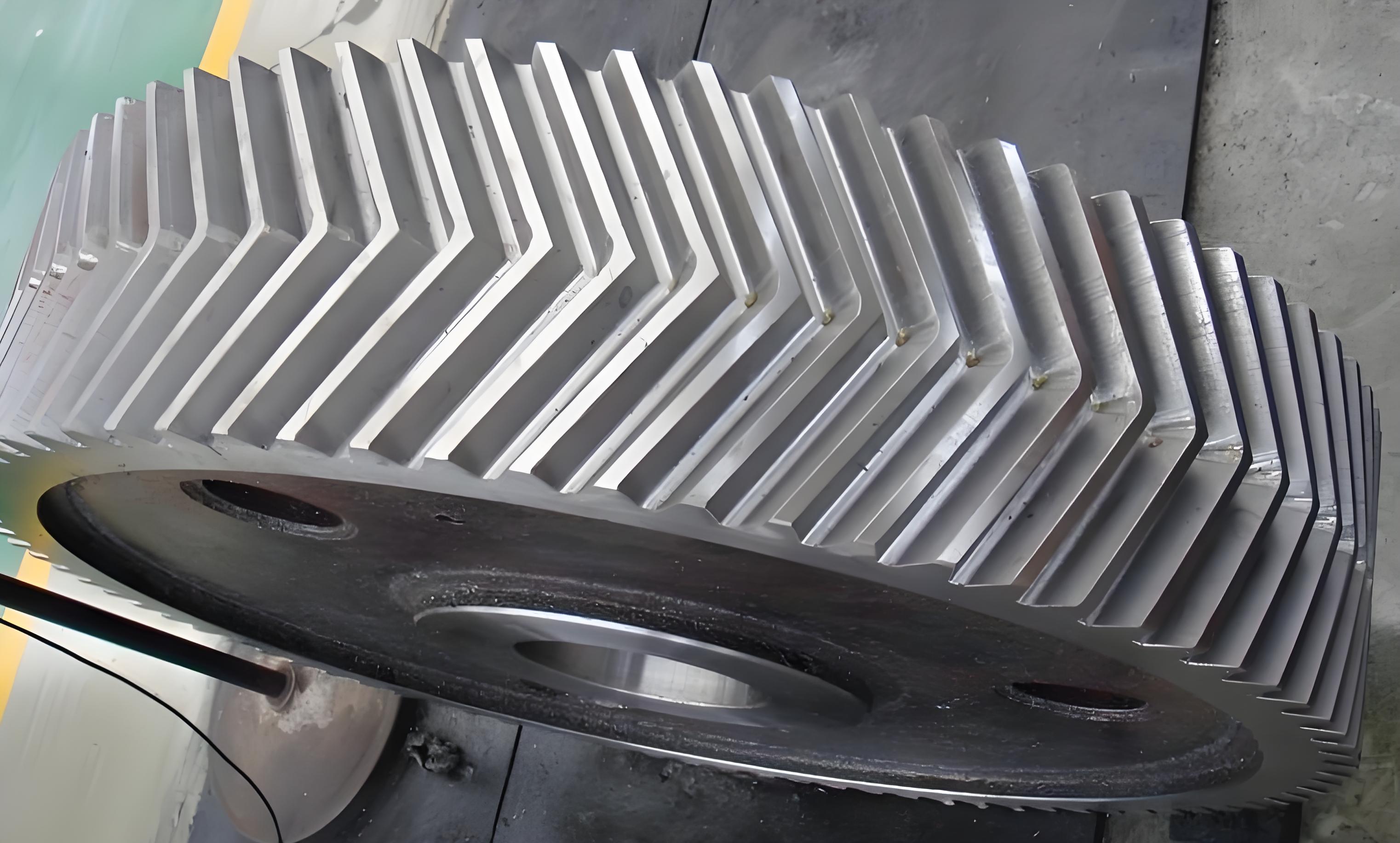
This configuration eliminates stress concentrations at groove points, but it necessitates meticulous工艺 planning to avoid distortions and ensure uniform hardness. From my perspective, the success of producing such herringbone gears hinges on a well-orchestrated sequence of operations, from forging to final finishing, with special attention to heat treatment and deformation control.
The typical工艺 for medium-hard tooth surface herringbone gears involves rough machining of the gear teeth followed by overall quenching and tempering. This approach ensures that the tooth surface hardness is consistent from the tip to the root, significantly extending the service life of the herringbone gears. Based on my involvement in类似 projects, I will outline a detailed流程, incorporating tables and formulas to summarize critical parameters. For instance, the gear specifications often include module, pressure angle, number of teeth, helix angle, and hardness range. Let me start by presenting a table that encapsulates the key technical conditions for a representative herringbone gear shaft.
| Parameter | Value | Unit |
|---|---|---|
| Material | 42CrMo4 (Equivalent to ASTM AISI 4140) | – |
| Module (m) | 30 | mm |
| Pressure Angle (α) | 20 | degrees |
| Number of Teeth (z) | 47 | – |
| Helix Angle (β) | 18 | degrees |
| Accuracy Grade | 6-5-5 per ISO 1328 | – |
| Hardness | 300-350 HB | Brinell |
These specifications dictate the manufacturing流程, which I will now describe in detail. The工艺流程 for such herringbone gears typically follows these steps: forging blank → first quenching and tempering → marking → face milling and boring → rough turning → rough hobbing → rough milling of flats → second quenching and tempering → semi-finish turning → hobbing → finish turning → finish milling of flats → inspection. Each stage plays a crucial role in achieving the desired properties for herringbone gears. In the following sections, I will break down the important工序, using formulas to explain heat treatment curves and tables to compare留量 values.
Starting with the rough turning operation, the forged blank undergoes first quenching and tempering to a hardness of approximately 240-280 HB. After marking, it is rough-turned according to the forging粗加工简图. From my experience, determining the machining allowance is vital to accommodate后续 deformations. Generally, the outer diameter should leave an allowance of 1.5 to 3.0 mm, while other dimensions are adjusted based on predicted distortions. The allowance can be expressed mathematically to ensure precision. For example, the outer diameter allowance \( A_d \) can be calculated based on the gear module and heat treatment effects:
$$ A_d = k \cdot m + \Delta_h $$
where \( k \) is a coefficient typically ranging from 0.05 to 0.1 for herringbone gears, \( m \) is the module in mm, and \( \Delta_h \) is an additional term accounting for热处理-induced变形, often derived empirically. This formula helps in standardizing the process across different sizes of herringbone gears.
The rough hobbing operation is a critical step before the second quenching and tempering. Its primary function is to enable uniform tooth surface hardness after heat treatment. Since herringbone gears undergo complex intertwined deformations in axial, radial, and tooth direction during热处理, the tooth thickness allowance must be carefully determined. I recommend a single-sided tooth thickness allowance of 2 to 3 mm, with tooth-end chamfering at 2 × 45° and a root fillet radius not less than 0.5 mm. To quantify this, consider the tooth thickness allowance \( A_t \) as a function of module and helix angle:
$$ A_t = 0.07 \cdot m \cdot \sqrt{\sin \beta} + C $$
where \( C \) is a constant between 0.5 and 1.0 mm for herringbone gears, and \( \beta \) is the helix angle in radians. This ensures adequate material for后续 finishing while minimizing distortion risks. The following table summarizes the recommended allowances for various parameters in rough machining of herringbone gears.
| Feature | Allowance Range | Notes |
|---|---|---|
| Outer Diameter | 1.5–3.0 mm | Depends on module and heat treatment |
| Tooth Thickness (Single Side) | 2.0–3.0 mm | Critical for uniform hardness |
| Tooth End Chamfer | 2 × 45° | Reduces stress concentration |
| Root Fillet Radius | ≥ 0.5 mm | Prevents cracking during heat treatment |
After rough hobbing, the herringbone gear shaft undergoes a second quenching and tempering process. This heat treatment is essential for achieving the desired medium-hard tooth surface. Based on my observations, the thermal cycle must be meticulously controlled to minimize变形 while enhancing hardness. The process typically involves heating at a rate of 50°C per hour to 850°C ± 10°C, holding for 4 hours, then heating at 50°C per hour to 950°C ± 10°C and holding for 4.5 hours. This is followed by oil quenching for 30 minutes, air cooling for 2 minutes, and another oil quenching for 50 minutes before tempering. The tempering phase involves holding at 250°C ± 10°C for 6 hours, heating at 20°C per hour to 450°C–500°C, holding for 12 hours, and air cooling to room temperature. These curves can be represented using mathematical models for temperature \( T \) over time \( t \):
For the heating phase to 850°C: $$ T(t) = 50t + T_0 \quad \text{for } 0 \leq t \leq 16 \text{ hours} $$
For the holding at 850°C: $$ T(t) = 850 \quad \text{for } 16 < t \leq 20 \text{ hours} $$
For the heating to 950°C: $$ T(t) = 50(t – 20) + 850 \quad \text{for } 20 < t \leq 30 \text{ hours} $$
For the holding at 950°C: $$ T(t) = 950 \quad \text{for } 30 < t \leq 34.5 \text{ hours} $$
where \( T_0 \) is the initial temperature. This precise control is vital for herringbone gears to achieve a hardness of 300-350 HB uniformly across the tooth profile. The变形 during this process must be monitored closely, as it directly impacts the后续 machining steps.
The semi-finish turning operation is another key工序 aimed at correcting deformations from the second quenching and tempering. In this stage, I always check radial runout and bending distortions, and修正 the center holes based on the magnitude and direction of变形. This ensures that the remaining allowances are均匀 distributed. Frequent dimensional inspections are necessary here to maintain accuracy. The correction can be modeled using a deformation vector \( \vec{D} \) that influences the machining path:
$$ \vec{D} = ( \Delta_x, \Delta_y, \Delta_z ) $$
where \( \Delta_x \), \( \Delta_y \), and \( \Delta_z \) represent deformations in axial, radial, and tangential directions for herringbone gears. By adjusting the tool path with补偿 offsets, we can achieve uniform余量, which is crucial for the final精度 of herringbone gears.
Now, let me address some critical issues that require attention during the manufacturing of herringbone gears. First, the determination of allowance values. From practical experience, I assert that for herringbone gear shafts before rough hobbing and quenching, it is essential to have bilateral allowances on both outer diameter and cutting depth. If only the outer diameter allowance is increased, after finish turning, the quenching effect at the tooth tip will be compromised. Conversely, reducing outer diameter allowance while increasing cutting depth allowance may lead to difficulties in correcting bending deformations along the tooth length after quenching, and the strengthening at the tooth root could be affected. Therefore, a balanced approach with appropriate allowances on both dimensions is prudent for herringbone gears. This can be summarized with a formula for total allowance \( A_{total} \):
$$ A_{total} = A_d + A_h $$
where \( A_d \) is the diameter allowance and \( A_h \) is the depth allowance, both optimized based on historical data for herringbone gears.
Second, the control of deformation during heat treatment is paramount. For herringbone gear shafts, the变形量 is influenced by factors like material homogeneity, heating rates, and cooling methods. To minimize变形, I recommend using a pit furnace with hanging-style treatment for herringbone gears. This allows for uniform heating and reduces sagging distortions. The deformation control can be quantified using statistical process control (SPC) charts, where the deformation index \( \delta \) is monitored:
$$ \delta = \sqrt{ \left( \frac{\Delta L}{L} \right)^2 + \left( \frac{\Delta D}{D} \right)^2 } $$
where \( \Delta L \) is the length change, \( L \) is the original length, \( \Delta D \) is the diameter change, and \( D \) is the original diameter for herringbone gears. Keeping \( \delta \) within tight limits ensures dimensional stability. The following table provides typical deformation tolerances for herringbone gears during heat treatment.
| Deformation Type | Tolerance Range | Impact on Herringbone Gears |
|---|---|---|
| Axial Bending | ≤ 0.1 mm per meter | Affects tooth alignment and contact pattern |
| Radial Runout | ≤ 0.05 mm | Critical for gear meshing and noise reduction |
| Tooth Twist | ≤ 0.02° per tooth | Influences load distribution on herringbone gears |
In recent years, there have been advancements in the工艺 for herringbone gears. For instance, after rough hobbing and finish hobbing, gas deep carburizing can be applied to achieve a carburized layer depth of 4–6 mm. This enhances the internal strength and tooth surface contact strength of herringbone gears, further extending their service life. The carburizing process can be described using Fick’s law of diffusion:
$$ \frac{\partial C}{\partial t} = D \frac{\partial^2 C}{\partial x^2} $$
where \( C \) is the carbon concentration, \( t \) is time, \( D \) is the diffusion coefficient, and \( x \) is the depth from the surface. For herringbone gears, this results in a hardened case that resists wear and pitting. The case depth \( d_c \) can be estimated as:
$$ d_c = k_c \cdot \sqrt{t} $$
where \( k_c \) is a material-specific constant for herringbone gears. This新工艺 represents a significant improvement over traditional methods, offering greater durability for herringbone gears in heavy-duty applications.
To further illustrate the manufacturing流程, I have compiled a comprehensive table outlining each step with key parameters and objectives. This table serves as a quick reference for engineers working on herringbone gears.
| Step | Description | Key Parameters | Objective for Herringbone Gears |
|---|---|---|---|
| 1. Forging | Form the blank to near-net shape | Material: 42CrMo4; Forging ratio ≥ 3 | Achieve grain flow alignment |
| 2. First Quenching/Tempering | Initial heat treatment for hardness | Hardness: 240-280 HB; Cooling: oil | Prepare for rough machining |
| 3. Marking | Locate reference points | Precision: ±0.5 mm | Ensure accurate alignment |
| 4. Face Milling/Boring | Machine end faces and center holes | Surface finish: Ra 3.2 µm | Create datum for subsequent operations |
| 5. Rough Turning | Remove excess material | Allowance: 1.5-3.0 mm on diameter | Shape the herringbone gear shaft轮廓 |
| 6. Rough Hobbing | Cut initial tooth profiles | Tooth thickness allowance: 2-3 mm | Enable uniform heat treatment |
| 7. Rough Milling of Flats | Machine非-齿 features | Tolerance: ±0.1 mm | Complete rough geometry |
| 8. Second Quenching/Tempering | Final heat treatment for tooth hardness | Hardness: 300-350 HB; Cycle as per curves | Achieve medium-hard tooth surface |
| 9. Semi-Finish Turning | Correct deformations | Runout correction: ≤ 0.05 mm | Uniform余量 for finishing |
| 10. Hobbing | Finish cut tooth profiles | Accuracy: ISO 6-5-5; Finish: Ra 1.6 µm | Achieve final gear geometry |
| 11. Finish Turning | Final diameter and surface machining | Tolerance: IT7; Finish: Ra 0.8 µm | Meet dimensional specifications |
| 12. Finish Milling of Flats | Complete非-齿 features | Precision: ±0.05 mm | Ensure overall accuracy |
| 13. Inspection | Verify all parameters | Tools: CMM, hardness tester | Quality assurance for herringbone gears |
In conclusion, the manufacturing of heavy-duty herringbone gear shafts without relief grooves requires a meticulous and integrated approach. From my experience, the粗滚齿调质工艺 is instrumental in achieving uniform tooth surface hardness from tip to root, thereby enhancing the service life of herringbone gears. The use of advanced techniques like gas deep carburizing further pushes the boundaries, offering improved strength and durability. Throughout this article, I have emphasized the importance of allowance determination, deformation control, and precise heat treatment for herringbone gears. By adhering to these principles and continuously refining the工艺, we can produce herringbone gears that meet the demanding requirements of modern industrial applications. The journey from forging to inspection is complex, but with careful planning and execution, herringbone gears can deliver exceptional performance in重载 environments.
To encapsulate the key formulas discussed, here is a summary in mathematical terms:
1. Outer diameter allowance: $$ A_d = k \cdot m + \Delta_h $$
2. Tooth thickness allowance: $$ A_t = 0.07 \cdot m \cdot \sqrt{\sin \beta} + C $$
3. Heat treatment temperature curve: $$ T(t) = \begin{cases} 50t + T_0 & \text{for heating phases} \\ \text{constant} & \text{for holding phases} \end{cases} $$
4. Deformation index: $$ \delta = \sqrt{ \left( \frac{\Delta L}{L} \right)^2 + \left( \frac{\Delta D}{D} \right)^2 } $$
5. Carburizing case depth: $$ d_c = k_c \cdot \sqrt{t} $$
These formulas, along with the tables provided, offer a comprehensive framework for optimizing the manufacturing process of herringbone gears. As technology evolves, I believe that further innovations will continue to enhance the capabilities of herringbone gears, making them even more reliable and efficient in heavy-duty applications. The focus on precision and quality at every step ensures that herringbone gears remain a cornerstone of industrial machinery.