
The pursuit of high-performance, compact, and reliable power transmission systems in demanding sectors such as aerospace, marine, and heavy machinery has consistently driven the advancement of gear technology. Among various configurations, herringbone gears stand out due to their inherent ability to cancel out axial thrust forces, which allows for the use of high helix angles. This characteristic directly contributes to increased load-sharing capabilities and smoother operation. This article presents a comprehensive methodology for the dynamic performance optimization of herringbone gears, specifically targeting designs with high contact ratio. The core of this work lies in integrating a detailed nonlinear dynamic model with an efficient metaheuristic optimization algorithm, culminating in a significant reduction in vibration and noise, validated through physical experimentation.
The fundamental advantage of a high contact ratio design is the increased number of tooth pairs in simultaneous contact. For herringbone gears, the total contact ratio ($\varepsilon_{\gamma}$) is the sum of the transverse contact ratio ($\varepsilon_{\alpha}$) and the axial (or face) contact ratio ($\varepsilon_{\beta}$). The formulas are given by:
$$
\varepsilon_{\alpha} = \frac{1}{2\pi} \left[ z_1 (\tan \alpha_{at1} – \tan \alpha_t’) \pm z_2 (\tan \alpha_{at2} – \tan \alpha_t’) \right]
$$
$$
\varepsilon_{\beta} = \frac{b \sin \beta}{\pi m_n}
$$
$$
\varepsilon_{\gamma} = \varepsilon_{\alpha} + \varepsilon_{\beta}
$$
where $z_{1,2}$ are the number of teeth, $\alpha_{at1,2}$ are the transverse pressure angles at the tip, $\alpha_t’$ is the operating transverse pressure angle, $b$ is the face width, $\beta$ is the helix angle, and $m_n$ is the normal module. The “±” sign becomes “+” for external gears and “-” for internal gears. To achieve a high $\varepsilon_{\gamma}$, one can increase the addendum coefficient ($h_{an}^*$) to boost $\varepsilon_{\alpha}$ and employ a large helix angle ($\beta$) to maximize $\varepsilon_{\beta}$. Since herringbone gears inherently balance axial forces, helix angles in the range of 25° to 40° are feasible without requiring massive thrust bearings. Furthermore, profile shifting (modification) can be applied strategically; a positive shift on the pinion and a negative shift on the gear can enhance bending strength and control the center distance, contributing to a more compact and robust design suitable for aviation applications.
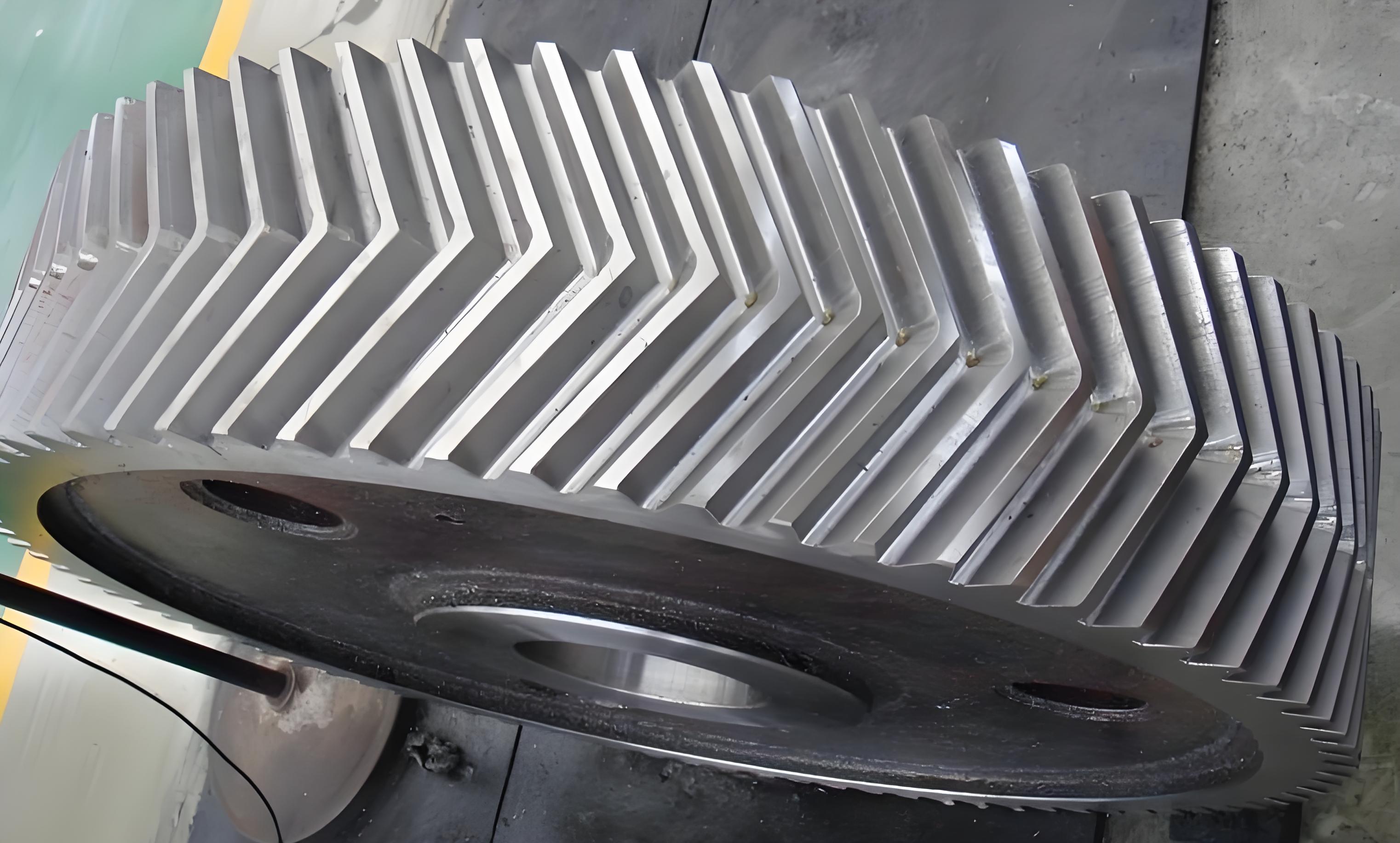
The dynamic behavior of a gear transmission system is the primary source of vibration and noise. To accurately capture this for herringbone gears, a sophisticated nonlinear dynamic model must be constructed. The model is based on the following key dynamic excitations:
- Stiffness Excitation: The time-varying mesh stiffness ($k_m(t)$) is a principal internal excitation. It was obtained through a Loaded Tooth Contact Analysis (LTCA) model that incorporates parabolic lead and profile modifications. The discrete stiffness values over a mesh cycle are fitted and expressed as a Fourier series: $k_m(t) = k_{m0} + \sum_{n=1}^{N} [a_n \cos(n\omega_m t) + b_n \sin(n\omega_m t)]$, where $\omega_m$ is the mesh frequency.
- Error Excitation: Manufacturing and assembly errors, such as profile error and pitch error, are synthesized into a static transmission error (STE) function $e(t)$, which acts as a displacement excitation.
- Mesh Impact Excitation: Due to errors and deformations, teeth do not mate perfectly at the theoretical start of contact (SAC), causing an impact. The meshing-in impact force is calculated based on the approach velocity and contact compliance.
A 12-degree-of-freedom (DOF) bending-torsional-axial coupled lumped-parameter model was developed, specifically accounting for the axial floating installation of the pinion, which is typical for herringbone gears to ensure load sharing between the two helical halves. The model considers the interaction between the left and right helical halves. The generalized displacement vector is $\{\delta\} = \{ y_{p1}, z_{p1}, \theta_{p1}, y_{g1}, z_{g1}, \theta_{g1}, y_{p2}, z_{p2}, \theta_{p2}, y_{g2}, z_{g2}, \theta_{g2} \}^T$, where $y$, $z$ are translational displacements and $\theta$ is torsional displacement. The equations of motion are derived using Newton’s second law. For example, the equations for the pinion’s left-side translational motions are:
$$
m_p \ddot{y}_{p1} + c_{p1y} \dot{y}_{p1} + k_{p1y} y_{p1} + c_{py} (\dot{y}_{p1} – \dot{y}_{p2}) + k_{py} (y_{p1} – y_{p2}) = -F_{yp1}
$$
$$
m_p \ddot{z}_{p1} + c_{pz} (\dot{z}_{p1} + \dot{z}_{p2}) + k_{pz} (z_{p1} + z_{p2}) = -F_{z1}
$$
where $F_{yp1}$ and $F_{z1}$ are the dynamic mesh forces in the tangential (circumferential) and axial directions for the left-side mesh. The torsional equation for the pinion’s left side is $I_{p1} \ddot{\theta}_{p1} = T_{p1} – F_{yp1} R_{p1}$. Similar equations are written for the gear and the right-side gear pair. The dynamic mesh forces are functions of the relative displacement, mesh stiffness, damping, and error: $F_{mj} = k_{mj}(t) \cdot (\delta_{j} – e_j(t)) + c_{mj} \cdot (\dot{\delta}_{j} – \dot{e}_j(t))$, where $j=1,2$ denotes the left and right mesh paths.
The system of equations is non-dimensionalized using a characteristic length $b_c$ (e.g., base pitch) and a natural frequency $\omega_n = \sqrt{k_{m0}/m_e}$, where $m_e$ is the equivalent mass. The resulting non-dimensional equations are solved using a numerical integration routine (e.g., Runge-Kutta ODE45) to obtain the steady-state dynamic response, such as vibration acceleration.
Optimizing the dynamic performance of herringbone gears is a complex, computationally expensive task. The relationship between design parameters and the dynamic response (objective function) is implicit, requiring a full dynamic simulation for each evaluation. Traditional Genetic Algorithms (GAs) become inefficient as evaluating the fitness (objective) for each individual in a population is time-consuming. To address this, a Fitness Approximation Genetic Algorithm (FAGA) was developed.
The core innovation of FAGA is a trust-based fitness prediction model. Each individual in the population has a fitness value and an associated credibility $R(i)$. If the fitness was computed via the full simulation, $R(i)=1$; if it was predicted, $0 \le R(i) < 1$. Each individual $i$ has a fitness sharing radius $r_{share}$, defining a region $\Omega_i$ in the design space. When evaluating a new individual $i$, the algorithm looks at all historically evaluated individuals $s_j$ within $\Omega_i$. A predicted credibility $\hat{R}(i)$ is computed as a weighted sum of the credibilities of these neighbors:
$$
\hat{R}(i) = \sum_{j=1}^{m} \omega(s_j) \cdot R(s_j), \quad \text{where} \quad \omega(s_j) = \frac{\exp(-\alpha \cdot \tilde{d}_j)}{\sum_{k=1}^{m} \exp(-\alpha \cdot \tilde{d}_k)}
$$
Here, $\tilde{d}_j$ is the normalized Euclidean distance to neighbor $s_j$, and $\alpha$ is a scaling factor. If $\hat{R}(i)$ exceeds a trust threshold $R^*$, the fitness is predicted as a similar weighted sum of the neighbors’ fitness values:
$$
\widehat{fitness}(i) = \sum_{j=1}^{m} \omega(s_j) \cdot fitness(s_j)
$$
If $\hat{R}(i) < R^*$, the full simulation is run to get the true fitness, and $R(i)$ is set to 1. To manage the history database, a redundancy measure is used to prune overly similar individuals, and the credibility of predicted individuals decays over generations: $R(i, t+1) = \beta \cdot R(i, t)$, where $\beta$ is the credibility decay rate ($0<\beta<1$). This approach dramatically reduces the number of full simulations required, improving efficiency by approximately 60-65% based on benchmark tests, as shown in the table below.
| Test Function | Max. Evaluations | Avg. Actual Evaluations (FAGA) | Reduction |
|---|---|---|---|
| Goldstein-Price | 20,000 | ~7,168 | ~64.2% |
| Six-Hump Camel | 20,000 | ~7,561 | ~62.2% |
| Shekel’s Foxholes | 20,000 | ~7,212 | ~63.9% |
The optimization problem is formulated with the goal of minimizing vibration. The design variables include key geometric and modification parameters that influence both the static load distribution and dynamic excitation:
$$
\mathbf{X} = [ \beta,\ x_{n1},\ h_{an}^*,\ A,\ B,\ C ]^T
$$
- $\beta$: Helix angle.
- $x_{n1}$: Pinion normal profile shift coefficient.
- $h_{an}^*$: Normal addendum coefficient.
- $A, B$: Coefficients for parabolic profile modification on the pinion tool ($y = Ax^2 + B$).
- $C$: Coefficient for parabolic lead (axial) modification on the pinion ($y = Cx^2$).
The objective function is the Root Mean Square (RMS) of the vibration acceleration along the line of action for one helical side, as it correlates strongly with radiated noise:
$$
\min f_1(\mathbf{X}) = \sqrt{ \frac{1}{n} \sum_{i=1}^{n} \ddot{x}_i^2 }
$$
The optimization is subject to multiple constraints ensuring gear integrity and performance:
- Geometric & Strength Constraints: Bending stress $\sigma_F \le [\sigma_F]$, contact stress $\sigma_H \le [\sigma_H]$, minimum tooth top land thickness, no undercut.
- Interference & Continuity: Contact ratio $\varepsilon_{\gamma} \ge \varepsilon_{\gamma}^{target}$ (e.g., >2.0), no tip interference.
- Dynamic Performance Constraints: Maximum dynamic load factor, peak-to-peak transmission error.
The optimization workflow integrates the FAGA with the dynamic model and LTCA, as illustrated conceptually: Design Variables $\rightarrow$ FAGA $\rightarrow$ Gear Geometry & LTCA $\rightarrow$ Dynamic Model $\rightarrow$ Objective/Constraints $\rightarrow$ Back to FAGA until convergence.
To demonstrate the methodology, an aerospace-grade herringbone gear pair was optimized. The initial and optimized parameters are compared below.
| Parameter | Initial Design | Optimized Design |
|---|---|---|
| Pinion/Gear Teeth ($z_1$/$z_2$) | 31 / 103 | 31 / 103 |
| Normal Module, $m_n$ (mm) | 4.5 | 4.5 |
| Helix Angle, $\beta$ (°) | 31 | 34 |
| Addendum Coeff., $h_{an}^*$ | 1.0 | 1.297 |
| Profile Shift, $x_{n1}$ / $x_{n2}$ | 0 / 0 | +0.4203 / -0.4203 |
| Profile Mod. Coeff. $A$, $B$ | 0, 0 | 0.005, 0.03 |
| Lead Mod. Coeff., $C$ | 0 | 4.0E-6 |
| Total/Trans. Contact Ratio $\varepsilon_{\gamma}$ / $\varepsilon_{\alpha}$ | 7.33 / 1.40 | 8.40 / 1.73 |
| Vibration Accel. RMS (m/s²) | 28.37 | 18.93 |
The optimization successfully increased the total contact ratio by approximately 14.6% and the transverse contact ratio by 23.4%. More importantly, the RMS of the vibration acceleration was reduced by about 33.3%. The dynamic response plots show a clear attenuation in both the circumferential and axial vibration acceleration amplitudes for the optimized herringbone gears. The convergence plot of the FAGA showed rapid improvement in fitness (lower RMS) within the first 25 generations, followed by stabilization, confirming the algorithm’s effectiveness.
The ultimate validation of any dynamic optimization for herringbone gears is its impact on noise. Loaded tests were conducted on a high-speed gear noise test rig. Noise levels were measured at six microphone positions around the gearbox under different torque and speed conditions. The average sound pressure levels (in dB) before and after optimization are summarized below.
| Test Condition | Measurement Point | Initial Design Avg. (dB) | Optimized Design Avg. (dB) | Noise Reduction |
|---|---|---|---|---|
| 2000 N·m | 1-6 (Average) | ~124.85 | ~118.63 | ~6.22 dB |
| Point 1 | 125.32 | 119.82 | 5.50 dB | |
| Point 3 | 127.54 | 120.14 | 7.40 dB | |
| 1000 N·m | 1-6 (Average) | ~114.68 | ~109.14 | ~5.54 dB |
| Point 2 | 117.87 | 111.16 | 6.71 dB | |
| Point 6 | 112.07 | 106.96 | 5.11 dB |
The experimental results confirm a substantial noise reduction of 5 to 7 dB across different operating conditions. This directly correlates with the 33% reduction in simulated vibration acceleration RMS, proving the efficacy of the integrated dynamic modeling and optimization approach for herringbone gears.
In conclusion, this work presents a robust framework for the dynamic performance optimization of high-contact-ratio herringbone gears. The methodology hinges on three pillars: a high-fidelity nonlinear dynamic model that accurately captures the unique bending-torsional-axial coupling and floating-axis characteristics of herringbone gears; an efficient Fitness Approximation Genetic Algorithm (FAGA) that mitigates the high computational cost of fitness evaluation; and a multi-variable optimization targeting both fundamental geometric parameters (helix angle, addendum, profile shift) and detailed modification coefficients. The successful application to an aerospace case study demonstrated a simultaneous significant increase in contact ratio (improving load sharing and smoothness) and a dramatic reduction in vibration (33%) and radiated noise (5-7 dB). This holistic approach provides a powerful tool for designing quieter, more reliable, and higher-performance herringbone gear transmissions for the most demanding applications.