
In the field of mechanical transmission, herringbone gears play a pivotal role due to their high load-carrying capacity, smooth operation, and self-balancing axial forces. These advantages make them indispensable in aerospace, marine, and aviation applications, such as in helicopter main reducers for power-split and combine transmissions. However, with the increasing demand for higher performance, herringbone gears with high contact ratio have emerged, offering even greater load distribution by involving more tooth pairs in mesh. Despite this benefit, high contact ratio herringbone gears are more sensitive to errors and deformations, necessitating precise tooth modification to mitigate issues like vibration, impact, and uneven load distribution. In this article, I will delve into the optimization of tooth modification for herringbone gears, focusing on parabolic profile and lead crowning, using multi-objective genetic algorithms to enhance transmission performance. Through geometric tooth contact analysis and experimental validation, we aim to demonstrate the effectiveness of our approach in reducing noise and improving meshing characteristics.
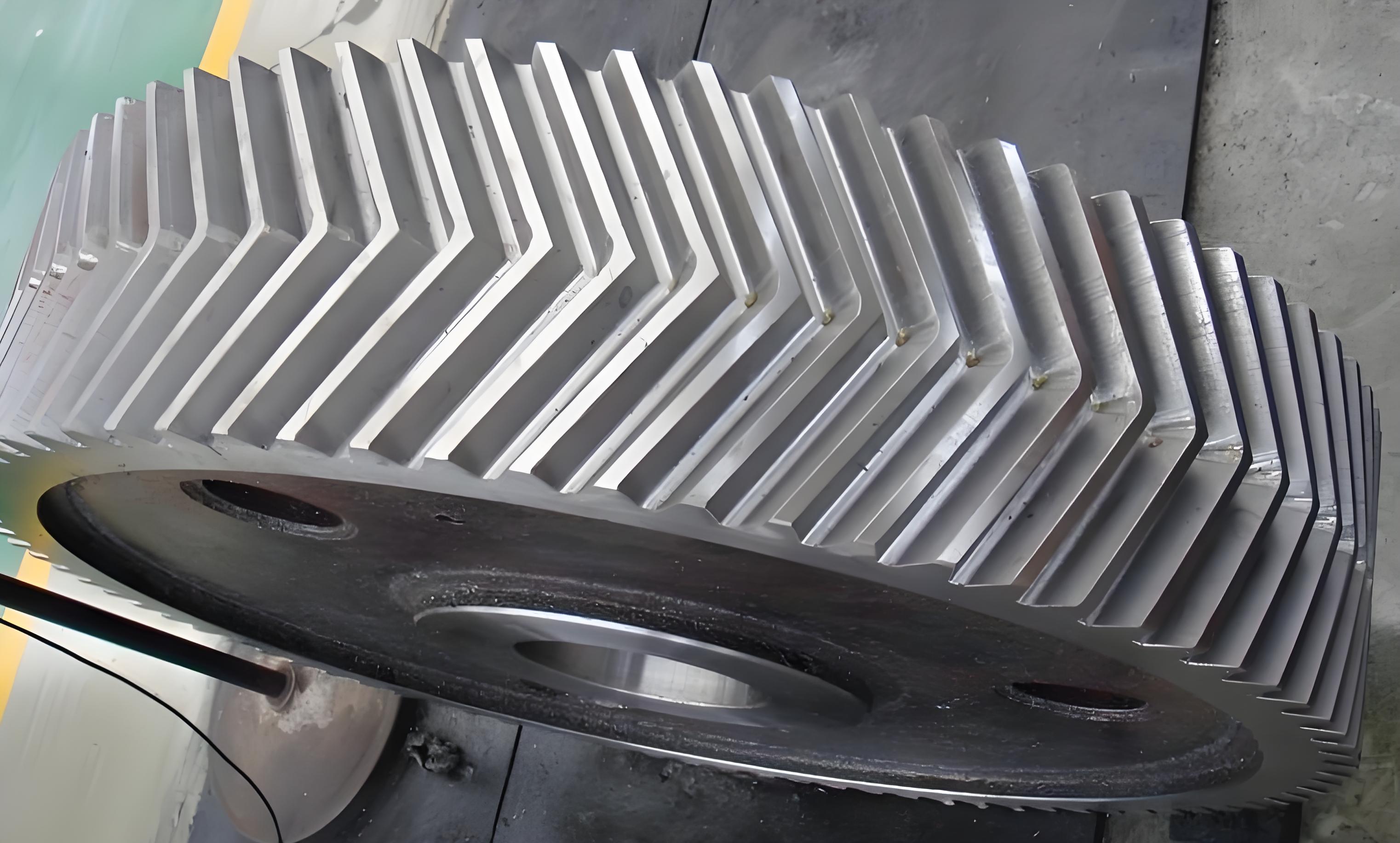
Herringbone gears consist of two helical gears with opposite hand but identical helix angles, joined together. This configuration eliminates axial thrust, but it introduces complexities in meshing synchronization, especially under manufacturing and assembly errors. Tooth modification, involving deliberate alterations to the tooth surface geometry, is crucial for compensating these errors and ensuring optimal contact patterns. Traditional methods often focus on profile modification alone, but for herringbone gears, lead modification is equally important due to the sequential loading along the tooth width. In our study, we adopt parabolic modifications for both profile and lead, as parabolic shapes are easier to machine and have proven effective in reducing transmission errors and improving load distribution. The modification is applied only to the pinion, considering economic feasibility, by concentrating the deformation effects from both gears onto the smaller component.
For profile modification, we replace the straight rack-cutter profile with a parabolic curve. Let us define the coordinate systems: in the rack-cutter profile plane, the parabolic curve is expressed in terms of a parameter \(u_i\), where \(a_i\) is the parabolic coefficient. The left-side profile of the rack-cutter in coordinate system \(S_a\) is given by:
$$ \mathbf{r}_a(u_i) = [a_i u_i^2, -u_i, 0, 1]^T $$
Through coordinate transformations to the rack-cutter surface coordinate system \(S_c\), we derive the modified tooth surface equation for manufacturing. For herringbone gears, since the left and right helical halves may not mesh simultaneously due to errors, we can use different modification parameters for each side, but for simplicity in optimization, we assume symmetric modifications initially. The lead modification involves a parabolic crowning along the tooth width direction, centered at the midpoint of each helical half. The normal modification amount \(y\) is expressed as:
$$ y = a^* x^2 $$
where \(a^*\) is the lead parabolic coefficient, and \(x\) is the coordinate along the spiral direction. This bidirectional modification helps achieve a parabolic transmission error curve, which minimizes vibration. The actual machining can be done using CNC grinding machines by controlling radial and tangential feeds, translating these coefficients into equivalent tooth surface deviations.
To analyze the meshing behavior of modified herringbone gears, we employ tooth contact analysis (TCA), a numerical simulation technique for studying contact patterns and transmission errors under realistic conditions. For helical gears, TCA involves solving equations for continuous tangency between mating surfaces, considering installation errors such as center distance error \(\Delta E\), axial offset \(\Delta L\), and axis parallelism error \(\Delta \gamma\). The coordinate systems are set up with fixed frame \(S_g\), gear-attached frames \(S_1\) and \(S_2\), and auxiliary frames for error incorporation. The condition for point contact is given by:
$$ \mathbf{r}^{(1)}_g(u_1, l_1, \varphi_1) = \mathbf{r}^{(2)}_g(u_2, l_2, \varphi_2) $$
$$ \mathbf{n}^{(1)}_g(u_1, l_1, \varphi_1) = \mathbf{n}^{(2)}_g(u_2, l_2, \varphi_2) $$
where \(\mathbf{r}\) and \(\mathbf{n}\) denote position vectors and normals in the fixed frame, with superscripts for pinion and gear, and parameters \(u_i, l_i\) for tooth surface coordinates. By iterating over the pinion rotation angle \(\varphi_1\), we obtain contact points and transmission error, defined as:
$$ \Delta \varphi_2 = \varphi_2 – \varphi^{(0)}_2 – \left( \varphi_1 – \varphi^{(0)}_1 \right) \frac{z_1}{z_2} $$
Here, \(z_1\) and \(z_2\) are tooth numbers, and \(\varphi^{(0)}_i\) are initial angles. For herringbone gears, we treat the left and right helical pairs as separate meshes, synchronizing them in analysis. Due to phase errors from manufacturing, we introduce a phase shift \(\Delta \varphi\) between left and right pinion rotations:
$$ \varphi_L = \varphi_R – \Delta \varphi, \quad \Delta \varphi = \frac{\sum e}{r_b \cos \beta_b} $$
where \(\sum e\) is the relative manufacturing error, \(r_b\) is the base radius, and \(\beta_b\) is the base helix angle. By combining results from both sides, we get the overall contact pattern and transmission error for the herringbone gear pair.
The optimization of modification parameters aims to minimize transmission error fluctuations and maximize contact points on the left helical half to reduce bias loading. We formulate a multi-objective problem with design variables: profile parabolic coefficient \(\alpha_1\), profile vertex parameter \(u_{01}\), and lead parabolic coefficient \(a^*\). The objectives are:
First objective: minimize the fluctuation of transmission error:
$$ \min f_1 = \min \left( \max(\Delta \varphi_2) – \min(\Delta \varphi_2) \right) $$
Second objective: maximize the number of contact points on the left tooth surface (or minimize the negative count):
$$ \min f_2 = \min ( -PN ) $$
where \(PN\) is the contact point count. We use the fast non-dominated sorting genetic algorithm (NSGA-II) with elitism to solve this, as it avoids local convergence and provides a Pareto-optimal set of solutions. The algorithm parameters include a population size of 108, maximum generations of 100, crossover probability of 0.8, mutation probability of 0.3, and distribution indices for crossover and mutation. This allows designers to select parameters based on practical needs without weighting objectives manually.
To illustrate, consider a herringbone gear pair for a high-power transmission: input power \(P = 1000 \text{ kW}\), speed \(n_1 = 2584 \text{ r/min}\), ratio \(u = 10\), center distance \(a = 621 \text{ mm}\). The gear parameters and assumed errors are summarized in Table 1.
| Parameter | Pinion / Gear |
|---|---|
| Number of teeth | 23 / 231 |
| Module (mm) | 4.051 |
| Pressure angle (°) | 20 |
| Helix angle (°) | 34.096 |
| Face width (mm) | 112.51 |
| Center distance error (mm) | 0.04 |
| Axis parallelism error (arcmin) | 0.01 |
The optimization process evolves over generations, improving both objectives. Initially, the left contact points vary from 0 to 2, indicating severe bias load. By generation 40, points stabilize around 2, and by generation 60, they reach 3 with reduced transmission error fluctuation. At generation 100, we achieve 3 to 4 contact points and error fluctuations within 0 to 1.25 arcseconds. A sample optimized parameter set is shown in Table 2.
| Modification Parameter | Before / After Optimization |
|---|---|
| Profile parabolic coefficient \(\alpha_1\) | 0.005 / 0.00637 |
| Profile vertex position \(u_{01}\) (mm) | -0.01 / -0.0329 |
| Lead parabolic coefficient \(a^*\) | 2×10-11 / 4×10⁻⁶ |
| Transmission error fluctuation (arcsec) | 1.27 / 0.332 |
| Left surface contact points | 0 / 3 |
The contact patterns and transmission error curves before and after optimization demonstrate significant improvements. Prior to modification, the herringbone gears exhibited no contact on the left side during right-side meshing, leading to bias load and discontinuous error curves. After optimization, the contact pattern on the right side becomes skewed, improving load distribution, while the left side gains multiple contact points. The transmission error curve transforms into a continuous parabolic shape, compensating for errors and reducing meshing impact. This underscores the value of combined profile and lead modification for herringbone gears.
To validate the optimization, we conducted noise tests on a high-speed gear vibration and noise reduction test rig. The experimental setup included microphones, amplifiers, data acquisition systems, sound level meters, and tape recorders. Six measurement points were placed around the gearbox, at 1-meter distance, to capture airborne noise levels. The results, averaged over multiple runs, are presented in Table 3.
| Measurement Point | Noise Level Before (dB) | Noise Level After (dB) |
|---|---|---|
| 1 | 114.34 | 108.72 |
| 2 | 117.13 | 111.11 |
| 3 | 113.56 | 108.24 |
| 4 | 115.27 | 109.56 |
| 5 | 116.79 | 111.49 |
| 6 | 115.76 | 108.91 |
The noise reduction of approximately 5 to 7 dB across all points confirms the effectiveness of our modification optimization in damping vibrations and enhancing the acoustic performance of herringbone gears. This aligns with theoretical expectations, as parabolic modifications smooth out transmission errors and promote even contact.
In conclusion, the optimization of herringbone gear modification through parabolic profile and lead crowning, guided by multi-objective genetic algorithms and tooth contact analysis, offers a robust method for improving transmission performance in high contact ratio applications. By minimizing transmission error fluctuations and maximizing contact points, we mitigate bias loading and reduce noise. The instance study and experimental results validate our approach, highlighting its practical relevance for industries relying on herringbone gears. Future work could explore asymmetric modifications for left and right halves or incorporate dynamic load conditions for even broader applicability. Overall, this research contributes to advancing gear design methodologies, ensuring that herringbone gears continue to meet the demands of modern mechanical systems.