
In modern aerospace engineering, gear transmission systems play a pivotal role in achieving efficient power transfer and operational reliability. Among various gear types, herringbone gears stand out due to their unique double helical design, which effectively cancels axial thrust forces and enables high-load capacity. This study focuses on a star-type planetary gear system incorporating herringbone gears, which is commonly employed in geared turbofan engines to decouple fan and low-pressure rotor speeds. Understanding the dynamic behavior, particularly modal characteristics, is crucial for predicting resonance issues that can lead to excessive vibration and potential system failure. Herein, we present a comprehensive investigation using a 3D finite element model to analyze the modal properties of such a herringbone gear transmission system, with an emphasis on resonance mechanisms identified through experimental validation.
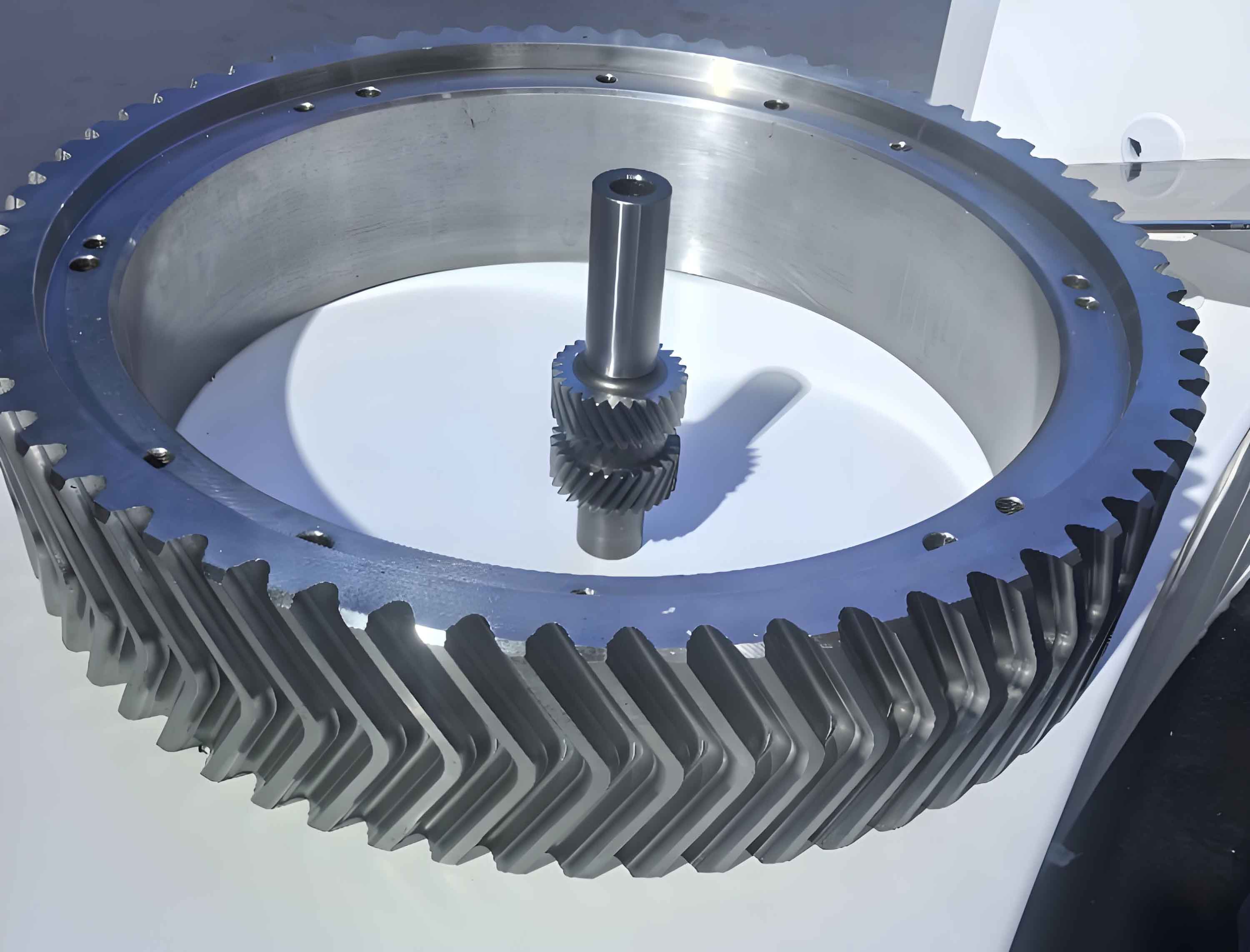
The herringbone gears, as illustrated, feature a symmetrical helical arrangement that enhances stability and reduces noise. Our research aims to bridge the gap between lumped-parameter models and detailed finite element analyses by developing a hybrid approach that incorporates gear meshing stiffness matrices into a 3D framework. This allows for accurate modal prediction while maintaining computational efficiency. The study is structured as follows: we first describe experimental observations of resonance phenomena, then detail the finite element modeling methodology for herringbone gears, followed by modal analysis results and comparisons with test data. Throughout this work, the term “herringbone gears” is emphasized to highlight their significance in the system’s dynamics.
Experimental investigations were conducted on a power-closed test rig designed for star-type planetary gear systems with herringbone gears. The setup included a differential planetary loading mechanism and multiple vibration sensors strategically placed on the transmission housing and shafts. Data acquisition involved sweeping the input speed across a operational range while recording vibration velocities. Spectral analysis revealed distinct resonance peaks associated with rotational frequency (1×) and meshing frequency excitations. The root mean square (RMS) values of vibration velocity for these frequency components were extracted, as summarized in Table 1. Notably, the meshing frequency resonances exhibited higher amplitudes compared to rotational frequency ones, underscoring the critical role of gear interaction dynamics in herringbone gear systems.
| Excitation Type | Resonance Speed (r/min) | Corresponding Frequency (Hz) |
|---|---|---|
| Rotational Frequency (Radial Vibration) | 4500, 6120 | 75, 102 |
| Rotational Frequency (Axial Vibration) | 3420, 5245 | 57, 87.4 |
| Meshing Frequency (Radial Vibration) | 4300, 5300, 6100, 6400 | 3079.3, 3814.2, 4424.7, 5097.1 |
To delve into the root causes of these resonances, we developed a 3D finite element model using ANSYS software, concentrating on the herringbone gear transmission assembly while simplifying peripheral components. The modeling approach involved two key aspects: simplification of gear bodies and implementation of gear meshing effects via stiffness matrices. For the herringbone gears, each helical strand was treated as an independent helical gear pair to capture the coupled torsional and translational motions. The gear bodies (sun, planet, and ring) were simplified by removing tooth profiles and portions of rims, with mass points added to preserve inertial properties. Free modal analyses confirmed that this simplification did not significantly alter natural frequencies, as demonstrated for the sun gear in Table 2. Similar validations were performed for planet gears and the ring gear, with maximum frequency errors below 7%, ensuring model fidelity for herringbone gears dynamics.
| Mode Order | Frequency Before Simplification (Hz) | Frequency After Simplification (Hz) | Error (%) |
|---|---|---|---|
| 1 | 1946.7 | 1969.1 | 1.15 |
| 2 | 1946.8 | 1969.3 | 1.16 |
| 3 | 2617.8 | 2621.1 | 0.13 |
| 4 | 2620.0 | 2621.7 | 0.06 |
| 5 | 5328.2 | 5353.5 | 0.47 |
| 6 | 5334.8 | 5354.6 | 0.37 |
The core of the modeling lies in representing the meshing action of herringbone gears using time-varying stiffness matrices. For a helical gear pair, the relative displacement along the meshing line can be expressed as:
$$
\delta_m = [ (x_p – x_g) \sin \alpha_n + (y_p – y_g) \cos \alpha_n + (r_p \theta_{pz} + r_g \theta_{gz}) ] \cos \beta + [ (r_p \theta_{py} – r_g \theta_{gy}) \cos \alpha_n + (r_p \theta_{px} – r_g \theta_{gx}) \sin \alpha_n + (z_g – z_p) ] \sin \beta – E_{ste}(t)
$$
where \(x, y, z\) denote translational displacements, \(\theta\) denotes rotational displacements about corresponding axes, subscript \(p\) and \(g\) refer to pinion and gear respectively, \(\alpha_n\) is the normal pressure angle, \(\beta\) is the helix angle, \(r\) is the base circle radius, and \(E_{ste}(t)\) represents manufacturing error excitation given by \(E_{ste}(t) = E_{mj} \sin(\Omega_m t)\) with \(\Omega_m\) as meshing frequency. The meshing stiffness varies periodically:
$$
K(t) = K_m + k_0 \sin(\Omega_m t)
$$
where \(K_m\) is the mean meshing stiffness and \(k_0\) is the fluctuation amplitude. The meshing force is then:
$$
F_m = K(t) \delta_m + c_m \dot{\delta}_m
$$
This can be reformulated into matrix form, leading to a 12×12 stiffness matrix for each gear pair. For herringbone gears, we consider two independent helical pairs per gear, resulting in multiple stiffness matrices for sun-planet and planet-ring interactions. The geometric parameters of the herringbone gears are listed in Table 3, which are essential for computing these matrices.
| Parameter | Sun Gear | Planet Gear | Ring Gear |
|---|---|---|---|
| Number of Teeth | 43 | 41 | 127 |
| Module (mm) | 3.5 | 3.5 | 3.5 |
| Normal Pressure Angle (°) | 22.5 | 22.5 | 22.5 |
| Helix Angle (°) | 28.019 | 28.019 | 28.019 |
| Total Face Width (mm) [Per Helix Width] | 60 [30] | 59 [31] | 57 [33] |
The stiffness parameters, derived from detailed contact analyses in ABAQUS, are summarized in Table 4. These values are critical for accurately modeling the herringbone gears meshing behavior in the finite element environment.
| Parameter | Value (N/m) |
|---|---|
| Mean Meshing Stiffness \(K_m\) | 1.65 × 10⁹ |
| Fluctuation Amplitude \(k_0\) | 0.05 × 10⁹ |
The full stiffness matrix for a sun-planet external meshing pair is structured as:
$$
\mathbf{K} = K_m \begin{bmatrix} \mathbf{K}_{11} & \mathbf{K}_{12} \\ \mathbf{K}_{21} & \mathbf{K}_{22} \end{bmatrix}
$$
where the submatrices \(\mathbf{K}_{ij}\) are functions of pressure angle, helix angle, and base radii. For instance, \(\mathbf{K}_{11}\) is given by:
$$
\mathbf{K}_{11} = \begin{bmatrix}
c_b^2 s^2 & c c_b^2 s & -c_b s s_b & c_b r_p s^2 s_b & c c_b r_p s s_b & c_b^2 r_p s \\
c c_b^2 s & c^2 c_b^2 & -c c_b s s_b & c c_b r_p s s_b & c^2 c_b r_p s_b & c c_b^2 r_p \\
-c_b s s_b & -c c_b s s_b & s_b^2 & -r_p s s_b^2 & -c r_p s^2 s_b & -c_b r_p s s_b \\
c_b r_p s^2 s_b & c c_b r_p s s_b & -r_p s s_b^2 & r_p^2 s^2 s_b^2 & c r_p^2 s s_b^2 & c_b r_p^2 s s_b \\
c c_b r_p s s_b & c^2 c_b r_p s_b & -c r_p s^2 s_b & c r_p^2 s s_b^2 & c^2 r_p^2 s^2 & c c_b r_p^2 s \\
c_b^2 r_p s & c c_b^2 r_p & -c_b r_p s s_b & c_b r_p^2 s s_b & c c_b r_p^2 s & c_b^2 r_p^2
\end{bmatrix}
$$
with \(c = \cos \alpha_n\), \(s = \sin \alpha_n\), \(c_b = \cos \beta\), \(s_b = \sin \beta\). Similar matrices are derived for planet-ring internal meshing, with sign adjustments due to contact direction. In ANSYS, these matrices are implemented via MATRIX27 elements, replacing initial COMBIN14 spring elements through APDL commands, thereby embedding the herringbone gears meshing dynamics into the 3D finite element model.
Other system connections, including bearings and shaft couplings, were modeled using bushing elements or fixed constraints based on physical configurations. Bearing stiffness values, obtained from manufacturer data and static tests, are listed in Table 5. These connections ensure that the model accurately represents the boundary conditions and support stiffnesses affecting the herringbone gears system dynamics.
| Bearing Location | Radial Stiffness (N/m) | Axial Stiffness (N/m) | Tilt Stiffness (N·m/rad) | Torsional Stiffness (N·m/rad) |
|---|---|---|---|---|
| Input Shaft Bearings | 1.5 × 10⁸ | 8.22 × 10⁶ | 4 × 10⁴ | – |
| Output Shaft Ball Bearing | 1.715 × 10⁸ | 0.85 × 10⁸ | 106 | – |
| Output Shaft Roller Bearing | 7.2 × 10⁸ | – | 106 | – |
| Planet Gear Bearings (Dual Row) | 1.61 × 10⁹ | – | – | – |
| Input Coupling (Spline) | 109 | 0 | 0 | 1.54 × 10⁸ |
After assembling the complete finite element model, a static analysis was performed to verify torque transmission accuracy. Applying an input torque of 25,590 N·m yielded an output torque of 75,438 N·m, which deviates by only 0.19% from the theoretical value of 75,580 N·m, confirming the model’s mechanical consistency for herringbone gears load paths.
Modal analysis was then conducted up to 5500 Hz, covering the range of meshing frequencies at maximum operational speed. The natural frequencies extracted from the model are numerous and complex, as depicted in a frequency summary plot (conceptually represented). We focused on modes correlating with experimental resonance frequencies. For rotational frequency excitations (below 125 Hz), three primary modes were identified: two axial modes and one radial mode, as detailed in Table 6. These modes correspond to vibrations of the input shaft assembly and show good agreement with experimental peaks, with errors under 4%. The absence of a simulated mode at 75 Hz suggests that resonance at this frequency may originate from test rig components not included in our herringbone gears model.
| Simulated Frequency (Hz) | Experimental Frequency (Hz) | Error (%) | Primary Vibration Direction |
|---|---|---|---|
| 56.14 | 57 | 1.53 | Axial |
| 84.5 | 87.4 | 3.43 | Axial |
| 104.0 | 102 | -1.92 | Radial |
For meshing frequency excitations, the analysis revealed that dominant resonance modes involve coupled vibrations between the ring gear and the gear pairs. Specifically, modes characterized by a 5-diameter (5-nodal diameter) pattern on the ring gear coupled with torsional vibrations of the herringbone gears pairs were prevalent. Table 7 lists four such modes that closely match experimental meshing frequency resonances, with errors ranging from 0.01% to 6.79%. The mode shapes, visualized through finite element post-processing, clearly show the ring gear deforming with five circumferential nodes while the sun and planet gears undergo relative torsion, highlighting the interactive dynamics inherent to herringbone gears systems.
| Simulated Frequency (Hz) | Experimental Frequency (Hz) | Error (%) | Mode Description |
|---|---|---|---|
| 3078.9 | 3079.3 | 0.01 | Ring gear 5-diameter coupled with gear pair torsion |
| 3822.1 | 3814.2 | -0.21 | Ring gear 5-diameter coupled with gear pair torsion |
| 4351.2 | 4424.7 | 1.69 | Ring gear 5-diameter coupled with gear pair torsion |
| 5468.5 | 5097.1 | -6.79 | Ring gear 5-diameter coupled with gear pair torsion |
Additionally, we identified other modes with similar ring gear 5-diameter characteristics, though their corresponding experimental resonance amplitudes were smaller. These are summarized in Table 8, indicating that multiple modes with this pattern exist within the herringbone gears system, and their excitation depends on damping and operational conditions. The prevalence of these modes underscores the importance of ring gear flexibility in meshing frequency resonance, a key insight for designing robust herringbone gears transmissions.
| Simulated Frequency (Hz) | Corresponding Speed (r/min) | Potential Excitation at Meshing Frequency |
|---|---|---|
| 3839.5 | 5357.4 | Yes, with lower amplitude |
| 4055.9 | 5659.4 | Yes, with lower amplitude |
| 4221.4 | 5890.3 | Yes, with lower amplitude |
The finite element model also allowed us to examine the governing equations of motion for the herringbone gears system in matrix form. The general equation can be expressed as:
$$
[\mathbf{M}] \ddot{\mathbf{q}}(t) + [\mathbf{C}] \dot{\mathbf{q}}(t) + [\mathbf{K}(t)] \mathbf{q}(t) = \mathbf{F}(t)
$$
where \([\mathbf{M}]\) is the mass matrix, \([\mathbf{C}]\) is the damping matrix (approximated for modal analysis), \([\mathbf{K}(t)]\) is the time-varying stiffness matrix incorporating herringbone gears meshing, \(\mathbf{q}(t)\) is the displacement vector, and \(\mathbf{F}(t)\) represents external excitations. For modal analysis, we consider the homogeneous equation with constant stiffness averaged over time, leading to the eigenvalue problem:
$$
\left( [\mathbf{K}] – \omega^2 [\mathbf{M}] \right) \boldsymbol{\phi} = \mathbf{0}
$$
where \(\omega\) is the natural frequency and \(\boldsymbol{\phi}\) is the mode shape. The stiffness matrix \([\mathbf{K}]\) here includes contributions from gear meshing stiffness matrices as well as structural stiffnesses from bearings and connections. Solving this yields the natural frequencies and mode shapes discussed earlier.
In summary, this study successfully established a 3D finite element model for modal analysis of a planetary gear system with herringbone gears, integrating gear meshing dynamics through stiffness matrices. The model demonstrated strong correlation with experimental data, particularly in identifying resonance modes linked to rotational and meshing frequencies. Key findings include: (1) Rotational frequency resonances are primarily associated with axial and radial vibrations of shaft components, and our model captured these with errors under 4%. (2) Meshing frequency resonances are dominated by ring gear 5-diameter vibration patterns coupled with torsional motions of herringbone gears pairs, with simulation errors generally below 7%. (3) The modeling approach, which combines gear body simplification with detailed meshing stiffness representation, offers a balanced solution for efficient yet accurate resonance prediction in herringbone gears transmissions.
These insights provide valuable guidance for engineers designing herringbone gears systems, emphasizing the need to consider ring gear flexibility and gear pair coupling in dynamic analyses. Future work could extend this model to include nonlinear effects such as backlash and time-varying damping, further enhancing its predictive capability for herringbone gears applications in aerospace and other high-performance industries.