
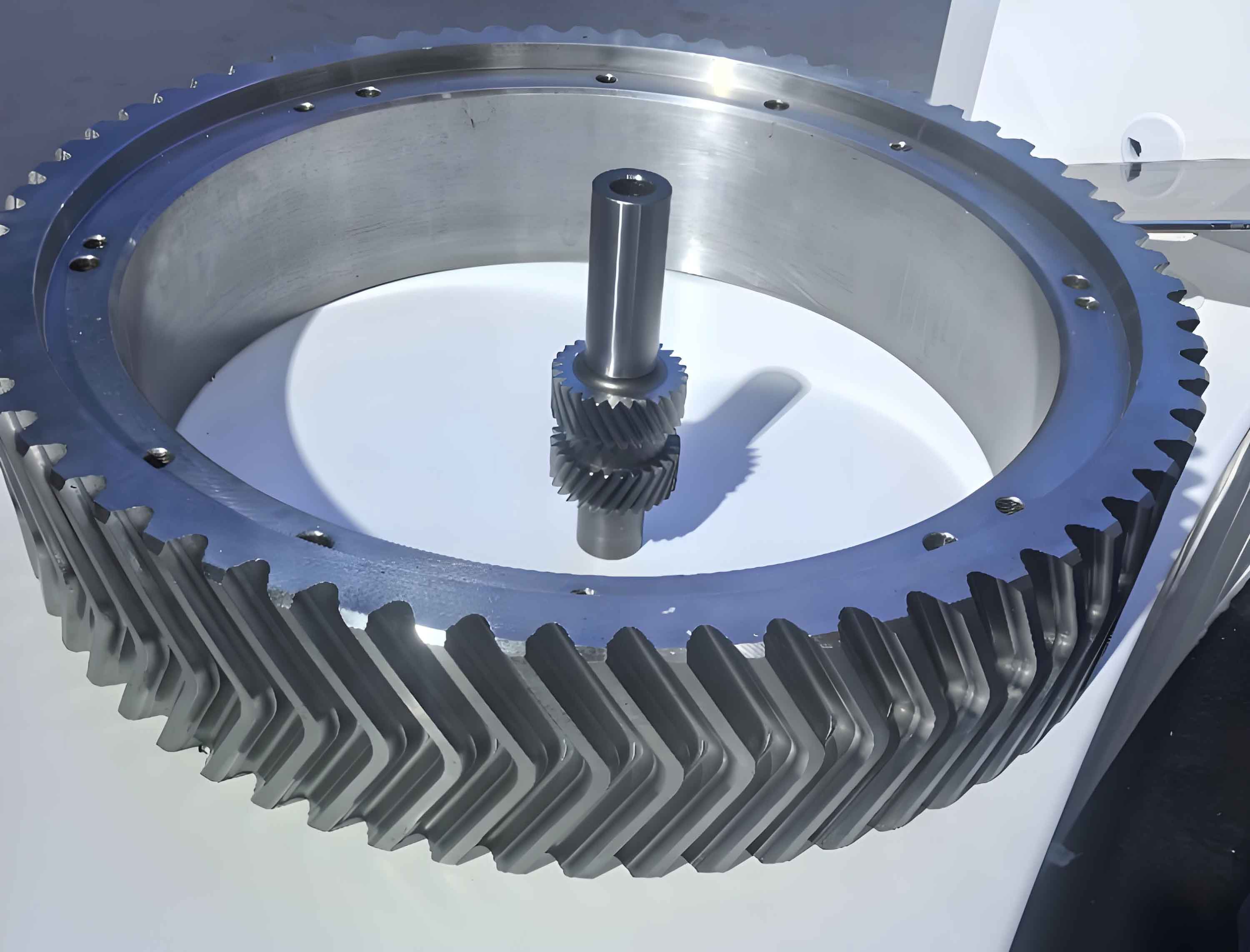
In modern mechanical transmission systems, particularly in aerospace applications such as gear-driven fan engines, the performance and reliability of gear systems are paramount. Herringbone gears, characterized by their double helical structure, offer significant advantages including high load capacity, reduced axial thrust, and enhanced stability. However, the longevity and efficiency of these gears heavily depend on their lubrication and friction characteristics. In this study, I investigate the thermal elastohydrodynamic lubrication (TEHL) behavior and friction properties of modified herringbone gears. The analysis encompasses contact mechanics, fluid dynamics, and thermal effects, with a focus on how operational parameters and geometric modifications influence the lubricant film and frictional forces. Understanding these aspects is crucial for optimizing gear design and preventing failures like scuffing and wear.
The unique geometry of herringbone gears presents complex contact patterns during meshing. Unlike spur gears, the helical teeth engage gradually, leading to time-varying contact lines that affect pressure distribution and lubricant flow. To analyze this, I begin with a detailed contact analysis for a specific herringbone gear pair under defined operating conditions. The gears have the following parameters: pinion teeth Z1 = 44, gear teeth Z2 = 41, normal module mn = 3.5 mm, normal pressure angle αn = 22.5°, face width B = 60 mm, and helix angle β = 28.019°. The base operating condition is set at an input torque M1 = 80 N·m and a pinion speed n1 = 300 rpm. Crown modification is applied to mitigate misalignment effects, with a modification amount Cα = 20 μm, as illustrated in the following figure that shows the crowned tooth surface profile.
Contact analysis for herringbone gears involves determining the instantaneous contact lines, which vary in length and position during meshing. Due to the helical structure, the contact lines are time-dependent, and their total number correlates with the number of teeth in contact. The transverse contact ratio εα and axial contact ratio εβ dictate the contact line behavior. For this gear pair, εα < εβ, meaning the contact lines follow a specific pattern where they initially increase in length, remain constant, and then decrease. The length of a single instantaneous contact line li can be expressed as:
$$ l_i = \begin{cases} s_i / \sin \beta_b, & 0 \leq s_i < \varepsilon_\alpha p_{bt} \\ \varepsilon_\alpha p_{bt} / \sin \beta_b, & \varepsilon_\alpha p_{bt} \leq s_i < \varepsilon_\beta p_{bt} \\ -s_i + b \tan \beta_b + L_0 / \sin \beta_b, & \varepsilon_\beta p_{bt} \leq s_i < (\varepsilon_\alpha + \varepsilon_\beta) p_{bt} \\ 0, & (\varepsilon_\alpha + \varepsilon_\beta) p_{bt} \leq s_i < \lceil \varepsilon_\alpha + \varepsilon_\beta \rceil p_{bt} \end{cases} $$
Here, si is the displacement along the path of contact, βb is the base helix angle, pbt is the transverse base pitch, b is the face width, and L0 is the length of the actual contact zone. The total contact line length L is the sum of all active contact lines. From this, I select three representative meshing points along the contact path for detailed analysis: S1 at the engagement side, S2 at the pitch point, and S3 at the disengagement side. These points correspond to specific angular positions of the pinion, denoted by θ. The contact parameters at these points are critical for subsequent lubrication analysis.
The curvature radii, entrainment velocity, normal contact force, and slide-to-roll ratio are derived from gear geometry and kinematics. For point contact conditions, the equivalent curvature radius in the x-direction (along the tooth profile) and y-direction (across the tooth width) are calculated. The x-direction equivalent radius Rx is given by:
$$ R_x = \frac{R_{x1} R_{x2}}{R_{x1} + R_{x2}} $$
where Rx1 and Rx2 are the curvature radii of the pinion and gear, respectively, adjusted for the base helix angle. The y-direction equivalent radius Ry depends on the crown modification and face width:
$$ R_y = \frac{b^2}{8 C_\alpha \cos \beta_b} $$
The entrainment velocity Ue, which drives lubricant into the contact zone, is the average of the surface velocities U1 and U2:
$$ U_e = \frac{U_1 + U_2}{2}, \quad U_1 = \omega_1 R_{x1}, \quad U_2 = \omega_2 R_{x2} $$
where ω1 and ω2 are the angular velocities. The normal contact force Fn at the gear pair is derived from the input torque:
$$ F_n = \frac{M}{r_{b1}}, \quad M = \frac{9550 P_w}{n} \cdot \frac{1}{2} $$
with rb1 as the base circle radius of the pinion, Pw as input power, and n as speed. Due to load sharing among multiple teeth, the force on a single tooth pair Fni is scaled by the load distribution ratio γ = li / L. The slide-to-roll ratio s, indicative of sliding intensity, is:
$$ s = \frac{U_1 – U_2}{U_e} $$
Using these formulas, I compute the contact parameters for the selected meshing points. The results are summarized in the table below, showcasing the time-varying nature of these parameters along the contact path.
| Meshing Point | Normal Force Fni (N) | Equivalent Radius Rx (mm) | Entrainment Velocity Ue (m/s) | Slide-to-Roll Ratio s |
|---|---|---|---|---|
| S1 (Engagement) | 850.3 | 25.4 | 1.12 | 0.45 |
| S2 (Pitch Point) | 1020.5 | 28.1 | 1.08 | 0.02 |
| S3 (Disengagement) | 920.7 | 26.8 | 1.10 | 0.38 |
The TEHL theory is employed to analyze the lubrication characteristics at these meshing points. The governing equations include the film thickness equation, Reynolds equation, energy equation, thermal interface equations, load balance equation, and lubricant property equations. For point contact, the film thickness h(x,y) accounts for elastic deformation:
$$ h(x,y) = h_0 + \frac{x^2}{2R_x} + \frac{y^2}{2R_y} + \frac{2}{\pi E^*} \iint_\Omega \frac{p(s,t)}{\sqrt{(x-s)^2 + (y-t)^2}} ds dt $$
where h0 is the central film thickness, E* is the equivalent elastic modulus, and p is pressure. The generalized Reynolds equation for non-Newtonian fluids under thermal conditions is:
$$ \frac{\partial}{\partial x} \left( \frac{\rho h^3}{\eta} \frac{\partial p}{\partial x} \right) + \frac{\partial}{\partial y} \left( \frac{\rho h^3}{\eta} \frac{\partial p}{\partial y} \right) = 12 U_e \frac{\partial (\rho h)}{\partial x} $$
with boundary conditions p = 0 at the edges. The energy equation for temperature distribution T within the film is:
$$ c_p \rho \left( u \frac{\partial T}{\partial x} + v \frac{\partial T}{\partial y} \right) = k \frac{\partial^2 T}{\partial z^2} – \frac{T}{\rho} \frac{\partial \rho}{\partial T} \left( u \frac{\partial p}{\partial x} + v \frac{\partial p}{\partial y} \right) + \eta \left[ \left( \frac{\partial u}{\partial z} \right)^2 + \left( \frac{\partial v}{\partial z} \right)^2 \right] $$
where cp is specific heat, k is thermal conductivity, and u, v are fluid velocities. Thermal interface equations account for heat conduction into the gear surfaces. The load balance equation ensures pressure integration equals the applied load:
$$ \iint_\Omega p(x,y) dx dy = w $$
Lubricant properties are modeled with the Roelands equation for viscosity η and a density ρ relation:
$$ \eta = \eta_0 \exp \left( (\ln \eta_0 + 9.67) \left[ (1 + 5.1 \times 10^{-9} p)^z \left( \frac{T – 138}{T_0 – 138} \right)^{-s_0} – 1 \right] \right) $$
$$ \rho = \rho_0 \left( 1 + \frac{A p}{1 + B p} + D (T – T_0) \right) $$
with η0 = 0.03 Pa·s, ρ0 = 956 kg/m³, A = 0.6×10⁻⁹ m²/N, B = 1.7×10⁻⁹ m²/N, D = -0.00065 K⁻¹, T0 = 303 K, z = 0.68, and s0 = 1.1. Gear material properties are density 7860 kg/m³, specific heat 470 J/(kg·K), and thermal conductivity 46 W/(m·K).
Prior to analyzing herringbone gears, I validate the TEHL numerical program against published experimental data from ball-on-disc tests under full-film lubrication. The computed central film thickness of 1.5327 μm aligns with experimental measurements of approximately 1.400 μm, yielding a relative error of 8.66%, which is acceptable considering measurement resolution and numerical approximations. This validation confirms the program’s reliability for herringbone gear applications.
For the herringbone gear meshing points S1, S2, and S3 under base conditions, I perform TEHL calculations. The results extract key film characteristics: minimum film thickness hmin, maximum film pressure pmax, and maximum film temperature rise ΔTmax. The two-dimensional film profile curves illustrate pressure and temperature distributions. The data are summarized in the following table.
| Meshing Point | hmin (μm) | pmax (GPa) | ΔTmax (K) |
|---|---|---|---|
| S1 | 0.1499 | 0.9146 | 44.289 |
| S2 | 0.1251 | 1.0983 | 4.110 |
| S3 | 0.1341 | 1.0335 | 32.637 |
The trends show that pmax peaks near the pitch point due to higher normal force, while hmin is lowest there. ΔTmax is significantly higher at engagement and disengagement sides because of larger slide-to-roll ratios, indicating intense sliding friction. These variations underscore the importance of analyzing multiple points along the contact path for herringbone gears.
To understand parameter influences, I vary input torque, pinion speed, and crown modification amount, focusing on meshing point S1. First, the pinion speed n1 is increased to 400 and 500 rpm while keeping torque at 80 N·m. The film profiles indicate that higher speeds elevate film thickness and temperature rise due to increased shear, but pressure changes marginally. Second, the input torque M1 is raised to 120 and 160 N·m at constant speed 300 rpm. This boosts normal force, leading to higher pressure and temperature peaks, while film thickness slightly decreases at the necking region. The effects are quantified below.
| Case | Condition | hmin at S1 (μm) | pmax at S1 (GPa) | ΔTmax at S1 (K) |
|---|---|---|---|---|
| Speed Variation | n1 = 400 rpm, M1 = 80 N·m | 0.1623 | 0.9101 | 48.752 |
| n1 = 500 rpm, M1 = 80 N·m | 0.1750 | 0.9089 | 53.114 | |
| Torque Variation | n1 = 300 rpm, M1 = 120 N·m | 0.1482 | 1.2015 | 55.367 |
| n1 = 300 rpm, M1 = 160 N·m | 0.1465 | 1.4883 | 66.445 |
Crown modification amount Cα is varied as 10, 15, and 20 μm. As Cα increases, Ry decreases, reducing contact area and raising pressure. Film thickness remains relatively stable, but temperature rise climbs due to heightened pressure. This suggests that excessive modification may compromise lubrication, so optimal Cα must balance load distribution and thermal effects.
Friction characteristics are derived using the Ree-Eyring model for non-Newtonian fluid shear stress. The total friction force Fz in the contact zone is:
$$ F_z = \iint_\Omega \left( \frac{\partial p}{\partial x} \frac{h}{2} + \tau_0 \sinh(c) \right) dx dy $$
$$ c = \frac{(U_2 – U_1) C_H – \sqrt{C_H^2 – S_H^2 + (U_2 – U_1)^2} S_H}{C_H^2 – S_H^2} $$
$$ C_H = \int_0^h \frac{\tau_0}{\eta} \cosh\left( \frac{1}{\tau_0} \frac{\partial p}{\partial x} z \right) dz, \quad S_H = \int_0^h \frac{\tau_0}{\eta} \sinh\left( \frac{1}{\tau_0} \frac{\partial p}{\partial x} z \right) dz $$
with τ0 as the limiting shear stress. The friction coefficient μ is computed as μ = Fz / Fni. For the base condition, μ at S1 is 0.0309, at S2 is 0.0010, and at S3 is 0.0152. This trend mirrors the slide-to-roll ratio: near-zero at the pitch point (pure rolling) and higher at engagement/disengagement sides (significant sliding). The friction coefficients correlate with temperature rise, highlighting regions prone to thermal distress.
In summary, this analysis reveals critical insights into herringbone gear lubrication and friction. The time-varying contact parameters lead to fluctuating film properties, with pressure peaking at the pitch point and temperature rising at the sides. Operational factors like speed and torque directly influence film thickness and thermal behavior, while crown modification affects pressure concentration. Friction coefficients vary along the contact path, emphasizing the need for targeted cooling in high-sliding zones. These findings aid in designing herringbone gears for enhanced durability and efficiency in demanding applications.
The study underscores the complexity of herringbone gear systems and the value of TEHL modeling. Future work could explore dynamic effects, surface roughness, and alternative lubricants. By integrating these analyses, engineers can optimize herringbone gear performance, ensuring reliable operation in aerospace and industrial transmissions. Herringbone gears, with their unique double helical design, continue to be a focal point for advancing gear technology, and understanding their lubrication mechanisms is key to unlocking their full potential.