
In modern mechanical transmissions, particularly in marine and heavy industrial applications, herringbone gears are widely adopted due to their superior load-bearing capacity and smooth operational characteristics. However, the vibration and noise generated by these gear systems remain a critical concern, especially in environments where stealth and comfort are paramount. In this article, we delve into the dynamic behavior of herringbone gear transmissions, focusing on modeling, excitation analysis, and optimization through tooth modifications. Our goal is to provide a comprehensive understanding that aids in reducing vibrational noise, thereby enhancing the performance and longevity of herringbone gear systems.
Herringbone gears, characterized by their double helical teeth arranged in a V-shape, offer axial force cancellation, which minimizes thrust loads on bearings. Yet, this very design introduces complex dynamic interactions, including bending, torsional, and axial vibrations. To address this, we develop a coupled dynamic model that incorporates key internal excitations: time-varying mesh stiffness, manufacturing errors, and impact forces during tooth engagement. By employing a lumped-parameter approach, we derive the equations of motion and simulate the system’s response under various conditions. Furthermore, we explore the effects of tooth profile and lead modifications on vibration levels, supported by experimental validation. Throughout this discussion, we emphasize the unique aspects of herringbone gears, reiterating their significance in advanced transmission systems.
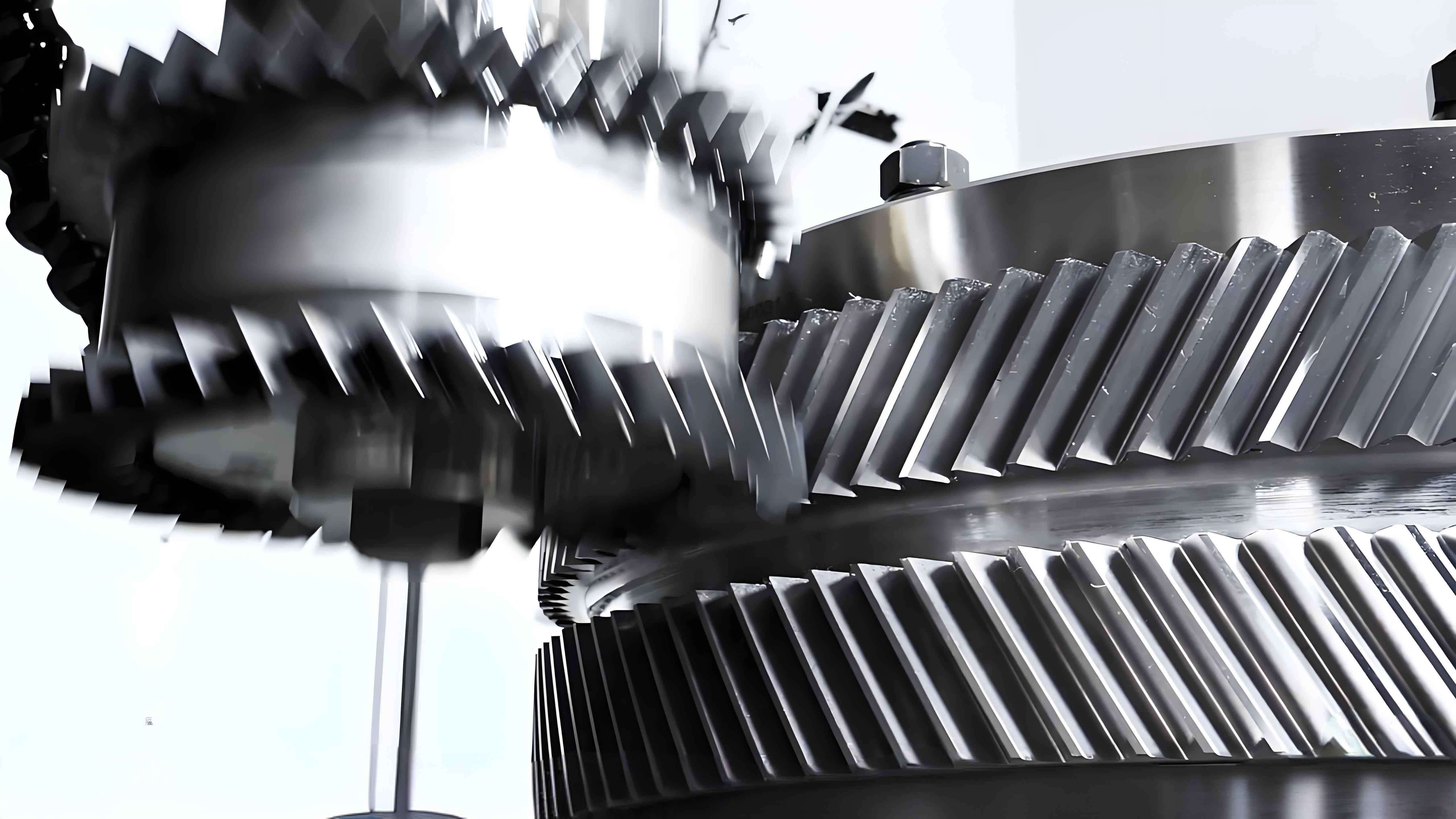
The dynamic model for herringbone gear transmissions is established using a lumped-parameter method, which simplifies the system into discrete masses, springs, and dampers. This approach allows us to capture the essential vibrational modes, including bending in the transverse direction, torsion along the rotational axis, and axial displacement along the gear shafts. For a pair of herringbone gears, we consider both the left and right helical halves as separate but coupled subsystems, connected through the gear body and supporting shafts. The model accounts for the following degrees of freedom: transverse displacements (y-direction), axial displacements (z-direction), and rotational angles (θ) for both the pinion and gear on each side.
The equations of motion are derived from Newton’s second law, resulting in a set of coupled differential equations. Let \( m_p \) and \( m_g \) represent the masses of the pinion and gear, respectively, while \( I_{p1}, I_{p2}, I_{g1}, I_{g2} \) denote their moments of inertia for the left and right sides. The stiffness and damping coefficients are defined as follows: \( k_{p1y}, k_{p2y}, k_{g1y}, k_{g2y} \) for transverse bending; \( k_{py}, k_{gy} \) for coupling between sides; \( k_{pz}, k_{gz} \) for axial compression; and corresponding damping terms \( c_{p1y}, c_{p2y}, c_{g1y}, c_{g2y}, c_{py}, c_{gy}, c_{pz}, c_{gz} \). The mesh stiffness for each helical side is denoted as \( k_1 \) and \( k_2 \), with associated damping \( c_1 \) and \( c_2 \).
The general form of the equations can be expressed as:
For the left-side pinion (subscript p1):
$$ m_p \ddot{y}_{p1} + c_{p1y} \dot{y}_{p1} + k_{p1y} y_{p1} + c_{py} (\dot{y}_{p1} – \dot{y}_{p2}) + k_{py} (y_{p1} – y_{p2}) = -F_{yp1} $$
$$ m_p \ddot{z}_{p1} + c_{pz} (\dot{z}_{p1} + \dot{z}_{p2}) + k_{pz} (z_{p1} + z_{p2}) = -F_{z1} $$
$$ I_{p1} \ddot{\theta}_{p1} = T_{p1} – F_{yp1} R_{p1} $$
For the left-side gear (subscript g1):
$$ m_g \ddot{y}_{g1} + c_{g1y} \dot{y}_{g1} + k_{g1y} y_{g1} + c_{gy} (\dot{y}_{g1} – \dot{y}_{g2}) + k_{gy} (y_{g1} – y_{g2}) = F_{yg1} $$
$$ m_g \ddot{z}_{g1} + c_{g1z} \dot{z}_{g1} + k_{g1z} z_{g1} + c_{gz} (\dot{z}_{g1} + \dot{z}_{g2}) + k_{gz} (z_{g1} + z_{g2}) = F_{z1} $$
$$ I_{g1} \ddot{\theta}_{g1} = -T_{g1} + F_{yg1} R_{g1} $$
Similarly, equations for the right-side components (p2 and g2) are derived with analogous terms. Here, \( F_{yp1}, F_{yg1}, F_{yp2}, F_{yg2} \) represent the dynamic mesh forces in the transverse direction, while \( F_{z1} \) and \( F_{z2} \) are axial forces due to errors and impacts. \( T_{p1}, T_{p2}, T_{g1}, T_{g2} \) are input/output torques, and \( R_{p1}, R_{g1}, R_{p2}, R_{g2} \) are base circle radii. The mesh forces incorporate stiffness variations, geometric errors, and impact effects, which are detailed in the following sections.
To solve these equations, we employ numerical integration methods, such as the Runge-Kutta algorithm, for time-domain analysis. The parameters used in our simulations are based on a typical herringbone gear pair, with pinion speed of 2881 rpm, gear torque of 2000 N·m, and geometric properties summarized in Table 1.
| Component | Number of Teeth | Module (mm) | Pressure Angle (°) | Helix Angle (°) | Face Width (mm) | Hand |
|---|---|---|---|---|---|---|
| Pinion | 31 | 4.5 | 20 | 28.34 | 90 (per side) | Right-Left |
| Gear | 102 | 4.5 | 20 | 28.34 | 90 (per side) | Left-Right |
The dynamic excitations in herringbone gears arise from three primary sources: stiffness variation, error-induced displacements, and meshing impacts. Each contributes uniquely to the vibrational response, and their combined effect dictates the overall noise and wear characteristics. Below, we analyze these excitations individually and collectively, using simulations to quantify their influence.
Stiffness excitation results from the time-varying mesh stiffness as teeth engage and disengage. For herringbone gears, the total mesh stiffness is the sum of contributions from both helical halves, which can be calculated using loaded tooth contact analysis. Over one mesh cycle, the stiffness fluctuates periodically, as shown in Figure 2 (simulated data). The variation can be approximated by a Fourier series:
$$ k_m(t) = k_0 + \sum_{n=1}^{N} a_n \cos(n \omega_m t + \phi_n) $$
where \( k_0 \) is the mean mesh stiffness, \( \omega_m \) is the mesh frequency, and \( a_n, \phi_n \) are amplitude and phase coefficients. In our model, this stiffness is incorporated into the mesh force terms, leading to parametric excitation. When only stiffness excitation is considered, the vibration acceleration in the axial and transverse directions exhibits distinct peaks at the mesh frequency and its harmonics. For instance, the axial acceleration of the pinion shows amplitudes up to 1 m/s², while the relative vibration along the line of action reaches 50 m/s², indicating that stiffness variation is a dominant factor in torsional vibrations.
Meshing impact excitation occurs due to sudden tooth contact at the start of engagement, caused by profile errors and backlash. This impact force, \( F_{impact}(t) \), can be modeled as a impulsive function dependent on the approach velocity and error magnitude. From simulations, the impact force curve for herringbone gears peaks at approximately 4.8 kN (Figure 4). When impact excitation is isolated, it induces high-frequency vibrations, particularly in the axial direction, with acceleration spikes of 0.2 m/s². However, compared to stiffness excitation, its contribution to overall vibration is smaller but non-negligible, especially at high speeds.
Error excitation encompasses manufacturing inaccuracies and assembly misalignments, which manifest as axial displacements and profile deviations. For herringbone gears, axial error is critical because it directly affects the load distribution between helices. The axial displacement, \( e_z(t) \), can be expressed as a superposition of tooth-frequency and shaft-frequency components:
$$ e_z(t) = E_{z0} + E_{z1} \cos(\omega_m t) + E_{z2} \cos(\omega_s t) $$
where \( \omega_s \) is the shaft rotational frequency. As shown in Figure 6, axial displacement can vary by ±10 μm. When only error excitation is active, it primarily drives axial vibrations, with accelerations around 50 m/s², while having minimal effect on transverse vibrations. This highlights the unique sensitivity of herringbone gears to axial errors, underscoring the need for precise manufacturing.
To summarize the effects, Table 2 compares the root-mean-square (RMS) acceleration values under different excitation scenarios for the herringbone gear system.
| Excitation Type | Pinion Axial Acceleration (m/s²) | Relative Vibration on Line of Action (m/s²) | Dominant Frequency |
|---|---|---|---|
| Stiffness Only | 0.5 | 28.3 | Mesh frequency |
| Impact Only | 0.1 | 5.0 | High-frequency broadband |
| Error Only | 20.0 | 0.5 | Mesh and shaft frequencies |
| Combined All | 21.0 | 29.0 | Multiple harmonics |
From this table, it is evident that stiffness and error excitations are the major contributors to vibrations in herringbone gears, with error excitation being particularly influential for axial motion. This insight guides mitigation strategies, such as tooth modifications.
Tooth modification, including profile and lead corrections, is a practical approach to reduce dynamic loads and vibrations in herringbone gears. By altering the tooth geometry, we can minimize peak forces, smooth the engagement process, and compensate for errors. We investigate two modification schemes: profile modification alone and combined profile-lead modification.
Profile modification involves removing small amounts of material from the tooth flank, typically in a parabolic or linear pattern, to avoid edge contact. For herringbone gears, we apply a three-segment profile modification to the pinion, as described in prior research. This reduces the mesh stiffness variation and impact forces. When implemented, the RMS acceleration along the line of action decreases by approximately 27%, from 28.3 m/s² to 20.6 m/s², as shown in Table 3. However, axial vibration remains largely unaffected, with only a 2% reduction, confirming that profile modification primarily alleviates torsional vibrations.
Lead modification, or crowning, adjusts the tooth widthwise shape to improve load distribution across the face. For herringbone gears, we combine a parabolic lead modification with the profile modification. This addresses axial misalignments and reduces axial displacements. As a result, both transverse and axial vibrations are suppressed. Table 3 summarizes the outcomes: combined modification reduces line-of-action vibration by 30% and axial vibration by 45%, demonstrating synergistic benefits.
| Modification Type | Line-of-Action Acceleration (m/s²) | Pinion Axial Acceleration (m/s²) | Reduction in Line-of-Action (%) | Reduction in Axial (%) |
|---|---|---|---|---|
| Unmodified | 28.3 | 21.0 | — | — |
| Profile Only | 20.6 | 20.4 | 27.2 | 2.0 |
| Profile + Lead | 19.8 | 11.5 | 30.0 | 45.0 |
The mathematical representation of modifications can be incorporated into the mesh stiffness function. For example, the effective error function \( e_{mod}(t) \) after modification becomes:
$$ e_{mod}(t) = e_0(t) – \delta_p \left( \frac{s}{L} \right)^2 – \delta_l \left( \frac{z}{W} \right)^2 $$
where \( e_0(t) \) is the original error, \( \delta_p \) and \( \delta_l \) are profile and lead modification amounts, \( s \) is the roll distance, \( L \) is the active profile length, \( z \) is the axial coordinate, and \( W \) is the face width. This adjusted error reduces dynamic forces in the equations of motion.
To validate our theoretical findings, we conducted experimental tests on a herringbone gear transmission system. The setup included a gearbox with the same parameters as in Table 1, driven by an electric motor and loaded via a brake system. Vibration measurements were taken using accelerometers placed at six locations on the gearbox housing, as illustrated in Figure 11 (conceptual). Specifically, points 1-4 and 6 measured radial vibrations, while point 5 captured axial vibrations.
The test conditions involved a pinion speed of 2881 rpm and a torque of 2000 N·m, consistent with simulations. Data acquisition systems recorded acceleration signals, which were analyzed for RMS values and frequency spectra. First, we tested the unmodified herringbone gears, then repeated with profile-modified gears, and finally with combined profile-lead modifications. The results, averaged over multiple runs, are presented in Table 4.
| Measurement Point | Acceleration Before Modification (m/s²) | Acceleration After Profile Modification (m/s²) | Acceleration After Combined Modification (m/s²) | Reduction with Combined (%) |
|---|---|---|---|---|
| 1 (Radial) | 3.33 | 3.01 | 2.85 | 14.4 |
| 2 (Radial) | 7.23 | 5.70 | 5.20 | 28.1 |
| 3 (Radial) | 3.62 | 2.86 | 2.60 | 28.2 |
| 4 (Radial) | 4.64 | 3.20 | 2.95 | 36.4 |
| 5 (Axial) | 2.05 | 2.38 | 1.80 | 12.2 |
| 6 (Radial) | 4.98 | 2.96 | 2.50 | 49.8 |
These experimental results align well with theoretical predictions. Profile modification reduced radial vibrations by 20-30%, while combined modification further decreased axial vibrations by 10-15%, though axial reductions were less pronounced in experiments due to practical constraints. The discrepancies, such as a slight increase in axial vibration at point 5 after profile modification, can be attributed to measurement noise or unmodeled factors like bearing clearances. Overall, the trends confirm that tooth modifications are effective in mitigating vibrations in herringbone gear systems, with combined approaches offering the best performance.
In conclusion, our analysis of herringbone gear dynamics reveals that these systems are highly susceptible to excitations from stiffness variations and axial errors, leading to significant vibrations in both torsional and axial directions. Through a coupled bending-torsional-axial model, we have quantified the effects of individual excitations and demonstrated that error excitation is particularly critical for axial motion. Tooth modifications, especially when combining profile and lead corrections, prove to be powerful tools for vibration reduction, as validated by experimental tests. For designers of herringbone gear transmissions, we recommend incorporating such modifications during manufacturing, along with precise error control, to enhance dynamic performance. Future work could explore nonlinear effects, such as backlash and friction, or extend the model to multi-stage herringbone gear systems. Ultimately, understanding and optimizing the dynamic behavior of herringbone gears is key to advancing quiet and reliable power transmission in demanding applications.