
In my experience as a welding engineer, the fabrication of herringbone gears for heavy machinery, such as a 1600-ton press, presents unique challenges due to the use of dissimilar materials. The herringbone gears I worked on were constructed from multiple welded components: the outer teeth made of 42CrMo, the web plate of Q235B, and the shaft sleeve of 45# steel. This combination classifies it as an异种材料焊接, requiring careful工艺 to ensure structural integrity. To simplify this, I implemented a transition layer堆焊 technique on the齿圈, effectively converting the joint between the齿圈 and web into a similar-material weld. This approach significantly reduced焊接难度, and I will detail the welding工艺 below, emphasizing the importance of herringbone gears in industrial applications.
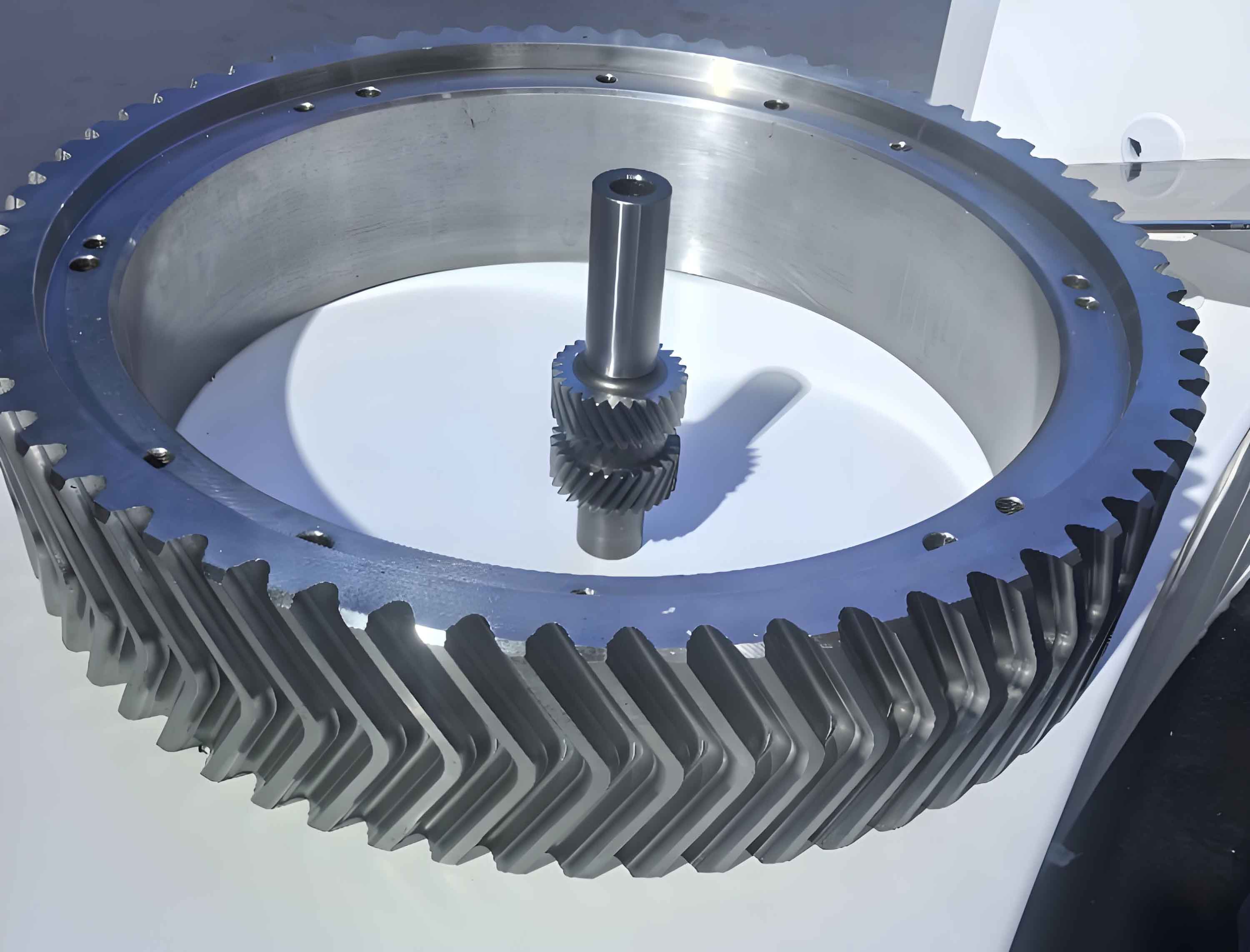
Herringbone gears are critical components in high-torque transmission systems, and their performance hinges on robust welding joints. The 42CrMo material, a medium-carbon quenched and tempered steel, has a high carbon content and alloying elements, making it prone to hardening and cracking. When welded to Q235B, a low-carbon steel, the disparity in properties exacerbates the risk of defects. Thus, understanding the焊接性 is paramount for successful fabrication of herringbone gears.
Weldability Analysis of 42CrMo and Q235B for Herringbone Gears
The weldability of herringbone gears depends heavily on the base materials. 42CrMo, with its composition, exhibits significant淬硬倾向 and cold crack susceptibility due to its high carbon equivalent (CE). I calculated the CE using the International Institute of Welding (IIW) formula to quantify this:
$$CE = C + \frac{Mn}{6} + \frac{Cr + Mo + V}{5} + \frac{Ni + Cu}{15}$$
For 42CrMo, based on typical values from Table 1, the CE approximates to 0.76, indicating high hardenability. This leads to the formation of brittle martensite in the heat-affected zone (HAZ), increasing冷裂倾向. Additionally, the wide solidification temperature range raises热裂敏感性. In contrast, Q235B has a lower CE, around 0.3-0.4, making it more weldable. The异种钢 welding between 42CrMo and Q235B requires mitigating these issues through controlled heat input and post-weld treatment. The material compositions are summarized below:
| Material | C (%) | Si (%) | Mn (%) | Mo (%) | Cr (%) | V (%) | Other (%) |
|---|---|---|---|---|---|---|---|
| 42CrMo | 0.38-0.45 | 0.17-0.37 | 0.50-0.80 | 0.15-0.25 | 0.90-1.20 | – | Bal. |
| Q235B | ≤0.20 | ≤0.35 | 0.30-0.70 | – | – | – | Bal. |
To further analyze, the martensite start temperature (Ms) for 42CrMo can be estimated using empirical formulas, which influences cracking. A common approximation is:
$$M_s (\degree C) = 539 – 423C – 30.4Mn – 17.7Cr – 12.1Mo – 7.5Si$$
Substituting values yields a low Ms, promoting martensite formation. For herringbone gears, this necessitates preheating to slow cooling rates. The difference in thermal expansion coefficients between 42CrMo and Q235B also induces residual stresses, calculated as:
$$\sigma_{res} = E \cdot \alpha \cdot \Delta T$$
where \(E\) is Young’s modulus, \(\alpha\) is the coefficient of thermal expansion, and \(\Delta T\) is the temperature gradient. Proper工艺 minimizes these stresses to ensure the durability of herringbone gears.
Selection of Welding Materials for Herringbone Gears
Choosing the right filler material is crucial for herringbone gears to balance strength and crack resistance. Since the齿圈 (42CrMo) and web (Q235B) have different strengths, the weld should match the lower-strength base metal (Q235B) to avoid over-matching and stress concentration. I selected ER50-6 CO2 gas-shielded welding wire for its good mechanical properties and compatibility. Its deposited metal composition and performance are detailed in Tables 2 and 3, which support the structural needs of herringbone gears.
| Element | C | Mn | Si | P | S | Ni | Cr | Mo | Ti | Al |
|---|---|---|---|---|---|---|---|---|---|---|
| Content (%) | 0.06 | 1.41 | 0.76 | 0.012 | 0.010 | – | – | – | – | – |
| Property | Yield Strength (MPa) | Tensile Strength (MPa) | Elongation (%) | Impact Energy at -29°C (J) |
|---|---|---|---|---|
| Value | 447 | 572 | 29 | 89 |
The choice of ER50-6 helps dilute the carbon and alloy elements from 42CrMo in the transition layer, facilitating同种钢 welding for herringbone gears. The tensile strength meets Q235B requirements, while the impact toughness ensures resistance to dynamic loads common in herringbone gear operations.
Welding Process for Herringbone Gears
The welding process for herringbone gears involves meticulous steps to prevent defects. I divided it into pre-weld preparation, welding execution, and post-weld treatment, each critical for gears承受较大的扭矩.
Pre-Weld Preparation
For herringbone gears, I machined a groove on the 42CrMo齿圈 to accommodate the transition layer. The groove design, with specific angles and dimensions, ensures proper fusion. Preheating is essential to reduce cooling speeds and hydrogen diffusion. Using a car-bottom furnace, I heated the gear to 250°C for 2-3 hours, maintaining this to prevent cracking. The preheat temperature (\(T_p\)) can be derived from carbon equivalent formulas:
$$T_p (\degree C) = 350 \times \sqrt{CE} – 100$$
For CE=0.76, this gives approximately 250°C, aligning with my实践. Cleaning the groove within 20 mm removes contaminants that could cause porosity in herringbone gears.
Welding Execution
After removal from the furnace, I positioned the齿圈 vertically and immediately began CO2 welding with two welders to ensure continuous operation. The interpass temperature was kept at 200-250°C, monitored with infrared thermometers. For herringbone gears, low heat input is vital to minimize distortion and HAZ width. The heat input (\(Q\)) is calculated as:
$$Q = \frac{60 \times I \times V}{v \times 1000} \, \text{(kJ/mm)}$$
where \(I\) is current (A), \(V\) is voltage (V), and \(v\) is speed (cm/min). Using small parameters for the first layer, I ensured full penetration, then increased gradually. The welding parameters are tabulated below, optimized for herringbone gears.
| Weld Pass | Wire Diameter (mm) | Current (A) | Voltage (V) | Gas Flow (L/min) | Speed (cm/min) |
|---|---|---|---|---|---|
| First Layer | 1.2 | 160-180 | 30-35 | 10-13 | 18-20 |
| Second Layer | 1.2 | 200-220 | 30-35 | 12-15 | 20-25 |
| Third/Fourth Layers | 1.2 | 220-240 | 30-35 | 15-18 | 25-30 |
Layer-by-layer deposition with thorough cleaning prevented slag inclusion. For herringbone gears, this multi-pass approach distributes stress and refines the microstructure.
Post-Weld Treatment
Upon completion, I returned the齿圈 to the furnace at 300°C for slow cooling, which tempers the martensite and reduces residual stresses. The post-weld heat treatment (PWHT) temperature can be estimated based on material properties:
$$T_{PWHT} = 0.8 \times T_m – 150$$
where \(T_m\) is the melting point. For 42CrMo, this aligns with 300-400°C. Controlled cooling to room temperature ensured hardness uniformity in the herringbone gears.
Quality Inspection and Performance of Herringbone Gears
After welding, I conducted非破坏性 testing on the herringbone gears. Ultrasonic examination revealed no cracks or slag, confirming the transition layer’s integrity. The subsequent welds between the transition layer, web, and shaft sleeve followed standard procedures, as the dissimilarity issue was resolved. Herringbone gears subjected to torque tests showed no failure, validating the工艺. The overall weld quality can be quantified using a reliability index (\(R\)):
$$R = 1 – \frac{N_d}{N_t}$$
where \(N_d\) is defect count and \(N_t\) is total inspections. For these herringbone gears, \(R\) approached 1, indicating high reliability.
Advanced Considerations for Herringbone Gears Welding
To further optimize herringbone gears, I explored additional factors like hydrogen control and microstructure prediction. Hydrogen-induced cracking is a risk in high-strength steels like 42CrMo. The diffusion of hydrogen can be modeled with Fick’s law:
$$\frac{\partial C}{\partial t} = D \nabla^2 C$$
where \(C\) is hydrogen concentration and \(D\) is diffusivity. Preheating and low-hydrogen practices reduce \(C\), critical for herringbone gears in humid environments. Moreover, the microstructure evolution during welding affects toughness. Using continuous cooling transformation (CCT) diagrams, I predicted phases like bainite and martensite. For herringbone gears, a mixture of fine bainite and tempered martensite in the HAZ is desirable, achievable through controlled cooling rates (\(CR\)):
$$CR = \frac{T_1 – T_2}{t}$$
where \(T_1\) and \(T_2\) are temperature points, and \(t\) is time. Keeping \(CR\) below 30°C/s for 42CrMo minimizes hardness peaks.
Herringbone gears also require平衡 for smooth operation. Welding distortion can alter gear geometry, so I applied clamping fixtures and sequenced welds symmetrically. The distortion angle (\(\theta\)) can be approximated as:
$$\theta = k \cdot Q \cdot L / E \cdot I$$
where \(k\) is a constant, \(L\) is length, and \(I\) is moment of inertia. Minimizing \(Q\) through参数优化 helped maintain accuracy for herringbone gears.
Conclusion on Welding Herringbone Gears
In summary, welding herringbone gears made of 42CrMo and Q235B demands a strategic approach. By堆焊 a transition layer with ER50-6 wire, I converted the异种钢 joint into a同种钢 connection, simplifying the process and enhancing quality. The use of preheating, controlled parameters, and PWHT mitigated cracking risks, ensuring the herringbone gears could withstand operational stresses. This methodology not only applies to herringbone gears but also to other复合组件 in heavy industry, showcasing the importance of tailored welding solutions. Future work could involve finite element analysis to simulate stress distributions in herringbone gears under load, further refining the工艺 for these critical components.
Throughout this discussion, herringbone gears have been emphasized as vital elements in mechanical systems, and their successful welding hinges on meticulous material science and engineering practices. By integrating formulas, tables, and practical insights, I have outlined a comprehensive framework for fabricating durable herringbone gears that meet industrial demands.