
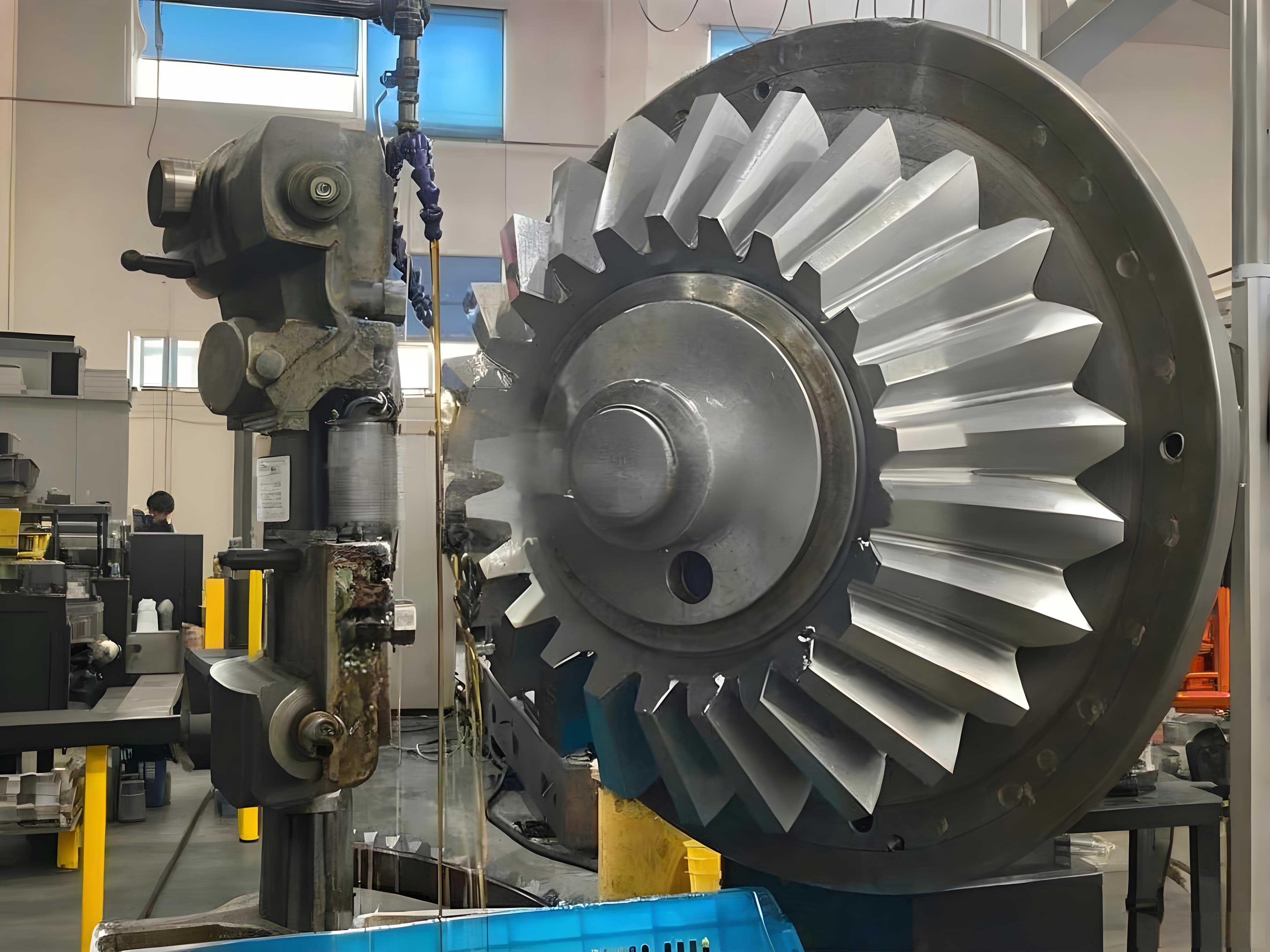
In my research, I focus on the development of high-performance miter gears, which are crucial for power transmission in intersecting shafts, especially in applications like automotive differentials, aerospace systems, and industrial machinery. Miter gears, typically straight bevel gears with a 90-degree shaft angle, offer advantages such as simplicity, low axial thrust, and ease of assembly. However, traditional manufacturing methods like forging or planing often result in limited precision and an inability to implement tooth surface modifications, leading to issues like edge contact, vibration, and noise under misalignment or load variations. To address these challenges, I propose an efficient machining approach using dual interlocking circular cutters for milling or grinding miter gears. This method simulates a crown generating wheel, enabling simultaneous cutting of both tooth flanks with controlled tool-workpiece relative motion, eliminating the need for feed motion along the tooth direction. This simplifies machine tool structure, reduces processing time, and enhances efficiency. In this article, I will detail the mathematical modeling of tooth surfaces considering profile and lead modifications, establish tooth contact analysis (TCA) and loaded tooth contact analysis (LTCA) models, and optimize cutter parameters to minimize transmission error fluctuations, thereby improving the meshing performance of miter gears.
The dual interlocking circular cutter system essentially consists of two disc-shaped tools—such as grinding wheels or milling cutters—that rotate to form the teeth of a virtual crown generating wheel. This simulated crown wheel then envelopes the tooth surfaces of the miter gears. To achieve tooth modifications, I introduce key parameters: the tool profiling coefficient \(a_t\), the mean radius of the cutter disk \(\rho_m\), and the cutting edge angle \(\delta\). These parameters allow for controlled profile crowning (via parabolic modification) and lead crowning (via the cutter’s orientation), which are essential for compensating misalignments and ensuring favorable contact patterns under load. The cutter positioning is defined in coordinate systems to relate the tool geometry to the generated gear tooth surface. Let me start by describing the tool geometry and its transformation.
I define a tool normal section reference coordinate system \(S_m\), where the position vector of a point \(Q\) on the cutter edge is given by:
$$r_m^{(Q)}(u) = \begin{bmatrix} 0 \\ u_0 + u \\ a_t (u_0 + u)^2 \\ 1 \end{bmatrix}$$
Here, \(u\) is a parameter along the cutter edge, \(u_0\) is the origin position of the parabolic modification curve, and \(a_t\) is the tool profiling coefficient. When \(a_t = 0\), the cutter produces a standard involute-like profile without modification. This vector is transformed to the cutter disk coordinate system \(S_{cd}\) through rotations, yielding \(r_{cd}(u, \phi)\), where \(\phi\) is the rotation angle of the cutter. The cutter disk is then positioned relative to the crown generating wheel coordinate system \(S_{cg}\). The homogeneous transformation matrix \(M_{cg,cd}\) is constructed based on the orientation and location of the cutter disk center. The position vector of the crown generating wheel surface formed by the dual cutters is:
$$r_{cg}(u, \phi) = M_{cg,cd} r_{cd}(u, \phi)$$
For lead modification, I incorporate the cutting edge angle \(\delta\). At a reference point on the tooth surface, I define an auxiliary vector \(t_{aux} = n_{cg} \times t_{\phi s}\), where \(n_{cg}\) is the unit normal and \(t_{\phi s}\) is a unit tangent vector. By rotating the cutter orientation about \(t_{aux}\) by angle \(\delta\), I introduce a conical cutting action that imparts lead crowning to the gear tooth. Adjusting \(\delta\) and \(\rho_m\) controls the extent of lead modification; a smaller \(\rho_m\) or larger \(\delta\) increases the crowning effect.
The generation of the miter gear tooth surface involves enveloping the crown generating wheel surface family. I define coordinate systems for the gear (index \(i=1\) for pinion, \(i=2\) for gear) and the generating process. The position vector of the gear tooth surface is:
$$r_i(u, \phi, \psi_i) = M_{il}(\psi_i) M_{lk} M_{kj} M_{jcg} r_{cg}(u, \phi)$$
where \(\psi_i\) is the generating rotation angle of the gear. The meshing equation ensures contact between the generating surface and the gear tooth:
$$f_{icg}(u, \phi, \psi_i) = \left( \frac{\partial r_i}{\partial u} \times \frac{\partial r_i}{\partial \phi} \right) \cdot \frac{\partial r_i}{\partial \psi_i} = 0$$
Solving this equation simultaneously with the surface equation yields the gear tooth surface representation. The unit normal vector \(n_i\) is derived accordingly. This model fully incorporates the effects of \(a_t\), \(\rho_m\), and \(\delta\), allowing for tailored tooth surface modifications in miter gears.
To analyze the meshing performance of miter gears, I establish a tooth contact analysis (TCA) model. This model simulates the conjugation of pinion and gear tooth surfaces under no-load conditions, accounting for alignment settings. I define fixed coordinate system \(S_h\) and rotating coordinates \(S_1\) and \(S_2\) for the pinion and gear, with meshing rotation angles \(\phi_1\) and \(\phi_2\). The TCA equations are based on the condition that the position vectors and unit normals of both surfaces coincide at contact points:
$$
\begin{cases}
r_h^{(1)}(u_1, \phi_1, \psi_1, \varphi_1) = r_h^{(2)}(u_2, \phi_2, \psi_2, \varphi_2) \\
n_h^{(1)}(u_1, \phi_1, \psi_1, \varphi_1) = n_h^{(2)}(u_2, \phi_2, \psi_2, \varphi_2)
\end{cases}
$$
This system comprises seven equations with eight unknowns: \(u_1, \phi_1, \psi_1, \varphi_1, u_2, \phi_2, \psi_2, \varphi_2\). By specifying the pinion rotation angle \(\varphi_1\) as input and solving iteratively, I obtain the contact path and unloaded transmission error (UTE). The transmission error is calculated as:
$$\delta \varphi_2 = (\varphi_2 – \varphi_{20}) – \frac{N_1}{N_2} (\varphi_1 – \varphi_{10})$$
where \(N_1\) and \(N_2\) are tooth numbers, and \(\varphi_{10}, \varphi_{20}\) are initial angles. An ideal UTE curve for miter gears should be symmetric and parabolic, ensuring smooth engagement and disengagement.
For loaded conditions, I develop a loaded tooth contact analysis (LTCA) model using a mathematical programming approach. This model considers tooth compliance, contact deformation, and load distribution. I discretize the potential contact line along the tooth surface into \(n\) points. The LTCA formulation minimizes the total deformation energy subject to constraints:
$$
\begin{aligned}
&\min \sum_{j=1}^{n+1} X_j \\
&\text{subject to:} \\
&-F p + Z + d + X = w \\
&P = e^T p + X_{n+1} \\
&p_j \geq 0, \quad d_j \geq 0, \quad Z_j \geq 0, \quad X_j \geq 0 \\
&p_j = 0 \quad \text{or} \quad d_j = 0
\end{aligned}
$$
Here, \(p\) is the vector of normal loads at discrete points, \(d\) is the gap after deformation, \(Z\) is the normal displacement, \(X\) are artificial variables, \(w\) is the initial separation vector, \(F\) is the normal flexibility matrix computed based on tooth geometry and material properties, \(P\) is the total transmitted load, and \(e\) is a vector of ones. Solving this nonlinear programming problem yields the load distribution and loaded transmission error (LTE). The LTE in arc-seconds is:
$$T_e = \frac{Z}{r_2 \times n_2} \times \frac{180}{\pi \times 3600}$$
where \(r_2\) and \(n_2\) are the position and unit normal vectors at the gear contact point. Fluctuations in LTE directly correlate with vibration excitation in miter gears; thus, minimizing LTE amplitude is key to noise reduction.
With the TCA and LTCA models, I proceed to optimize the cutter parameters for enhanced meshing performance of miter gears. The goal is to achieve a symmetric UTE curve and minimize LTE fluctuations under operating loads. I first adjust the tool profiling origin position \(u_0\) to obtain symmetric UTE. Then, I optimize \(a_t\), \(\delta\), and \(\rho_m\) to minimize LTE amplitude. The objective function is:
$$
\min \, F(a_t, \delta, \rho_m) = \frac{\Delta T_e}{\Delta T_{e0}}, \quad \text{where} \quad \Delta T_e = \max(T_e) – \min(T_e)
$$
Here, \(\Delta T_{e0}\) is the initial LTE amplitude before optimization. Since the relationship between design variables and objective is implicit and nonlinear, I employ a genetic algorithm (GA) for global optimization. The GA process includes encoding parameters, generating an initial population, evaluating fitness via TCA/LTCA simulations, and performing selection, crossover, and mutation over generations. The optimization flowchart involves iterative calls to the TCA and LTCA solvers until convergence. The bounds for the variables are set based on practical considerations: \(a_t \in [0, 0.0008]\), \(\delta \in [0^\circ, 2.5^\circ]\), and \(\rho_m \in [100, 300] \, \text{mm}\).
To demonstrate the methodology, I present a case study of a miter gear pair. The basic geometric parameters are summarized in Table 1. These parameters define a typical straight bevel gear set with a 90-degree shaft angle, suitable for applications like differential drives. The pinion has 25 teeth, and the gear has 36 teeth, ensuring a speed reduction ratio. The module is 5 mm, and the pressure angle is 25 degrees. The face width is 29.2 mm, with standard addendum and dedendum coefficients. Although not strictly equal-diameter, this gear pair functions as miter gears in a broad sense due to the intersecting axes, and I refer to them as miter gears throughout the analysis.
| Parameter | Pinion | Gear |
|---|---|---|
| Number of teeth, \(N_i\) | 25 | 36 |
| Module, \(m\) (mm) | 5.0 | 5.0 |
| Pressure angle, \(\alpha\) (degrees) | 25.0 | 25.0 |
| Shaft angle, \(\Sigma\) (degrees) | 90.0 | 90.0 |
| Face width, \(F_w\) (mm) | 29.2 | 29.2 |
| Addendum coefficient, \(h_a\) | 1.0 | 1.0 |
| Dedendum coefficient, \(h_f\) | 1.25 | 1.25 |
The initial cutter parameters for the pinion are varied to study their effects on miter gear performance, as shown in Table 2. The gear cutter is kept standard for simplicity. The mean radius \(\rho_m\) influences lead crowning, the cutting edge angle \(\delta\) controls the conical cutting action, and the profiling coefficient \(a_t\) determines profile crowning. By analyzing different combinations, I can understand how each parameter affects contact patterns and transmission errors.
| Parameter | Values for Pinion | Value for Gear |
|---|---|---|
| Mean radius, \(\rho_m\) (mm) | 120.0, 160.0, 200.0 | 200.0 |
| Tip radius, \(\rho_f\) (mm) | 0.8 | 0.8 |
| Cutting edge angle, \(\delta\) (degrees) | 1.5, 2.0, 2.5 | 2.0 |
| Profiling coefficient, \(a_t\) | 0.0001, 0.0002, 0.0003 | 0.0 |
I first investigate the impact of mean radius \(\rho_m\) on miter gear meshing. With \(a_t = 0\) and \(\delta = 2.0^\circ\), I compute TCA and LTCA for \(\rho_m = 120.0, 160.0, 200.0 \, \text{mm}\). The results show that as \(\rho_m\) increases, the contact pattern expands along the tooth face, indicating reduced lead crowning. The LTE amplitude decreases with larger \(\rho_m\), because less crowning leads to more uniform load distribution. For instance, at \(\rho_m = 120.0 \, \text{mm}\), the LTE amplitude is relatively high due to pronounced crowning, while at \(\rho_m = 200.0 \, \text{mm}\), it is lower. The UTE remains zero and asymmetric in these cases, highlighting the need for profile modification via \(a_t\) to achieve symmetry.
Next, I examine the effect of cutting edge angle \(\delta\) with \(a_t = 0\) and \(\rho_m = 200.0 \, \text{mm}\). For \(\delta = 1.5^\circ, 2.0^\circ, 2.5^\circ\), the contact pattern size decreases as \(\delta\) increases, demonstrating enhanced lead crowning. The LTE amplitude rises with larger \(\delta\), as crowning localizes contact and increases stress concentrations. Again, UTE is asymmetric without profile modification. This underscores that both lead and profile modifications are interdependent in optimizing miter gear performance.
Now, I vary the profiling coefficient \(a_t\) with \(\delta = 2.0^\circ\) and \(\rho_m = 160.0 \, \text{mm}\). For \(a_t = 0.0001, 0.0002, 0.0003\), the UTE curves become parabolic, and their amplitude increases with \(a_t\). For example, at \(a_t = 0.0001\), the UTE amplitude is small, while at \(a_t = 0.0003\), it is larger. The LTE amplitude also grows with \(a_t\), but the contact pattern remains similar, as profile crowning primarily affects the tooth profile rather than the lead direction. This indicates that \(a_t\) is crucial for controlling UTE symmetry and magnitude, which in turn influences LTE under load.
Based on these insights, I proceed to optimize the cutter parameters for the pinion. The initial reference state is taken as \(a_t = 0\), \(\delta = 0^\circ\), \(\rho_m = 10 \, \text{m}\) (approximating no modification), yielding \(\Delta T_{e0} = 25.5673\) arc-seconds. I first adjust \(u_0\) to achieve a symmetric UTE curve. Then, I apply GA to optimize \(a_t\), \(\delta\), and \(\rho_m\) within the specified bounds. The GA parameters are: population size 20, crossover probability 0.9, mutation probability 0.1, and termination after 50 generations. The optimization converges to the results in Table 3.
| Parameter | Optimized Value |
|---|---|
| Profiling coefficient, \(a_t\) | 0.00056 |
| Cutting edge angle, \(\delta\) (degrees) | 1.7832 |
| Mean radius, \(\rho_m\) (mm) | 181.6523 |
Using these optimized parameters, I recompute TCA and LTCA for the miter gear pair under a pinion torque of 700 N·m. The optimized UTE curve is symmetric and parabolic, indicating good unloaded meshing. The contact pattern is slightly reduced compared to the initial design, due to the lead crowning from \(\delta\) and \(\rho_m\). Most importantly, the LTE amplitude drops significantly. The optimized LTE amplitude \(\Delta T_e\) is 11.104 arc-seconds, which is a 56.54% reduction from the initial \(\Delta T_{e0}\). This substantial decrease demonstrates the effectiveness of the optimization in minimizing vibration excitation for miter gears.
I also analyze the LTE amplitude variation with load for both the initial and optimized miter gears. For the initial unmodified gears, LTE amplitude increases linearly with load. For the optimized gears, LTE amplitude first decreases, reaches a minimum near the design load of 700 N·m, and then increases slightly at higher loads. This behavior indicates that the optimized tooth modifications are tailored to the operating condition, providing robust performance across a load range. At all loads, the optimized gears show lower LTE amplitudes than the initial gears, confirming the superiority of the proposed approach.
The tooth surface deviation map for the optimized pinion reveals a crowned surface with maximum modification of about 19.87 µm at the toe and top regions. This crowning ensures that contact is centralized under load, avoiding edge contact and reducing stress concentrations. The mathematical model successfully captures these modifications, enabling precise manufacturing of high-performance miter gears.
In conclusion, my research presents a comprehensive methodology for analyzing and optimizing the meshing performance of miter gears machined with dual interlocking circular cutters. I have developed a tooth surface model that incorporates profile and lead modifications through parameters \(a_t\), \(\rho_m\), and \(\delta\). The TCA and LTCA models allow for detailed simulation of unloaded and loaded contact behavior. Through sensitivity analysis, I found that the tool profiling coefficient \(a_t\) primarily affects UTE symmetry and amplitude, while mean radius \(\rho_m\) and cutting edge angle \(\delta\) influence lead crowning and contact pattern size. By optimizing these parameters using a genetic algorithm, I achieved a 56.54% reduction in LTE fluctuations under working load, significantly lowering vibration incentives. The optimized miter gears exhibit symmetric UTE and favorable contact patterns, ensuring smooth and reliable power transmission. This approach provides a new pathway for designing and manufacturing high-performance miter gears for demanding applications in automotive, aerospace, and industrial sectors. Future work could extend this method to spiral bevel gears or include dynamic analysis for further refinement.