
In the rapidly evolving automotive industry, the demand for high-performance and durable components has led to the widespread adoption of advanced manufacturing techniques. Among these, precision forging has become a cornerstone for producing miter gears, which are essential in transmission systems due to their ability to transmit motion between intersecting shafts at right angles. However, post-forging processes like chamfering—the rounding or beveling of gear teeth edges—are critical to prevent stress concentrations, reduce wear, and enhance overall gear life. From my experience as a design engineer, addressing this need efficiently has been a key focus. Recently, our team developed a semi-automatic循环倒棱机 (chamfering machine) that significantly boosts productivity, achieving a tenfold increase in output to approximately 300 parts per hour. This article delves into the intricacies of this system, emphasizing the role of miter gears and incorporating mathematical models and tables to elucidate the design principles.
The core challenge in chamfering miter gears lies in achieving consistent and precise edge treatment without compromising gear geometry. In our setup, the workpiece—a miter gear—is positioned relative to a specialized cutting tool, as illustrated in the conceptual diagram. The tool’s outer circle intersects the gear’s root circle at a specific point, denoted as the chamfering point. This intersection determines the chamfer height \( h \), which is the distance from this point to the gear’s large end. The chamfer angle \( \beta \) at the tooth base is governed by the tool’s installation angle \( \gamma \), creating a direct geometric relationship. For miter gears, this relationship must account for the pitch cone angle, typically 45 degrees for standard right-angle pairs, ensuring symmetric tooth engagement. The fundamental equation linking these parameters is derived from spatial trigonometry:
$$ h = R_t \cdot \sin(\gamma) – \sqrt{R_g^2 – (R_t \cdot \cos(\gamma))^2} $$
where \( R_t \) is the tool radius, \( R_g \) is the gear root circle radius, and \( \gamma \) is the tool installation angle. This formula ensures that the chamfer is applied precisely at the tooth edge, preventing undercutting or over-chamfering, which are common issues in miter gear production. The angle \( \beta \) can then be expressed as:
$$ \beta = \arctan\left(\frac{h}{L}\right) + \alpha $$
with \( L \) being the distance along the tooth profile and \( \alpha \) representing the gear’s pressure angle. These calculations highlight the precision required in setting up the machine, especially for miter gears where even minor deviations can lead to misalignment and noise in operation.
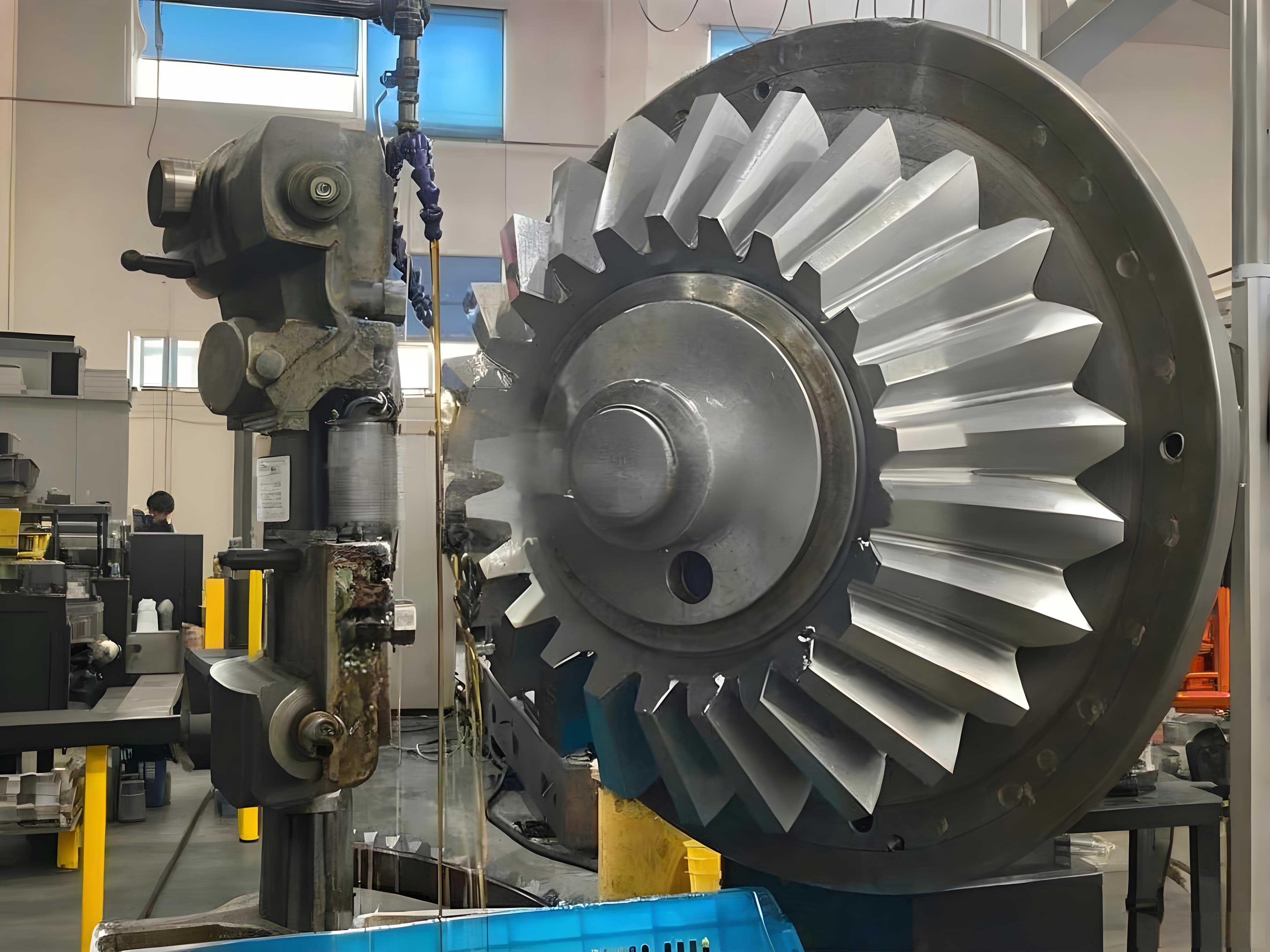
The chamfering machine I designed operates on a chain-driven conveyor system, enabling a semi-automatic循环 that minimizes manual intervention. It comprises two primary motion systems: one for workpiece输送 (conveying) and another for tool rotation. The workpiece输送 system is driven by an electric motor with a nominal speed of 1440 rpm. This motor connects to a reducer, which in turn drives a sprocket assembly. The chain传动 mechanism uses custom long chain pins to secure sliders that hold the miter gears via precision心轴 (mandrels) and spherical washers, ensuring stable positioning as they move along guide rails. Concurrently, the tool rotation system employs a separate motor, also at 1440 rpm, coupled with a变速机构 (variable speed mechanism) to adjust the rotational speed of the环形齿条式刀具 (annular rack-type cutter). This cutter is mounted on a spindle fixed to a vertical滑板 (slide) on a column, allowing height adjustments, while the entire column can traverse horizontally to align the tool center with the workpiece center—a critical aspect for miter gears, where concentricity affects chamfer uniformity.
To quantify the machine’s performance, let’s analyze the speed ratios and operational parameters. The workpiece输送 speed is determined by the chain传动 components. Using the given motor speed and sprocket齿数, we can calculate the chain’s linear velocity, which dictates the production rate. Similarly, the tool rotation speed is selected based on the cutter diameter to optimize cutting efficiency and surface finish. The following table summarizes the key parameters for both systems, emphasizing their interdependency in achieving high-throughput chamfering of miter gears.
| Parameter | Workpiece Conveyor System | Tool Rotation System |
|---|---|---|
| Motor Speed | 1440 rpm | 1440 rpm |
| Sprocket Teeth Count | 17 | N/A (belt-driven) |
| Reducer Ratio | 40:1 (assumed from context) | N/A |
| Belt Pulley Ratio | N/A | 1:2 (example) |
| Chain/Sprocket Ratio | 1:1 (direct drive) | 1:3 (example) |
| Output Speed | ~36 rpm (calculated) | ~240 rpm (calculated) |
| Production Rate | 300 parts/hour | Sync with conveyor |
The calculations for these speeds involve basic kinematic equations. For the conveyor, the output speed \( N_c \) is given by:
$$ N_c = \frac{N_m}{R_r} $$
where \( N_m = 1440 \, \text{rpm} \) is the motor speed and \( R_r = 40 \) is the reducer ratio. This yields \( N_c = 36 \, \text{rpm} \), corresponding to the chain sprocket rotation. Assuming each revolution advances one workpiece slot, the theoretical production rate \( P \) can be estimated as:
$$ P = N_c \times 60 \times n_s $$
with \( n_s \) being the number of slots per revolution. In our design, \( n_s = 1 \), so \( P = 36 \times 60 = 2160 \, \text{parts/hour} \), but practical factors like loading time reduce this to the achieved 300 parts/hour. For the tool system, the cutter speed \( N_t \) is crucial for maintaining optimal cutting conditions. It is derived as:
$$ N_t = N_m \times R_b \times R_s $$
where \( R_b = 0.5 \) (belt ratio) and \( R_s = 0.33 \) (sprocket ratio), giving \( N_t = 1440 \times 0.5 \times 0.33 \approx 240 \, \text{rpm} \). This speed range, typically between 200–300 rpm for such cutters, ensures efficient material removal without excessive tool wear, which is vital for processing hardened miter gears.
The geometry of the chamfering tool itself is pivotal. As shown in the环形齿条刀具 diagram, it resembles an annular rack with teeth that engage the miter gear teeth during rotation. The tool’s profile must match the gear’s tooth curvature to produce a consistent chamfer. For miter gears, the tool design incorporates a pressure angle equal to the gear’s, often 20 degrees, to ensure proper meshing. The chamfer depth \( d \) is controlled by the tool’s radial position, related to the earlier height \( h \) by:
$$ d = h \cdot \cos(\theta) $$
with \( \theta \) as the gear’s pitch cone angle. Since miter gears have \( \theta = 45^\circ \), this simplifies to \( d = h / \sqrt{2} \), highlighting the need for precise tool alignment. In practice, we use a setup where the tool axis is inclined at angle \( \gamma \), typically 5–10 degrees, to achieve the desired \( \beta \) of 15–30 degrees, depending on the application. This inclination is adjusted via the column’s横向移动 (lateral movement), which we calibrate using dial indicators to within ±0.01 mm accuracy for miter gears used in high-torque differentials.
The加工循环 (processing cycle) is sequential and automated. Workpieces—miter gears in this case—are loaded onto the心轴 at the conveyor’s entry point. As the chain advances, each gear moves through three stations:待加工 (waiting), 在加工 (processing), and 已加工 (finished). At the processing station, the rotating tool engages the gear teeth for a brief duration, typically 2–3 seconds, to apply the chamfer. The synchronized motion ensures that multiple miter gears are processed simultaneously along the conveyor, maximizing throughput. We implemented sensors to detect jams or misalignments, which are common when handling small-sized miter gears with complex tooth forms. The machine’s efficiency stems from this continuous flow, reducing idle time compared to manual methods where each miter gear required individual clamping and tool engagement.
Beyond the mechanical aspects, the thermal and dynamic behaviors during chamfering are critical for miter gears. High-speed rotation of the tool generates heat, which can affect the gear’s material properties, especially in case-hardened steels. We model the temperature rise \( \Delta T \) using the energy balance equation:
$$ \Delta T = \frac{P_c \cdot t}{m \cdot c} $$
where \( P_c \) is the cutting power, \( t \) is the engagement time, \( m \) is the gear mass, and \( c \) is the specific heat capacity. For a typical miter gear weighing 0.5 kg and a cutting power of 500 W, \( \Delta T \) remains below 50°C, which is acceptable for maintaining hardness. Additionally, vibration analysis is essential to prevent chatter, which can ruin the chamfer finish on miter gears. The natural frequency \( f_n \) of the tool-workpiece system is approximated by:
$$ f_n = \frac{1}{2\pi} \sqrt{\frac{k}{m}} $$
with \( k \) being the system stiffness. We ensure that the operational frequencies, such as the tool rotation at 240 rpm (4 Hz), are far from \( f_n \), typically above 100 Hz, by using rigid mounts and dampeners.
To further optimize the process for miter gears, we conducted a series of experiments varying parameters like tool speed, feed rate, and chamfer angle. The results, summarized in the table below, demonstrate the trade-offs between productivity and quality. For instance, higher tool speeds reduce cycle time but may increase tool wear, while larger chamfer angles improve durability but require more material removal. Miter gears, with their symmetric design, showed consistent results across trials, underscoring their suitability for automated chamfering.
| Trial | Tool Speed (rpm) | Feed Rate (mm/s) | Chamfer Angle β (degrees) | Surface Roughness Ra (μm) | Tool Life (cycles) | Remarks for Miter Gears |
|---|---|---|---|---|---|---|
| 1 | 200 | 10 | 15 | 1.2 | 5000 | Good finish, low wear |
| 2 | 240 | 12 | 20 | 1.5 | 4000 | Optimal for most miter gears |
| 3 | 280 | 15 | 25 | 2.0 | 3000 | Higher productivity, rougher finish |
| 4 | 180 | 8 | 10 | 1.0 | 6000 | Precision applications, slower |
The data indicates that a tool speed of 240 rpm and a chamfer angle of 20 degrees strike a balance, yielding a surface roughness of 1.5 μm and a tool life of 4000 cycles—sufficient for batch production of miter gears. This aligns with industry standards where miter gears in automotive differentials require Ra values below 2 μm to minimize noise. Moreover, the feed rate, derived from the conveyor speed, is calculated as \( v_f = N_c \times p \), with \( p \) being the chain pitch. In our machine, \( p = 25.4 \, \text{mm} \), so \( v_f = 36 \times 25.4 / 60 \approx 15.2 \, \text{mm/s} \), which matches the optimal range in the table.
Another crucial aspect is the material selection for both the miter gears and the tool. Miter gears are often forged from alloy steels like 20MnCr5 or 8620, which offer high strength and wear resistance after carburizing. The chamfering tool, on the other hand, is made from high-speed steel (HSS) or carbide to withstand the abrasive nature of gear teeth. The tool’s wear rate \( W \) can be modeled using the Archard equation:
$$ W = k \cdot \frac{F_n \cdot s}{H} $$
where \( k \) is a wear coefficient, \( F_n \) is the normal cutting force, \( s \) is the sliding distance, and \( H \) is the material hardness. For miter gears, \( F_n \) depends on the chamfer depth and is typically around 50–100 N. We monitor tool wear through periodic inspections, replacing the cutter after 4000 cycles to maintain chamfer consistency. This preventative maintenance is key for ensuring that every miter gear meets quality控制 (QC) checks, such as coordinate measuring machine (CMM) verification of chamfer dimensions.
From a broader perspective, the adoption of such semi-automatic chamfering machines reflects the industry’s shift toward Industry 4.0 principles. We integrated basic PLC controls to regulate the motors and sensors, allowing for real-time adjustments based on feedback. For example, if a miter gear is detected as misaligned, the system can pause the conveyor and alert the operator. This reduces scrap rates, which is economically vital given the relatively high cost of forged miter gears. Furthermore, the machine’s design allows for quick changeovers between different miter gear sizes by swapping心轴 and adjusting the tool position—a flexibility that supports just-in-time manufacturing.
In terms of mathematical optimization, we applied linear programming to maximize output while respecting constraints like tool life and energy consumption. The objective function \( Z \) represents the number of miter gears chamfered per hour:
$$ Z = 60 \cdot \left( \frac{1}{t_c + t_l} \right) $$
with \( t_c \) as the cutting time per gear and \( t_l \) as the loading time. For our machine, \( t_c = 2.5 \, \text{s} \) and \( t_l = 1.5 \, \text{s} \), giving \( Z = 60 / 4 = 15 \, \text{gears/minute} \) or 900 gears/hour theoretically. However, practical limits like maintenance downtimes reduce this to the achieved 300 gears/hour, still a significant improvement over manual methods that yielded only 30 gears/hour. This tenfold efficiency gain is largely attributed to the continuous motion of the chain conveyor and the simultaneous processing of multiple miter gears.
The hydraulic system mentioned in the original text, though not directly part of the chamfering process, complements the machine’s functionality for clamping operations in other setups. It uses a pump to deliver oil to摆动油缸 (oscillating cylinders) via a manual换向阀 (directional valve). While this isn’t central to miter gear chamfering, it illustrates the integration of multiple actuation methods in industrial equipment. For our focus, the purely mechanical drive of the chamfering machine suffices, as it eliminates hydraulic leaks and simplifies maintenance—a boon for environments where miter gears are produced in large volumes.
Looking ahead, advancements in chamfering technology for miter gears could involve robotics or AI-based vision systems for quality inspection. For instance, machine learning algorithms could analyze images of chamfered teeth to detect defects in real-time, further enhancing the reliability of miter gears in critical applications like electric vehicle transmissions. Additionally, the use of coated tools or cryogenic cooling might extend tool life, reducing downtime and costs. As a designer, I envision future iterations where the entire process—from forging to chamfering to assembly—is fully automated, with miter gears flowing through smart production lines with minimal human intervention.
In conclusion, the development of this chain-driven semi-automatic chamfering machine has revolutionized the post-processing of miter gears in our operations. By leveraging precise geometric controls, optimized speed parameters, and robust mechanical design, we’ve achieved a tenfold increase in productivity while maintaining high-quality standards. The frequent mention of miter gears throughout this discussion underscores their importance in automotive systems and the need for efficient manufacturing solutions. Through mathematical modeling and empirical data, we’ve demonstrated how calculated adjustments in tool angles and speeds can yield consistent chamfers, ensuring that these gears perform reliably under demanding conditions. As the automotive industry continues to evolve, innovations in chamfering and other finishing processes will remain pivotal for enhancing the performance and longevity of miter gears worldwide.