
The demand for large-scale power transmission in industries such as heavy machinery, marine engineering, and mining has driven significant interest in the manufacturing of extra-large straight bevel gears. Traditional generating methods, like planing, often prove inefficient and economically challenging for such large components due to substantial machine tool footprints, long cycle times, and high costs associated with complex tooling. This necessitates the exploration of alternative, more efficient machining strategies. We propose a novel machining theory termed “Straight Profile Variable-Depth Cutting” specifically for the larger member of a straight bevel gear pair. This approach fundamentally shifts from the conventional involute tooth profile to a straight-line profile, machined using a custom-designed finger-type milling cutter. The core innovation lies in dynamically varying the cutting depth along the tooth length to approximate the correct tooth geometry, followed by deriving the fully conjugate pinion tooth surface and applying strategic topological modifications for optimal contact performance.
The principle of variable-depth cutting is rooted in the geometry of the straight bevel gear. The tooth profile is based on a spherical involute, but for manufacturing simplicity, it is commonly approximated using the “Tredgold’s method,” where the back-cone is developed to form an equivalent spur gear with a planar involute profile. When using a form milling cutter, the tool profile is typically based on the tooth form of this equivalent gear at a specific reference section, usually the midpoint of the face width. However, because the module of the equivalent gear changes continuously from the heel to the toe of the tooth, a simple translational feed along the root line will not produce the correct tooth slot width. To compensate for this varying geometry, the cutter’s path must be adjusted by advancing or retracting relative to the theoretical pitch cone line during the feed motion. This ensures that the machined chordal tooth thickness at any given cross-section matches the required design value. The feed direction and cutter orientation are critical: the cutter axis is maintained perpendicular to the pitch cone element of the gear blank, and feed typically proceeds from the heel (large end) to the toe (small end) to facilitate chip evacuation.
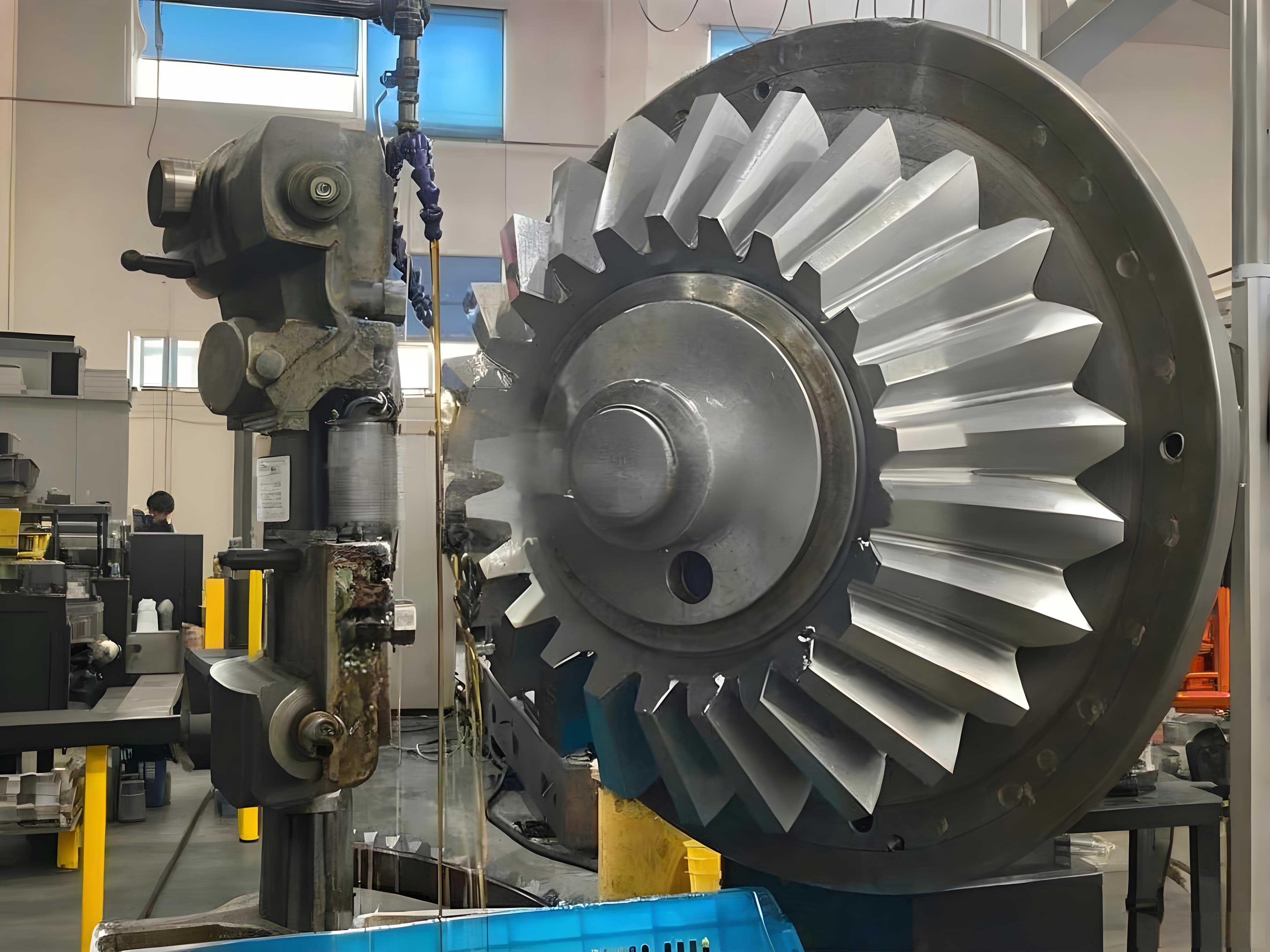
The design of the straight-profile finger milling cutter is based on the single-cutter, double-face machining principle. The cutter profile is derived from the basic rack profile corresponding to the equivalent gear at the mid-face design point. Only the active cutting edge portion needs to be precisely defined. The key parameters include the addendum $$h_a$$, dedendum $$h_f$$, and the chordal thickness at the cutter’s reference pitch line, $$S$$. During machining, for any cross-section at a distance from the reference point, the required local tooth space width $$e_i$$ must equal the design slot width $$e$$ at that section. This condition determines the necessary radial offset $$K_i$$ for the cutter. The derivation leads to the fundamental variable-depth function:
$$K_i = \frac{1}{4\tan\alpha}(\pi m_i – 2S)$$
where $$\alpha$$ is the pressure angle (typically 20°) and $$m_i$$ is the module of the equivalent spur gear at the i-th cross-section. A positive $$K_i$$ indicates an advance of the cutter (deeper cut), while a negative value indicates a retraction (shallower cut). For a practical gear, this function is calculated at discrete points along the face width and fitted to a continuous curve that guides the CNC tool path. The geometry of the straight-edge cutter is defined in its local coordinate system $$(X_p, Y)$$, where $$Y$$ is the feed direction. The cutting edge is a straight line segment with length $$S_p$$ and an inclination angle equal to the pressure angle $$\alpha$$. The position vector of a point on the cutting edge, parameterized by $$s_p$$, is:
$$\mathbf{r}_t(s_p, y) = [X_p + s_p \cos\alpha,\; y,\; s_p \sin\alpha,\; 1]^T$$
This vector, along with the prescribed tool path $$K(y)$$, defines the family of tool surfaces that generate the tooth flank of the large gear, denoted as $$\Sigma_2$$ with equation $$\mathbf{r}_2^{(2)}(s_p^{(2)}, y_2)$$.
To achieve a functional gear pair, the pinion tooth surface must be geometrically conjugate to the generated large gear surface. This is solved using the theory of gearing and coordinate transformations. A fixed global coordinate system $$S_m (X_m, Y_m, Z_m)$$ is established. The gear and pinion have associated moving coordinate systems $$S_2 (X_2, Y_2, Z_2)$$ and $$S_1 (X_1, Y_1, Z_1)$$, respectively. For a standard setup with a shaft angle $$\Sigma = 90^\circ$$, the relationship between the rotation angles $$\phi_1$$ (pinion) and $$\phi_2$$ (gear) is governed by the ratio:
$$\phi_1 = \frac{Z_2}{Z_1} (\phi_2 – \phi_2′) + \phi_1’$$
where $$\phi_1’$$ and $$\phi_2’$$ are initial angular positions, and $$Z_1, Z_2$$ are the tooth numbers. The condition for contact between the two surfaces is expressed by the meshing equation:
$$\mathbf{n}_1 \cdot \mathbf{v}_{12}^{(1)} = f(s_p^{(2)}, y_2, \phi_2) = 0$$
Here, $$\mathbf{n}_1$$ is the unit normal to the pinion surface and $$\mathbf{v}_{12}^{(1)}$$ is the relative velocity vector at the potential contact point, expressed in coordinate system $$S_1$$. By treating the large gear as a generating tool, the pinion tooth surface $$\Sigma_1$$ and its unit normal are obtained through coordinate transformation:
$$
\begin{aligned}
\mathbf{r}_1^{(1)}(s_p^{(1)}, y_1) &= \mathbf{M}_{1m} \mathbf{M}_{m2} \mathbf{r}_2^{(2)}(s_p^{(2)}, y_2) \\
\mathbf{n}_1^{(1)}(s_p^{(1)}, y_1) &= \mathbf{L}_{1m} \mathbf{L}_{m2} \mathbf{n}_2^{(2)}(s_p^{(2)}, y_2)
\end{aligned}
$$
The transformation matrices $$\mathbf{M}_{1m}$$ and $$\mathbf{M}_{m2}$$ represent the rotations from $$S_2$$ to $$S_m$$ and from $$S_m$$ to $$S_1$$, respectively, with $$\mathbf{L}$$ denoting their 3×3 rotational sub-matrices.
$$\mathbf{M}_{m2} =
\begin{bmatrix}
\cos\phi_2 & -\sin\phi_2 & 0 & 0 \\
\sin\phi_2 & \cos\phi_2 & 0 & 0 \\
0 & 0 & 1 & 0 \\
0 & 0 & 0 & 1
\end{bmatrix},
\quad
\mathbf{M}_{1m} =
\begin{bmatrix}
\cos\phi_1 & 0 & -\sin\phi_1 & 0 \\
0 & 1 & 0 & 0 \\
\sin\phi_1 & 0 & \cos\phi_1 & 0 \\
0 & 0 & 0 & 1
\end{bmatrix}$$
The theoretically conjugate pair results in line contact along the tooth flank, which is highly sensitive to misalignments and deformations, leading to edge loading and stress concentrations. Therefore, intentional topological modification of the pinion tooth surface is essential. Let the unmodified conjugate pinion surface be $$\Sigma_1$$. The modified surface $$\Sigma_0$$ is defined by introducing a small normal deviation $$\Delta\delta$$ from $$\Sigma_1$$. This deviation function is typically a second-order polynomial (paraboloid) in the local tooth coordinate directions $$X_j$$ (profile direction) and $$Y_j$$ (lead direction):
$$\Delta\delta(X_j, Y_j) = a_1 X_j^2 + a_2 Y_j^2$$
where $$a_1$$ and $$a_2$$ are the crown drop coefficients for profile and lead modifications, respectively. By judiciously selecting these coefficients, the contact pattern can be shaped from a line into a localized ellipse centered in the middle of the tooth flank, significantly improving load distribution and tolerance to assembly errors. This is particularly important for ensuring the durability of miter gears operating under heavy loads, where precise alignment is often difficult to maintain. To analyze the transmission error (TE) of the modified pair, a Tooth Contact Analysis (TCA) program is implemented. The TCA solves for the contact point under loaded conditions by finding points on both surfaces that share a common position and surface normal under the kinematic constraints of meshing.
To demonstrate the theory, a detailed numerical case study is presented. The geometric parameters of the example extra-large straight bevel gear pair are listed in the following table. This specific pair, with a 1:3.538 ratio, exemplifies the type of gearing used in heavy industrial applications, though the principles apply equally to 1:1 ratio miter gears.
| Parameter | Value |
|---|---|
| Number of teeth, pinion ($$Z_1$$) | 13 |
| Number of teeth, gear ($$Z_2$$) | 46 |
| Module at large end ($$M_e$$, mm) | 20.45 |
| Outer cone distance ($$R_e$$, mm) | 880 |
| Face width ($$b$$, mm) | 340 |
| Pressure angle ($$\alpha$$, °) | 20 |
| Shaft angle ($$\Sigma$$, °) | 90 |
The variable depth function $$K_i$$ is calculated for nine equally spaced sections along the face width. The results are fitted, producing a smooth curve that dictates the CNC tool path. The analysis confirms that cutting depth must increase toward the heel and decrease toward the toe relative to the nominal pitch cone setting. For the pinion, topological modification coefficients are chosen as $$a_1 = 1 \times 10^{-5}$$ and $$a_2 = 1 \times 10^{-5}$$. The resulting deviation map shows a maximum crowning of approximately 0.35 mm at the heel and toe edges, and about 0.05 mm at the tip and root edges, creating a pronounced central contact zone. The TCA results for this modified pair predict a well-defined elliptical contact pattern located centrally on the tooth flank and a parabolic transmission error curve with minimal amplitude, both indicators of stable and low-vibration meshing. The successful simulation of this pair confirms the viability of the conjugate derivation and modification process.
The final and crucial step is physical validation through machining and roll testing. The large gear blank is mounted on a CNC milling machine equipped with a rotary table. After precise alignment, the custom straight-profile carbide insert cutter is positioned with its axis perpendicular to the pitch cone. The pre-calculated variable-depth toolpath is executed. The pinion is machined on a similar setup, incorporating the topological modification into its toolpath. Subsequently, a roll test is conducted: the pinion is rotated as the driver, and its flanks are coated with marking compound (e.g., Prussian blue). After several revolutions under light load, the contact pattern transferred onto the large gear teeth is examined. The experimental pattern shows a distinct, centralized elliptical contact area, closely matching the pattern predicted by the TCA simulation. This agreement between theoretical prediction and empirical evidence robustly validates the correctness and practical feasibility of the proposed straight profile variable-depth cutting theory for large straight bevel gears.
In conclusion, the Straight Profile Variable-Depth Cutting method presents a significant advancement for manufacturing large and extra-large straight bevel gears. By replacing the traditional involute profile with a straight line and employing a dynamically adjusted cutting depth, it leverages the advantages of simpler, more robust carbide tooling and potential for higher machining efficiency. The systematic derivation of the fully conjugate pinion surface ensures correct kinematic operation, while the application of controlled topological modifications via second-order polynomials guarantees favorable contact conditions under real-world operating scenarios involving misalignments. This comprehensive approach—from theoretical modeling and numerical simulation to physical machining and testing—provides a reliable framework for producing high-performance, durable gears for demanding industrial applications. The method’s principles are broadly applicable, offering a valuable alternative to traditional generating processes, especially in the realm of large-scale power transmission where conventional methods reach their economic and logistical limits. The successful application to a 90-degree shaft angle gear pair also highlights its direct relevance for manufacturing high-performance miter gears, where efficient power transfer at a right angle is paramount.