
In the field of gear manufacturing, particularly for straight bevel gears, the need for efficient and accurate quality control has always been paramount. As a designer deeply involved in precision measurement tools, I have focused on developing a double-flank testing instrument tailored specifically for miter gears. This project stems from the current manufacturing and inspection challenges faced by industries relying on these gears. Traditional testing equipment, while advanced, often comes with high costs, complex operations, and stringent environmental requirements, making them unsuitable for on-line inspection in typical production settings. Miter gears, being a critical component in many mechanical systems, demand rigorous monitoring to ensure performance and longevity. Thus, I embarked on designing a cost-effective, reliable, and functional double-flank tester that can be deployed directly on the shop floor. This instrument leverages the principles of double-flank meshing to provide comprehensive assessments of gear quality, including tooth thickness, mounting distance consistency, and overall error profiles. In this article, I will elaborate on the working principles, functionalities, structural design schemes, and usage methods of this instrument, emphasizing its applicability to miter gears through detailed explanations, tables, and formulas.
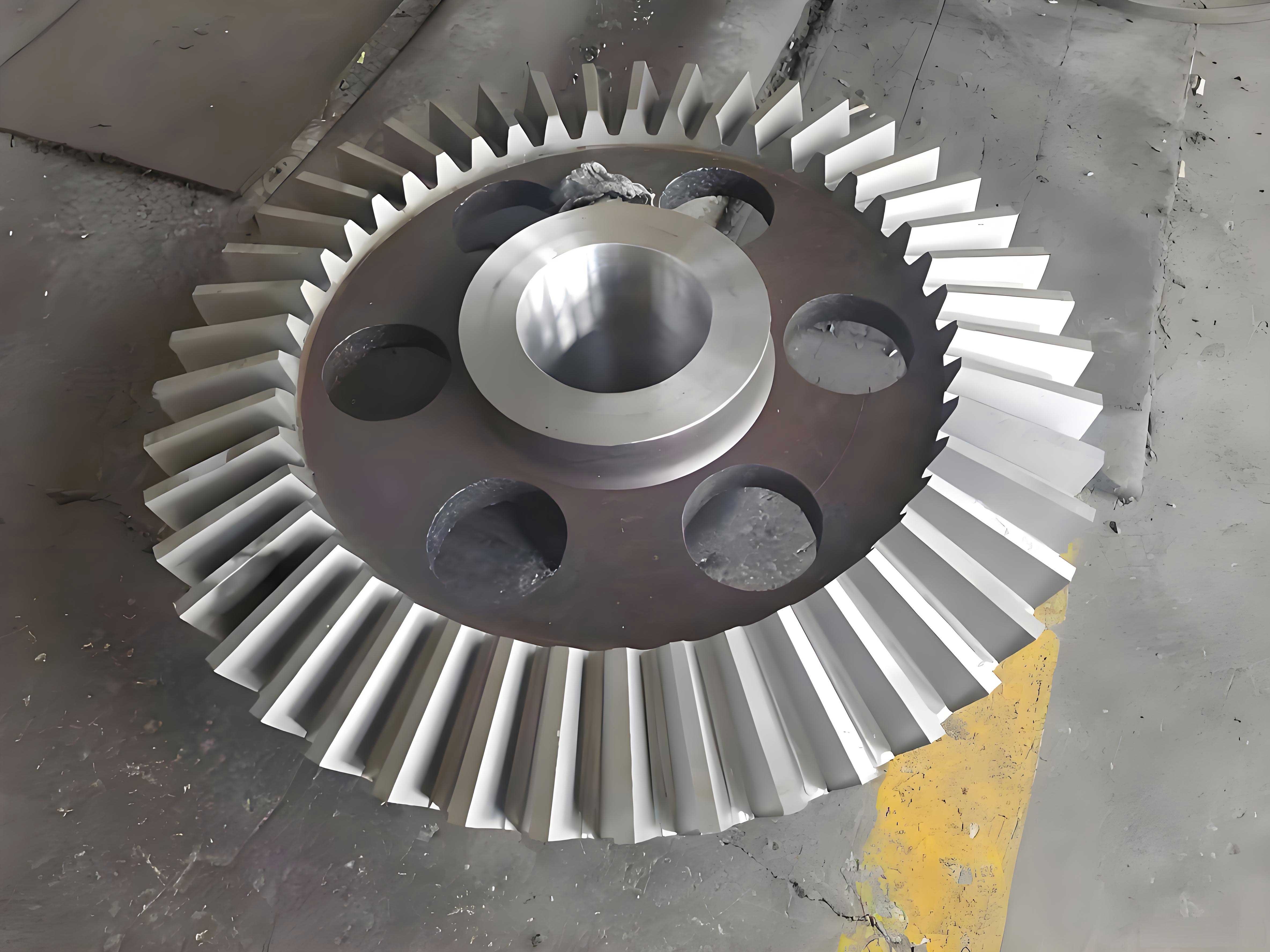
The double-flank meshing method involves bringing a test gear into tight, zero-backlash contact with a master gear, and then rotating them to measure variations in the center distance. These variations reflect composite errors such as tooth-to-tooth runout, total cumulative pitch deviation, and eccentricity. For miter gears, which are straight bevel gears with a 1:1 ratio and typically a 90° shaft angle, this method is especially relevant because it simulates actual operating conditions. My design aims to capture these errors efficiently, making it ideal for batch production monitoring. The core components of the instrument include a base, a main body for mounting the pinion gear (often referred to as the semi-axial gear), an adjustable slide for the ring gear (or planetary gear), a rolling guide mechanism, an eccentric cam system, and a dial indicator. The instrument is adjusted to a specific mounting distance, and the spring-loaded slide ensures continuous meshing without backlash. As the gears rotate, any imperfections cause the slide to move, and this displacement is recorded by the dial indicator, providing a direct readout of center distance variations. This process is crucial for miter gears, as even minor deviations can lead to noise, vibration, and premature failure in applications.
One of the key advantages of this double-flank tester is its economic viability. Commercial double-flank testers can cost tens of thousands of dollars, whereas the total manufacturing cost for this instrument is approximately $1,000. This significant cost reduction makes it accessible for small to medium-sized enterprises that produce miter gears in high volumes. Additionally, the structural simplicity enhances reliability. By using basic locating elements, robust clamping devices, and low-friction rolling guides, the instrument minimizes the impact of harsh factory environments. This ensures consistent measurements of miter gears’ tooth thickness and mounting distance, which are critical parameters for proper assembly and function. The functionality is also superior for on-line measurement; it can continuously reflect errors across the entire gear mesh, providing parameters like single-tooth jump and total tooth jump. This comprehensive error profiling helps in identifying specific manufacturing issues, such as tool wear or misalignment in the forging process for miter gears.
To delve deeper into the design, let me outline the key technical aspects that ensure the instrument’s performance. These include the guide mechanism, positioning and clamping of gears, eccentric cam system, and mounting distance adjustment. Each element is optimized for miter gears, considering their conical geometry and meshing characteristics.
Guide Mechanism
The guide mechanism employs a rolling guide system to facilitate smooth and precise movement of the slide. The moving component features two V-grooves that interact with corresponding V-grooves and a flat surface on the main body, supported by three steel balls arranged at the vertices of a triangle. This configuration minimizes friction and ensures stability. The spring force is applied at the centroid of the triangle formed by the ball supports, balancing the weight and load of the moving parts. Given the large dimensions of the components, hardened steel pads are installed on the sliding surfaces, secured by semi-cylindrical pressure plates. This design not only enhances durability but also simplifies maintenance. The low friction coefficient and automatic clearance adjustment make this guide ideal for double-flank testing of miter gears, where even micron-level movements must be accurately captured.
The performance of the guide can be summarized using the following formula for frictional resistance:
$$F_f = \mu \cdot N$$
where \(F_f\) is the frictional force, \(\mu\) is the coefficient of friction (typically 0.001 to 0.005 for rolling guides), and \(N\) is the normal load. For miter gears, the normal load is derived from the spring force and gear meshing forces. Ensuring \(F_f\) is minimal allows the slide to respond sensitively to center distance changes.
| Guide Type | Friction Coefficient | Precision | Suitability for Miter Gears | Cost |
|---|---|---|---|---|
| Rolling Guide (Used Here) | 0.001-0.005 | High (±1 μm) | Excellent | Low |
| Sliding Guide | 0.1-0.3 | Moderate (±5 μm) | Poor | Very Low |
| Air Bearing | ~0.0001 | Very High (±0.1 μm) | Good | High |
Positioning and Clamping of Gears
For the semi-axial gear (including the master gear), positioning is achieved via the outer diameter and end face. A small handle is connected to a threaded rod that clamps the workpiece. The rod has a groove controlled by a screw on the main body to limit its travel, allowing quick installation and removal using a split washer. A large handle, integrated with the main shaft, rotates the gear for meshing, serving as the driving element. To ensure smooth rotation, radial and axial clearances in the shaft must be carefully adjusted—excessive clearance causes play and reduces accuracy, while insufficient clearance leads to jamming. For miter gears, maintaining a fixed positional relationship between the semi-axial gear’s end face and the planetary gear is critical throughout rotation.
The planetary gear (including the test gear) is positioned using a spherical surface and inner bore. High-quality spherical surfaces are machined via CNC processes and often nitrided for wear resistance, verified with coordinate measuring machines. During installation, a flange acts as a dust cover and is ground to minimize radial clearance, ensuring cleanliness and precision. This design is particularly effective for miter gears, where the conical teeth require consistent alignment to avoid measurement errors.
Eccentric Cam System
The eccentric cam system addresses the need for ample space during gear loading and unloading. It allows the slide to move horizontally relative to the semi-axial gear over a sufficient distance, determined by both the guide travel and the cam’s eccentric throw. The cam’s travel depends on the eccentricity \(e\), and its relationship with the guide travel is mediated by the position of an angle plate. Proper calculation ensures overlapping travel ranges, providing enough clearance for miter gears. The cam is connected to a long handle, with two pins on the instrument body limiting the handle’s extreme positions, thus defining whether the planetary gear is in working or loading state. This mechanism enhances operational convenience for frequent testing of miter gears.
The travel distances can be expressed with the following equations:
$$L_{\text{total}} = L_{\text{guide}} + L_{\text{cam}}$$
$$L_{\text{cam}} = 2e \cdot \sin(\theta)$$
where \(L_{\text{total}}\) is the total displacement for unloading, \(L_{\text{guide}}\) is the guide travel, \(e\) is the eccentricity, and \(\theta\) is the rotation angle of the cam. For miter gears, a typical \(L_{\text{total}}\) of 20-30 mm is sufficient to accommodate gear sizes common in industry.
Mounting Distance Adjustment
Mounting distance is a crucial parameter for miter gears, affecting their meshing quality and noise levels. In this instrument, the planetary gear mounting distance \(A_p\) is determined by three dimensions: the distance from the slide’s upper plane to the semi-axial gear’s mounting center \(D_1\), the spherical washer size \(S\), and the shaft shoulder dimension \(H\). Adjusting \(D_1\) and \(H\) allows precise control of \(A_p\). The semi-axial gear mounting distance \(A_s\) is adjusted via a screw mechanism that sets the position of a pin, which contacts a cylindrical part of a cam to lock the slide. Once set, tightening the screw secures the pin through split bushings, fixing the mounting distance. This adjustability is vital for accommodating various sizes of miter gears, ensuring accurate testing across production batches.
The mounting distance relationships can be summarized as:
$$A_p = D_1 \pm S + H$$
$$A_s = \text{fixed value} \pm \Delta$$
where \(\Delta\) is the adjustment range, typically ±0.5 mm for miter gears. The following table provides example values for common miter gear modules:
| Module (mm) | Typical \(A_p\) (mm) | Adjustment Range \(D_1\) (mm) | Spherical Washer \(S\) (mm) | Shaft Shoulder \(H\) (mm) |
|---|---|---|---|---|
| 1 | 25.0 | 20.0-22.0 | 2.0 | 3.0 |
| 2 | 30.0 | 24.0-26.0 | 3.0 | 3.0 |
| 3 | 35.0 | 28.0-30.0 | 4.0 | 3.0 |
| 4 | 40.0 | 32.0-34.0 | 5.0 | 3.0 |
| 5 | 45.0 | 36.0-38.0 | 6.0 | 3.0 |
In practice, the double-flank testing process for miter gears involves setting the mounting distances, installing the master and test gears, and initiating rotation. The dial indicator records center distance variations, which can be analyzed to derive error curves. For instance, the total composite error \(F_i”\) can be calculated from the peak-to-valley difference in the indicator reading over one revolution:
$$F_i” = \max(\Delta a) – \min(\Delta a)$$
where \(\Delta a\) is the center distance variation. This error encompasses contributions from tooth profile, pitch, and runout errors, providing a holistic view of miter gear quality. Additionally, the tooth-to-tooth composite error \(f_i”\) can be extracted by analyzing fluctuations per tooth mesh, which is critical for identifying localized defects in miter gears.
The development of this instrument also considered ergonomics and efficiency. The handles and clamping systems are designed for quick operation, reducing inspection time per miter gear to under 30 seconds. This is essential for on-line monitoring in high-volume production of miter gears, where forging or machining processes may require real-time adjustments. Moreover, the robust construction minimizes downtime due to environmental factors like dust or temperature variations, which are common in manufacturing plants producing miter gears.
Looking ahead, there are several avenues for enhancement. First, a thorough error analysis and measurement system analysis (MSA) should be conducted to quantify the instrument’s uncertainty and repeatability. This involves statistical methods such as Gage R&R studies, which can be summarized with formulas like:
$$\text{%GRR} = \frac{\sigma_{\text{measurement}}}{\sigma_{\text{total}}} \times 100\%$$
where \(\sigma_{\text{measurement}}\) is the standard deviation due to measurement variation, and \(\sigma_{\text{total}}\) is the overall process variation. For miter gears, a %GRR below 10% is desirable for reliable inspections. Second, the collected data can be used to plot double-flank error curves, enabling root cause analysis of manufacturing errors. For example, periodic errors might indicate issues in the hobbling or forging dies used for miter gears. Third, integrating IoT technology could allow real-time monitoring and data logging, facilitating predictive maintenance of production equipment for miter gears. This aligns with Industry 4.0 trends, where smart instruments enhance quality control.
In conclusion, the double-flank testing instrument I designed has been successfully manufactured and assembled in a gear production facility, meeting all requirements for inspecting miter gears. It validates the correctness of the theoretical and structural design, as well as the economic benefits of in-house development. The instrument’s simplicity, reliability, and functionality make it a valuable tool for ensuring the quality of miter gears in batch production. By focusing on key aspects like guide mechanisms, positioning systems, and mounting distance adjustment, this design offers a practical solution for on-line inspection of miter gears. Future work will involve further refinements, such as incorporating digital readouts and automated data analysis, to keep pace with evolving demands in miter gear manufacturing. Ultimately, this project underscores the importance of tailored measurement solutions in advancing the precision and efficiency of gear production, particularly for critical components like miter gears.