
In the realm of mechanical transmission systems, miter gears—a specific type of straight bevel gears with a 90-degree shaft angle—play a pivotal role due to their ability to transmit motion between intersecting axes efficiently. As the global machinery and automotive industries evolve, the demand for high-precision, high-strength miter gears has surged, driving the adoption of precision forging technologies over traditional cutting methods. From my perspective as a researcher in metal forming, precision forging of miter gears represents a transformative approach that enhances material properties, reduces waste, and boosts production efficiency. This article delves into the current status and developmental trajectories of precision forging technologies for miter gears, encompassing hot forging, warm forging, cold forging, and hybrid hot-cold forging processes. I will explore these methods in detail, supported by tables and formulas to summarize key insights, while emphasizing the unique advantages and challenges associated with miter gears fabrication.
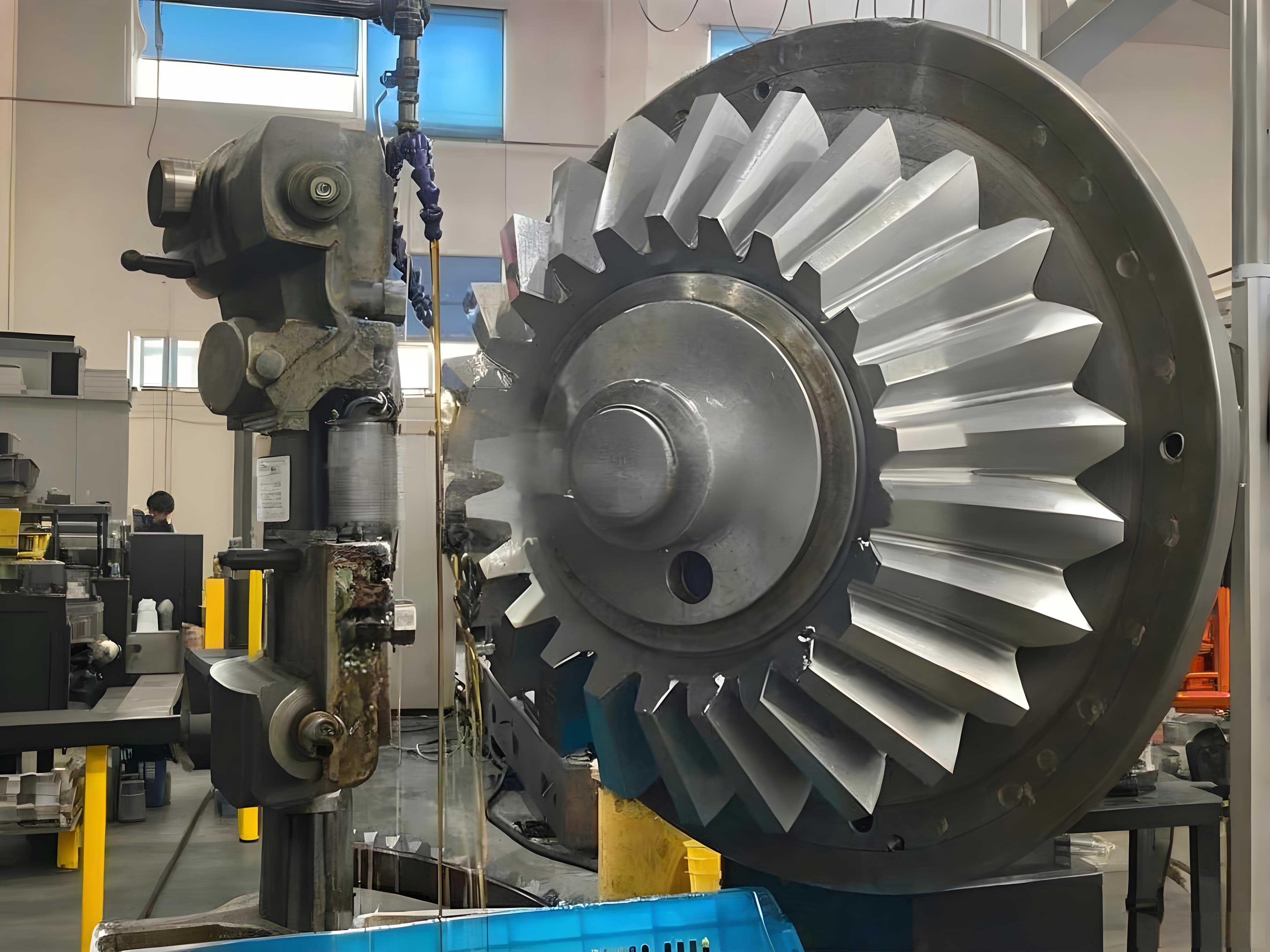
Precision forging of miter gears refers to the process where the gear teeth are directly formed from a billet through forging, eliminating or minimizing subsequent machining. This technique yields gears with near-net or net shapes, characterized by improved mechanical performance, higher accuracy, and superior surface finish. The core benefits include enhanced fatigue strength, reduced material consumption, and increased production rates. For instance, precision-forged miter gears often exhibit a bending strength improvement of over 20% compared to cut gears, thanks to the continuous grain flow and refined microstructure. In my analysis, I have observed that the adoption of precision forging for miter gears aligns with global trends toward sustainability and resource efficiency, as it cuts down on energy use and scrap generation. The following sections will dissect the various forging methodologies, highlighting their applications and advancements in producing miter gears.
The current landscape of precision forging technology for miter gears is shaped by decades of innovation, particularly in regions like China, Europe, and North America. Initially, hot forging dominated the scene, but over time, warm and cold forging methods have gained traction due to their ability to achieve tighter tolerances and better surface quality. In China, for example, the growth of the automotive sector has fueled investments in precision forging lines, with companies like Jiangsu Pacific Precision Forging Co., Ltd. leading the charge in mass-producing miter gears using combined processes. Globally, the push for lightweight and high-performance components in vehicles has spurred research into advanced forging techniques for miter gears, such as closed-die forging and orbital forging. From my experience, the integration of computer-aided design (CAD) and finite element analysis (FEA) has revolutionized process optimization, enabling precise control over deformation and minimizing defects in miter gears. The table below summarizes the key characteristics of different precision forging methods for miter gears, based on industry data and research findings.
| Forging Method | Temperature Range | Typical Accuracy (mm) | Material Utilization (%) | Key Advantages | Common Applications for Miter Gears |
|---|---|---|---|---|---|
| Hot Forging | 1000-1200°C | 0.1-0.3 | 70-80 | High formability, low forces | Automotive differential gears |
| Warm Forging | 700-850°C | 0.05-0.1 | 80-90 | Balanced strength and precision | Precision transmission components |
| Cold Forging | Room temperature | 0.02-0.05 | 90-95 | Excellent surface finish, high strength | High-load miter gears in aerospace |
| Hot-Cold Hybrid | Combined cycles | 0.01-0.03 | 85-92 | Optimal accuracy and efficiency | Premium automotive miter gears |
Hot forging of miter gears has been a cornerstone technology since the 1970s, particularly for high-volume production in automotive applications. In this process, the billet is heated above the recrystallization temperature to reduce flow stress and enhance plasticity, allowing complex shapes like miter gears to be formed with minimal effort. I have seen that hot forging is ideal for large-diameter miter gears, as it facilitates deformation in fewer steps, often using multi-stage presses. For example, in China, hot forging lines for miter gears have evolved from double-heating cycles to single-heat processes, improving efficiency and reducing energy consumption. The precision achievable with hot forging typically ranges between 0.1 to 0.3 mm, which suffices for many industrial miter gears in differential systems. However, challenges such as oxidation and thermal shrinkage can affect dimensional consistency. To mitigate this, advanced die designs and lubricants are employed. The deformation force in hot forging can be approximated by the formula: $$ F = k \cdot \sigma_y \cdot A $$ where \( F \) is the forging force, \( k \) is a factor accounting for friction and geometry, \( \sigma_y \) is the yield strength at forging temperature, and \( A \) is the projected area. For miter gears, this force must be carefully controlled to prevent defects like underfilling or excessive wear on dies.
Warm forging has emerged as a hybrid solution for miter gears, operating at temperatures between 700°C and 850°C to balance the benefits of hot and cold forging. From my research, warm forging reduces oxidation compared to hot forging, leading to better surface quality and higher accuracy—often within 0.05 to 0.1 mm for miter gears. This method also lowers the required forging forces relative to cold forging, making it suitable for medium-to-high carbon steels used in miter gears. The key technologies in warm forging include precise temperature control, advanced lubrication systems, and high-strength die materials. In Germany, companies like ThyssenKrupp have pioneered warm forging for automotive miter gears, achieving near-net shapes with minimal post-processing. The plastic deformation behavior during warm forging can be modeled using the Arrhenius-type equation: $$ \dot{\varepsilon} = A \cdot \exp\left(-\frac{Q}{RT}\right) \cdot \sigma^n $$ where \( \dot{\varepsilon} \) is the strain rate, \( A \) is a material constant, \( Q \) is the activation energy, \( R \) is the gas constant, \( T \) is the absolute temperature, and \( n \) is the stress exponent. This helps optimize process parameters for miter gears to enhance dimensional stability and mechanical properties.
Cold forging of miter gears represents the pinnacle of precision, conducted at room temperature to achieve accuracies as tight as 0.02 to 0.05 mm. This process is highly effective for producing high-strength miter gears with excellent surface finishes, as it induces work hardening that boosts fatigue resistance. However, cold forging demands high pressures and specialized equipment, such as multi-action presses for closed-die forging. I have observed that cold forging is particularly advantageous for small-to-medium miter gears in applications like steering systems and precision machinery. Techniques like orbital cold forging have been successfully applied to miter gears, enabling incremental deformation that reduces tool loads and improves fill. The table below compares cold forging methods for miter gears, highlighting their suitability based on gear size and complexity.
| Cold Forging Technique | Deformation Mechanism | Typical Miter Gear Size (mm) | Tool Life (cycles) | Advantages for Miter Gears |
|---|---|---|---|---|
| Closed-Die Forging | Multi-directional compression | 20-100 | 10,000-20,000 | High accuracy, no flash |
| Orbital Forging | Incremental rocking motion | 10-50 | 15,000-25,000 | Reduced forces, complex shapes |
| Extrusion | Axial material flow | 5-30 | 8,000-15,000 | Good surface finish, high strength |
The development of cold forging for miter gears has been propelled by advancements in tool materials and lubrication. For instance, the use of phosphating and soaping treatments aids in reducing friction, but environmental concerns have spurred research into dry lubricants. From my perspective, the future of cold forging for miter gears lies in integrating simulation tools to predict defects and optimize die life. The stress-strain relationship in cold forging can be expressed as: $$ \sigma = K \cdot \varepsilon^n $$ where \( \sigma \) is the true stress, \( K \) is the strength coefficient, \( \varepsilon \) is the true strain, and \( n \) is the hardening exponent. For miter gears, this model helps in designing preforms to ensure uniform deformation and avoid cracking.
Hybrid hot-cold forging, or composite forming, combines the initial shaping of hot forging with the final precision of cold forging to produce miter gears with superior accuracy and surface quality. This approach mitigates the drawbacks of individual methods—such as oxidation in hot forging and high forces in cold forging—making it ideal for high-end miter gears in automotive and aerospace sectors. In my analysis, hybrid processes often involve hot forging to near-net shape, followed by a cold calibration step that refines the tooth profile to within 0.01 to 0.03 mm. Companies in China and Germany have adopted this for mass-producing miter gears, achieving significant cost savings and performance enhancements. The overall forming efficiency can be quantified by the equation: $$ \eta = \frac{V_f}{V_i} \times 100\% $$ where \( \eta \) is the material utilization efficiency, \( V_f \) is the final gear volume, and \( V_i \) is the initial billet volume. For hybrid-forged miter gears, \( \eta \) often exceeds 90%, underscoring the sustainability benefits.
Looking ahead, the evolution of precision forging for miter gears is closely tied to digitalization and smart manufacturing trends. The integration of Industry 4.0 technologies, such as real-time monitoring and artificial intelligence, promises to further enhance process control and quality assurance for miter gears. From my viewpoint, research should focus on developing new alloy compositions tailored for forging miter gears, as well as eco-friendly lubricants to reduce environmental impact. Additionally, the adoption of additive manufacturing for forging dies could revolutionize the production of complex miter gears by enabling rapid prototyping and customization. The global market for miter gears is poised for growth, driven by electric vehicles and renewable energy systems, which demand lightweight and durable transmission components. In conclusion, precision forging technologies for miter gears have matured significantly, offering a blend of efficiency, accuracy, and sustainability. By leveraging advancements in hot, warm, cold, and hybrid forging, manufacturers can meet the escalating demands for high-performance miter gears while contributing to a greener industrial landscape. The continuous innovation in this field ensures that miter gears will remain integral to modern machinery, with forging playing a central role in their manufacture.