
In the field of mechanical transmission, straight bevel gears, often referred to as miter gears when the shaft angle is 90 degrees, play a crucial role in transmitting torque between intersecting shafts. As an engineer specializing in process research, I have encountered numerous challenges in ensuring the proper meshing of these gears before final assembly. Miter gears are essential components in various machinery, including rubber and plastic processing equipment like twin-screw extruders. Unlike cylindrical gears, miter gears offer advantages such as the ability to accommodate shaft angles from 0° to 90°, smoother operation, and higher torque transmission capacity. However, their conical geometry, with varying module along the tooth width, introduces complexities in inspection. While single-piece inspections can check parameters like tooth height, chordal thickness, and base tangent length, critical meshing characteristics—such as backlash, contact pattern, apex clearance, and shaft angle—require paired testing. If miter gears are assembled without prior meshing verification, any issues discovered post-assembly lead to tedious disassembly, especially since these gears are typically mounted on shafts via interference or transition fits using thermal or cold assembly methods. To address this, my team and I designed a specialized fixture for miter gear meshing inspection, enabling pre-assembly evaluation of key meshing parameters and ensuring optimal performance and longevity.
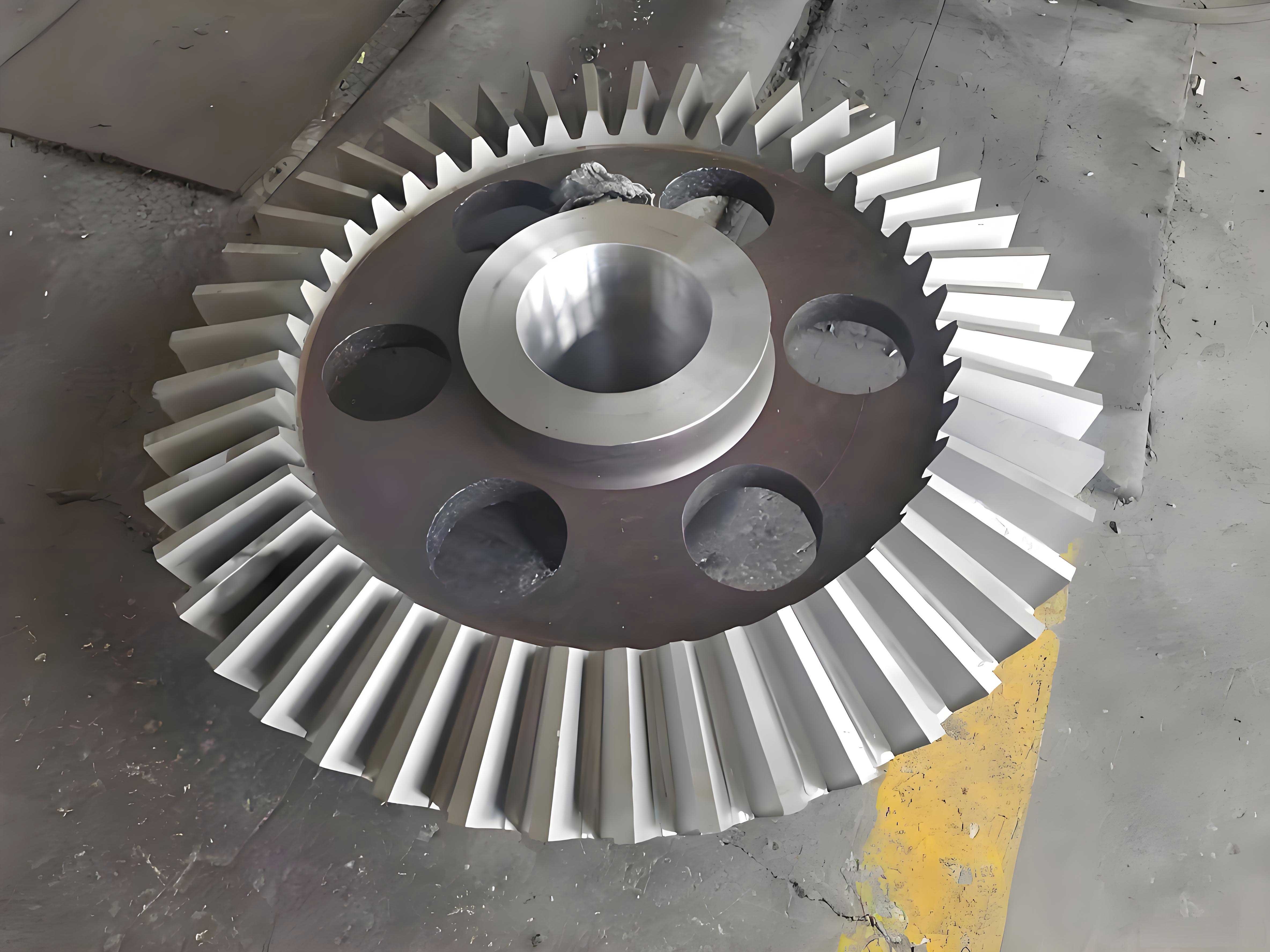
In our company, a leading manufacturer of rubber and plastic machinery such as internal mixers, twin-screw extruders, and vulcanizing presses, we focus on the transmission components used in twin-screw extruders. Specifically, we deal with synchronization miter gears, like the model 416 single-hang double-cone twin-screw extruder gear. This miter gear is an equal-dedendum straight bevel gear with 48 teeth, a pressure angle of 20°, a pitch cone angle of 7°, a large-end module of 20 mm, a design base tangent length of 338.14 mm, and an assembly backlash of 0.5 mm. In practice, we often observed that after assembling paired miter gears, the backlash measured at the large end differed significantly from that at the small end when using feeler gauges. This discrepancy indicates incomplete contact along the tooth width, resulting in a contact pattern smaller than specified. Consequently, uneven wear occurs, accelerating damage at contacting areas and compromising transmission efficiency and service life. Since single-piece inspections cannot eliminate all quality issues affecting assembly, and disassembling miter gears post-installation is labor-intensive and risks damaging components like spherical roller bearings or transmission shafts, we developed this miter gear meshing fixture to facilitate pre-assembly pairing checks.
The miter gear meshing fixture, designed for versatility and ease of use, comprises several key components that allow for adjustable setup and precise measurement. Below is a detailed breakdown of its structure and functionality, presented to emphasize the engineering considerations behind its design.
| Component Number | Name | Function |
|---|---|---|
| 1 | Base | Provides a stable foundation for the entire fixture, ensuring rigidity during measurements. |
| 2 | Guide Rail | Allows horizontal movement of the support assembly to facilitate gear engagement. |
| 3 | Sliding Block | Secures the support assembly in position after adjustment, preventing unintended displacement. |
| 4 | Mounting Plate | Serves as a platform for attaching other components, enhancing modularity. |
| 5 | Pin Shaft | Acts as a pivot point for the fixed block, enabling angular adjustments for pitch cone angle simulation. |
| 6 | Support Bracket | Holds the installation shaft and gears, movable along the guide rail for meshing alignment. |
| 7 | Fixed Block | Supports the installation shaft and can be tilted via support bolts to set the desired pitch cone angle. |
| 8 | Distance Sleeve | Determines the axial position of the miter gear on the installation shaft, crucial for backlash adjustment. |
| 9 | Support Bolt | Adjusts the tilt angle of the fixed block, allowing precise control over the pitch cone angle setting. |
| 10 | Circular Nut | Pre-tightens the installation shaft to prevent loosening of the bearings during operation. |
| 11 | Distance Ring | Spacers used to fine-tune the axial location of gears, affecting the cone distance parameter. |
| 12 | Cylindrical Self-Aligning Roller Bearing | Supports radial loads and accommodates minor misalignments, ensuring smooth rotation. |
| 13 | Cylindrical Thrust Roller Bearing | Handles axial loads generated during gear meshing, maintaining stability. |
| 14 | Installation Shaft | The shaft on which the miter gear is mounted, modified to have a clearance fit for easy installation and removal. |
| 15 | Key | Prevents relative rotation between the miter gear and installation shaft during testing. |
| 16 | Miter Gear | The test specimen, typically a straight bevel gear, mounted on the installation shaft for meshing evaluation. |
The fixture’s operation involves a systematic procedure to ensure accurate meshing simulation. We begin by leveling the fixed block to its horizontal state. Next, we install the miter gear onto the installation shaft; to facilitate easy mounting and dismounting, we apply lubricant to the gear’s bore and modify the shaft diameter to achieve a clearance fit instead of the original interference or transition fit. The key is then inserted to lock the gear against rotation. We pre-tighten the circular nut at the shaft’s end to secure the bearings. Using the support bolts, we tilt the fixed block to match the design pitch cone angle of the miter gear—this adjustability allows the fixture to simulate various shaft angles, including 0° for spur gears. The support bracket is moved along the guide rail to bring the two miter gears into mesh, after which the sliding block is locked to fix the bracket’s position. Finally, by turning the hexagon wrench hole on the installation shaft’s end face, we manually rotate the meshing miter gears to observe and measure their interaction.
This miter gear fixture is designed to accommodate a wide range of gear sizes and types, making it a versatile tool in our inspection arsenal. The following table summarizes its key specifications and application scope, highlighting its adaptability for different industrial scenarios involving miter gears.
| Parameter | Value or Description |
|---|---|
| Overall Dimensions | 2000 mm × 1020 mm × 1300 mm (Length × Width × Height) |
| Applicable Gear Types | Spur Gears, Straight Bevel Gears (Miter Gears) |
| Adjustable Pitch Cone Angle Range | 0° to 20° |
| Gear Diameter Range | Φ800 mm to Φ1200 mm |
| Maximum Gear Weight Capacity | 5 tonnes per piece |
The meshing quality of miter gears is influenced by several geometric parameters, with cone distance and pitch cone angle being paramount. Cone distance, analogous to center distance in cylindrical gears, defines the position of gears along their axes and can be adjusted to modify backlash. However, this adjustment is effective only when the pitch cone angles of the paired miter gears are identical. The pitch cone angle, denoted as δ, is the angle between the gear axis and the pitch cone element. It directly affects the contact pattern and backlash distribution. In practice, we analyze miter gear meshing through four distinct states, each characterized by specific relationships between backlash and pitch cone angle. To quantify these states, we introduce formulas for backlash and contact geometry. For a pair of miter gears with shaft angle Σ, the theoretical pitch cone angles for the pinion and gear are given by:
$$ \delta_1 = \arctan\left(\frac{\sin \Sigma}{z_2/z_1 + \cos \Sigma}\right) $$
$$ \delta_2 = \Sigma – \delta_1 $$
where $z_1$ and $z_2$ are the tooth numbers of the pinion and gear, respectively. The cone distance $R$ is calculated as:
$$ R = \frac{m_t z_1}{2 \sin \delta_1} = \frac{m_t z_2}{2 \sin \delta_2} $$
with $m_t$ being the transverse module at the large end. Backlash $j$ along the tooth flank can be expressed as a function of the axial displacement $\Delta X$ and pitch cone angle error $\Delta \delta$:
$$ j = 2 \Delta X \tan \alpha_n \cos \delta + R \Delta \delta \sin \alpha_n $$
where $\alpha_n$ is the normal pressure angle. This formula helps us understand how deviations impact meshing. The four meshing states are detailed below, with a focus on their implications for miter gear performance.
| Meshing State | Backlash Distribution | Contact Pattern | Corrective Actions |
|---|---|---|---|
| Ideal Meshing | Zero backlash on both driving and non-driving flanks across entire tooth width. | Full contact along tooth face. | Not used in practice due to risk of jamming; serves as theoretical reference. |
| Parallel Meshing | Zero backlash on driving flank, equal backlash on non-driving flank at both ends. | Uniform contact, optimal for power transmission. | Adjust cone distance via distance sleeves to achieve design backlash. |
| Pitch Cone Angle Too Large | Backlash at small end less than at large end; non-zero on both flanks. | Contact concentrated at small end, leading to localized wear. | Reject or rework gears; minor errors may allow downgraded use. |
| Pitch Cone Angle Too Small | Backlash at small end greater than at large end; non-zero on both flanks. | Contact concentrated at large end, causing uneven wear. | Similar to above; requires gear replacement or modification. |
To further elucidate these states, we derive equations for backlash variation. For parallel meshing, the backlash $j$ is constant along the tooth width and set to the design value $j_d$. The required axial adjustment $\Delta X$ can be found from:
$$ \Delta X = \frac{j_d}{2 \tan \alpha_n \cos \delta} $$
When pitch cone angle errors exist, the backlash difference between large end ($j_L$) and small end ($j_S$) is:
$$ \Delta j = j_L – j_S = 2R \Delta \delta \sin \alpha_n $$
where $\Delta \delta$ is the deviation from the ideal pitch cone angle. For miter gears with a shaft angle of 90°, often called miter gears, $\delta_1 = \delta_2 = 45°$, simplifying calculations. In such cases, the cone distance becomes:
$$ R = \frac{m_t z}{2 \sin 45°} = \frac{m_t z}{\sqrt{2}} $$
and backlash sensitivity to errors increases. Our fixture allows empirical measurement of $j_L$ and $j_S$ using feeler gauges, enabling calculation of $\Delta \delta$ and assessment of gear quality. For instance, if measured backlashes are $j_L = 0.6$ mm and $j_S = 0.4$ mm for a miter gear with $R = 500$ mm and $\alpha_n = 20°$, then:
$$ \Delta \delta = \frac{\Delta j}{2R \sin \alpha_n} = \frac{0.2}{2 \times 500 \times \sin 20°} \approx 0.00058 \text{ radians} \approx 0.033° $$
This small error might be acceptable depending on tolerance standards, showcasing the fixture’s precision in evaluating miter gears.
Beyond backlash, the fixture facilitates contact pattern analysis by applying a thin layer of marking compound to the tooth surfaces. After rotation, the contact area reveals the meshing quality. The contact ratio for miter gears, a critical performance metric, can be estimated using the formula:
$$ \varepsilon = \frac{\sqrt{R_{a1}^2 – R_{b1}^2} + \sqrt{R_{a2}^2 – R_{b2}^2} – a \sin \Sigma}{p_{bt}} $$
where $R_a$ and $R_b$ are the tip and base cone radii, $a$ is the mounting distance, and $p_{bt}$ is the base pitch. Our fixture mimics real assembly conditions, allowing us to measure these parameters indirectly. For example, by adjusting the support bolts, we vary the pitch cone angle and observe changes in contact pattern. This process helps identify manufacturing defects in miter gears, such as improper tooth profile or heat treatment distortions.
The importance of this miter gear meshing fixture extends beyond mere inspection; it serves as a proactive tool for quality assurance and process optimization. By enabling pre-assembly checks, we reduce the risk of field failures and costly downtime. In our experience, using this fixture has improved the reliability of miter gears in twin-screw extruders, leading to longer service intervals and enhanced product performance. The fixture’s design principles—adjustability, robustness, and simplicity—make it adaptable to other gear types, though miter gears remain its primary focus. Future enhancements could integrate digital sensors for automated backlash measurement and data logging, further advancing inspection capabilities for miter gears.
In conclusion, the development of this miter gear meshing fixture addresses a critical need in mechanical transmission systems. Miter gears, with their complex geometry, require meticulous pairing verification to ensure efficient torque transmission and durability. Our fixture provides a practical solution for evaluating key meshing parameters like backlash, contact pattern, and pitch cone angle alignment. Through systematic analysis and formulas, we can diagnose meshing issues and implement corrections before final assembly. This not only streamlines production but also elevates the overall quality of machinery incorporating miter gears. As technology evolves, such fixtures will continue to play a vital role in advancing gear manufacturing and maintenance practices, underscoring the enduring significance of miter gears in industrial applications.