
In the realm of mechanical transmission, bevel gear drives hold a pivotal position as a fundamental form of power transfer. Among these, straight bevel gears, and specifically miter gears where the shaft angle is 90 degrees, are critical components in many aerospace and high-precision industrial applications. The performance, longevity, noise characteristics, and load-bearing capacity of a gear pair are profoundly influenced by the quality and characteristics of the tooth contact pattern, or contact zone. This article, drawn from extensive practical experience in the development and manufacturing of high-lift system gears for large passenger aircraft, delves into the advanced techniques for modifying and controlling the contact zone in high-precision straight bevel gears, with a particular focus on miter gears. I will explore the contrast between different standardization approaches, the factors affecting the contact zone, sophisticated modification methodologies, inspection protocols, and the impact of heat treatment. The goal is to provide a comprehensive guide that underscores the importance of moving beyond traditional machining methods towards数控铣削 (CNC milling) to achieve superior gear performance and interchangeability.
The evaluation of gear accuracy extends beyond simple dimensional checks. While standards like GB/T 11365-2019 define tolerances for parameters such as pitch deviations and runout, they often leave the specification of the contact zone to agreement between supplier and customer, noting no direct correlation with accuracy grade. However, in the demanding world of aerospace, following standards like ANSI/AGMA 2009-B01, the contact zone is explicitly defined on drawings with strict requirements for its shape, location, size, and boundary condition. This detailed control is not arbitrary; it is the key to ensuring optimal performance under all operational loads and achieving true interchangeability of individual pinions and gears within a pair. This philosophy introduces the crucial concepts of the master gear and the control gear, which are cornerstones of high-volume, high-quality miter gear production. The transition from conventional gear generation methods like planing to CNC milling, specifically the STRAIGHT BEVEL CONIFLEX method developed for machines like the Gleason Phoenix II, has been a game-changer. It enables not only higher precision but, most importantly, the controlled modification of the tooth flank to create a localized contact zone that can be optimized for the application’s specific load and deformation characteristics.
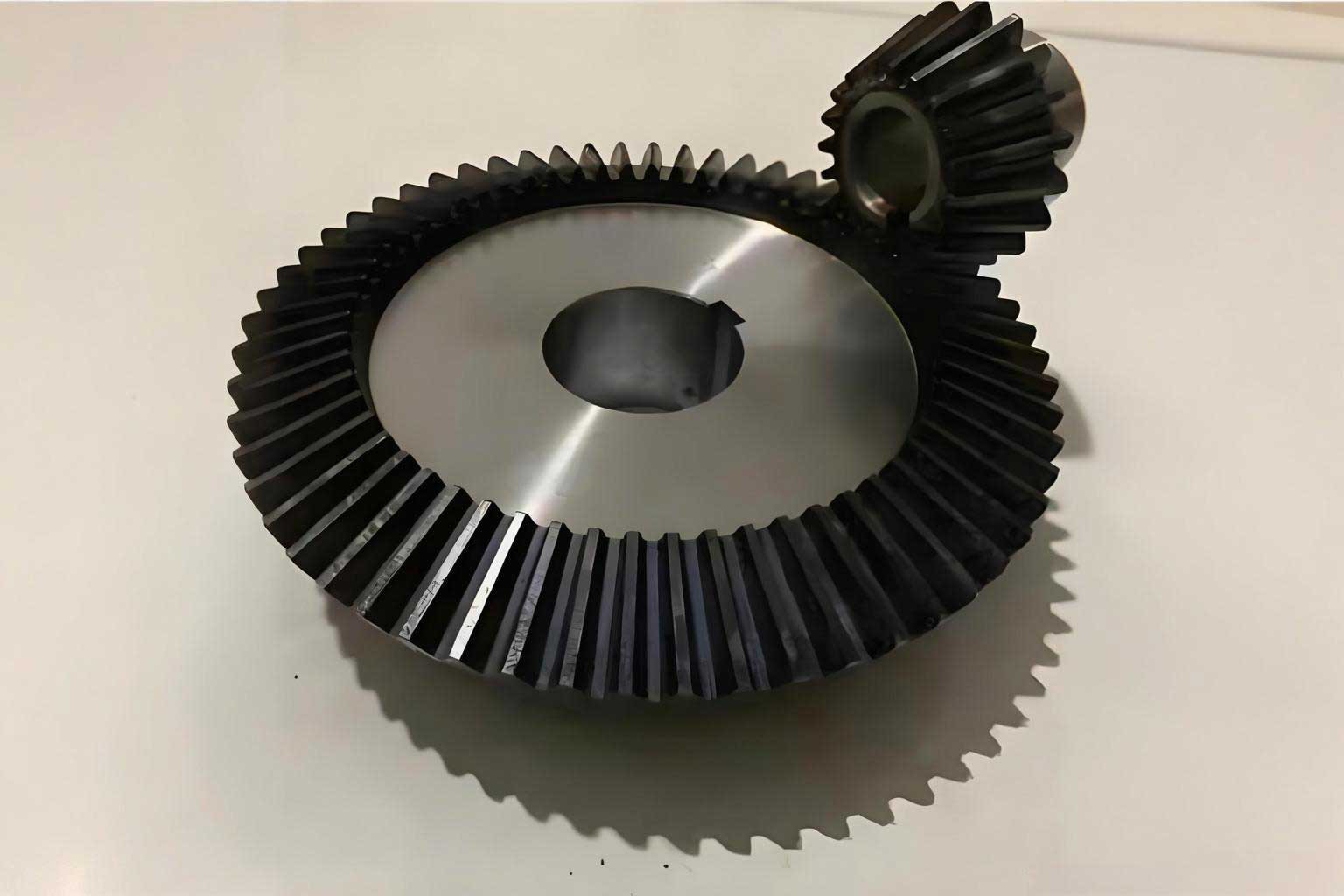
The behavior of the contact zone under load is a primary consideration in the design and manufacturing process. For miter gears, the contact pattern does not remain static; it evolves with applied torque. Generally, three load conditions are considered: light load on a rolling tester, light load in the actual gearbox assembly, and the full operational load. A well-designed and manufactured miter gear pair must maintain a favorable contact zone across this spectrum. Under increasing load, the contact zone typically expands in size and shifts towards the heel (the large end of the tooth) and often slightly towards the toe. The empirical rule observed in practice is that the contact area may increase by 5% to 35% of the total face width, while its center may shift towards the heel by 5% to 35% of the face width. Therefore, the initial, light-load contact zone must be deliberately positioned. For instance, to achieve a centered contact under full load, the light-load zone is often targeted towards the toe (small end). A common specification is to have the center of the light-load contact zone located at 65% of the face width from the toe, meaning it is intentionally biased towards the heel from the midpoint. The contact zone must never extend to the very edges of the tooth (tip, root, toe, or heel); a minimum margin of 2.5% of the face width from the edges is recommended to prevent stress concentrations and edge loading. This predictable shift is the foundational principle guiding the pre-correction of the tooth flank during machining.
The ability to control the final contact zone in miter gears is a synthesis of controlling numerous variables throughout the manufacturing chain. The following table summarizes the key factors and their influence:
| Factor | Description | Primary Influence on Contact Zone |
|---|---|---|
| Machining Process | Choice between planing, two-tool cycle, or CNC milling (CONIFLEX). | Determines the fundamental tooth flank form (linear vs. crowned). CNC milling enables controlled crowning and localized contact. |
| Gear Blank | Precision of the raw forging/machined blank before tooth cutting. | Inaccuracies in reference surfaces (bore, faces) directly translate into tooth alignment errors, affecting zone location and uniformity. ANSI/AGMA defines stringent “Grade 1” tolerances for these. |
| Workholding Fixture | Device used to locate and clamp the blank in the gear cutter. | Hydraulic fixtures providing automatic, repeatable centering (< 0.005 mm) are essential for high-precision miter gears, eliminating manual alignment errors. |
| Cutting Tool | The form cutter used in the generation process. | Blade Pressure Angle: Directly controls contact zone length. Larger angle gives longer zone. Blade Point (Width): Critical for proper generation and avoiding undercut/overcut, especially when modifying spiral angle. Edge Radius: Defines root fillet geometry. |
| Machine & Program | The CNC铣齿机 and its generated tool path. | The program calculates the relative motion between cutter and blank to generate the theoretical flank. Modifications are applied here via software parameters. |
| Heat Treatment | Hardening process (e.g., for 300M steel). | Causes unavoidable distortion, altering the tooth flank geometry and thus the contact zone. Pre-correction must account for the predictable component of this shift. |
Among these, the cutting tool parameters are particularly crucial for active contact zone control during the milling of miter gears. The blade point width, often referred to as the “blade point” or “setover,” is a critical setting. If an incorrect value is chosen when applying spiral angle corrections to move the contact zone, it can lead to undercut at the toe or residual material at the heel. The maximum allowable blade point width \( W_{T.max} \) for the pinion cutter (when cutting the gear) can be derived from gear geometry to ensure clean generation:
$$ W_{T.max} = W_{L.i} – S $$
where \( S \) is the stock allowance for the finishing roll, and \( W_{L.i} \) is the inner space width of the generated gear at the base of the tooth. A more detailed formula based on basic gear parameters is:
$$ W_{L.i} = \frac{A_o – F_w}{A_o} \left( T_{on} – 2 b_o \tan \phi \right) – k $$
Here, \( A_o \) is the outer cone distance, \( F_w \) is the face width, \( T_{on} \) is the mating gear’s outer arc tooth thickness, \( b_o \) is the outer dedendum, \( \phi \) is the pressure angle, and \( k \) is a small clearance constant (e.g., 0.0381 mm). The modern practice for high-quality miter gears is to use a “double roll” cycle, where both the infeed and outfeed motions of the cutter are used for cutting, with a fine finishing pass on the outfeed roll. This ensures excellent surface finish and accurate flank form replication.
The core of achieving a specified contact zone lies in deliberate flank modification. The CNC铣削 process for straight bevel or miter gears inherently produces a small amount of lengthwise crowning due to the generating motion with a circular cutter. The amount of this “natural” crown is inversely related to the cutter diameter and the tool pressure angle. However, this alone is seldom sufficient. Systematic modification techniques, often implemented through machine software (e.g., Gleason’s GEMS or similar systems), are employed. These are broadly classified into first-order and second-order modifications, which are essentially adjustments to the machine settings that alter the relative curvatures of the mating flanks.
First-Order Modifications: These are used to adjust the contact zone’s position along the tooth profile (height-wise) and along the tooth length (length-wise).
- Pressure Angle Modification (Profile Crowning): This controls the contact pattern’s position on the tooth profile. A positive adjustment moves the zone towards the tip, a negative adjustment moves it towards the root. It corrects for “tip-to-root” contact conditions caused by deviations in the effective pressure angle of the miter gear pair. The adjustment value \( \Delta \alpha \) directly influences the shift.
- Spiral Angle Modification (Lengthwise Crowning): This controls the contact pattern’s position along the face width. A positive spiral angle adjustment moves the zone towards the toe (small end), while a negative adjustment moves it towards the heel (large end). This is the primary lever used to position the light-load contact zone towards the toe in anticipation of its heelward shift under load. The adjustment value \( \Delta \beta \) governs the magnitude of the shift.
These modifications can be applied to either the pinion, the gear, or both members of the miter gear pair to achieve the desired conjugate action.
Second-Order Modifications: These are combinations of first-order changes that primarily affect the width or size of the contact zone without significantly altering its central location. They adjust the degree of mismatch (or conformity) between the mating tooth surfaces. A positive second-order modification increases mismatch, making the contact zone narrower and more resistant to misalignment. A negative modification decreases mismatch, resulting in a broader contact zone. The effect can be visualized as changing the relative curvatures in a more complex manner. The mathematical foundation for these corrections stems from the kinematics of gear generation and can be represented by higher-order terms in the equation of the generated surface. The modern software performs a Tooth Contact Analysis (TCA) simulation to predict the contact ellipse under load based on these machine settings. The TCA solves the system of equations defining the contact between two surfaces:
$$ \mathbf{r}_1(u_1, v_1) = \mathbf{r}_2(u_2, v_2) $$
$$ \mathbf{n}_1(u_1, v_1) \parallel \mathbf{n}_2(u_2, v_2) $$
where \( \mathbf{r}_1, \mathbf{r}_2 \) are the position vectors of the pinion and gear tooth surfaces, and \( \mathbf{n}_1, \mathbf{n}_2 \) are their unit normals. The solution yields the path of contact and the instantaneous contact ellipse, whose dimensions are inversely proportional to the principal relative curvatures \( \kappa_{\Sigma} \):
$$ \text{Semi-major axis of contact ellipse} \propto \frac{1}{\sqrt{\kappa_{\Sigma}}} $$
Modifications directly influence these curvatures \( \kappa_{\Sigma} \).
The process of qualifying and controlling the contact zone in production involves a rigorous, multi-stage inspection protocol.
- Flank Form Measurement (CMM): After initial machining and software-based correction, the actual tooth flank is measured on a Coordinate Measuring Machine (CMM) against its theoretical digital model. The flank is evaluated at a grid of points (e.g., 5 points along the profile, 9 points along the length). The deviation must fall within a tight tolerance, typically ±0.01 mm for high-precision miter gears. The machine settings are iteratively adjusted (“compensated”) based on this data until the measured flank conforms to the theoretical target.
- Rolling Test under Light Load: The first physically mated pair from the compensated process is run on a gear rolling tester. A predetermined light torque (e.g., 17.7-22.3 N·m) is applied, and the actual contact pattern is developed using a marking compound (e.g., Prussian blue). The pattern’s length, position, shape, and the gear’s backlash are meticulously recorded and compared to the drawing specification. This step validates the TCA predictions in the real world.
- Establishment of Master and Control Gears: Once a pair meets all light-load contact zone and backlash requirements, it is designated as the Master Control Set (the “golden gear pair”). The flank geometry of this master set is digitally “zeroed” and becomes the new reference standard for all subsequent production. A separate Inspection Control Set is also created. This inspection set is used on the rolling tester to qualify every future production miter gear. The master gear concept is the linchpin for achieving part-to-part interchangeability, as each new pinion or gear is checked for compatible contact with a known-perfect mate, rather than requiring selective pairing.
The final significant challenge in the production of high-strength miter gears is managing heat treatment distortion. Materials like 300M steel are hardened to achieve the necessary durability, but the quenching process induces complex stresses leading to dimensional changes. The tooth flank geometry is not immune. Typically, the post-heat-treatment contact zone becomes slightly smaller and less perfectly rounded compared to its pre-heat-treatment state. The predictable component of this shift—often a further slight movement towards the heel—must be factored into the pre-correction strategy during machining. Therefore, the acceptable contact zone criteria for a heat-treated gear are slightly relaxed in terms of perfect shape but must still show a centered, uniform pattern without any edge contact. The following formula can be used to estimate a pre-correction offset \( \delta_{pre} \) based on historical distortion data:
$$ \delta_{pre} = k_{HT} \cdot \Delta_{load} + \delta_0 $$
where \( \Delta_{load} \) is the expected contact shift from light to full load, \( k_{HT} \) is an empirical heat treatment distortion factor (between 0.1 and 0.3), and \( \delta_0 \) is a constant baseline offset. Controlling this requires excellent process consistency in both machining and heat treatment.
The contrast between traditional and advanced manufacturing for miter gears is stark. Conventional planing produces a straight line contact along the entire face width, which is highly sensitive to misalignment and load-induced deformations, often leading to edge loading and reduced life. In contrast, the CNC铣削 CONIFLEX process creates a localized, crowned contact patch. This deliberate “discrepancy” or “mismatch” is the key to robustness. It allows the contact zone to spread favorably under load without reaching the edges, accommodates small misalignments from housing deflections or bearing clearances, and significantly reduces stress concentrations. The ability to precisely control this zone through the modification techniques described enables the consistent production of miter gears that meet ANSI/AGMA B5 or higher accuracy grades. This level of precision is not just about tighter tolerances; it is about engineering a controlled contact condition that optimizes performance. The successful application of these technologies in the high-lift systems of modern commercial aircraft like the Boeing 787 and Airbus A350, and now in emerging programs, validates their superiority. For any application demanding high reliability, low noise, and long service life from bevel gearing, the adoption of数控铣削 with active contact zone modification for miter gears is no longer an advanced option but a necessary standard.
In conclusion, the journey from a gear drawing to a high-performance, interchangeable miter gear pair is a symphony of advanced technology. It encompasses the understanding of load-deformation characteristics, the mastery of CNC铣削 kinematics and tooling, the application of sophisticated flank modification algorithms (first and second-order), a rigorous inspection regimen anchored by master gears, and the careful management of heat treatment effects. The central theme throughout is the proactive design and control of the tooth contact zone. This approach transforms the gear from a simple geometric component into a precisely engineered interface whose behavior under real-world conditions is predictable and optimal. As industries continue to push for higher power density, greater efficiency, and enhanced reliability, the techniques for modifying and controlling the contact zone in miter gears will remain at the forefront of precision gear manufacturing technology.