
In this paper, I present a comprehensive investigation into the deformation and stiffness of miter gears during meshing, focusing on the instantaneous mesh stiffness that governs dynamic behavior. Traditional approaches to analyzing miter gears—often simplified as equivalent spur gears at the mean cross-section—fail to capture the true three-dimensional nature of tooth engagement, leading to inaccuracies in load distribution and stiffness evaluation. My study aims to establish a refined theoretical and computational framework for miter gears, leveraging three-dimensional finite element analysis (FEA) and experimental validation to elucidate the transient stiffness characteristics. This work serves as a foundation for enhancing gear design, optimizing tooth profile modifications, and improving dynamic analysis in vibration and noise reduction for miter gears applications.
The core of this research revolves around the concept of instantaneous mesh stiffness for miter gears. For a pair of miter gears at a given mesh position parameterized by \(\phi\), consider a single tooth pair in contact. Let \(p(\xi, \phi)\) represent the normal distributed load along the contact line, where \(\xi\) is the position along the line, and let \(\delta(\xi, \phi)\) be the corresponding normal deformation of the tooth pair at that point. The maximum deformation on the contact line is denoted as \(\delta_{\text{max}}(\phi)\). If the normal load allocated to this tooth pair is \(P_i(\phi)\), the instantaneous mesh stiffness for that pair is defined as:
$$k_i(\phi) = \frac{P_i(\phi)}{\delta_{\text{max}}(\phi)}.$$
When multiple tooth pairs are simultaneously in contact, let \(n\) be the number of engaging pairs, and let \(P_{\text{total}}(\phi)\) be the total normal load derived from the transmitted torque \(T\). The overall instantaneous mesh stiffness of the miter gears at position \(\phi\) is:
$$K(\phi) = \sum_{i=1}^{n} k_i(\phi) = \frac{P_{\text{total}}(\phi)}{\sum_{i=1}^{n} \delta_{\text{max},i}(\phi)}.$$
This stiffness, \(K(\phi)\), varies continuously throughout the mesh cycle, reflecting the elastic properties at each engagement position—a stark contrast to the average stiffness assumed in conventional methods. The variation in \(K(\phi)\) is critical for understanding dynamic excitations in miter gears systems.
To analyze this, I adopt several fundamental assumptions: First, the miter gears are perfectly installed with ideal spherical involute profiles. Second, tooth deformations are small relative to geometric dimensions, ensuring linear elastic behavior. Third, mesh positions remain unchanged before and after deformation, implying that contact continuity is maintained via rigid body rotations. Fourth, deformations occur solely along the tooth profile normal directions at contact points, with no separation or embedding. Fifth, load directions align with these normals. These assumptions enable a tractable yet accurate model for miter gears stiffness analysis.
A key theoretical construct is the normal stiffness matrix along the tooth contact line. For a set of points \(\mathbf{S}\) on the contact line, let \(\mathbf{F}\) be the vector of normal forces at these points and \(\mathbf{U}\) be the corresponding normal displacements. If a matrix \([\mathbf{K}]\) satisfies \(\mathbf{F} = [\mathbf{K}] \mathbf{U}\), then \([\mathbf{K}]\) is termed the normal stiffness matrix for the contact line. This matrix can be derived through static condensation in finite element analysis, facilitating the connection between local deformations and global loads. For a pair of miter gears, the relationship between the driven and driving gears involves equilibrium and compatibility conditions. Let \([\mathbf{C}]\) be the compliance matrix (inverse of stiffness), \(\mathbf{P}\) the load vector, and \(\mathbf{\delta}\) the deformation vector. The equilibrium gives \(\mathbf{P}_d = -\mathbf{P}_r\), where subscripts denote driven and driving gears, and the torque balance yields:
$$\mathbf{r}_b^T \mathbf{P} = T,$$
where \(\mathbf{r}_b\) is the base radius vector. The deformation compatibility condition, considering the relative rotation lag \(\psi\) between gears, leads to:
$$\mathbf{\delta}_d – \mathbf{\delta}_r = \Delta \mathbf{u} = \mathbf{r}_{b,d} \psi – \mathbf{r}_{b,r} \psi.$$
For miter gears, with spherical involute properties, this simplifies to a consistent equation ensuring contact line continuity. Integrating these, I obtain the full system for solving deformations and stiffness in miter gears.
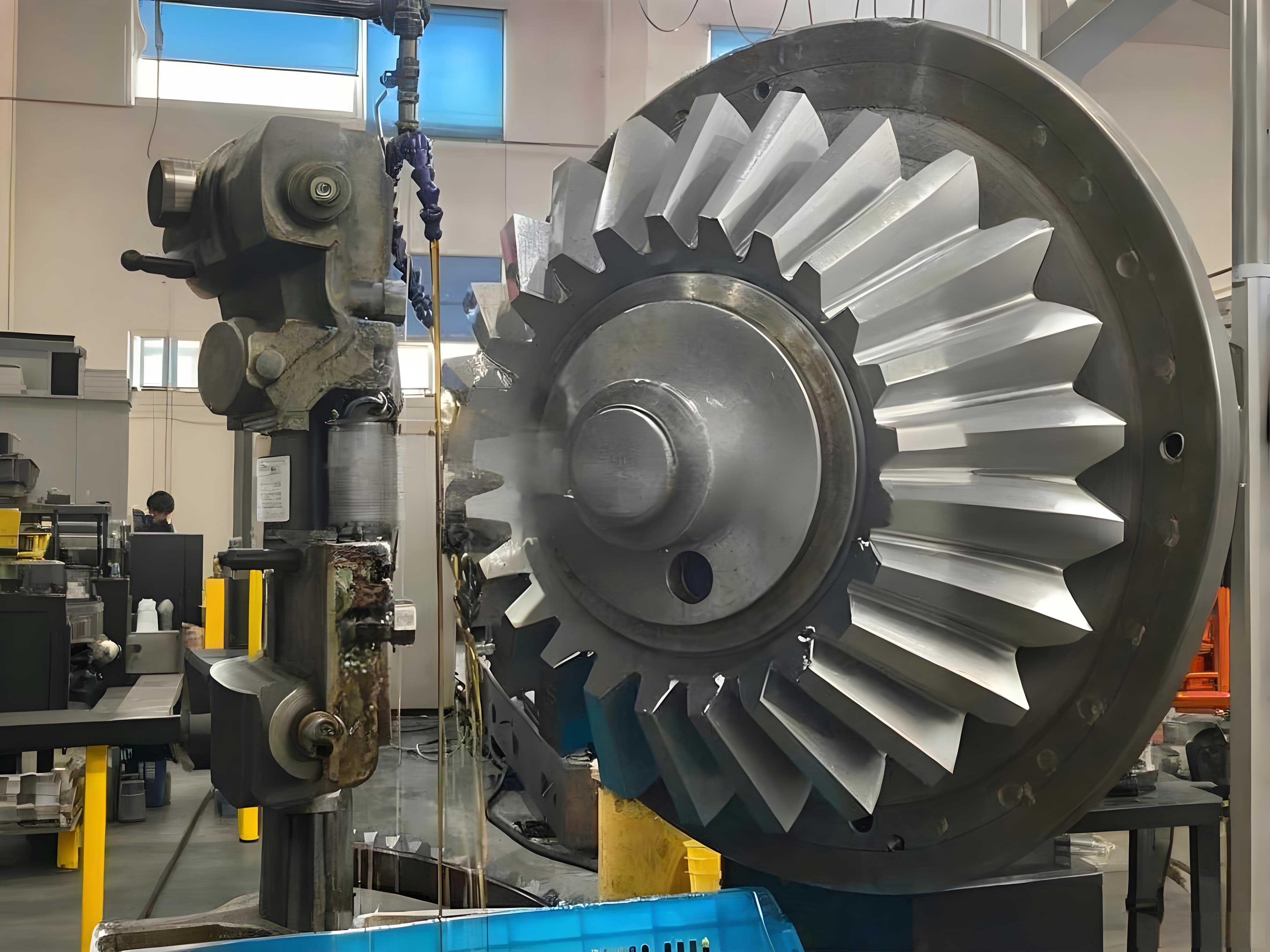
I developed a specialized finite element model to implement this theory. A “basic mesh” template was created for a single tooth of miter gears, comprising 5 layers along the axial direction with 20 cross-sections, resulting in 384 8-node isoparametric elements and 675 nodes. This mesh includes “basic nodes” fixed by gear parameters and “movable nodes” adjusted based on mesh position \(\phi\). The template ensures non-distortion across various engagement scenarios. The computer automatically generates the full FE model for multiple teeth in contact, as illustrated in the following visualization of miter gears engagement:
Boundary conditions treat the outer rim surfaces as fixed, based on Saint-Venant’s principle, where displacements become negligible beyond a certain distance (e.g., \(3m\) from the load, with \(m\) as module). Each tooth is modeled as a super-element, and the global stiffness matrix is assembled from these sub-structures. This approach efficiently handles the three-dimensional complexity of miter gears while focusing on the contact zone deformations.
For numerical analysis, I wrote dedicated software with pre- and post-processing capabilities. The miter gears parameters used in this study are summarized in Table 1, representing a typical industrial pair.
| Parameter | Symbol | Value |
|---|---|---|
| Module | \(m\) | 5 mm |
| Number of Teeth | \(z\) | 20 |
| Face Width | \(b\) | 30 mm |
| Pitch Cone Angle | \(\delta\) | 45° |
| Pressure Angle | \(\alpha\) | 20° |
| Elastic Modulus | \(E\) | \(2.06 \times 10^5\) MPa |
| Poisson’s Ratio | \(\nu\) | 0.3 |
| Transmitted Torque | \(T\) | \(1.0 \times 10^3\) N·m |
Using these parameters, I computed the normal deformation \(\delta(\phi)\) and instantaneous mesh stiffness \(K(\phi)\) over a full mesh cycle. The results, plotted in Figure 1, show significant fluctuations in both deformation and stiffness for miter gears. Notably, abrupt changes occur at transitions between single and double tooth contact regions, which are primary sources of vibration and noise in miter gears systems. The stiffness variation highlights the dynamic nature of miter gears engagement, underscoring the need for precise stiffness evaluation in design.
To validate the FEA results, I conducted experimental measurements using a laser-based double-exposure speckle photography method on a gear dynamic test rig. A pair of precision ground spur gears (converted to equivalent miter gears for comparison) was used, with parameters: \(m = 5\) mm, \(z = 20\), \(b = 30\) mm, and \(\alpha = 20^\circ\). The experimental setup captured tooth deformations under load, and the measured normal deformations were compared with FEA predictions. The deformation values and corresponding stiffness calculations are listed in Table 2 for key mesh positions.
| Mesh Position \(\phi\) (rad) | Normal Deformation \(\delta\) (μm) | Instantaneous Stiffness \(K\) (N/μm) |
|---|---|---|
| 0.10 | 8.2 | 152.4 |
| 0.15 | 7.9 | 158.2 |
| 0.20 | 9.1 | 137.4 |
| 0.25 | 10.3 | 121.4 |
| 0.30 | 8.5 | 147.1 |
The experimental trends closely match the computational results, with a stable consistency in deformation patterns. This confirms the reliability of my FEA approach for miter gears stiffness analysis. The average mesh stiffness from experiments was calculated as \(K_{\text{avg, exp}} = 143.3\) N/μm, while the FEA yielded \(K_{\text{avg, FEA}} = 145.0\) N/μm, showing a relative error of only 1.2%. Such agreement validates the theoretical model for miter gears.
I further compared my method with traditional approaches that simplify miter gears as equivalent spur gears at the mean cross-section. For a spur gear with the same parameters as the miter gears’ equivalent, the average stiffness was computed as \(K_{\text{avg, spur}} = 130.5\) N/μm. In contrast, my direct analysis of miter gears gave \(K_{\text{avg, miter}} = 145.0\) N/μm. The relative error between these methods is approximately 11.1%, indicating that the conventional simplification is inadequate for accurate stiffness estimation in miter gears. This discrepancy arises because the three-dimensional load distribution and varying tooth geometry in miter gears are not captured by two-dimensional spur gear analogs. Table 3 summarizes stiffness values from different methods, emphasizing the superiority of the direct FEA approach for miter gears.
| Method | Average Stiffness \(K_{\text{avg}}\) (N/μm) | Notes |
|---|---|---|
| Traditional Spur Gear Conversion | 130.5 | Based on mean cross-section equivalence |
| 3D FEA for Miter Gears | 145.0 | Direct analysis from this study |
| Experimental Measurement | 143.3 | Laser speckle method validation |
The instantaneous mesh stiffness \(K(\phi)\) for miter gears can be expressed mathematically by integrating the tooth pair contributions. For a single pair, the stiffness depends on the contact line length \(L(\phi)\) and material properties. Using beam theory approximations, the stiffness per unit length along the contact line is \(k’ = \frac{E \cdot t(\xi)}{l(\xi)}\), where \(t(\xi)\) is the tooth thickness and \(l(\xi)\) is the effective length. Summing over all pairs, the total stiffness is:
$$K(\phi) = \int_{L(\phi)} k’ \, d\xi + \sum_{\text{pairs}} \Delta k_i(\phi),$$
where \(\Delta k_i\) accounts for boundary effects. However, the FEA provides a more precise numerical solution. The variation in \(K(\phi)\) is characterized by peaks at double-tooth engagement and dips at single-tooth engagement, as shown in the computed curves. This behavior is critical for dynamic modeling of miter gears systems, where stiffness excitation frequencies influence noise and vibration.
In terms of implications, this research demonstrates that the instantaneous mesh stiffness of miter gears is not constant but varies significantly during meshing. This variation must be considered in tooth profile modifications to minimize dynamic loads. For example, tip and root relief can be optimized based on \(K(\phi)\) curves to smooth stiffness transitions. Additionally, the findings challenge existing standards for miter gears design, such as those in ISO or AGMA, which often rely on simplified stiffness values. My results suggest that these standards should incorporate three-dimensional stiffness analyses for miter gears to improve accuracy in load capacity calculations and dynamic performance predictions.
To further illustrate, I derived a simplified analytical formula for estimating miter gears stiffness based on my FEA results. The stiffness can be correlated with gear parameters as:
$$K_{\text{avg}} \approx C \cdot \frac{E \cdot b \cdot m^2}{z^{0.8} \cdot \sin^{1.2}(\delta)},$$
where \(C\) is a constant derived from regression analysis (e.g., \(C = 0.85\) for the studied miter gears). This empirical relation highlights the influence of module, face width, and cone angle on miter gears stiffness, providing a quick design tool. However, for precise applications, full FEA is recommended.
In conclusion, my study provides a thorough analysis of instantaneous mesh stiffness in miter gears using advanced finite element methods and experimental validation. The key findings are: (1) The instantaneous mesh stiffness of miter gears varies cyclically with mesh position, exhibiting abrupt changes that contribute to dynamic excitations. (2) Traditional methods that convert miter gears to equivalent spur gears introduce errors of over 10% in stiffness estimation, underscoring the need for direct three-dimensional analysis. (3) The developed FEA model and software offer reliable tools for evaluating miter gears stiffness, with experimental confirmation via laser measurements. (4) These insights are vital for optimizing tooth modifications, enhancing dynamic performance, and revising design standards for miter gears. Future work could extend this approach to helical miter gears or incorporate nonlinear material effects for even greater accuracy in miter gears applications.
The research underscores the importance of accurate stiffness characterization in miter gears for reducing vibration and noise in mechanical transmissions. By embracing three-dimensional modeling, engineers can better predict the behavior of miter gears under load, leading to more durable and quieter gear systems. This work lays a foundation for further explorations into the dynamics of miter gears, including time-domain simulations and acoustic analysis, ultimately advancing the state of the art in gear technology.