
In modern mechanical transmission systems, miter gears play a crucial role due to their ability to transmit rotational motion between intersecting shafts at a fixed ratio. As a type of straight bevel gear, miter gears are characterized by their simplicity in design and manufacturing compared to spiral bevel gears, making them widely adopted in various machinery. However, the precision of miter gears heavily relies on the accuracy of the cutting tools used in their production. In this article, I will delve into the optimal design of milling cutter profiles for miter gears, leveraging MATLAB for enhanced accuracy and efficiency. The focus is on improving the tooth profile fitting, ensuring smooth transitions, and strengthening the cutter design, all while emphasizing the application to miter gears throughout the discussion.
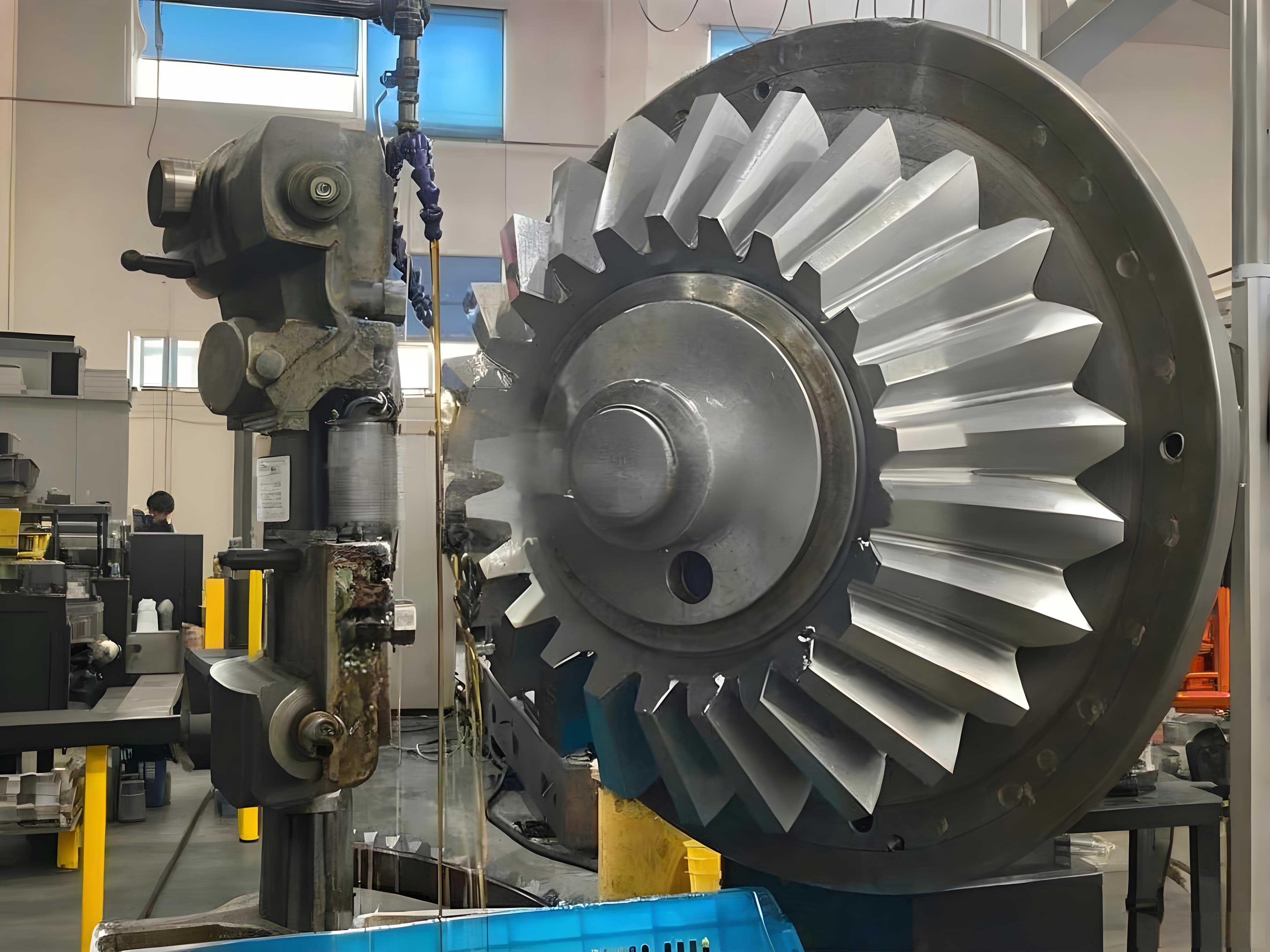
The design of milling cutters for miter gears is based on the forming machining principle, where the cutter profile must accurately replicate the gear tooth shape to ensure proper meshing and performance. Traditionally, the tooth profile of miter gears is derived from spherical involutes, but due to the complexity of representing these curves on a plane, an equivalent tooth shape from the back cone is used. This approximation simplifies calculations and manufacturing, allowing for the design of cutter profiles using equivalent cylindrical gear parameters. In this context, I will explore how MATLAB can be employed to optimize the cutter profile, addressing limitations in traditional methods like point plotting and single-arc fitting that often lead to excessive errors and poor connectivity between profile segments.
When designing milling cutters for miter gears, the effective tooth profile section is critical. It is determined by the equivalent gear slot shape at the large end of the miter gear. The coordinates of the slot profile are calculated using the following equations, where the origin is set at the midpoint of the slot bottom, and the symmetric axis is the y-axis. For an equivalent gear with tooth count $z_v = \frac{z}{\cos \delta}$, where $z$ is the actual tooth number and $\delta$ is the pitch cone angle, the slot coordinates $(x, y)$ at any radius $r_y$ are given by:
$$x = r_y \sin \eta_y$$
$$y = r_y \cos \eta_y – \frac{m z_v}{2} – 1.2m$$
Here, $m$ is the module, and $\eta_y$ is the slot center half-angle at radius $r_y$, computed as $\eta_y = \eta – \text{inv} \alpha + \text{inv} \alpha_y$, with $\eta = \frac{\pi – 4x \tan \alpha}{2z_v}$ being the half-angle at the pitch circle, and $\alpha_y = \arccos \left( \frac{r_o}{r_y} \right)$ as the pressure angle at $r_y$. The base radius $r_o$ is $\frac{1}{2} m z_v \cos \alpha$. For miter gears, these calculations ensure that the cutter profile matches the gear geometry, but accuracy depends on the fitting method used for discrete coordinate points.
To achieve high precision, the cutter profile coordinates are transformed based on the offset and rotation during machining. The offset distance $e$ and rotation angle $\tau$ are derived from the intersection points of the large-end and small-end profiles. The transformed coordinates $(x’, y’)$ for the cutter effective profile are:
$$x’ = x \cos \tau – y \sin \tau – e$$
$$y’ = x \sin \tau + y \cos \tau$$
where $(x, y)$ are the slot coordinates from the previous equations. This transformation aligns the cutter profile with the machining process for miter gears, but the discrete points must be fitted smoothly to minimize errors. Traditional methods like point plotting often result in inaccuracies, prompting the need for advanced fitting techniques.
In addition to the effective profile, the transition curve section of the cutter is vital for avoiding interference and stress concentrations. For miter gears with pressure angles of 20° and tooth counts between 19 and 34, the transition consists of a straight line and a circular arc. The parameters are determined using the point of tangency between the extended involute and the involute curve. The radial distance $r_F$ to this point is:
$$r_F = \sqrt{ \frac{m^2 z^2}{4} – h’_a z + \frac{h’_r}{\sin^2 \alpha_0} }$$
where $h’_a$ and $h’_r$ are addendum and dedendum coefficients. The coordinates $(x_F, y_F)$ are then $x_F = r_F \sin \eta_F$ and $y_F = r_F \cos \eta_F$, with $\eta_F = \eta – \text{inv} \alpha_0 + \text{inv} \alpha_F$ and $\alpha_F = \arccos (r_b / r_F)$. The angle $\delta$ for the straight line is $\delta = \eta_F + \alpha_F$, and the arc radius $r_c$ is computed as:
$$r_c = \frac{x_F – y_{1F} \tan \delta}{\tan \left( \frac{90^\circ – \delta}{2} \right)}$$
For miter gears with tooth counts of 35 or more, the transition simplifies to a straight line and an arc with radius $r_c = y_F – r_f (1 – \sin \delta)$. These calculations ensure that the transition curve does not affect gear meshing, but optimization is needed for smooth connections.
Fitting the cutter profile is a key step in achieving precision. I often use arc fitting methods, such as single-arc or double-arc fitting, to approximate the theoretical profile. In single-arc fitting, three coordinate points $(x_1, y_1)$, $(x_2, y_2)$, and $(x_3, y_3)$ are selected, and a circle passing through them is used. The radius $R$ and center $(x_a, y_a)$ are given by:
$$R = \frac{\sqrt{(x_3 – x_2)^2 + (y_3 – y_2)^2}}{2 \sin \beta \sin (\phi – \epsilon)}$$
$$x_a = R \cos (\beta + \phi – \epsilon) + x_3, \quad y_a = -R \sin (\beta + \phi – \epsilon) + y_3$$
where $\beta$, $\phi$, and $\epsilon$ are angles determined from the coordinates. However, for miter gears, single-arc fitting may not meet accuracy requirements, leading to the use of double-arc fitting, where six points are divided into two sets for separate arcs. This approach reduces errors but requires careful selection of points.
Alternatively, polynomial fitting with MATLAB offers a more flexible solution. Using the least squares method, I fit the coordinate points with a polynomial $\phi(x) = a_0 + a_1 x + \dots + a_n x^n$. For $m$ points $(x_i, y_i)$, the coefficients are solved from the linear system:
$$\begin{bmatrix}
m & \sum x_i & \cdots & \sum x_i^n \\
\sum x_i & \sum x_i^2 & \cdots & \sum x_i^{n+1} \\
\vdots & \vdots & \ddots & \vdots \\
\sum x_i^n & \sum x_i^{n+1} & \cdots & \sum x_i^{2n}
\end{bmatrix}
\begin{bmatrix}
a_0 \\ a_1 \\ \vdots \\ a_n
\end{bmatrix}
=
\begin{bmatrix}
\sum y_i \\ \sum x_i y_i \\ \vdots \\ \sum x_i^n y_i
\end{bmatrix}$$
The fitting error $\delta_i = \phi(x_i) – y_i$ is minimized by adjusting the polynomial degree $n$. Higher degrees improve accuracy but may lead to overfitting. For miter gear cutters, I typically start with $n=4$ and increase as needed to achieve errors below 0.08 mm.
Optimizing the cutter profile involves three aspects: improving fitting accuracy, ensuring smooth transitions, and enhancing cutter strength. Using MATLAB, I automate the fitting process for the effective profile points. For instance, by calling the polyfit function with vectors of coordinates, I obtain polynomial coefficients that define the profile. The transition curve is optimized by adjusting the straight line angle $\delta$ and arc radius $r_c$ to guarantee tangency. The straight line equation is $y – y_1 = \tan \delta (x – x_1)$, where $(x_1, y_1)$ is the intersection with the effective profile. The arc equation is $(y – y_0)^2 + (x – x_0)^2 = r_c^2$, and for a smooth connection, the arc radius is computed as:
$$r_c = \frac{y_1 – x_1 \tan \delta – r_c}{\sqrt{\tan^2 \delta + 1}}$$
This ensures that the effective profile, transition line, and tooth tip arc connect seamlessly, avoiding stress concentrations. Additionally, increasing the tooth tip arc radius strengthens the cutter, reducing the risk of chipping during machining of miter gears.
To illustrate the optimization process, I present an application example. Consider a miter gear pair with module $m=3$, tooth numbers $z_1=22$ and $z_2=44$, pressure angle $\alpha_f=20^\circ$, and pitch cone angles $\phi_1=26^\circ 34’$ and $\phi_2=63^\circ 26’$. The equivalent tooth count is $z_v = 25$, and the cutter design parameters include a tip radius $R=1.29$ mm and angle $\delta=5^\circ 04’$. The discrete coordinates for the cutter profile are listed in the table below.
| Point No. | $x_i$ (mm) | $y_i$ (mm) |
|---|---|---|
| 1 | 1.40 | 1.78 |
| 2 | 1.46 | 2.17 |
| 3 | 1.61 | 2.78 |
| 4 | 1.82 | 3.38 |
| 5 | 2.08 | 3.99 |
| 6 | 2.37 | 4.61 |
| 7 | 2.71 | 5.22 |
| 8 | 3.09 | 5.83 |
| 9 | 3.50 | 6.45 |
| 10 | 3.96 | 7.07 |
First, I attempt single-arc fitting using points (1.40, 1.78), (2.08, 3.99), and (3.96, 7.07). The calculated radius is $R = 12.1832$ mm with center $(13.3277, 0.7254)$, but the maximum error $\Delta_{\text{max}} = 0.1409$ mm exceeds the 0.08 mm tolerance, making it unsuitable for miter gear cutters. Next, I apply double-arc fitting. For the first arc, points (1.40, 1.78), (1.61, 2.78), and (2.08, 3.99) yield $R_1 = 7.1028$ mm and center $(8.4381, 0.824)$, with $\Delta_{\text{max}} = 0.0211$ mm. For the second arc, points (2.08, 3.99), (2.71, 5.22), and (3.96, 7.07) give $R_2 = 14.9649$ mm and center $(15.7, -2.2098)$, with $\Delta_{\text{max}} = 0.0185$ mm. Both errors are within tolerance, validating the double-arc approach for miter gears.
For the transition curve, with $x_1 = 1.40$, $y_1 = 1.78$, and $\delta = 5^\circ 04’$, the straight line equation is $y – 1.78 = 11.2789(x – 1.40)$. Optimizing the tooth tip arc radius using the smooth connection formula gives $r_c = 1.36$ mm. Thus, the complete cutter profile equations are:
For $2.08 \leq x \leq 3.96$: $$(x – 15.7)^2 + (y + 2.2098)^2 = (14.9649)^2$$
For $1.40 \leq x \leq 2.08$: $$(x – 8.4381)^2 + (y – 0.824)^2 = (7.1028)^2$$
For $1.34 \leq x \leq 1.40$: $$y – 1.78 = 11.2789(x – 1.40)$$
For $-1.34 \leq x \leq 1.34$: $$x^2 + (y – 1.36)^2 = (1.36)^2$$
For $-1.40 \leq x \leq -1.34$: $$y – 1.78 = -11.2789(x + 1.40)$$
For $-2.08 \leq x \leq -1.40$: $$(x + 8.4381)^2 + (y – 0.824)^2 = (7.1028)^2$$
For $-3.96 \leq x \leq -2.08$: $$(x + 15.7)^2 + (y + 2.2098)^2 = (14.9649)^2$$
This ensures smooth connectivity across all segments. Alternatively, polynomial fitting with MATLAB uses the coordinate vectors $X = [1.40, 1.46, 1.61, 1.82, 2.08, 2.37, 2.71, 3.09, 3.50, 3.96]$ and $Y = [1.78, 2.17, 2.78, 3.38, 3.99, 4.61, 5.22, 5.83, 6.45, 7.07]$. With a fourth-degree polynomial, the fitted function is:
$$\phi(x) = -14.7418 + 22.5382x – 10.5621x^2 + 2.3701x^3 – 0.1992x^4$$
The maximum error is $\Delta_{\text{max}} = 0.0681$ mm, meeting the tolerance. The transition curve optimization remains the same, resulting in a seamless profile. The polynomial-based profile equations are:
For $1.40 \leq x \leq 3.96$: $$y = -14.7418 + 22.5382x – 10.5621x^2 + 2.3701x^3 – 0.1992x^4$$
For $1.34 \leq x \leq 1.40$: $$y – 1.78 = 11.2789(x – 1.40)$$
For $-1.34 \leq x \leq 1.34$: $$x^2 + (y – 1.36)^2 = (1.36)^2$$
For $-1.40 \leq x \leq -1.34$: $$y – 1.78 = -11.2789(x + 1.40)$$
For $-3.96 \leq x \leq -1.40$: $$y = -14.7418 – 22.5382x – 10.5621x^2 – 2.3701x^3 – 0.1992x^4$$
Both double-arc and polynomial fittings provide high precision for miter gear cutters, but the polynomial method offers better adaptability to complex profiles. The optimization process demonstrates how MATLAB enhances design reliability by automating calculations and ensuring smooth transitions.
In conclusion, the optimization of milling cutter profiles for miter gears using MATLAB significantly improves design accuracy and efficiency. By employing double-arc or polynomial fitting, I achieve tighter tolerances compared to traditional methods like point plotting. The smooth connection between the effective profile, transition line, and tooth tip arc eliminates stress concentrations and enhances cutter durability. Moreover, the increased tooth tip arc radius strengthens the cutter, reducing failure risks during machining. This approach not only elevates the precision of miter gear production but also boosts automation and reliability in tool design. Future work could explore real-time simulation and adaptive fitting techniques for further refinement in miter gear applications.
Throughout this discussion, I have emphasized the importance of miter gears in mechanical systems and how advanced MATLAB-based optimization can address design challenges. The integration of mathematical modeling, curve fitting, and transition smoothing ensures that milling cutters meet the stringent requirements of modern gear manufacturing. As industries demand higher performance from miter gears, such optimization methods will become increasingly vital for achieving superior quality and efficiency in transmission systems.