
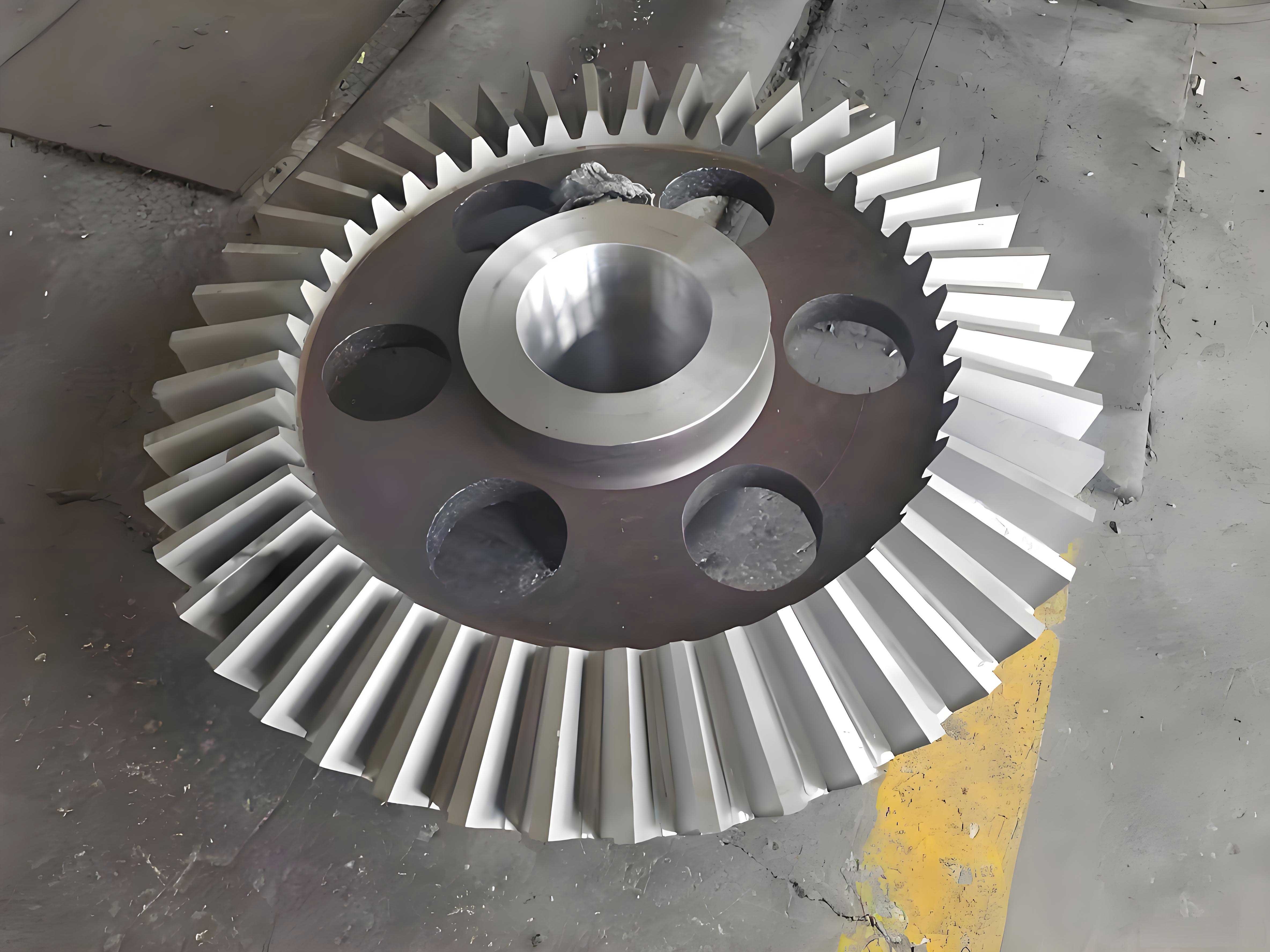
In the design and optimization of power transmission systems for heavy-duty agricultural equipment, such as rotary tillers, understanding the dynamic characteristics of critical components is paramount. Among these, the assembly comprising the main spindle and the miter gears responsible for redirecting torque through a 90-degree angle is particularly susceptible to vibrational issues. These vibrations, if coincident with operational frequencies, can lead to premature fatigue failure, excessive noise, and reduced operational reliability. This article presents a comprehensive finite element-based modal analysis of such a spindle and straight-tooth miter gear assembly. The primary objective is to extract its fundamental natural frequencies and corresponding mode shapes, thereby providing a theoretical foundation for dynamic design validation and structural optimization to avoid resonant conditions during field operation.
Theoretical Foundation of Modal Analysis
Modal analysis is a fundamental technique in structural dynamics used to determine the inherent vibration characteristics of a mechanical system. These characteristics, known as modes, are defined by natural frequencies, damping ratios, and mode shapes. They are intrinsic properties of a structure, determined by its mass distribution and stiffness matrix, and are independent of external loads. For a linear, undamped multi-degree-of-freedom system, the equations of motion can be expressed in matrix form as:
$$ [M]\{\ddot{x}\} + [C]\{\dot{x}\} + [K]\{x\} = \{F(t)\} $$
Where:
$[M]$ is the global mass matrix,
$[C]$ is the global damping matrix,
$[K]$ is the global stiffness matrix,
$\{x\}$ is the displacement vector,
$\{F(t)\}$ is the time-varying force vector.
For a free-vibration modal analysis, external forces are neglected ($\{F(t)\} = 0$), and damping is typically omitted to find the undamped natural frequencies. This simplifies the equation to:
$$ [M]\{\ddot{x}\} + [K]\{x\} = \{0\} $$
Assuming harmonic motion of the form $\{x\} = \{\phi\} e^{i \omega t}$, where $\{\phi\}$ is the mode shape vector and $\omega$ is the circular natural frequency, we substitute into the free-vibration equation to obtain the classical eigenvalue problem:
$$ ( [K] – \omega^2 [M] ) \{\phi\} = \{0\} $$
For a non-trivial solution ($\{\phi\} \neq 0$), the determinant must be zero:
$$ \det( [K] – \omega^2 [M] ) = 0 $$
Solving this eigenvalue problem yields ‘n’ eigenvalues $\lambda_i = \omega_i^2$, where $\omega_i$ are the system’s natural frequencies (in rad/s), and ‘n’ corresponding eigenvectors $\{\phi_i\}$, which are the mode shapes. The fundamental frequency ($i=1$) is the lowest, and higher-order modes ($i=2,3,…n$) follow. The relationship between circular frequency $\omega_i$ (rad/s) and natural frequency $f_i$ (Hz) is:
$$ f_i = \frac{\omega_i}{2\pi} $$
The primary goal of the analysis is to identify these parameters for the spindle and miter gear assembly to ensure that its operational speed remains sufficiently distant from any critical frequency, thus preventing resonance.
Finite Element Model Development
The accuracy of a modal analysis is fundamentally tied to the fidelity of the finite element model. The process involves several critical steps: geometry creation, material property assignment, meshing, and defining connection interactions.
Geometry and Assembly
A precise three-dimensional model of the spindle and the straight-tooth miter gear was created using CAD software. The spindle typically features stepped diameters, keyways or splines for torque transmission, and bearing journals. The miter gear geometry requires accurate modeling of the conical tooth profile. The two components are then virtually assembled with an interference fit at the shaft-gear interface, simulating a press-fit or keyed connection commonly used to transmit torque.
Material Properties
Correct material definition is crucial as it directly influences mass and stiffness matrices. For such drivetrain components, high-strength alloy steels are standard. The properties used in the model are summarized below:
| Component | Material | Young’s Modulus, E (GPa) | Poisson’s Ratio, ν | Density, ρ (kg/m³) |
|---|---|---|---|---|
| Spindle | 45C / AISI 1045 | 210 | 0.269 | 7,850 |
| Miter Gear | 20CrMnTi / AISI 8620 | 207 | 0.25 | 7,800 |
Mesh Generation
Meshing discretizes the continuous geometry into finite elements. A balance between computational efficiency and result accuracy must be struck. A tetrahedral mesh is often employed for complex geometries like gear teeth. Mesh sensitivity studies are recommended to ensure results are independent of element size. For instance, a finer mesh is applied to the tooth roots and fillets of the miter gears where stress concentrations are expected, while a coarser mesh can be used for simpler regions of the spindle.
| Region | Element Type | Target Size | Remarks |
|---|---|---|---|
| Gear Teeth | Quad/Tet Dominant | Fine (e.g., 1-2 mm) | Captures curvature and stress gradients. |
| Spindle Body | Hex Dominant / Tet | Medium (e.g., 5-8 mm) | Balances accuracy and element count. |
| Keyway/Spline | Refined Local Mesh | Fine | Accounts for geometric discontinuities. |
Connections and Boundary Conditions
Defining the interaction between the spindle and the miter gear is critical. A “Bonded” contact condition is typically applied at the mating surfaces, assuming no relative motion (perfect adhesion), which is valid for a tight interference or keyed fit.
Boundary conditions (BCs) constrain the model to reflect its real mounting. A common simplification is to model bearing supports as spring elements or discrete remote displacement points. For a modal analysis, which calculates free-vibration characteristics, only constraints that prevent rigid body motion are necessary. Often, the spindle is constrained at the bearing locations:
- Locating Bearing: All translational degrees of freedom (DOFs) are fixed ($U_x=U_y=U_z=0$). Rotational DOFs may be free or constrained depending on bearing type.
- Floating Bearing: Constrained radially but may be free axially (e.g., $U_x=U_y=0$, $U_z$ free for a cylindrical roller bearing).
These constraints are essential; without them, the first six modes would be rigid body modes (three translations and three rotations) with frequencies near zero.
Analysis Execution and Results
With the FE model prepared, the Lanczos or Block Lanczos eigenvalue solver is typically employed to extract the first several modes of interest. The results consist of natural frequencies and their associated deformation patterns (mode shapes).
Extracted Modal Parameters
The table below presents a typical set of results for the first six flexible modes of a spindle and miter gear assembly. Note that the first two modes are often very close in frequency, forming a “doublet,” which indicates similar stiffness in two orthogonal planes.
| Mode Order | Natural Frequency, f (Hz) | Description of Dominant Mode Shape |
|---|---|---|
| 1 | 89.0 | First bending of the assembly, primarily lateral deflection of the spindle/gear head in the Y-Z plane. |
| 2 | 89.1 | First bending in the orthogonal direction (X-Z plane). Forms a doublet with Mode 1. |
| 3 | 460.4 | Second bending mode or a combined bending-torsional mode, often with significant deformation at the gear teeth. |
| 4 | 1,231.0 | Primarily torsional mode about the spindle axis, possibly combined with axial deformation of the miter gear teeth. |
| 5 | 1,231.4 | Torsional mode orthogonal to Mode 4, forming another doublet. Local deformation at spindle steps is prominent. |
| 6 | 1,951.1 | Higher-order bending or a complex three-dimensional mode involving deformation of both spindle and gear body. |
Critical Speed Calculation
A key application of the fundamental bending frequency (Mode 1) is the calculation of the shaft’s critical speed. The critical rotational speed $N_{cr}$ in revolutions per minute (RPM) is directly related to the first bending natural frequency $f_1$:
$$ N_{cr} = f_1 \times 60 $$
For the result above:
$$ N_{cr} = 89.0 \, \text{Hz} \times 60 \, \frac{\text{s}}{\text{min}} = 5,340 \, \text{RPM} $$
This value represents the rotational speed at which the spindle would experience severe resonant lateral vibrations. A fundamental design rule is to operate well away from this speed. A common safety margin is to ensure the maximum operating speed $N_{op}$ is less than 75% of the first critical speed:
$$ N_{op} < 0.75 \times N_{cr} $$
Given that the typical operational speed for such an assembly in a rotary tiller gearbox is often below 2,000 RPM, the design possesses a substantial margin of safety ($2,000 < 0.75 \times 5,340 \approx 4,005$), indicating a low risk of resonance-induced failure under normal working conditions.
Discussion and Design Implications
The modal analysis provides profound insights that guide the design process:
1. Resonance Avoidance: The primary and most direct outcome is the verification that the assembly’s natural frequencies are sufficiently separated from excitation sources. In a gearbox, the main excitations are at the meshing frequency ($f_{mesh} = \text{Tooth Count} \times \text{Shaft RPM} / 60$) and its harmonics. The analyst must check that none of the extracted natural frequencies (especially the lower ones) coincide with these excitation frequencies within the operating range.
2. Stiffness vs. Mass Identification: The mode shapes reveal the weakest links in the assembly’s dynamic stiffness. For instance, if the first modes show excessive deflection localized at the miter gear teeth, it suggests that the gear design (e.g., module, face width) or its support on the spindle may need reinforcement. Conversely, if the spindle bends significantly between bearings, increasing its diameter or reducing bearing span should be considered.
3. Importance of Miter Gear Design: The analysis explicitly highlights the dynamic role of the miter gear. It is not merely a static torque transmitter; its mass and stiffness significantly influence the system’s global vibrational behavior. Optimizing the gear’s blank design, moving mass closer to the rotational axis, or using materials with higher specific stiffness can positively shift natural frequencies.
4. Foundation for Further Analysis: The successful modal analysis lays the groundwork for more advanced simulations. The extracted modes can be used as a basis for:
- Harmonic Response Analysis: To predict steady-state vibration levels under sinusoidal loads (e.g., from gear meshing forces).
- Random Vibration Analysis: To assess performance under spectrum loads, such as those induced by rough terrain.
- Transient Dynamic Analysis: To study shock loads during impact or startup.
Conclusion
This detailed exploration underscores the critical importance of performing a finite element modal analysis on power transmission assemblies, specifically those involving spindles and miter gears in demanding agricultural applications. The process, from geometric modeling and material definition through to meshing, constraint application, and eigenvalue solving, provides a robust framework for understanding the intrinsic dynamic characteristics of the system. By calculating the fundamental natural frequencies and visualizing the corresponding mode shapes, engineers can conclusively verify that the design maintains a safe operating margin from resonant conditions. The calculated critical speed, derived from the first bending mode, serves as a key performance indicator. Furthermore, the insights gained into the deformation patterns guide targeted design improvements, enhancing stiffness where needed and optimizing mass distribution. Ultimately, integrating such an analysis into the development cycle of a spindle and miter gear assembly is not merely an academic exercise but a practical necessity. It ensures the resulting component is not only structurally sound under static loads but also dynamically reliable, leading to agricultural machinery that is more durable, quieter, and capable of sustained high-performance operation in the field.