
In the field of mechanical power transmission, the design of gear systems for optimal performance, minimal material usage, and compact size is a persistent engineering challenge. My research focuses on a specific, yet commonly encountered scenario in light industrial machinery: the optimization of straight bevel gear drives where the axes of the two gears are not perpendicular. While standard miter gears are a well-documented subset of bevel gears designed for a 1:1 ratio at a 90-degree shaft angle, the general case of non-right-angle and non-unity ratio transmissions lacks extensive coverage in mainstream design handbooks and textbooks. This gap complicates their design and often leads to suboptimal solutions. This article presents my first-person account of developing and applying a formal optimization methodology for such transmissions, aiming to maximize load capacity and minimize overall volume.
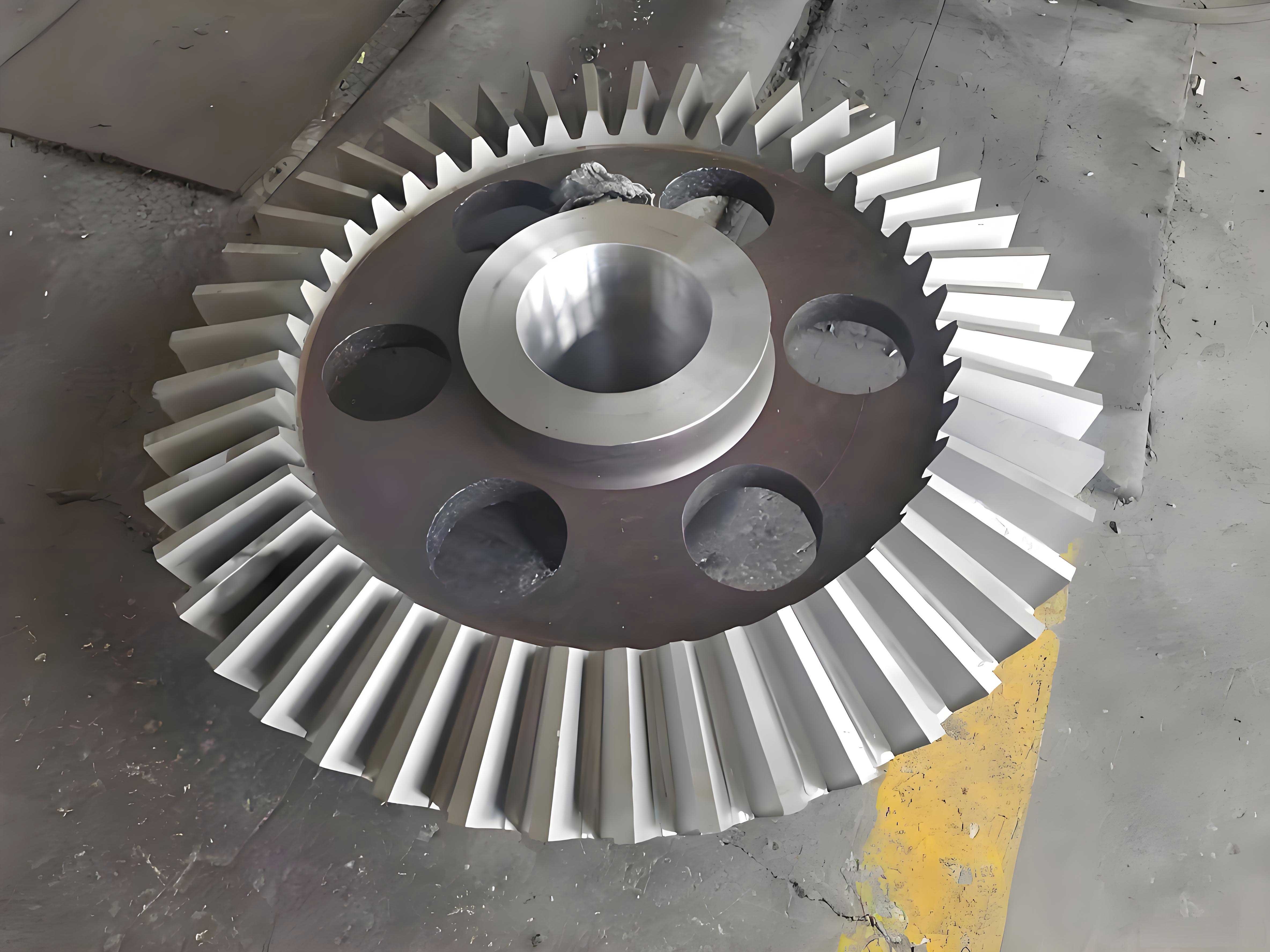
The core objective of my work was to formulate this as a constrained nonlinear programming problem. Given the operational parameters—input torque, speed, and desired gear ratio—the conventional design process selects parameters somewhat iteratively. My approach systematizes this by defining a clear objective: minimizing the total material volume of the two gear blanks, which directly correlates with weight and cost. The independent design variables I identified are the pinion tooth number (\(z_1\)), the face width coefficient (\(\psi_R\)), and the module at the large end of the gear (\(m\)). Thus, the design vector is:
$$
\mathbf{X} = [z_1, \psi_R, m]^T = [x_1, x_2, x_3]^T
$$
The total volume \( F(\mathbf{X}) \) is derived from the frustum of cones representing the gear blanks from the back cone to the front cone. For a pinion with pitch diameter \(d_1 = m z_1\), cone distance \(R\), face width \(B = \psi_R R\), and pitch cone angles \(\delta_1\) and \(\delta_2\), the volume functions are:
$$
\begin{aligned}
F(\mathbf{X}) &= f_1(\mathbf{X}) + f_2(\mathbf{X}) \\
f_1(\mathbf{X}) &= \frac{\pi}{3} \frac{B}{\cos \delta_1} \left[ \left( \frac{d_1}{2} \right)^2 + \left( \frac{d_1}{2} \cdot \frac{R-B}{R} \right)^2 + \left( \frac{d_1}{2} \right) \left( \frac{d_1}{2} \cdot \frac{R-B}{R} \right) \right] \\
f_2(\mathbf{X}) &= \frac{\pi}{3} \frac{B}{\cos \delta_2} \left[ \left( \frac{d_2}{2} \right)^2 + \left( \frac{d_2}{2} \cdot \frac{R-B}{R} \right)^2 + \left( \frac{d_2}{2} \right) \left( \frac{d_2}{2} \cdot \frac{R-B}{R} \right) \right]
\end{aligned}
$$
Where \(d_2 = m z_2\) is the gear pitch diameter, and the pitch cone angles are determined by the shaft angle \(\theta\) and the gear ratio \(u = z_2/z_1\):
$$
\delta_1 = \arctan \left( \frac{\sin \theta}{u + \cos \theta} \right), \quad \delta_2 = \theta – \delta_1
$$
$$
R = \frac{m z_1}{2 \sin \delta_1} = \frac{m z_2}{2 \sin \delta_2}
$$
This objective function is subject to a set of engineering constraints to ensure safe and functional operation. The constraints are based on the well-established “virtual gear” method, where the gear pair is analyzed at the midpoint of the face width as equivalent spur gears. The contact stress constraint, preventing surface fatigue (pitting), is formulated as:
$$
\sigma_H = Z_H Z_E \sqrt{ \frac{F_{tc}}{0.85 B d_{v1}} \cdot \frac{u_v + 1}{u_v} } \le [\sigma]_H
$$
Here, \(Z_H\) is the zone factor, \(Z_E\) is the elasticity coefficient, \(F_{tc} = K F_t\) is the calculated tangential load at the mid-face including a load factor \(K\), \([\sigma]_H\) is the allowable contact stress, and \(d_{v1}\) and \(u_v\) are the virtual pitch diameter and ratio. For non-right-angle gears, these virtual parameters are:
$$
u_v = \frac{u (u + \cos \theta)}{u \cos \theta + 1}, \quad d_{v1} = d_1 (1 – 0.5\psi_R) \sqrt{1 + \left( \frac{\sin \theta}{u + \cos \theta} \right)^2 }
$$
This leads to the final contact stress constraint function \(g_1(\mathbf{X}) \ge 0\):
$$
g_1(\mathbf{X}) = [\sigma]_H – Z_H Z_E W \sqrt{ \frac{F_{tc}}{0.85 B d_1 (1 – 0.5\psi_R)} } \ge 0
$$
where \( W = \sqrt{ \frac{u^2 + 2u \cos \theta + 1}{u} } \).
The bending stress constraints, preventing tooth breakage, are applied separately to the pinion and gear:
$$
\sigma_F = \frac{F_{tc} Y_F}{0.85 B m_m} \le [\sigma]_F
$$
The midpoint module is \(m_m = m(1 – 0.5\psi_R)\), and \(Y_F\) is the tooth form factor based on the virtual tooth number \(z_v = z / \cos \delta\). This yields two constraint functions:
$$
\begin{aligned}
g_2(\mathbf{X}) &= [\sigma]_{F1} – \frac{F_{tc} Y_{F1}}{0.85 B m (1 – 0.5\psi_R)} \ge 0 \\
g_3(\mathbf{X}) &= [\sigma]_{F2} – \frac{F_{tc} Y_{F2}}{0.85 B m (1 – 0.5\psi_R)} \ge 0
\end{aligned}
$$
Additional practical design bounds are enforced. To avoid undercutting and ensure proper tooth action, the pinion’s virtual tooth number must be sufficient. While standard miter gears have a simple relationship, the general case requires:
$$
g_4(\mathbf{X}) = z_1 \cos \delta_1 – 17 \ge 0
$$
Common design practice limits the face width coefficient and sets minimum values for module and pinion teeth:
$$
\begin{aligned}
g_5(\mathbf{X}) &= \psi_R – 0.2 \ge 0 \\
g_6(\mathbf{X}) &= 0.35 – \psi_R \ge 0 \\
g_7(\mathbf{X}) &= m – 1.5 \ge 0 \\
g_8(\mathbf{X}) &= z_1 – 13 \ge 0 \\
g_9(\mathbf{X}) &= 36 – z_1 \ge 0
\end{aligned}
$$
The complete nonlinear constrained optimization problem is therefore:
$$
\begin{aligned}
&\text{Find: } \mathbf{X} = [x_1, x_2, x_3]^T \\
&\text{Minimize: } F(\mathbf{X}) \\
&\text{Subject to: } g_i(\mathbf{X}) \ge 0 \quad \text{for } i = 1, 2, …, 9
\end{aligned}
$$
To solve this problem, I employed the Complex (or Box) method, a robust direct search algorithm suitable for nonlinear problems with inequality constraints. It operates within the feasible domain, does not require gradient information, and can handle irregular constraint boundaries effectively. The algorithm initializes a “complex” of \(k > n+1\) vertices in the feasible space, iteratively reflecting the worst point away from the centroid of the remaining points until convergence to an optimum is achieved.
To demonstrate the efficacy of my methodology, I present a detailed design case. The goal is to design a straight bevel gear drive with a shaft angle \(\theta = 60^\circ\), a gear ratio \(u = 2.5\), transmitting a pinion torque \(T_1 = 75,000 \text{ N·mm}\). Both gears are made of 45# steel; the pinion is heat-treated to 240 HB and the gear is normalized to 200 HB. The design is for long-term, steady-state operation. First, a conventional design was performed using handbook procedures, yielding the baseline parameters:
| Parameter | Symbol | Conventional Design Value |
|---|---|---|
| Pinion Teeth | \(z_1\) | 22 |
| Gear Teeth | \(z_2\) | 55 |
| Module | \(m\) | 4.0 mm |
| Cone Distance | \(R\) | 158.67 mm |
| Pinion Pitch Diameter | \(d_1\) | 88.00 mm |
| Gear Pitch Diameter | \(d_2\) | 220.00 mm |
| Face Width | \(B\) | 40.00 mm |
| Total Volume | \(F(\mathbf{X}_0)\) | \(5.0206 \times 10^5 \text{ mm}^3\) |
Applying my optimization model and the Complex method, the continuous-variable optimal solution was found to be:
| Design Variable | Symbol | Optimal Continuous Value (\(\mathbf{X}^*\)) |
|---|---|---|
| Pinion Teeth | \(x_1 = z_1\) | 21.6027 |
| Face Width Coefficient | \(x_2 = \psi_R\) | 0.2751 |
| Module | \(x_3 = m\) | 3.6182 mm |
The corresponding optimal objective function value was \(F(\mathbf{X}^*) = 3.7446 \times 10^5 \text{ mm}^3\). Compared to the conventional design, this represents a volume reduction of:
$$
\text{Reduction} = \frac{F(\mathbf{X}_0) – F(\mathbf{X}^*)}{F(\mathbf{X}_0)} \times 100\% = \frac{5.0206 – 3.7446}{5.0206} \times 100\% \approx 25.4\%
$$
This significant reduction highlights the potential of formal optimization. However, practical manufacturing requires discrete values: \(z_1\) must be an integer, \(m\) must be a standard value, and \(B\) is typically an integer. Therefore, I performed a post-optimality analysis by evaluating feasible discrete combinations around the continuous optimum. The candidate discrete solutions are presented below:
| Case | \(z_1\) | \(B\) (mm) | \(m\) (mm) | Feasible? | Volume \(F(\mathbf{X})’\) (×10⁵ mm³) |
|---|---|---|---|---|---|
| 1 | 21 | 36 | 3.50 | No | – |
| 2 | 21 | 37 | 3.50 | No | – | 3 | 21 | 39 | 3.75 | Yes | 3.8253 |
| 4 | 21 | 40 | 3.75 | Yes | 3.8956 |
| 5 | 22 | 38 | 3.50 | No | – |
| 6 | 22 | 39 | 3.50 | No | – |
| 7 | 22 | 40 | 3.75 | Yes | 4.3338 |
| 8 | 22 | 41 | 3.75 | Yes | 4.4134 |
Among the feasible discrete designs, Case 3 offers the lowest volume. Selecting this practical optimum (\(z_1=21\), \(B=39\) mm, \(m=3.75\) mm) still achieves a substantial improvement over the initial conventional design:
$$
\text{Practical Reduction} = \frac{5.0206 – 3.8253}{5.0206} \times 100\% \approx 23.8\%
$$
This example conclusively validates the effectiveness of my proposed optimization framework. The methodology systematically navigates the design space, which is more complex than that for standard miter gears, to find a solution that significantly reduces material usage while satisfying all strength and geometric constraints. The volume savings of nearly 24% in the practical discrete solution translate directly into lower material costs, reduced weight, and potentially a more compact drive assembly.
In summary, I have successfully developed and demonstrated a formal optimization model for straight bevel gear drives with non-perpendicular axes. By defining volume minimization as the objective and incorporating critical constraints for contact and bending strength, along with practical manufacturing limits, the model reliably identifies superior designs compared to traditional iterative methods. The use of the Complex method proved to be a robust and efficient search strategy for this constrained nonlinear problem. This approach fills a notable gap in gear design resources and provides a valuable tool for engineers designing power transmission systems in light industrial machinery and other applications where non-right-angle configurations are necessary. The principles can be extended, though the specific formulas for virtual parameters and geometry differentiate it from the simpler case of miter gears.