
In the realm of mechanical power transmission systems involving intersecting shafts, miter gears hold a position of critical importance. As a specialized subset of straight bevel gears where the shaft angle is precisely 90 degrees and the gear pair has an equal number of teeth, miter gears are quintessential for redirecting rotational motion and torque efficiently within a compact spatial envelope. Their application spans across diverse and demanding industries, from heavy-duty coal mining machinery and precision automotive differentials to various industrial automation systems. The primary function of these components is to ensure the reliable and smooth transfer of motion and power between perpendicular axes, a task that places immense stress on their tooth geometry and material integrity. To achieve transmission systems that are not only high-performing but also exhibit extended fatigue life and operational quietness, significant research has been dedicated globally to various aspects of gear technology, including advanced design methodologies, precision manufacturing, and strategic tooth modifications. Among these, gear modification—the deliberate, micro-geometric alteration of the ideal tooth profile—has emerged as a powerful tool to mitigate inherent system imperfections. While substantial work exists on spur and helical gears, focused studies on the modification characteristics of straight bevel and specifically miter gears are relatively less extensive. This article, therefore, delves into a detailed investigation of the modification principles and their dynamic effects on miter gears, employing advanced finite element-based simulation techniques to provide insights for system optimization and performance enhancement.
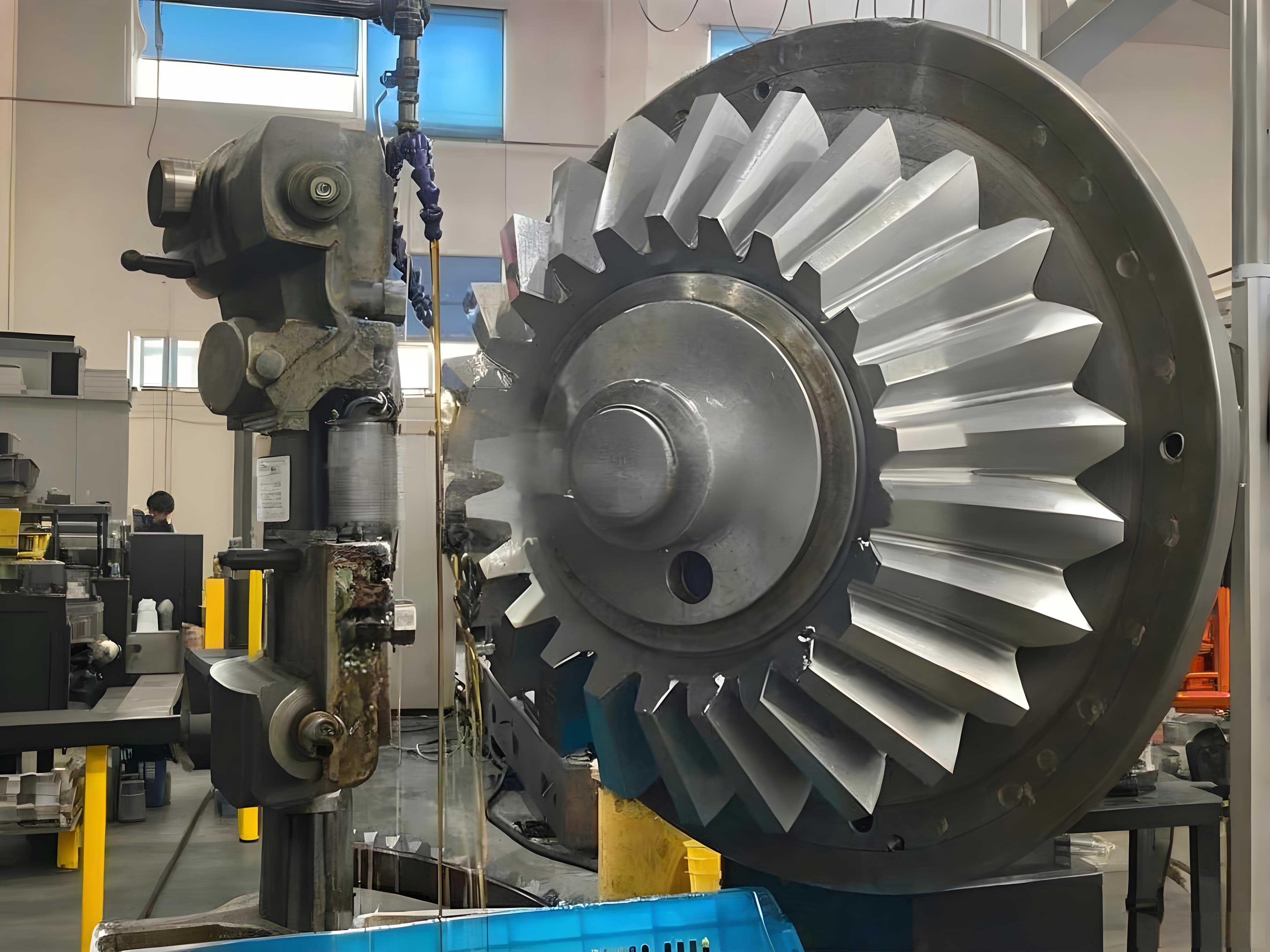
The fundamental necessity for modifying miter gears stems from the discrepancy between theoretical design and real-world operation. In a practical gear transmission assembly, components such as the gears themselves, supporting shafts, bearings, and the housing are not perfectly rigid. Under operational loads, they experience elastic deformations. Furthermore, factors like manufacturing inaccuracies, installation errors, and thermal expansion due to friction and lubricant heating contribute to misalignments and deviations from the ideal conjugate mesh. These phenomena lead to several issues: a non-uniform distribution of contact pressure along the face width, edge loading at the ends of the teeth, and fluctuations in the transmission error—the deviation of the output position from its theoretically perfect location. Transmission error is a primary excitation source for gear noise and vibration. Consequently, an unmodified pair of miter gears may suffer from increased dynamic loads, elevated stress concentrations, higher operating temperatures, and premature failure due to pitting, scuffing, or tooth breakage. The core philosophy of gear modification is to proactively alter the tooth’s geometry to compensate for these anticipated deflections and misalignments, thereby guiding the gear pair into a more favorable contact pattern under load. This proactive compensation enhances load distribution, dampens dynamic excitations, reduces noise and vibration, and ultimately increases the power density and service life of the miter gear drive. The modifications are typically applied in two principal directions: profile (or tip/root) modification and lead (or bias) modification, each targeting specific aspects of the meshing behavior.
Principles of Gear Modification
Profile modification involves altering the tooth profile, typically near the tip and/or root regions, from the standard involute form. The most common type is tip relief, where a small amount of material is removed from the tip region of the driving and/or driven gear tooth. The primary objective is to ease the engagement (mesh-in) and disengagement (mesh-out) of the teeth. In an ideal rigid system, the transition of load from one tooth pair to the next (the contact ratio) is instantaneous. In reality, due to tooth deflection, the incoming tooth pair may experience an impact if it comes into contact before the previous pair has sufficiently unloaded. Tip relief creates a slight recess that allows the new tooth pair to enter the mesh more smoothly, reducing this impact force and the associated transmission error peak. The amount of relief, often defined by a parabolic or linear function, is critical; insufficient relief fails to mitigate the problem, while excessive relief reduces the effective contact ratio and can lead to increased stress at the start of the active profile. The optimal profile modification for miter gears is often calculated based on the expected bending deflection under load and the kinematic geometry of the bevel gear set.
Lead modification, on the other hand, deals with the tooth geometry along its face width (the lead direction). In a perfect alignment scenario, the contact pattern under load should be centered on the tooth flank. However, shaft deflection, bearing clearance, and manufacturing errors often cause the gear to tilt, leading to the contact shifting towards one end of the tooth. This edge loading is highly detrimental. Lead modification, often called crowning or bias correction, introduces a slight barrel-shaped curvature along the tooth length or a bias angle. This curvature ensures that even under misalignment, the contact ellipse remains within the central portion of the tooth flank, promoting a uniform pressure distribution. For miter gears, which have a conical shape, lead modification must be carefully applied considering the convergence of the tooth towards the apex. The modification is usually defined relative to the pitch cone. The effectiveness of both profile and lead modifications is interdependent, and they are often applied in combination to achieve a comprehensive optimization of the miter gear meshing behavior.
The mathematical description of a modified tooth surface for a miter gear can be complex, building upon the standard bevel gear geometry. The unmodified tooth surface coordinates, derived from the basic gear geometry parameters, serve as the baseline. Modification functions are then superimposed. For instance, a linear lead crowning modifies the tooth surface coordinate \( z \) (along the face width) by adding a function of the form:
$$ \Delta z(x, y) = C_l \cdot (y – y_{mid})^2 $$
where \( C_l \) is the lead crowning coefficient and \( y_{mid} \) is the midpoint of the face width. Profile relief can be similarly defined as a function of the roll angle or distance along the profile path. The composite modified surface \( S_{modified}(u,v) \) becomes:
$$ S_{modified}(u,v) = S_{ideal}(u,v) + \Delta_{lead}(u,v) + \Delta_{profile}(u,v) $$
where \( u \) and \( v \) are the surface parameters.
Finite Element Modeling of Modified Miter Gears
To accurately analyze the impact of these modifications, a high-fidelity virtual model is essential. This study utilizes a systematic modeling approach within a specialized transmission simulation environment, Romax. The process begins with the precise definition of the miter gear pair. The key geometric parameters of the baseline (unmodified) gears are detailed in the table below. These parameters are fundamental for generating the initial solid model.
| Parameter | Pinion (Gear I) | Gear (Gear II) | Unit |
|---|---|---|---|
| Number of Teeth (z) | 24 | 20 | – |
| Module (m) | 3 | 3 | mm |
| Normal Pressure Angle (α) | 20 | 20 | deg |
| Shaft Angle (Σ) | 90 | 90 | deg |
| Face Width (b) | 40 | 40 | mm |
| Pitch Diameter | 72 | 60 | mm |
| Gear Ratio | 1.2 | – | – |
Subsequently, a three-dimensional solid model of the entire transmission assembly is created. This assembly model is crucial as it captures system-level interactions. It includes the two miter gears, their corresponding steel shafts, and the supporting bearing pairs at each shaft end. This assembly is then imported into the Romax software environment. Within Romax, a sophisticated finite element model is constructed. The software generates a detailed mesh for the gear teeth, allowing for precise calculation of contact stresses and deformations. The material properties assigned to each component are critical inputs for the structural analysis. The following table summarizes the material properties used in this simulation model.
| Component | Material | Density (ρ) | Young’s Modulus (E) | Poisson’s Ratio (ν) | Yield Strength (σ_y) |
|---|---|---|---|---|---|
| Miter Gears | 40Cr Alloy Steel | 7820 kg/m³ | 211 GPa | 0.30 | 785 MPa |
| Transmission Shafts | 45 Carbon Steel | 7800 kg/m³ | 210 GPa | 0.30 | 355 MPa |
| Support Bearings | GCr15 Bearing Steel | 7810 kg/m³ | 210 GPa | 0.29 | 1458 MPa |
The modification parameters are then applied to the tooth surfaces of the miter gears in the model. For this analysis, a combination of lead crowning and profile relief is implemented. The lead crowning is applied symmetrically, removing material towards both ends of the tooth to create a centered contact. The profile relief is applied at both the tip and root regions to soften the entry and exit of the mesh. The specific modification amounts used in this simulation are defined as functions of the face width and roll angle, respectively, and are programmed into the gear definition within Romax. This creates a “loaded tooth contact analysis” model that can simulate the meshing behavior under realistic operating conditions, accounting for system deflections.
Simulation Results and Detailed Analysis
The finite element model is subjected to dynamic analysis under specified operating conditions: an input speed of 1500 rpm (157.08 rad/s) and a constant output torque corresponding to a nominal tangential load at the mean radius of approximately 1250 N. The simulation solves for the dynamic response over several complete mesh cycles to ensure statistical significance. The key performance indicators analyzed include dynamic mesh force, time-varying mesh stiffness, and most importantly, the transmission error.
1. Dynamic Mesh Force: The mesh force is the internal force acting between the contacting teeth of the miter gears. In a perfect, rigid system, this force would be constant for a constant load. However, due to variations in mesh stiffness and transmission error, it fluctuates. The root mean square (RMS) and peak-to-peak values of this fluctuation are indicators of dynamic loading. The simulation results show that the unmodified miter gear pair exhibits a mesh force with a mean value around 7832.5 N and a certain amplitude of oscillation. After applying the optimal modification, the mean mesh force shifts slightly to around 7830 N. More significantly, the amplitude of the dynamic fluctuation is reduced. This reduction indicates that the modifications have successfully dampened the impact forces during mesh transitions. The smoother force transmission directly correlates to lower vibration excitation and reduced bearing forces in the system housing the miter gears. The dynamic mesh force \( F_m(t) \) can be conceptually related to the static load \( F_{static} \) and the dynamic transmission error \( e(t) \) through a simplified model:
$$ F_m(t) \approx k_m(t) \cdot ( \Delta s – e(t) ) $$
where \( k_m(t) \) is the time-varying mesh stiffness and \( \Delta s \) is the static deflection path. Modification alters \( e(t) \), thereby smoothing \( F_m(t) \).
2. Time-Varying Mesh Stiffness: Mesh stiffness is a periodic function that depends on the number of teeth in contact (contact ratio) and the instantaneous contact geometry along the tooth profile. As a pair of miter gear teeth roll through the mesh, the location of the contact point moves, changing the effective lever arm and the local contact conformity, which in turn changes the stiffness. The graph of mesh stiffness versus pinion roll angle reveals a characteristic waveform. The unmodified gears show a stiffness curve with sharper transitions and potentially higher peak values. The modified gears exhibit a stiffness curve with more rounded transitions and a slightly reduced average stiffness magnitude. This is a direct consequence of profile relief, which effectively reduces the material engaged at the very beginning and end of the contact path. While a lower peak stiffness might seem counterintuitive, the smoother variation is more beneficial as it reduces the fluctuation in the force for a given transmission error, lowering the dynamic amplification. The overall energy of the stiffness variation harmonic content is reduced, which is favorable for noise generation.
3. Transmission Error (TE): Transmission error is the cornerstone metric for gear noise and dynamic performance. It is defined as the difference between the actual angular position of the output gear and the position it would occupy if the gears were perfectly conjugate and rigid. TE is usually expressed in microns of linear deviation at the pitch circle. The simulation calculates the static transmission error (STE)—the error under load excluding torsional vibrations—which serves as the primary excitation function. The results are illuminating. The unmodified miter gears produce a transmission error curve that rises sharply at the start of single-tooth contact, has a plateau, and then falls sharply at the transition to double-tooth contact. This trapezoidal-like shape contains significant harmonic content, especially at the tooth meshing frequency and its multiples. After modification, the transmission error curve is dramatically altered. The sharp peaks and valleys are substantially attenuated. The curve becomes more sinusoidal in nature, with a significantly reduced peak-to-peak amplitude. The reduction in the amplitude of the first harmonic of TE can be estimated. If the unmodified TE has a peak-to-peak amplitude \( A_{unmod} \) and the modified has \( A_{mod} \), the reduction in dynamic force excitation can be proportional to \( (A_{unmod} – A_{mod}) \). This smoothing of the excitation source is the most direct contributor to lower noise and vibration levels in a system utilizing modified miter gears. The optimized TE waveform indicates that the modifications have successfully compensated for the deflections, allowing the teeth to maintain a more consistent kinematic relationship throughout the mesh cycle.
The comprehensive effect of these changes can be summarized by considering the system’s dynamic response. The modified miter gear pair presents a lower and smoother excitation (TE) to a system whose acceptance (governed by mesh stiffness and system inertia) has also been slightly softened and smoothed. The product of excitation and acceptance determines the dynamic response. Therefore, the overall vibration and noise levels are predictably lower for the modified configuration. This has direct implications for the design of quieter machinery, improved passenger comfort in automotive applications, and reduced dynamic stress for longer component life in industrial settings like mining, where miter gears are frequently employed in right-angle drives for conveyors and other equipment.
Conclusion and Practical Implications
This detailed finite element investigation substantiates the critical role of strategic tooth modification in enhancing the performance of miter gear pairs. By implementing a combination of profile and lead modifications tailored to the specific geometry and expected load conditions, engineers can effectively transform the meshing characteristics of these gears. The primary outcomes are a significant reduction in the peak-to-peak transmission error, a smoothing of the time-varying mesh stiffness function, and a consequent dampening of dynamic mesh force fluctuations. These improvements collectively translate into tangible benefits for any transmission system: markedly lower noise and vibration emissions, a more uniform distribution of contact stress across the tooth flanks mitigating the risk of premature pitting and wear, and a reduction in dynamic overloads that contribute to tooth bending fatigue. For high-performance, high-reliability applications—whether in the demanding environment of coal mine machinery, the precision-driven automotive sector, or general power transmission industries—the application of optimized modification to miter gears is not merely a refinement but an essential design practice. It provides a direct pathway to achieving higher power density, greater operational smoothness, and extended service life from a given gear set size and material. Future work in this domain could explore the interaction of modification with advanced lubrication regimes, the effects on scuffing resistance under high-speed conditions, and the development of automated optimization algorithms that define modification parameters based on multi-objective goals including stress, noise, and efficiency for custom miter gear applications.