
The precise transmission of motion and power between intersecting shafts is a cornerstone of mechanical design, with straight bevel gears serving as a fundamental solution. Among these, miter gears, characterized by a 1:1 ratio and a 90-degree shaft angle, represent a critical and widespread configuration in applications requiring direction change with high positional accuracy. The performance, manufacturability, and cost of these gears are intrinsically linked to the geometry of their tooth flanks. Historically, two primary tooth surface types have been developed for straight bevel gears: the spherical involute and the octoidal form. The spherical involute offers a theoretically perfect analog to the planar involute, extending its favorable meshing properties to the surface of a sphere. In contrast, the octoidal tooth surface is generated by a crown gear with planar flank profiles, which greatly simplifies the tool geometry. This study undertakes a comprehensive comparative investigation of these two tooth surface types for miter gears, focusing on mathematical modeling, ease-of-manufacture implications, and ultimately, their performance under load as evaluated through finite element analysis.
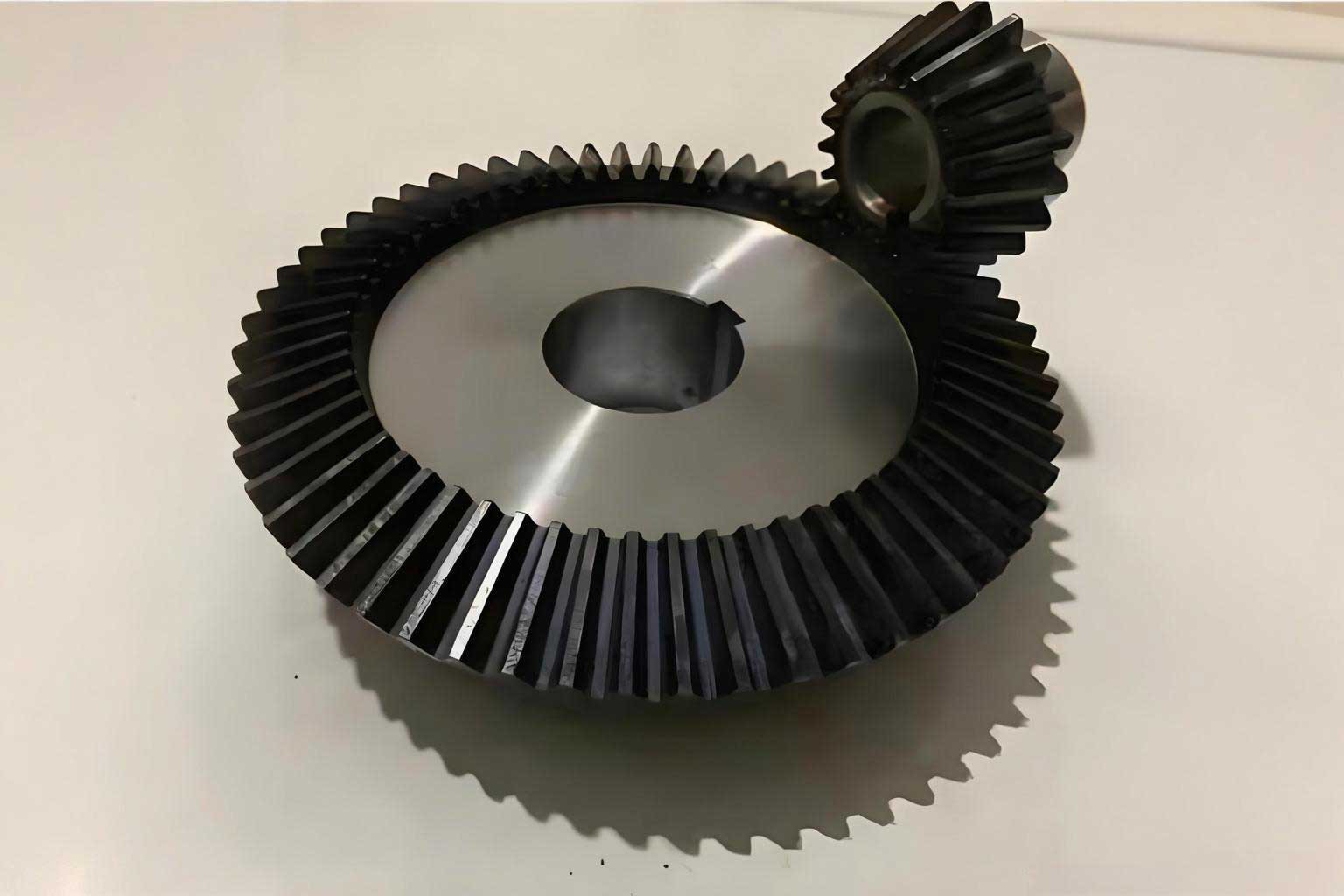
From a manufacturing standpoint, the advantage of the octoidal form is significant. The crown gear (or generating gear) used to produce octoidal miter gears possesses straight-line teeth, making the cutting tool exceptionally simple to produce, sharpen, and maintain compared to the complex curved tool required for a spherical involute crown gear. This simplicity translates directly to lower tooling costs, higher production efficiency, and improved machining accuracy. Therefore, a critical question arises: can the more manufacturable octoidal miter gears functionally replace spherical involute ones without compromising performance? This research aims to answer this by constructing precise mathematical models for both gear types, including the often-overlooked fillet region, and subjecting them to rigorous contact and stress analysis.
Mathematical Foundation of Tooth Surfaces
Spherical Involute Tooth Surface
The spherical involute is derived by projecting the concept of a planar involute onto a spherical surface. Consider a base cone with an apex at the sphere’s center O. A generating plane Π, tangent to this base cone along a line, rolls without slipping over the cone’s surface. The trace of a point P fixed on plane Π generates a spherical involute curve on the sphere.
Defining coordinate systems is crucial for the derivation. Let coordinate system \(S_0(O_0-x_0, y_0, z_0)\) be fixed to the generating plane Π, with \(O_0\) coinciding with the sphere center. The point P lies on the \(z_0\) axis. The final coordinate system \(S_3(O_3-x_3, y_3, z_3)\) is attached to the bevel gear, with its \(z_3\)-axis aligned with the gear’s axis. The transformation from \(S_0\) to \(S_3\) involves intermediate systems accounting for the roll angle \(\phi\) of the plane and the base cone angle \(\gamma_b\). The relationship between the roll angle \(\phi\) and the involute generation angle \(\psi\) is given by \(\phi = \sin \gamma_b \cdot \psi\).
The position vector of point P in \(S_0\) is \(\mathbf{r}_0^{(P)} = [0, 0, r_0, 1]^T\), where \(r_0\) is the spherical radius. Applying successive coordinate transformations yields the spherical involute surface in the gear coordinate system \(S_3\):
$$
\mathbf{r}_3^{(P)}(\psi, \phi) = \mathbf{M}_{32}(\psi) \cdot \mathbf{M}_{21} \cdot \mathbf{M}_{10}(\phi) \cdot \mathbf{r}_0^{(P)}
$$
Here, \(\mathbf{M}_{10}(\phi)\), \(\mathbf{M}_{21}\), and \(\mathbf{M}_{32}(\psi)\) are the \(4\times4\) homogeneous transformation matrices. Similarly, the unit normal vector \(\mathbf{n}_3^{(P)}\) to the surface at point P can be found by transforming the initial normal \(\mathbf{n}_0=[1,0,0]^T\) using the rotational sub-matrices \(\mathbf{L}_{ij}\) of the corresponding \(\mathbf{M}_{ij}\) matrices.
Octoidal Tooth Surface via Planar Crown Gear
The octoidal tooth surface for miter gears is generated through the simulation of a meshing process with a crown gear (rack) whose teeth have straight-sided, planar flanks. This crown gear has a pitch angle of 90° and acts as a hypothetical generating tool. The geometry of this planar crown gear is defined by its base cone angle \(\gamma_b^{cg}\) and tooth thickness. For a gear with pressure angle \(\alpha\), the crown gear’s base cone angle is \(\gamma_b^{cg} = 90° – \alpha\). The angular tooth thickness \(t_p\) at the pitch cone is \(t_p = 180° / N_{cg}\), where \(N_{cg}\) is the number of teeth on the crown gear, related to the generated pinion’s tooth count \(N_1\) and pitch angle \(\gamma_1\) by \(N_{cg} = N_1 / \sin \gamma_1\).
The crown gear’s flank surface is a plane. In a coordinate system \(S_{cg}\) attached to the crown gear, the equation for this planar surface, parameterized by \(\rho\) and \(\phi\), can be expressed as:
$$
\mathbf{r}_{cg}(\rho, \phi) =
\begin{bmatrix}
\pm \rho \left[ \cos\phi \sin(\frac{t_p}{2} + \theta_p) – \sin\alpha \sin\phi \cos(\frac{t_p}{2} + \theta_p) \right] \\
\rho \left[ \cos\phi \cos(\frac{t_p}{2} + \theta_p) \pm \sin\alpha \sin\phi \sin(\frac{t_p}{2} + \theta_p) \right] \\
-\rho (\sin\phi \cos\alpha) \\
1
\end{bmatrix}
$$
where \(\theta_p\) is the pitch cone polar angle, and the ± signs correspond to the left and right flanks, respectively.
To generate the pinion tooth surface, we consider the kinematic motion of the crown gear rotating with angle \(\psi_{cg}\) relative to the pinion blank rotating with angle \(\psi_1\). The generated pinion surface \(\mathbf{r}_1\) is the envelope of the family of crown gear surfaces in the pinion coordinate system \(S_1\):
$$
\mathbf{r}_1(\rho, \phi, \psi_1) = \mathbf{M}_{1, cg}(\psi_1) \cdot \mathbf{r}_{cg}(\rho, \phi)
$$
The relation between the generating rotations is \(\psi_{cg} = (N_1 / N_{cg}) \psi_1\). The specific form of the surface is determined by the meshing (or equation of contact), which states that the common normal vector at the contact point must be perpendicular to the relative velocity vector:
$$
f_{1}^{cg}(\rho, \phi, \psi_1) = \left( \frac{\partial \mathbf{r}_1}{\partial \rho} \times \frac{\partial \mathbf{r}_1}{\partial \phi} \right) \cdot \frac{\partial \mathbf{r}_1}{\partial \psi_1} = 0
$$
Solving this equation simultaneously with the surface equation yields the explicit octoidal tooth surface of the pinion.
Model Construction: Working Flank and Root Fillet
A complete and accurate model for finite element analysis (FEA) must include not just the active working flank but also the transition fillet connecting the flank to the root land. While the working surfaces are derived from meshing theory, the fillet is a trochoid generated by the tip of the cutting tool, and its exact mathematical description can be complex.
To ensure a continuous and smooth transition (\(G^1\) continuity) from the working surface to the root cylinder, a Hermite interpolation method is employed for both gear types. This method constructs a curve between a defined start point \(P_0\) on the working surface and an end point \(P_1\) on the root surface, matching not only the points but also their tangent vectors \(T_0\) and \(T_1\). The Hermite curve \(\mathbf{r}(t)\) is given by:
$$
\mathbf{r}(t) = (2t^3 – 3t^2 + 1)P_0 + (-2t^3 + 3t^2)P_1 + (t^3 – 2t^2 + t) \cdot \frac{t_0 s}{A_0} T_0 + (t^3 – t^2) \cdot \frac{t_1 s}{A_0} T_1
$$
where \(t \in [0,1]\) is the interpolation parameter, \(s\) is the distance from the apex to the root, \(A_0\) is the outer cone distance, and \(t_0\), \(t_1\) are scalar weighting factors controlling the “tightness” of the curve to the tangents at the endpoints. Sweeping this curve along the root line creates the fillet surface. This approach provides a high-quality approximation suitable for strength analysis.
Case Study: Geometry and Contact Analysis
A pair of 1:1 ratio miter gears with a 90° shaft angle is analyzed. The basic parameters are summarized in the following table:
| Parameter | Symbol | Value | Unit |
|---|---|---|---|
| Number of Teeth | \(z_1, z_2\) | 25 | – |
| Module (at large end) | \(m\) | 5.0 | mm |
| Pressure Angle | \(\alpha\) | 25.0 | ° |
| Shaft Angle | \(\Sigma\) | 90.0 | ° |
| Face Width | \(F_w\) | 29.2 | mm |
| Addendum Coefficient | \(h_a^*\) | 1.0 | – |
| Dedendum Coefficient | \(h_f^*\) | 1.25 | – |
Tooth Surface Deviation (Ease-off)
The primary geometric difference between the two types of miter gears is quantified by calculating the “ease-off” topography. This is defined as the normal deviation between the octoidal surface and the spherical involute surface, projected onto the normal vector of the spherical involute surface. A positive deviation indicates the octoidal surface is “further out” (material added) relative to the involute surface, while a negative value indicates it is “further in” (material removed).
The analysis reveals a systematic pattern: the octoidal tooth is thicker at the root (near the fillet) and slightly thinner at the tip (toe) compared to its spherical involute counterpart. For the given parameters, the deviation ranges from approximately +7.6 μm at the root to -3.5 μm at the tip. This inherent modification has direct implications for strength and contact.
Further parametric studies show that the magnitude of this maximum deviation scales linearly with key design parameters. This relationship can be summarized as follows:
| Varying Parameter | Effect on Max Absolute Deviation | Approximate Trend |
|---|---|---|
| Module (\(m\)) | Increases linearly with module. | \(\Delta_{max} \propto m\) |
| Pressure Angle (\(\alpha\)) | Increases linearly with pressure angle. | \(\Delta_{max} \propto \alpha\) |
Tooth Contact Analysis (TCA)
Tooth Contact Analysis simulates the meshing of the gear pair under no-load conditions to predict the contact pattern and transmission error. For the ideal, unmodified geometries of both spherical involute and octoidal miter gears, the TCA results indicate a theoretically perfect line contact across nearly the entire active flank. The calculated transmission error for both types is negligible, approaching zero, which is characteristic of conjugate action. This confirms that, kinematically, both tooth forms provide perfect motion transfer for the ideal geometry.
Finite Element Analysis for Strength Comparison
While TCA predicts kinematic behavior, Finite Element Analysis (FEA) is essential to evaluate structural performance under load. Three-dimensional static stress models of both gear pairs were built. The models incorporated the precisely defined working flanks and the Hermite-interpolated fillets. The material was defined as standard steel (Elastic Modulus \(E = 206\) GPa, Poisson’s ratio \(\nu = 0.3\)). A series of pinion input torques from 800 N·m to 1400 N·m was applied.
Root Fillet Bending Stress
The influence of the fillet modeling parameters \(t_0\) and \(t_1\) on the maximum bending stress was investigated for the octoidal gear. As expected, increasing these parameters, which tightens the fillet curve against the tangents (creating a sharper fillet), leads to an increase in the maximum bending stress concentration. For a consistent comparison, identical, moderately low values of \(t_0\) and \(t_1\) were used for both gear types in the subsequent stress comparison.
The key finding is that across the entire torque range, the octoidal miter gears exhibited lower maximum root bending stress compared to the spherical involute gears. At the nominal load of 1000 N·m, the reduction in maximum bending stress was approximately 6.24%. This is a direct consequence of the positive deviation (added material) in the root region of the octoidal tooth, which effectively thickens the critical section.
Contact Stress and Edge Contact
The analysis of contact pressure (Hertzian stress) revealed another significant advantage of the octoidal form. The spherical involute gear pair showed a sharp, abnormal increase in maximum contact stress at a pinion torque of 1200 N·m. Examination of the contact pressure contour plot clearly indicated edge contact at the toe of the tooth. In contrast, the octoidal gear pair maintained a stable, relatively lower maximum contact stress at this torque, with the contact pattern well-contained within the flank boundaries.
This behavior is attributed to the negative deviation (thinning) at the tooth tip of the octoidal gear. This acts as a built-in, very slight tip relief, preventing contact from reaching the very edge of the tooth under moderate misalignment or load deflection. Only at a higher torque of 1400 N·m did the octoidal gear also begin to exhibit edge contact. The comparative stress data is consolidated below:
| Pinion Input Torque (N·m) | Max Contact Stress – Spherical Involute (MPa) | Max Contact Stress – Octoidal (MPa) | Max Bending Stress – Spherical Involute (MPa) | Max Bending Stress – Octoidal (MPa) |
|---|---|---|---|---|
| 800 | ~1250 | ~1180 | ~285 | ~268 |
| 1000 | ~1560 | ~1475 | ~356 | ~334 (6.24% lower) |
| 1200 | ~2100 (Edge Contact) | ~1770 | ~427 | ~401 |
| 1400 | ~2250 | ~2080 (Edge Contact) | ~498 | ~467 |
Conclusion
This detailed comparative study between spherical involute and octoidal straight bevel miter gears leads to several important conclusions that strongly favor the adoption of the octoidal form for many applications.
Firstly, the mathematical modeling confirms that the working surfaces are very close kinematically. The octoidal surface, generated by a simple planar crown gear, deviates from the spherical involute in a predictable, systematic way: the tooth becomes progressively thicker towards the root and slightly thinner towards the tip. This deviation scales linearly with module and pressure angle.
Secondly, and most significantly, this inherent geometric deviation translates into tangible performance benefits. The thickened root section of the octoidal tooth provides a higher resistance to bending fatigue, as evidenced by a consistent reduction (approximately 6.24% at design load) in the maximum root fillet stress. Concurrently, the slightly thinner tip acts as a natural, minimal form of tip relief. This proves highly beneficial in preventing premature edge contact under load, a common failure mode in bevel gears, thereby improving surface durability and reducing the risk of scuffing under moderate overloads.
Therefore, when considering the design of straight bevel miter gears, the octoidal tooth form presents a compelling case. It combines superior manufacturability due to simplified tooling with unexpectedly improved mechanical performance—enhanced bending strength and better contact pattern control. For applications where cost, manufacturing precision, and reliability are paramount, the octoidal miter gear is not merely an acceptable substitute for the spherical involute, but often a preferable choice.