
In the realm of gear manufacturing, straight bevel gears, often referred to as miter gears when the shaft angle is 90 degrees, play a crucial role in transmitting motion between intersecting axes. Form milling remains a vital process for producing these gears in small batches or for repair purposes, especially when dedicated bevel gear cutting equipment is unavailable. However, the accuracy of form-milled miter gears heavily depends on the correct application of milling techniques and precise calculation of process parameters. Based on my extensive experience and analysis, many existing guidelines for form milling straight bevel gears contain inconsistencies, particularly regarding the relationship between cutter tooth form and cutting method. This article aims to elucidate the correct principles for using standard bevel gear milling cutters, explore accurate computational methods for key parameters, and propose pathways to enhance the quality of milled miter gears.
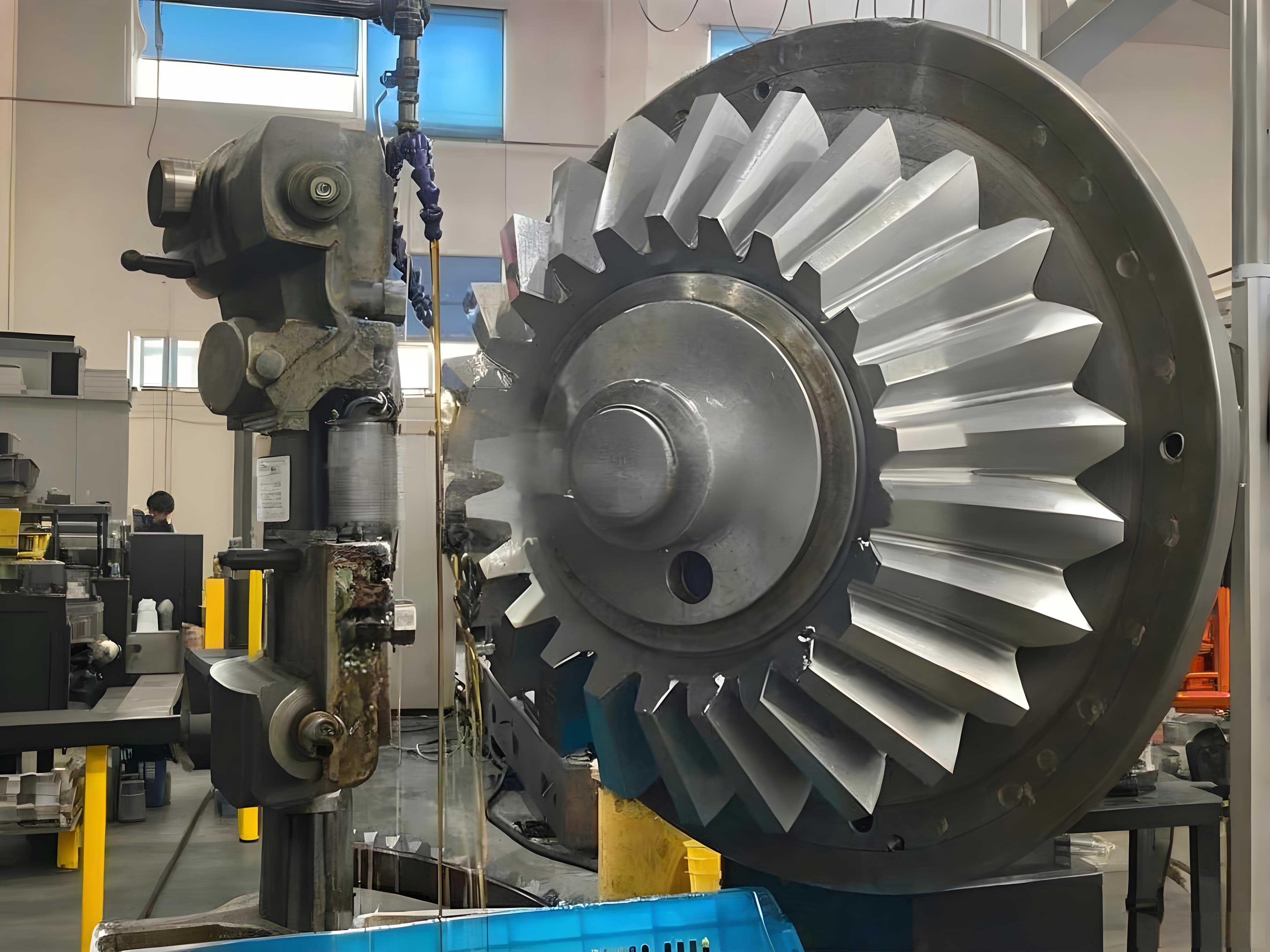
The fundamental challenge in form milling straight bevel gears arises from their spherical involute tooth profile, where the tooth shape and thickness vary continuously along the face width. Unlike cylindrical gears, the tooth form is not constant across the gear face. Therefore, a form milling cutter can only approximate this profile, typically being designed based on the tooth geometry at the large end of the gear. The accuracy of the final miter gear depends on how well the milling process compensates for the inherent geometrical discrepancies between the cutter profile and the desired small-end tooth form. In practice, several milling strategies exist, but each requires a cutter with a specific tooth form derived from its underlying cutting kinematics. Confusion between these strategies is a primary source of error in many workshop manuals.
Standard straight bevel gear milling cutters produced, for instance, are designed for a specific cutting method. These cutters are marked with a distinctive symbol (often a small circle or dot on the face) and their tooth profile is generated based on the large-end tooth form of a reference gear with a designated virtual tooth number $z_v$ and a specific pressure angle. The critical design parameter is the angular offset $\lambda$ which defines the position of the large-end tooth profile curve relative to the radial plane of the cutter. When such a cutter is used, the correct milling sequence involves a two-stage process for each tooth space: roughing the entire slot, followed by precise finishing cuts on each flank separately. This requires coordinated lateral displacement of the workpiece (or cutter) and rotation of the gear blank.
Specifically, after rough milling a tooth slot aligned symmetrically with the cutter axis, the gear blank must be shifted laterally by a precise offset distance $S$ along the direction of the cutter axis. Simultaneously, the blank is rotated about its own axis by a small angle $\omega$. This combined motion positions the cutter to finish one flank (e.g., the right-hand flank) of all tooth spaces. Subsequently, the blank is shifted in the opposite direction by a distance of $2S$ and rotated by $2\omega$ in the reverse direction to finish the opposite flanks. The angle $\omega$ is adjusted based on the required semi-value of the finishing allowance at the large end. This method ensures that the cutter’s tooth profile is correctly positioned relative to the gear’s theoretical large-end form curve. Alternative methods, such as tilting the workpiece holder about an axis perpendicular to the machine table, are theoretically valid but require cutters with a different tooth form design. Using the standard dot-marked cutter with such alternative methods introduces significant tooth profile errors, compromising the quality of the miter gears.
The cornerstone of achieving accuracy with standard cutters is the correct calculation and setting of the lateral offset $S$. This offset ensures that during the finishing cut, the cutter’s active profile coincides with the designed large-end tooth form curve (Curve 1 in the typical geometric diagram). The value of $S$ is not arbitrary; it is derived from the cutter’s own design parameters and its measured tooth thickness. Let $T$ be the actual tooth thickness of the cutter measured at a standard depth (e.g., $1.2m_0$ from the tooth tip, where $m_0$ is the cutter’s module). Let $e$ be the distance from the pitch point $P$ on the large-end form curve to the gear’s axial plane when the curve is in its design position. This distance $e$ is a function of the cutter’s design virtual tooth number $z_v$ and the angle $\lambda$:
$$ e = r_{ev} \sin(\eta – \lambda) = \frac{m_0 z_v}{2} \sin\left(\frac{90^\circ}{z_v} – \lambda\right) $$
Here, $r_{ev}$ is the virtual pitch radius and $\eta$ is related to the tooth geometry. The offset $S$ is then the difference between half the cutter’s tooth thickness and this distance $e$:
$$ S = \frac{T}{2} – e = \frac{T}{2} – \frac{m_0 z_v}{2} \sin\left(\frac{90^\circ}{z_v} – \lambda\right) $$
This can be simplified by defining an offset coefficient $Y$:
$$ Y = \frac{z_v}{2} \sin\left(\frac{90^\circ}{z_v} – \lambda\right) $$
Thus, the fundamental formula for the offset when milling miter gears with standard cutters is:
$$ S = \frac{T}{2} – Y m_0 \tag{1} $$
The value of $Y$ depends solely on the cutter’s design parameters ($z_v$ and $\lambda$), which are fixed for a given cutter number. It is independent of the gear being cut, such as its face width ratio $\phi_R = b / R$ (where $b$ is face width and $R$ is cone distance). This is a critical point often misunderstood. Some common methods calculate $S$ based on the condition that the tooth line passes through the cone apex or based on the small-end tooth top thickness. These methods yield different values for $S$, leading to inaccuracies in the large-end tooth profile and unnecessary thickening of the small-end tooth top. For standard dot-marked cutters, Equation (1) is the only correct basis. The angle $\lambda$ for standard cutters is typically designed for a nominal face width ratio (e.g., $\phi_R = 1/3$), but the cutter’s form curve position is fixed, so $S$ must not be adjusted for the actual $\phi_R$ of the miter gear being produced.
Based on standard cutter design data, the offset coefficients $Y$ for common cutter numbers (suitable for modules $m_0$ from 0.3 to 10 mm) are tabulated below. This table is essential for machinists working with miter gears.
| Cutter Number | $\lambda$ (angle) | Offset Coefficient $Y$ |
|---|---|---|
| 1 | $3^\circ 44’$ | 0.3942 |
| 2 | $3^\circ 14’$ | 0.3902 |
| 3 | $2^\circ 40’$ | 0.3897 |
| 4 | $2^\circ 12’$ | 0.3821 |
| 5 | $1^\circ 47’$ | 0.3807 |
| 6 | $1^\circ 21’$ | 0.3730 |
| 7 | $0^\circ 52’$ | 0.3694 |
| 8 | $0^\circ 22’$ | 0.3534 |
Another crucial parameter is the workpiece setting angle or cutting angle $\delta_f$. This is the angle at which the gear blank is tilted on the milling machine so that the tooth slot bottom (root cone) is parallel to the machine table during cutting. A common error is to set this angle equal to the gear’s root cone angle calculated under the assumption that the root line passes through the pitch cone apex. However, standard dot-marked cutters are designed to produce a constant radial clearance of $0.2m$ (where $m$ is the large-end module) at both ends. Consequently, the actual root cone does not pass through the pitch cone apex. The correct setting angle $\delta_f$ is given by:
$$ \delta_f = \delta – \arctan\left(\frac{m}{R}\right) \tag{2} $$
Here, $\delta$ is the pitch cone angle of the miter gear. Using an incorrect, smaller setting angle results in insufficient cutting depth at the small end, causing errors that increase from the large end to the small end. This also contributes to the small-end tooth top becoming thicker than intended. Proper calculation of $\delta_f$ is therefore vital for the axial positioning of the cutter and the depth of cut across the entire face width of the miter gear.
The issue of small-end tooth top thickness is inherent to form milling of straight bevel gears, including miter gears. Since the cutter profile is based on the large end, it cannot perfectly generate the theoretical small-end tooth form. With correctly calculated offset $S$ and setting angle $\delta_f$, the small-end tooth top thickening is minimized as the cutter design accounts for some of this error. In many cases, for general-purpose miter gears, the small end may not require hand filing. However, for gears with small pitch angles and low tooth counts, the discrepancy can be significant. The small-end tooth top of the pinion may become excessively thick, interfering with the root area of the mating gear’s small end.
A widespread but flawed practice to avoid hand filing is to arbitrarily reduce the offset $S$, thereby thinning the small-end tooth thickness. This approach adversely affects tooth contact pattern, load distribution, and tooth strength. It is not a recommended solution for quality miter gears. A more principled approach I have explored involves modifying the tooth addendum angle $\theta_a$ for the pinion. By slightly increasing $\theta_a$, the addendum height at the small end is effectively reduced, which controls the actual tooth top thickness without severely compromising the tooth form. The reduction in small-end addendum does slightly decrease the local contact ratio, but its impact on the smoothness and load capacity of the miter gear pair is generally less detrimental than the asymmetric thinning of the tooth flanks caused by an incorrect offset. The modified addendum can be calculated to ensure the small-end top land meets specification without filing.
To delve deeper into the kinematics, let’s consider the geometry in more detail. The virtual gear used for cutter design has a pitch radius $r_{ev} = m_0 z_v / 2$. The angle $\eta$ is effectively $90^\circ / z_v$ in the context of the basic rack profile. The derivation of $e$ comes from projecting the large-end form curve onto a plane perpendicular to the root cone line. The correctness of Equation (1) can be verified by considering that for a given cutter number, the profile is fixed, so the distance from the cutter’s tooth centerline to the gear’s axial plane during the finishing cut must be constant for all gears within its range, regardless of their actual tooth count or face width. This ensures the large-end profile accuracy for all miter gears milled with that cutter.
Furthermore, the rotation angle $\omega$ for the finishing cut is determined by the required side clearance and the excess material on the flanks. If $\Delta s$ is the semi-value of the finishing allowance on the large-end chordal tooth thickness, then the corresponding rotation angle $\omega$ can be approximated by:
$$ \omega \approx \frac{\Delta s}{R \sin \delta} \quad \text{(in radians)} $$
This adjustment is made during the setup after the offset $S$ is applied. Careful sequential finishing of each flank using this method produces miter gears with satisfactory bilateral flank symmetry and proper tooth spacing.
The process capability for form milling miter gears can be enhanced by attention to several ancillary factors. First, cutter condition is paramount. Wear on the cutter teeth directly translates into profile errors. Regular inspection and timely regrinding are essential. Second, the rigidity of the setup—including the milling machine, arbor, cutter, and workpiece fixture—directly influences surface finish and dimensional stability. Vibration can cause chatter marks and inaccuracies. Third, for critical applications, a trial cut on a soft blank and inspection of the tooth form via blue checking or coordinate measurement can help fine-tune the offset $S$ and rotation $\omega$ before machining the final hardened miter gears. Fourth, coolant application should be consistent to manage heat and chip evacuation, especially when cutting tougher materials common in miter gear applications like steel alloys.
It is also instructive to compare the form milling process with other methods like generating (e.g., using a Gleason machine) or CNC milling. While generating produces theoretically accurate spherical involute profiles, and CNC offers high flexibility, form milling remains economically advantageous for very small lots, prototyping, or maintenance repair of individual miter gears. The key is to manage its limitations through precise process control. For instance, the tooth contact pattern of form-milled miter gears will not be as optimal as generated ones, but it can be made acceptable for many industrial drives by following the correct methodology outlined here.
Let’s expand on the mathematical foundation. The geometry of a straight bevel gear, particularly a miter gear where the shaft angle is 90° and often the gear ratio is 1:1, is defined by its pitch cone. The cone distance $R$ is related to the pitch diameter $d$ and pitch angle $\delta$ by $R = d / (2 \sin \delta)$. For a pair of miter gears, $\delta = 45^\circ$. The transverse module at the large end is $m = d / z$, where $z$ is the actual tooth number. The cutter module $m_0$ is chosen to match this large-end module $m$. The relationship between the actual gear and the cutter’s virtual gear is central to the design. The virtual tooth number $z_v$ is typically chosen such that the cutter profile approximates the gear’s form across a range of actual tooth numbers. This is similar to the concept of “gear range” for form cutters for spur gears.
The error analysis for the small-end tooth top thickness can be quantified. The theoretical chordal tooth thickness at the small end $s_{small}$ is given by $s_{small} = m \cdot z \cdot \sin(90^\circ/z) \cdot (R – b)/R$, considering the proportional reduction. The actual thickness produced by the cutter $s’_{small}$ depends on the cutter profile and the offset $S$. The thickening $\Delta s_{top} = s’_{small} – s_{small}$ can be estimated geometrically. When this value exceeds the clearance with the mating gear’s root, interference occurs. The method of increasing the addendum angle $\theta_a$ reduces the addendum at the small end by an amount $\Delta h_a = (R – b) \cdot \tan(\Delta \theta_a)$, where $\Delta \theta_a$ is the incremental increase. This reduction in addendum allows the top land to be machined thinner without altering the flank profile significantly. A practical table for suggested addendum angle modifications for pinions with low tooth counts can be developed through simulation or experiment.
Another table summarizing the step-by-step procedure for form milling a straight bevel gear (miter gear) using a standard dot-marked cutter is beneficial:
| Step | Action | Key Parameter / Calculation |
|---|---|---|
| 1 | Select Cutter | Choose cutter number based on gear tooth count and module $m$. Ensure it has the standard dot mark. |
| 2 | Mount Blank | Set blank on dividing head. Tilt to setting angle $\delta_f$ per Equation (2). |
| 3 | Center Rough Cut | Align cutter symmetrically over blank axis. Rough mill all tooth slots to full depth. |
| 4 | Calculate Offset $S$ | Measure cutter tooth thickness $T$. Compute $S$ using Eq. (1) and table for $Y$. |
| 5 | Finish First Flank | Shift blank laterally by $+S$. Rotate blank by $+\omega$ (based on allowance). Finish cut all right flanks. |
| 6 | Finish Second Flank | Shift blank laterally by $-2S$. Rotate blank by $-2\omega$. Finish cut all left flanks. |
| 7 | Inspect & Adjust | Check large-end tooth thickness and contact pattern. Fine-tune $\omega$ if needed for subsequent gears. |
The application of these principles is not limited to 90° miter gears but extends to any straight bevel gear. However, the simplicity of the 90° configuration makes it a common test case. In high-precision applications, even small errors in offset or setting angle can lead to noisy operation and reduced lifespan of the gear pair. Therefore, investing time in precise setup calculations is justified.
From a metallurgical perspective, the form milling process induces certain residual stresses and work hardening effects on the tooth flanks, especially when cutting without coolant or with worn cutters. For miter gears subjected to high cyclical loads, such as in indexing mechanisms or differentials, these surface conditions can influence fatigue performance. Post-milling processes like shot peening or light grinding (if feasible) can ameliorate some of these effects.
In terms of machine setup, the dividing head must be precise. Any backlash in the rotation mechanism will affect the uniformity of the tooth spacing. Similarly, the lateral feed mechanism for applying the offset $S$ must be sensitive enough to achieve the required displacement, which is often in the range of a few tenths of a millimeter. Using a dial indicator or digital readout is highly recommended. For the rotation angle $\omega$, which is very small (often less than a degree), a sensitive dividing head or a rotary table with a vernier scale is necessary.
The economic aspect of form milling miter gears is also worth noting. For a single gear or a pair, the cost of a dedicated bevel gear cutter and setup time on a universal milling machine is far lower than outsourcing to a specialist with generating equipment. This makes the technique invaluable for repair and maintenance operations across various industries, from agricultural machinery to vintage automotive restoration. The ability to produce a serviceable miter gear on-site can prevent prolonged downtime.
To further illustrate the calculations, let’s consider a numerical example. Suppose we need to mill a 90° miter gear pair with 24 teeth each, a large-end module $m = 4 \text{ mm}$, a face width $b = 20 \text{ mm}$, and a pitch cone angle $\delta = 45^\circ$. The cone distance $R = \frac{m z}{2 \sin \delta} = \frac{4 \times 24}{2 \times \sin 45^\circ} = \frac{96}{1.414} \approx 67.88 \text{ mm}$.
- Cutter Selection: For 24 teeth, a specific cutter number is chosen (e.g., from manufacturer’s tables). Assume it is a No. 3 cutter with $m_0 = 4 \text{ mm}$, $z_v = 30$, and $\lambda = 2^\circ 40’$.
- Setting Angle $\delta_f$: $$ \delta_f = 45^\circ – \arctan\left(\frac{4}{67.88}\right) = 45^\circ – \arctan(0.0589) \approx 45^\circ – 3.37^\circ = 41.63^\circ $$
- Offset $S$: From the table, for cutter No. 3, $Y = 0.3897$. Assume measured cutter tooth thickness $T = 6.28 \text{ mm}$ (typical value). Then $$ S = \frac{6.28}{2} – 0.3897 \times 4 = 3.14 – 1.5588 = 1.5812 \text{ mm} $$
- Rotation Angle $\omega$: If the rough cut leaves an allowance of $\Delta s = 0.5 \text{ mm}$ on the large-end chordal thickness semi-value, then $$ \omega \approx \frac{0.5}{67.88 \times \sin 45^\circ} \text{ rad} = \frac{0.5}{67.88 \times 0.7071} \approx \frac{0.5}{48.0} \approx 0.0104 \text{ rad} \approx 0.6^\circ $$
This example shows the practical application of the formulas. The precise control of these parameters is what separates an accurate miter gear from a poorly functioning one.
In conclusion, the form milling of straight bevel gears, especially miter gears, is a viable and practical manufacturing method when executed with a thorough understanding of the cutter design and correct process kinematics. The prevalent confusion between different cutting methods and their associated cutter tooth forms is a major source of inaccuracy. By adhering to the correct method for standard dot-marked cutters—involving precise lateral offset $S$ calculated via $S = T/2 – Y m_0$, proper workpiece setting angle $\delta_f = \delta – \arctan(m/R)$, and controlled blank rotation—the quality of form-milled miter gears can be significantly improved. Addressing the small-end tooth top thickening through controlled addendum modification, rather than arbitrary offset reduction, preserves tooth strength and contact characteristics. As many workshops lack specialized bevel gear machinery, refining and disseminating accurate form milling practices for miter gears remains of great practical importance for the manufacturing and maintenance of mechanical transmission systems.