
In my extensive career within the forging and gear manufacturing industry, I have witnessed a profound transformation driven by the demand for higher efficiency, precision, and sustainability. Among the various components, miter gears hold a special place due to their critical role in transmitting power between intersecting shafts, typically at right angles. The production of high-quality miter gears through precision forging has become a cornerstone of modern mechanical systems, particularly in automotive applications like differential systems. This article, drawn from my first-hand experiences and technical engagements, delves into the advanced methodologies that define contemporary miter gear forging. I will explore multi-station automated forging lines, closed-die forging (often termed闭塞模锻 in some contexts), and the principles of the Toyota Production System as applied to these processes. My aim is to provide a comprehensive, technically detailed overview, utilizing tables and formulas to encapsulate key data and relationships, all while emphasizing the central theme: the精密锻造 of miter gears.
The traditional forging of miter gears often involved multiple, labor-intensive steps with significant material waste and variability in quality. Today, the shift is towards integrated, automated systems. A standard forging line for components like miter gears historically comprised several presses and required a team of skilled operators. In contrast, a modern multi-station automated forging line consolidates operations. I have been involved in projects where such a line for miter gears features a progression of dies within a single press or a synchronized press line. For instance, a three-station hot forging process for miter gears, which previously needed two operators and yielded around 10-12 pieces per minute, can be automated to achieve 20-25 pieces per minute. This near doubling of efficiency stems from the elimination of manual handling between stations and optimized die cooling. The operator’s role evolves from a manual laborer to a supervisor and controller of the process, enhancing both safety and consistency for miter gear production. The core equation for production rate gain can be simplified as:
$$ \text{Efficiency Gain Factor} = \frac{R_{auto}}{R_{manual}} $$
Where \( R_{auto} \) is the production rate of the automated line for miter gears and \( R_{manual} \) is the rate of the manual line. In the cases I’ve overseen, this factor often approaches or exceeds 2.0 for miter gear lines.
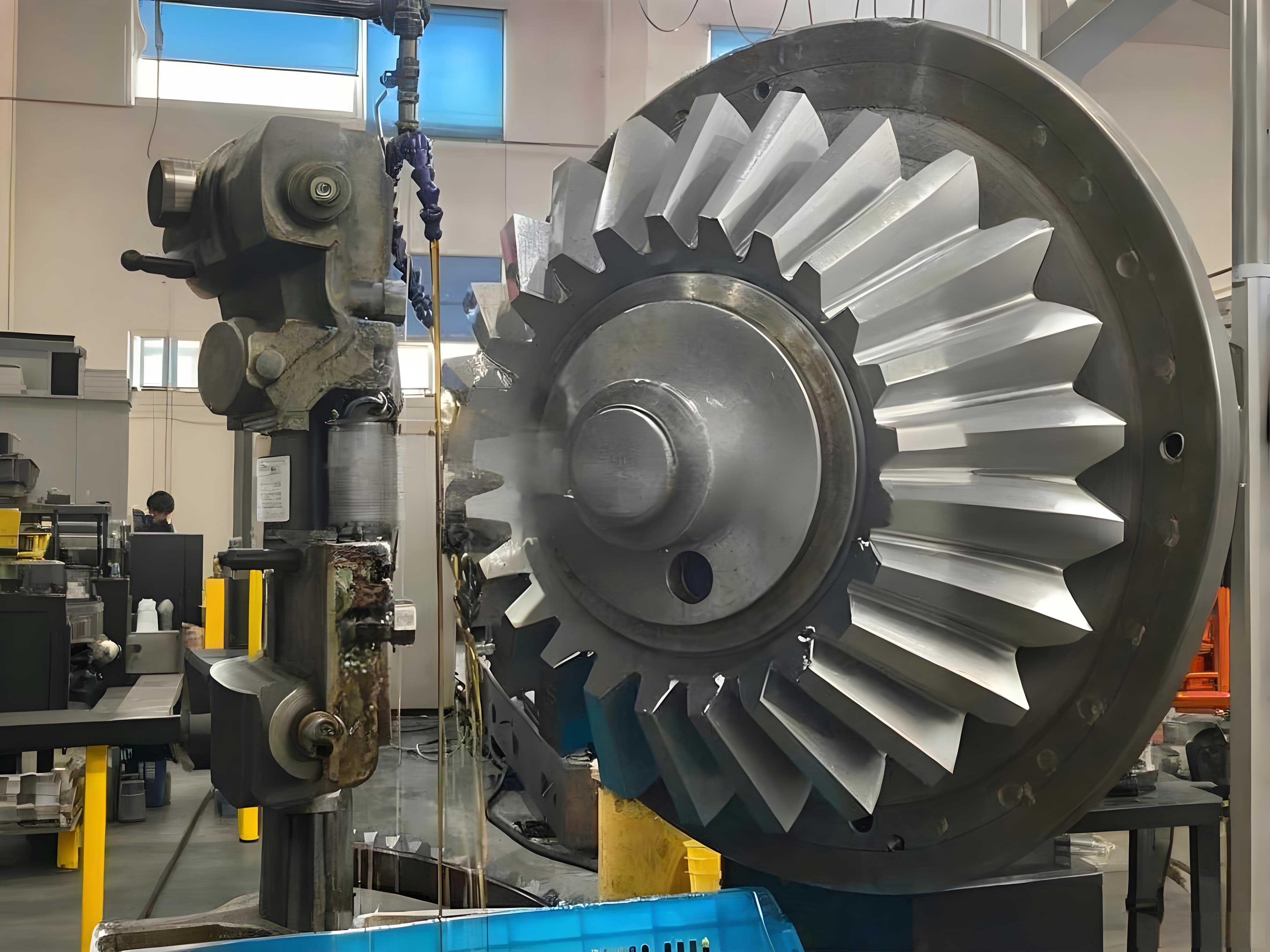
Beyond automation, the forging process itself has been refined. Closed-die forging, or复动成形, represents a leap in precision for complex shapes like miter gears. In this process, after the split dies close to form a sealed cavity, one or more punches act on the billet simultaneously, causing multi-axial metal flow. This allows for the complete or near-complete formation of intricate geometries, such as the teeth of miter gears, in a single press stroke. From my实践, this method drastically reduces machining allowances. For miter gears, the achievable dimensional accuracy and surface finish are remarkable. A comparative analysis of different forging routes for miter gears is best summarized in the following table:
| Forging Process for Miter Gears | Typical Gear Accuracy (DIN Standard) | Surface Roughness, Ra (μm) | Material Utilization Rate | Key Characteristics |
|---|---|---|---|---|
| Conventional Hot Open-Die Forging | 9-10 | 12.5 – 25 | ~70% | Lateral flash, requires more machining, higher labor. |
| Hot Closed-Die Forging | 8-9 | 6.3 – 12.5 | 85% – 90% | Near-net-shape for miter gears, less flash, better grain flow. |
| Cold Closed-Die Forging | 7-8 | 1.6 – 3.2 | 90% – 95% | Excellent precision for miter gears, high strength, no scale. |
| Warm Forging | 8-9 | 3.2 – 6.3 | 88% – 92% | Balance between accuracy and forming force for miter gears. |
The superiority of closed-die forging for miter gears is not just in finish but in mechanical properties. The controlled flow enhances grain structure, which is crucial for the durability of miter gears under cyclic loads. The forging pressure required can be estimated using a fundamental formula:
$$ P = Y_f \cdot K \cdot A $$
Where \( P \) is the forging pressure, \( Y_f \) is the flow stress of the material (which for miter gear steel is temperature and strain-rate dependent), \( K \) is a shape complexity factor (higher for intricate miter gear teeth), and \( A \) is the projected area of the forging. For closed-die forging of miter gears, \( K \) can be significantly higher than for simple shapes, necessitating robust press designs.
Implementing these advanced technical processes is only half the battle; the other half lies in production philosophy. This is where my experience with lean manufacturing, particularly the Toyota Production System (TPS), becomes invaluable. Applying TPS to a precision forging line for miter gears means relentlessly eliminating waste—not just scrap material, but waste in time, inventory, and motion. The two pillars, “Jidoka” (autonomation) and “Just-in-Time,” directly translate to forging miter gears. “Jidoka” implies building in quality at every step. In a miter gear forging line, this means sensors that monitor billet temperature before forging, in-process force monitoring to detect die wear or misplacement, and automated sorting of out-of-spec parts. A simple control logic for the heater could be: if billet temperature \( T < T_{min} \) or \( T > T_{max} \), then reject billet and alert. This prevents defective miter gears from proceeding downstream.
“Just-in-Time” advocates producing only what is needed, when it is needed, and in the amount needed. For a miter gear production cell, this challenges the traditional layout with large intermediate buffers between shearing, heating, forging, heat treatment, and shot blasting. In my redesign projects, we strive for a “one-piece flow” where possible. This requires meticulous balancing of cycle times. The ideal state has zero intermediate inventory. The relationship between station cycle times \( t_i \) for \( n \) stations must satisfy:
$$ \text{Takt Time} = \frac{\text{Available Production Time}}{\text{Customer Demand}} $$
and for a balanced line, \( t_i \approx \text{Takt Time} \) for all \( i \). If the forging press for miter gears has a cycle time of 12 seconds, but the shear runs at 10 seconds, we create overproduction waste. We must either slow the shear or add capability to the forging station. This synchronization is critical for the efficient, waste-free production of miter gears. The benefits are not just in reduced capital tied up in inventory but in faster problem identification and resolution—a scratch on a miter gear is noticed immediately, not days later in a buffer stock.
Let’s delve deeper into the metallurgical and process design aspects specific to miter gears. The tooth form of miter gears presents a unique forging challenge due to the need for precise conjugate profiles to ensure smooth meshing and minimal noise. The preform design is critical. Using upper-bound method analyses or finite element simulation (which I routinely employ), the material flow during the forging of miter gears can be optimized to prevent defects like laps or underfills. The strain distribution \( \epsilon \) within a forging miter gear tooth is complex. A simplified representation for the effective strain in the tooth region can be modeled as:
$$ \bar{\epsilon} \approx \ln\left(\frac{h_0}{h_f}\right) + C \cdot \frac{\Delta r}{r_0} $$
where \( h_0 \) and \( h_f \) are initial and final billet heights in the tooth zone, \( \Delta r \) is the radial displacement, \( r_0 \) is a characteristic radius, and \( C \) is a constant dependent on die geometry for the miter gear. This informs us that both axial compression and radial extrusion are at play in forming miter gear teeth.
The choice between hot, warm, and cold forging for miter gears involves a trade-off analysis. The table below expands on this decision matrix, incorporating more technical parameters:
| Criterion | Hot Forging of Miter Gears | Cold Forging of Miter Gears | Warm Forging of Miter Gears |
|---|---|---|---|
| Typical Temperature | 1150°C – 1250°C | 20°C – 200°C | 600°C – 850°C |
| Flow Stress (MPa, approx.) | 50 – 100 | 600 – 1000 | 200 – 400 |
| Required Press Tonnage | Lower | Very High | Moderate |
| Dimensional Tolerance (on miter gear tooth) | ±0.3 mm | ±0.05 mm | ±0.15 mm |
| Surface Oxidation | Significant (scale) | None | Minimal |
| Post-forging Operations | Often requires machining, cleaning | Minimal or no machining | Light machining may be needed |
| Best For | High-volume, larger miter gears; cost-sensitive | High-precision, small-to-medium miter gears; high strength | Balancing precision and force for complex miter gears |
In my projects focusing on automotive differential miter gears, we often employ a hybrid approach: hot or warm closed-die forging for near-net shape, followed by a cold calibration or sizing strike. This combines the high formability of hot working with the precision of cold working, ultimately yielding miter gears that can be directly assembled in passenger vehicles. The improvement in material utilization for miter gears from, say, 70% in open-die to over 90% in closed-die forging is a direct contributor to sustainability and cost reduction.
The automation aspect extends beyond the press. Robotic handling for loading billets and unloading forged miter gears is now standard. Vision systems for in-line inspection of miter gear tooth profile are being integrated. The overall equipment effectiveness (OEE) of a miter gear forging line becomes a key performance indicator. OEE is calculated as:
$$ \text{OEE} = \text{Availability} \times \text{Performance Efficiency} \times \text{Quality Rate} $$
For a world-class miter gear line, we target an OEE above 85%. Achieving this requires not only reliable hardware but also the TPS mindset of continuous improvement (Kaizen) by the operators and engineers. Every stoppage, every rejected miter gear, is an opportunity for root-cause analysis and prevention.
Looking forward, the trends are clear. The integration of digital twins, where a virtual model of the miter gear forging process simulates and optimizes parameters in real-time, is on the horizon. Additive manufacturing of complex forging dies for prototype or low-volume miter gear production is another exciting development. Furthermore, the demand for lighter, stronger miter gears is pushing the development of new alloys and composite-like structures achievable through advanced forging techniques.
In conclusion, from my vantage point, the精密锻造 of miter gears has evolved from a craft to a high-tech, integrated discipline. The synergy of advanced processes like closed-die forging, automated multi-station lines, and lean production principles has set a new standard. The humble miter gear, a critical component in countless machines, benefits immensely from these advancements, resulting in products that are more precise, durable, and economical to produce. The journey involves constant learning and adaptation, but the destination—a seamless, efficient, and zero-defect production flow for miter gears—is undoubtedly worth the pursuit. The mathematical models and comparative data presented here only scratch the surface of the deep engineering involved, but they underscore the systematic approach required to excel in forging these essential power transmission components.