
As a mechanical design engineer specializing in power transmission systems, I have extensively worked on improving the performance and efficiency of differentials used in various machinery. In this article, I will present a comprehensive overview of the optimization design for straight bevel gear differentials, often referred to as miter gear differentials due to their common use in right-angle drives. These differentials are planetary gear mechanisms known for their simplicity, ease of manufacturing, and maintenance, making them prevalent in applications such as hydraulic power machinery and vehicle transmission systems. To enhance design quality and reduce development cycles, we developed an optimization design software tailored to miter gear differentials, adhering to national design standards and specifications. This software, implemented in a high-level programming language on a personal computer, facilitates geometric calculations, strength verification, and optimization design through a natural language interface with bilingual input/output capabilities. Here, I will delve into the software’s functionality, mathematical modeling, key problem-solving techniques, and practical applications, emphasizing the role of miter gears throughout.
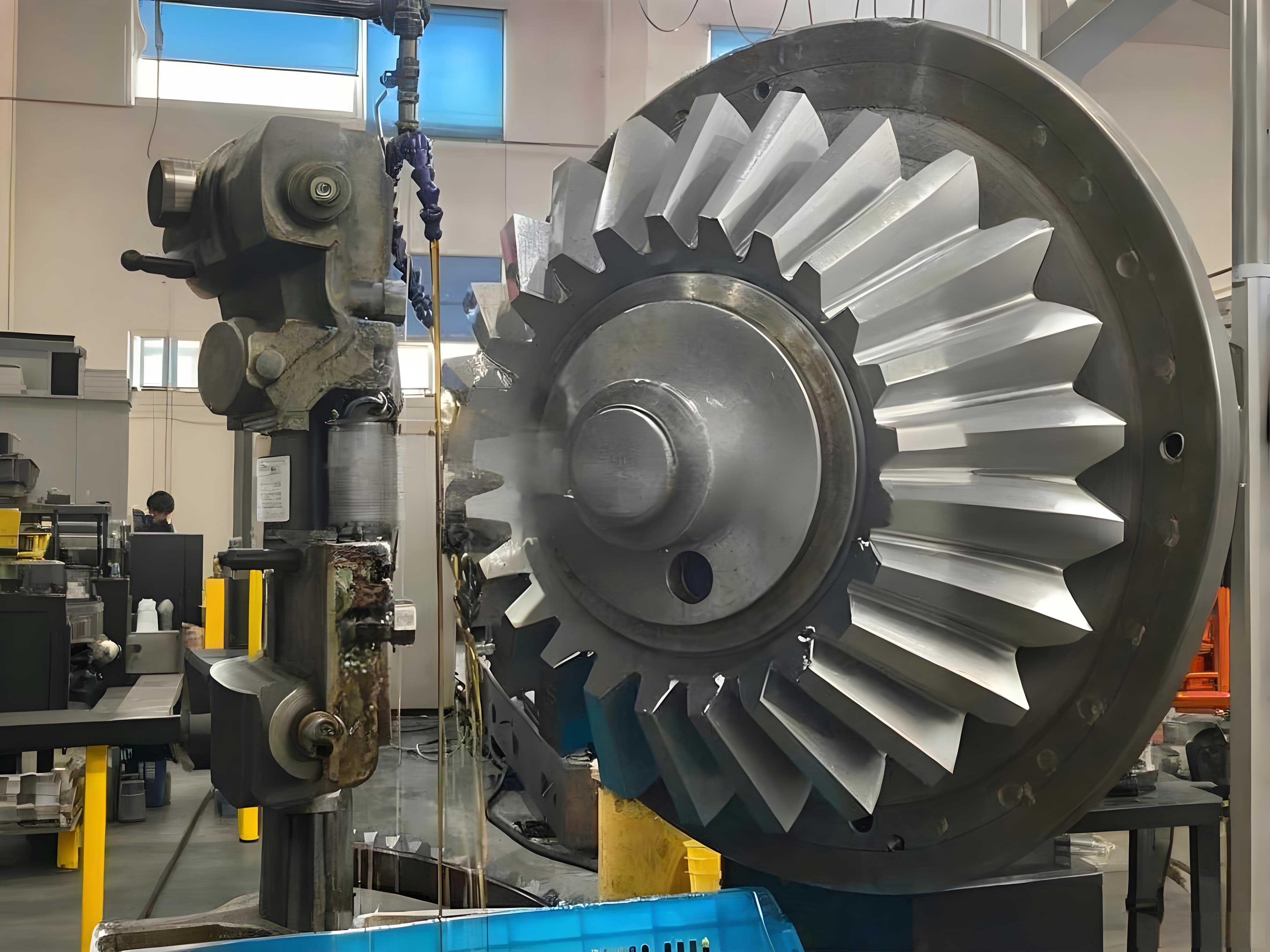
The optimization design software for miter gear differentials is structured modularly, consisting of multiple program modules that interact via calls and data transfer to form an integrated system. The core modules include a main program that manages data areas and execution paths, an input subroutine for entering initial parameters and variable values, function master and subroutines for computing objective and constraint functions, and specialized subroutines for tasks like maximum torque calculation, geometric dimension computation, gear strength analysis, shaft strength evaluation, and optimization algorithm execution. A rounding subroutine handles parameter standardization, while an output subroutine displays all design parameters and saves results to a data file. The program flow is designed such that optimization design invokes strength checking, which in turn calls geometric calculation modules, ensuring a cohesive design process. This modular architecture allows for flexibility in handling different design scenarios, whether for open or closed differential structures, with gear pressure angles of 20° or 22.5°, and using height modification, tangential modification, or angular modification for gear pairs.
In developing the mathematical model for optimizing miter gear differentials, we considered two primary objectives: minimizing volume and maximizing torque capacity. The volume minimization objective is relevant when the differential must transmit a specified torque while ensuring the strength of miter gears, shafts, and planetary pins. The objective function for volume minimization is expressed as:
$$f_1(\mathbf{x}) = \frac{\pi}{4} \left( m^2 b \left( z_p \sin \delta_p + z_g \sin \delta_g \right) + n_p d_p^2 l_p + d_s^2 l_s \right)$$
where ( m ) is the module, ( b ) is the face width, ( z_p ) and ( z_g ) are the numbers of teeth for the planet and sun miter gears, ( \delta_p ) and ( \delta_g ) are the pitch cone angles, ( n_p ) is the number of planets, ( d_p ) and ( l_p ) are the diameter and length of the planet pin, and ( d_s ) and ( l_s ) are the diameter and length of the sun shaft or cross shaft. For cases involving angular modification of miter gears, we aim to maximize the sum of modification coefficients to improve gear performance, leading to a combined objective function using weighting factors:
$$f_2(\mathbf{x}) = w_1 f_1(\mathbf{x}) + w_2 (x_{ap} + x_{ag})$$
where ( x_{ap} ) and ( x_{ag} ) are the angular modification coefficients for planet and sun miter gears, and ( w_1 ) and ( w_2 ) are weights. Conversely, when space constraints limit the differential’s size, the objective shifts to maximizing torque transmission, derived from the bending strength of miter gears, the compressive strength of planet pins, and the torsional or bending strength of shafts. The torque maximization objective function is:
$$f_3(\mathbf{x}) = \min(T_{gear}, T_{pin}, T_{shaft})$$
where ( T_{gear} ), ( T_{pin} ), and ( T_{shaft} ) represent the torque limits based on gear bending, pin compression, and shaft strength, respectively.
The selection of design variables depends on the design conditions and goals. For miter gear differentials with a pressure angle of 20° and fixed torque, variables include module, face width, sun gear teeth number, and shaft diameters. For fixed size scenarios, variables may expand to include modification coefficients. Similarly, for pressure angles of 22.5°, variable sets adjust accordingly. Key design variables are summarized in the table below, highlighting their roles in optimizing miter gear performance.
| Design Condition | Pressure Angle | Key Design Variables |
|---|---|---|
| Torque Fixed | 20° | \( m, b, z_g, d_p, d_s \) |
| Size Fixed | 20° | \( m, b, z_g, d_p, d_s, x_{ap}, x_{ag} \) |
| Torque Fixed | 22.5° | \( m, b, z_g, d_p, d_s, x_{tp}, x_{tg} \) |
| Size Fixed | 22.5° | \( m, b, z_g, d_p, d_s, x_{ap}, x_{ag}, x_{tp}, x_{tg} \) |
Constraint functions are established to ensure the practicality and safety of miter gear differentials. These include limits on gear teeth numbers, face width coefficients, module sizes, and strength criteria. For sun miter gears in open differentials, the teeth number ( z_g ) is constrained to 16–40, while for closed differentials, it is 20–40. The face width coefficient ( \phi_m ) must satisfy ( 0.25 \leq \phi_m \leq 0.35 ). The module ( m ) is bounded by minimum and maximum values based on application standards. Strength constraints involve gear bending safety factors, planet pin compressive stress, and shaft torsional or bending stress, expressed as:
$$S_{Fp} \geq [S_F], \quad S_{Fg} \geq [S_F]$$
$$\sigma_{cp} \leq [\sigma_{cp}]$$
$$\tau_s \leq [\tau_s] \quad \text{or} \quad \sigma_b \leq [\sigma_b]$$
where ( S_{Fp} ) and ( S_{Fg} ) are bending safety factors for planet and sun miter gears, ( [S_F] ) is the allowable safety factor, ( \sigma_{cp} ) is the compressive stress on planet pins, ( [\sigma_{cp}] ) is the allowable compressive stress, ( \tau_s ) is the torsional stress in shafts, ( [\tau_s] ) is the allowable torsional stress, and ( \sigma_b ) is the bending stress in cross shafts. For angular modification of miter gears, additional constraints ensure gear quality, such as avoidance of undercut, sufficient contact ratio, adequate tooth tip thickness, and prevention of fillet interference. These are evaluated using equivalent spur gear calculations, with formulas for undercut condition:
$$x_{ap} \geq h_{a0}^* – \frac{z_{vp} \sin^2 \alpha_0}{2}, \quad x_{ag} \geq h_{a0}^* – \frac{z_{vg} \sin^2 \alpha_0}{2}$$
contact ratio:
$$\epsilon \geq [\epsilon]$$
tooth tip thickness:
$$s_{ap} \geq [s_a] m, \quad s_{ag} \geq [s_a] m$$
and fillet interference condition:
$$\rho_{Fp} \geq \rho_{ap}, \quad \rho_{Fg} \geq \rho_{ag}$$
Here, ( z_{vp} ) and ( z_{vg} ) are equivalent teeth numbers, ( h_{a0}^* ) is the addendum coefficient, ( \alpha_0 ) is the pressure angle, ( \epsilon ) is the contact ratio, ( [\epsilon] ) is the allowable contact ratio, ( s_{ap} ) and ( s_{ag} ) are tooth tip thicknesses, ( [s_a] ) is the allowable tip thickness coefficient, and ( \rho ) terms denote radii of curvature.
To handle these optimization problems, we employed a constrained quasi-Newton method, which transforms constrained issues into a series of quadratic programming subproblems. This iterative approach updates design variables using search directions and step factors, efficiently converging to optimal solutions. A key aspect involved curve fitting for various design charts and tables, such as those for tangential modification coefficients in miter gears. Using least squares fitting, we achieved errors below 1%. For example, for a pressure angle of 20° and specific tooth counts, the tangential modification coefficient curve is approximated by:
$$x_t = 0.0123z^2 – 0.456z + 4.289$$
This allows accurate interpolation within software modules. Additionally, variable scaling and constraint normalization were implemented to address sensitivity disparities among design variables. For instance, variables like face width and module differ by orders of magnitude; scaling them as ( \hat{b} = b/10 ) and ( \hat{m} = m/5 ) ensures uniform sensitivity during optimization. Constraint functions are normalized to values between 0 and 1, improving numerical stability.
Parameter rounding and standardization are crucial for practical miter gear differential manufacturing. After optimization, variables such as sun gear teeth number, module, planet pin diameter, and shaft diameter are rounded to integer or standard values. A rounding algorithm evaluates integer point grids near optimal real values, selects points satisfying constraints, and chooses the one minimizing the objective function. This process ensures that designs are feasible for production, as outlined in the flowchart below, which integrates with the software’s output module.
In applying this optimization framework, we conducted a design case for a dump truck differential requiring high reliability, with specified torque, speed, pressure angle, lifespan, and material properties. The miter gears had a pressure angle of 20°, and the design aimed to minimize volume or maximize torque. Using our software, we obtained results that demonstrated significant improvements over conventional designs. The table below summarizes key outcomes, highlighting the effectiveness of optimization for miter gear differentials.
| Design Approach | Volume (cm³) | Max Torque (Nm) | Key Geometric Parameters | Strength Safety Factors |
|---|---|---|---|---|
| Conventional Design | 1250 | 8500 | \( m=6, b=20, z_g=28 \) | \( S_{Fp}=2.1, S_{Fg}=2.3 \) |
| Optimization for Volume Min | 980 | 8600 | \( m=5.5, b=18, z_g=26 \) | \( S_{Fp}=2.2, S_{Fg}=2.4 \) |
| Optimization for Torque Max | 1100 | 10200 | \( m=6.5, b=22, z_g=30 \) | \( S_{Fp}=2.0, S_{Fg}=2.2 \) |
The results show that volume minimization reduced differential volume by 21.6%, while torque maximization increased torque capacity by 20% compared to conventional methods. This underscores the value of optimization in enhancing miter gear differential performance. Furthermore, the software reduced design time significantly, from weeks to hours, by automating calculations and iterations.
Beyond the core optimization, several advanced topics merit discussion for miter gear differentials. For instance, the contact pattern and load distribution in miter gears are critical for durability, especially under high-torque conditions. We incorporated analysis of contact stresses using Hertzian theory, with formulas for maximum contact pressure:
$$\sigma_H = \sqrt{\frac{F_n E^*}{\pi b \rho_e}}$$
where ( F_n ) is the normal load, ( E^* ) is the equivalent modulus of elasticity, and ( \rho_e ) is the equivalent radius of curvature. This ensures that miter gears operate within allowable contact stress limits, preventing pitting and wear. Additionally, thermal effects due to friction in differentials can impact miter gear life; we integrated thermal modeling to estimate temperature rises and adjust lubrication requirements. The heat generation rate ( Q ) is given by:
$$Q = \mu F_n v_s$$
where ( \mu ) is the coefficient of friction and ( v_s ) is the sliding velocity. These considerations are vital for differentials in continuous operation, such as in industrial machinery.
The software also supports dynamic analysis of miter gear differentials, accounting for vibrations and noise. By modeling the differential as a multi-body system, we evaluate natural frequencies and mode shapes to avoid resonance. The equation of motion is:
$$M\ddot{x} + C\dot{x} + Kx = F(t)$$
where ( M ), ( C ), and ( K ) are mass, damping, and stiffness matrices, and ( F(t) ) is the external force vector. This helps in designing quieter and more stable differentials, particularly for automotive applications where noise reduction is paramount. Moreover, we extended the optimization to include cost objectives, factoring in material expenses and manufacturing complexities for miter gears. A cost function ( C ) might be:
$$C = c_m V + c_p P + c_a A$$
where ( c_m ) is material cost per volume, ( V ) is volume, ( c_p ) is processing cost, ( P ) is a complexity parameter, and ( c_a ) is assembly cost, ( A ) is assembly time. This holistic approach ensures that optimized designs are not only technically sound but also economically viable.
In terms of software implementation, we enhanced user interaction by adding graphical interfaces for inputting miter gear parameters and visualizing optimization progress. The program now includes modules for finite element analysis (FEA) integration, allowing users to import stress results from external simulations for validation. We also developed a database of standard miter gear dimensions and materials, speeding up the initial design phase. For example, common pressure angles, module series, and tooth profiles for miter gears are stored in lookup tables, accessible during variable selection.
Looking forward, the optimization of miter gear differentials can benefit from machine learning techniques. By training models on historical design data, we can predict optimal parameters faster and explore novel configurations. Neural networks could approximate objective functions, reducing computational overhead in iterative optimization. Additionally, additive manufacturing opens new possibilities for lightweight miter gears with complex geometries, potentially revolutionizing differential design. We are investigating topology optimization to minimize mass while maintaining strength, using formulations like:
$$\min \rho \quad \text{s.t.} \quad \sigma \leq [\sigma], \quad \delta \leq [\delta]$$
where ( \rho ) is material density, ( \sigma ) is stress, and ( \delta ) is deformation. This aligns with trends toward sustainable and efficient mechanical systems.
In conclusion, the optimization design of miter gear differentials represents a significant advancement in transmission technology. Through sophisticated mathematical modeling, robust software tools, and attention to practical constraints, we can achieve designs that are lighter, stronger, and more cost-effective. The repeated focus on miter gears throughout this process—from geometric calculations to strength analysis—highlights their central role in differential performance. As industries demand higher efficiency and reliability, continued innovation in optimization methodologies will be essential. I encourage engineers to adopt these approaches, leveraging computational power to push the boundaries of miter gear differential design, ultimately contributing to better machinery and vehicles worldwide.
To further illustrate the mathematical depth, consider the detailed formulation for gear bending stress in miter gears, based on the Lewis equation modified for bevel gears. The bending stress ( \sigma_F ) is given by:
$$\sigma_F = \frac{F_t K_A K_V K_{m\beta} K_{F\alpha}}{b m_n Y_F Y_S Y_\beta}$$
where ( F_t ) is the tangential force, ( K_A ) is the application factor, ( K_V ) is the dynamic factor, ( K_{m\beta} ) is the load distribution factor, ( K_{F\alpha} ) is the transverse load factor, ( m_n ) is the normal module, ( Y_F ) is the form factor, ( Y_S ) is the stress correction factor, and ( Y_\beta ) is the helix angle factor (zero for straight miter gears). This formula is integral to the strength constraints in our optimization model. Similarly, for planet pin compression, the stress is computed as:
$$\sigma_{cp} = \frac{F_r}{A_p} = \frac{2T}{n_p d_p l_p \cos \delta_p}$$
where ( F_r ) is the radial force and ( A_p ) is the contact area. These equations ensure that all components of the miter gear differential are rigorously evaluated.
Finally, the optimization algorithm’s convergence criteria are based on relative changes in the objective function and design variables, typically set to tolerances of ( 10^{-6} ) for function values and ( 10^{-4} ) for variables. This guarantees precise results without excessive computation. The software also includes sensitivity analysis to identify critical parameters affecting miter gear performance, helping designers focus on key factors. For instance, the sensitivity of volume to module changes is derived as:
$$\frac{\partial f_1}{\partial m} = \frac{\pi}{2} m b (z_p \sin \delta_p + z_g \sin \delta_g)$$
Such insights drive informed decision-making in the design process. Overall, this comprehensive approach to optimizing miter gear differentials showcases the power of computational engineering in advancing mechanical systems, and I am confident it will inspire further innovations in the field.