
In the realm of gear manufacturing, the production of straight bevel gears, including the specific case of miter gears where the shaft axes intersect at 90 degrees and the gear ratios are often 1:1, has always presented significant challenges. Throughout my career in automotive gear production, I have extensively studied and applied various cutting methods. The evolution from traditional milling-planing to more advanced processes like circular pull broaching represents a pivotal shift in high-volume manufacturing. This article delves into the core principles, advantages, and technical intricacies of the circular pull broaching method, a highly efficient technique particularly suited for mass production of straight bevel and miter gears in industries such as automotive and tractor manufacturing.
The quest for efficiency and precision in gear machining has driven continuous innovation. I recall the era when conventional methods dominated the shop floor. The circular pull broaching method, often simply called the “circular pull” or “round broaching” method, emerged as a transformative technology. Its ability to dramatically enhance productivity while improving gear quality has made it a cornerstone in modern gear production lines. In this discussion, I will explore this method from a fundamental perspective, incorporating mathematical models and comparative analyses to provide a comprehensive understanding.
Overview of Cutting Methods for Straight Bevel Gears
Before diving into the specifics of circular pull broaching, it is essential to contextualize it within the spectrum of existing techniques. In high-volume and batch production, three primary methods have been historically prevalent for machining straight bevel gears, including miter gears.
The first method is the conventional milling-planing process. This two-step operation involves rough milling using formed cutters followed by finish planing via a generating principle. The gears produced exhibit an approximate involute profile with octoid tooth engagement. While functional, this method has limitations in speed and precision for mass production.
The second technique is the double-cutter head milling method. For modules below approximately 2.5 mm, this method can finish the tooth slots in a single pass. It employs large-diameter cutter heads (around 300-400 mm) with an internal conical surface formed by cutting edges to mill the gears via a generating motion. Machines, such as those from Klingelnberg, often feature two workstations allowing alternating cutting of a mating pair. This overlap of machining and idle times boosts efficiency. The resulting tooth form is also of the octoid type, making gears interchangeable with those from the milling-planing method. Double-cutter head milling offers higher productivity than milling-planing, especially for smaller modules, improved tool life due to alternating cutting edges, and the capability to produce ideal crowned teeth in the lengthwise direction. However, the high-precision requirements make the cutters expensive, rendering the method more suitable for medium-batch production.
The third, and most efficient method for large-scale production, is the circular pull broaching method. My firsthand experience in transitioning production lines to this method revealed its profound impact. The following table summarizes a comparative analysis of these three key methods for machining straight bevel and miter gears.
| Method | Process Description | Tooth Engagement Type | Typical Application Volume | Relative Productivity | Key Advantages | Key Disadvantages |
|---|---|---|---|---|---|---|
| Milling-Planing | Rough milling + finish generating planing | Octoid (approximate involute) | Batch production | Base (1x) | Simple tooling, well-established | Low efficiency, multiple machines needed, lower precision |
| Double-Cutter Head Milling | Generating milling with large cutter heads | Octoid | Medium-batch production | Moderate (2-4x milling-planing) | Higher efficiency, can produce crowned teeth, good tool life | Expensive high-precision cutters |
| Circular Pull Broaching | Continuous broaching with a rotating tool containing sequential roughing and finishing teeth | Circular arc profile | Mass production (e.g., automotive) | High (10x or more vs. milling-planing) | Highest productivity, excellent precision and surface finish, reduced floor space and energy consumption | Complex and expensive broaching tool (broach head), no interchangeability with generated gears, higher sensitivity to setup errors |
The superiority of circular pull broaching in a mass production setting is undeniable. In my observation, it can increase productivity by a factor of ten or more. It consolidates machinery, reducing the number of machines required—for instance, a task needing several machines over three shifts can be accomplished by just two machines over two shifts. Energy savings are substantial due to lower total connected motor power. Furthermore, the static strength of the gears is improved, and the surface finish and accuracy are superior. Measuring the mounting distance variation when meshing with a master gear, the runout per revolution can be within 0.05 mm and per tooth within 0.02 mm, a level unattainable with the old milling-planing method. Scrap rates are reduced, and machine adjustments are minimized. However, a notable drawback is that the circular arc tooth profile, while corrected, is inherently more sensitive to installation errors compared to the octoid profiles from planing or double-cutter milling. Additionally, the integration of generating motion, depth feed, and tooth corrections into the broach head design makes the tool complex and costly to manufacture, often necessitating dedicated machines for broach head production.
Detailed Introduction to the Circular Pull Broaching Method
The circular pull broaching method for straight bevel gears, including miter gears, was developed by the Gleason Works in the United States in the 1930s. For decades, Gleason held a tight monopoly on this technology, supplying complete machine tools and tooling worldwide. Today, it is widely adopted in advanced industrial nations for high-volume production of medium-module straight bevel gears, such as those used in automotive differentials. Despite advances in chipless forming like precision forging and powder metallurgy, I believe circular pull broaching remains a vital, efficient, and reliable advanced machining method with enduring relevance.
The gears produced by this method rival or even surpass generated gears in meshing accuracy, transmission smoothness, noise level, strength, and wear resistance. A significant advantage is the simplification of the machine’s kinematic scheme and setup procedures compared to generating machines.
In circular pull broaching, when the tooth height does not exceed about 4.5 mm (corresponding roughly to a module of 2.25), both roughing and finishing of a tooth space can be completed in one revolution of the broach head. For larger tooth heights, roughing and finishing are separated into distinct operations. In the single-pass process, the gear blank remains stationary (or moves linearly relative to the tool along the tooth slot), while a large-diameter broach head (typically 400-450 mm) rotates continuously at a constant angular speed and simultaneously moves linearly along the tooth slot (or vice-versa; in finishing, these motions are precisely coordinated).
The broach head for a combined roughing-finishing operation consists of roughing teeth and finishing teeth sections. As the broach head feeds from the tooth’s toe (small end) towards the heel (large end), roughing occurs. The feed direction reverses for finishing. The process can be visualized in stages: The broach head center starts at a position where the first roughing tooth contacts the blank’s outer cone. A slow longitudinal feed via a cam mechanism moves the tool, and the roughing teeth, whose tops are arranged along a specific spiral, remove metal. The chip thickness depends on the spiral shape of the top edges. When the head center reaches a point where the slot is at full depth, it rapidly traverses to the heel position. During this rapid motion, semi-finishing teeth (the last few roughing teeth) operate. At the heel, the feed reverses to a constant-velocity feed in the opposite direction. During this finishing stroke, the finishing teeth cut the tooth flanks with their circular-arc side edges. An important feature is the inclusion of a chamfering device in an idle section between the last semi-finishing tooth and the first finishing tooth to remove burrs at the heel. Another idle section between the last finishing tooth and the first roughing tooth allows for indexing the blank to the next tooth space. This cycle repeats continuously until all teeth are machined. A complete cycle can take as little as 4 to 6 seconds. For separated roughing and finishing, the process differs: the finishing section is divided into semi-finish and finish parts, the feed during finishing may be constant, more finishing teeth are used, roughing has no relative linear feed motion, and no chamfering device is present.
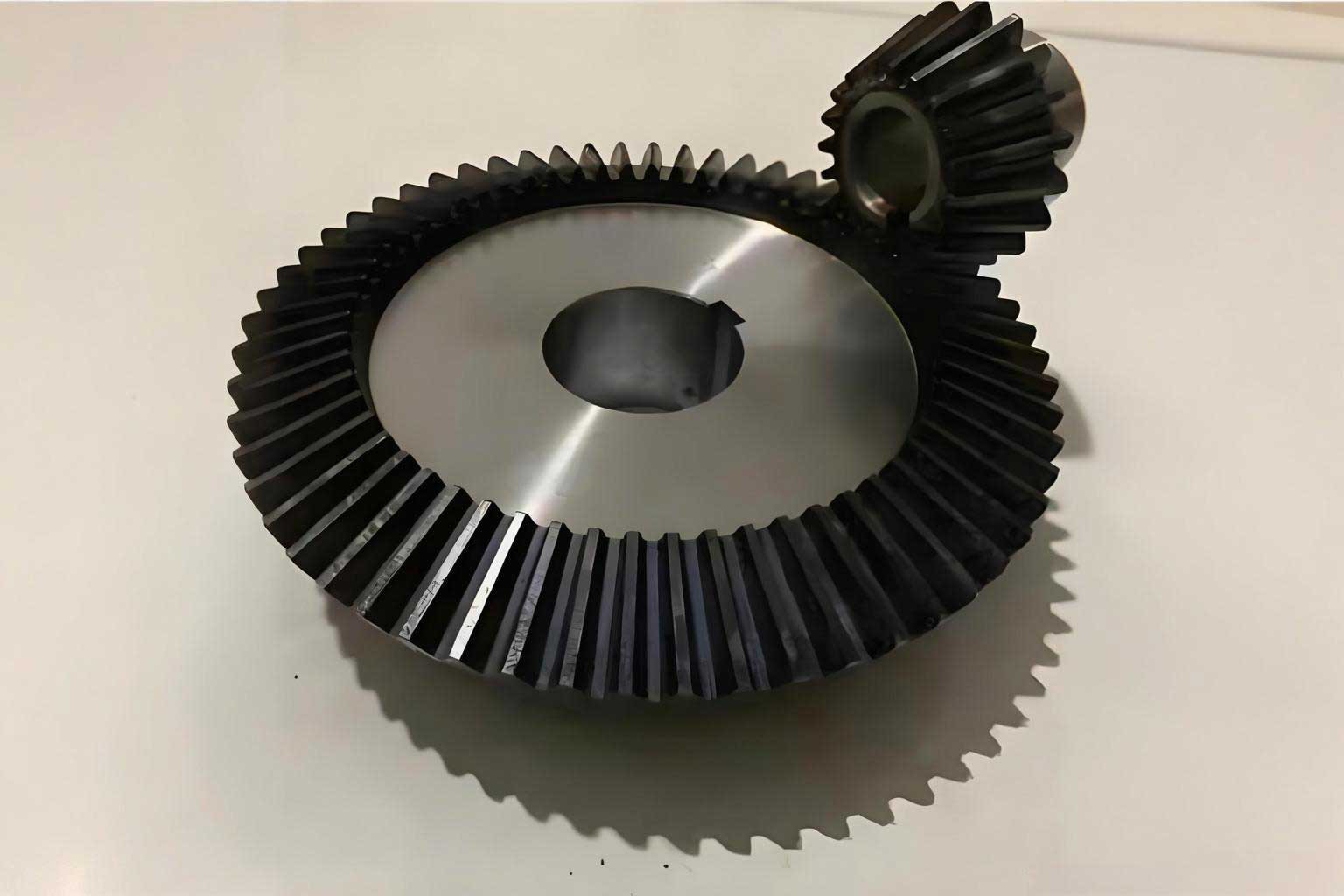
Circular pull broaching does not involve a relative generating motion between the tool and the gear. Based on the characteristics of tooth surface formation, it belongs to the category of “enveloping methods without a fixed instantaneous center.” This is a key differentiator from traditional generating methods used for miter gears and other straight bevel gears.
Broaching Tool (Broach Head) for Circular Pull Method
The cutting tool in circular pull broaching is an assembled structure. Each segment, called a knife block, contains radially arranged cutting teeth—typically 4 to 6 teeth per block. These blocks are mounted on the tool body. The inner cylindrical surface and the side conical surfaces of each block are precision-machined to fit tightly against corresponding reference surfaces on the body. They are securely fastened with two bolts, forming the complete circular broach head.
To machine both flanks of the tooth space simultaneously, the cutting teeth must have a bi-concave side cutting edge profile. For proper cutting, the teeth are ground with a rake face providing a top rake angle of about 10° and a clearance face providing a top relief angle of about 12°. The concave side relief is ground with the same backing-off amount to ensure the cutting edge profile remains unchanged after regrinding.
In the axial cross-section through the broach head center, the side edge profile of the tooth is designed as a circular arc. This arc is intended to produce an approximate circular arc profile in the developed back-cone plane (the plane perpendicular to the pitch cone element) of the gear tooth. It is crucial to note that the radius of curvature of the tool arc is not equal to that of the gear arc; they are related by a specific functional relationship. All cutting teeth on the broach head share the same radius of curvature for their side arcs.
To satisfy the requirement that the tooth space contracts proportionally from heel to toe along the cone distance, the centers of curvature for the arcs on different teeth must be positioned differently. This allows all tooth side profiles to be ground by the same grinding wheel set at different infeeds. A typical broach head might have 72 cutting teeth uniformly distributed on 12 blocks. Each block subtends a 30° angle, with an angular tooth pitch of 6°. The number of finishing teeth is usually 12 to 18. An idle section for indexing occupies 30° (one block’s space), and another for the chamfering device occupies 30°.
The design principle of using a constant arc radius but varying arc center positions is fundamental to making the tool manufacturable and cost-effective, even for complex profiles required for miter gears.
Tooth Profile Generated by Circular Pull Broaching
It is well-known that a straight bevel gear tooth produced by planing exhibits normal taper: from heel to toe along the tooth length, the tooth height, thickness, space depth, width, and flank contour shape all change proportionally. This characteristic must also be present in gears cut by circular pull broaching.
Since each finishing tooth’s side cutting edge forms a part of the tooth surface in a predetermined zone, the sum of all parts generated by all finishing teeth during the process constitutes the complete tooth flank surface. Therefore, achieving a varying tooth space (and hence tooth) along the length is possible by assigning each cutting tooth an appropriate width, height, position, and side edge profile.
If the gear were to have an involute profile, the tool teeth would need corresponding approximate involute profiles. However, since the base circle radius of a straight bevel gear’s involute decreases from heel to toe, the tool teeth would require varying involute profiles, complicating tool design and manufacturing, thus increasing cost prohibitively.
If the gear employs a circular arc profile, the tool teeth can also have circular arc profiles. But if the tool arc radii were varied to match the gear’s changing profile, complexity and cost would again be high. Therefore, the chosen solution is to use a constant radius of curvature for the side arcs of all tool teeth, while varying the positions of these arc centers appropriately. This approach simplifies tool structure, calculations, machine setup, and manufacturing, significantly reducing tool cost.
Although the gear tooth profile in the developed back-cone plane is an approximate circular arc, calculations show the profile error is negligible, and practice confirms it meets all operational requirements. The mating of gears produced this way is based on circular arc tooth engagement. It’s important to clarify that this modern circular arc profile is not merely a rough approximation of an involute as used in early cast gears. Instead, it is a curve derived from considerations of satisfying the fundamental law of gearing to ensure uniform motion transfer, while also accounting for practical factors like pitch errors, profile errors, mounting errors, and elastic deformations.
The theoretical involute profile, which provides full-line contact for exact kinematic transmission, is not ideal in real-world applications due to these unavoidable errors. In practice, a “relieved” or “crowned” profile is often preferred, where the tip and root regions are slightly lowered relative to the theoretical profile. This results in localized contact in the central region of the tooth height under no-load or light load, promoting smooth and quiet operation. By appropriately selecting the radius of the circular arc, the deviation from the theoretical profile can be tailored to create such a relieved profile, with equal profile error at the tip and root. This is a key feature of the circular arc profile from circular pull broaching—it naturally facilitates a profile conducive to quiet operation.
A second feature is that the circular arc profile does not impose a minimum number of teeth limited by a base circle, thus avoiding undercut. Consequently, there’s no need for profile modifications like addendum or dedendum alterations, or tangential corrections, as sometimes required for involute gears.
A third feature is that by appropriately adjusting the positions of the tool arc centers, an ideal lengthwise crown (barreling) can be achieved, resulting in localized contact in the central region of the tooth length under light loads. This gives the circular arc profiled straight bevel and miter gears a degree of tolerance to manufacturing and assembly errors. However, it must be emphasized that due to the profile difference, gears made by circular pull broaching are not interchangeable with those made by planing or double-cutter milling.
Formulas for the Curvature Radius of the Circular Arc Tooth Profile
From the requirement to satisfy the fundamental law of gearing, we can derive approximate formulas for the curvature radius of the circular arc tooth profile in the developed back-cone plane of the gear. For a pair of straight bevel gears, the formulas for the larger gear (gear 2, with more teeth) and the smaller gear (gear 1, with fewer teeth) are given below. These formulas are particularly relevant when designing for miter gear sets where the gears may have equal or different numbers of teeth.
Let:
- $R_{a2}$ = Curvature radius of the circular arc profile for the larger gear (gear 2) in its developed back-cone plane.
- $R_{a1}$ = Curvature radius of the circular arc profile for the smaller gear (gear 1) in its developed back-cone plane.
- $\alpha$ = Pressure angle at the pitch cone.
- $r_{v2}$ = Pitch radius of the equivalent spur gear in the developed back-cone plane for the larger gear.
- $r_{v1}$ = Pitch radius of the equivalent spur gear in the developed back-cone plane for the smaller gear.
The approximate formulas are:
$$ R_{a2} = \frac{r_{v2}}{\sin \alpha} \left( 1 + \frac{1}{2} \cdot \frac{r_{v1}}{r_{v2}} \cdot \frac{\cos^2 \alpha}{\sin \alpha} \right) $$
$$ R_{a1} = \frac{r_{v1}}{\sin \alpha} \left( 1 + \frac{1}{2} \cdot \frac{r_{v2}}{r_{v1}} \cdot \frac{\cos^2 \alpha}{\sin \alpha} \right) $$
It should be noted that during the derivation of these formulas, the Taylor series expansion was applied twice, and terms higher than the second order were neglected. Therefore, these formulas are approximations. For high-speed, heavily loaded gears or those requiring high transmission accuracy, the radius calculated from these formulas must be appropriately corrected based on empirical data and further analysis.
The equivalent pitch radii $r_v$ are related to the actual gear geometry. For a straight bevel gear with pitch cone angle $\delta$, number of teeth $z$, and module $m$, the pitch radius at the heel $r_p = m z / 2$. The radius of the equivalent spur gear in the developed back-cone is $r_v = r_p / \cos \delta$. For a miter gear pair with $\delta_1 + \delta_2 = 90^\circ$ and often $z_1 = z_2$, these relationships simplify.
Formula for the Theoretical Curvature Radius of the Tool Side Edge Profile
Through rigorous mathematical analysis of the cutting process and tooth formation principle in circular pull broaching, we can derive an exact formula for the theoretical curvature radius of the circular arc profile on the broach tooth’s side edge in the axial cross-section of the tool. This formula is fundamental for tool design.
Let:
- $\rho_t$ = Theoretical curvature radius of the broach tooth side edge arc in the tool’s axial cross-section.
- $R_a$ = Curvature radius of the gear tooth circular arc profile in the developed back-cone plane (e.g., $R_{a1}$ or $R_{a2}$ from above for the respective gear).
- $\Delta$ = Angle between the broach feed direction line and the gear’s pitch cone element (tooth line), measured in the tangent plane to the tooth surface along the pitch cone element.
- $\gamma$ = Half of the angle in the tool’s axial cross-section between the two tangent planes that contact the two opposing tooth flanks at their respective pitch cone elements within one tooth space.
- $R_c$ = Cutting radius in the tool’s axial cross-section where the broach tooth touches the gear’s pitch cone element.
- $R_r$ = Equivalent pure rolling radius during the broaching cutting motion.
The theoretical formula is:
$$ \rho_t = \frac{R_a \cdot R_r \cdot \sin(\Delta + \gamma)}{R_c \cdot \sin \Delta – R_a \cdot \cos(\Delta + \gamma)} $$
This formula is of great value for theoretical analysis of the circular pull broaching method. However, it cannot be directly used in practical broach head design calculations. After determining the theoretical arc radius using this formula, a series of corrections must be applied to account for tool wear, manufacturing tolerances, and optimal performance for specific gear types like miter gears. The derivations and correction methodologies are extensive and beyond the scope of this introductory article.
Practical Considerations and Future Outlook
In my experience implementing circular pull broaching lines, the transition requires careful planning. The high initial investment in broach heads and dedicated machinery is offset by the long-term gains in productivity, quality, and operational cost. The method’s efficiency stems from its continuous cycling and the integration of multiple operations into a single tool revolution. For high-volume production of straight bevel gears, especially miter gears for differentials and other power transmission applications, it is often the optimal choice.
The following table illustrates a typical productivity and resource comparison before and after adopting circular pull broaching for a hypothetical production line similar to the one described in the source material. This underscores the tangible benefits, particularly for miter gear production runs.
| Aspect | Milling-Planing Method (Baseline) | Circular Pull Broaching Method | Improvement / Saving |
|---|---|---|---|
| Number of Machines | 6 machines of different types | 2 broaching machines | Reduction of 4 machines |
| Shifts to Meet Output | 3 shifts | 2 shifts | Saving of 1 shift |
| Total Connected Motor Power | ~50 kW | ~20 kW | Saving of ~30 kW |
| Annual Energy Consumption | Base (e.g., 100,000 kWh) | ~40,000 kWh | Saving of ~60,000 kWh |
| Gear Accuracy (Mounting Distance Runout) | Larger variation | ≤ 0.05 mm (per revolution) ≤ 0.02 mm (per tooth) |
Significant precision gain |
| Surface Finish | Standard | Improved | Better wear and noise characteristics |
| Typical Tool Life (Broach Head vs. Planer Tools) | Shorter tool life, frequent changes | Long tool life, but high cost per tool | Overall lower cost per part in high volume |
Looking ahead, the future of straight bevel gear manufacturing, including miter gears, will likely involve a hybrid approach. While chipless methods advance, circular pull broaching will continue to dominate specific high-volume niches due to its unmatched efficiency and proven reliability. Research into more affordable broach head manufacturing, perhaps through additive manufacturing or improved grinding technologies, could further broaden its application. Furthermore, integration with Industry 4.0 concepts—real-time monitoring of broach head wear, adaptive control of cutting parameters, and digital twins of the process—will enhance its sustainability and precision.
In conclusion, the circular pull broaching method represents a sophisticated synthesis of mechanical design, kinematics, and production engineering. Its ability to produce high-quality straight bevel and miter gears at remarkable speeds makes it a cornerstone of modern mass production. Understanding its fundamental principles, as outlined through formulas, comparative tables, and operational descriptions, is essential for any engineer or practitioner involved in advanced gear manufacturing. The method’s specific profile generation philosophy, centered on a practical circular arc, offers a compelling alternative to traditional generating methods, balancing theoretical requirements with manufacturing pragmatism.