
In my years of experience designing and producing miter gears, I have come to recognize that the precision of the gear blank is a fundamental determinant of the final gear quality. Miter gears, which are conical gears used to transmit motion between intersecting shafts at typically 90-degree angles, demand stringent control over blank dimensions and tolerances. Any deviations in the blank can propagate through the cutting process, leading to inaccuracies in tooth geometry, misalignment in assembly, and ultimately, reduced performance and lifespan of the gear pair. This article explores, from a first-person perspective, the critical aspects of blank precision for miter gears, detailing how various errors impact manufacturing, along with methods for detection and calculation of these errors. I will emphasize the importance of each factor through formulas and tables, ensuring a comprehensive understanding for engineers and manufacturers.
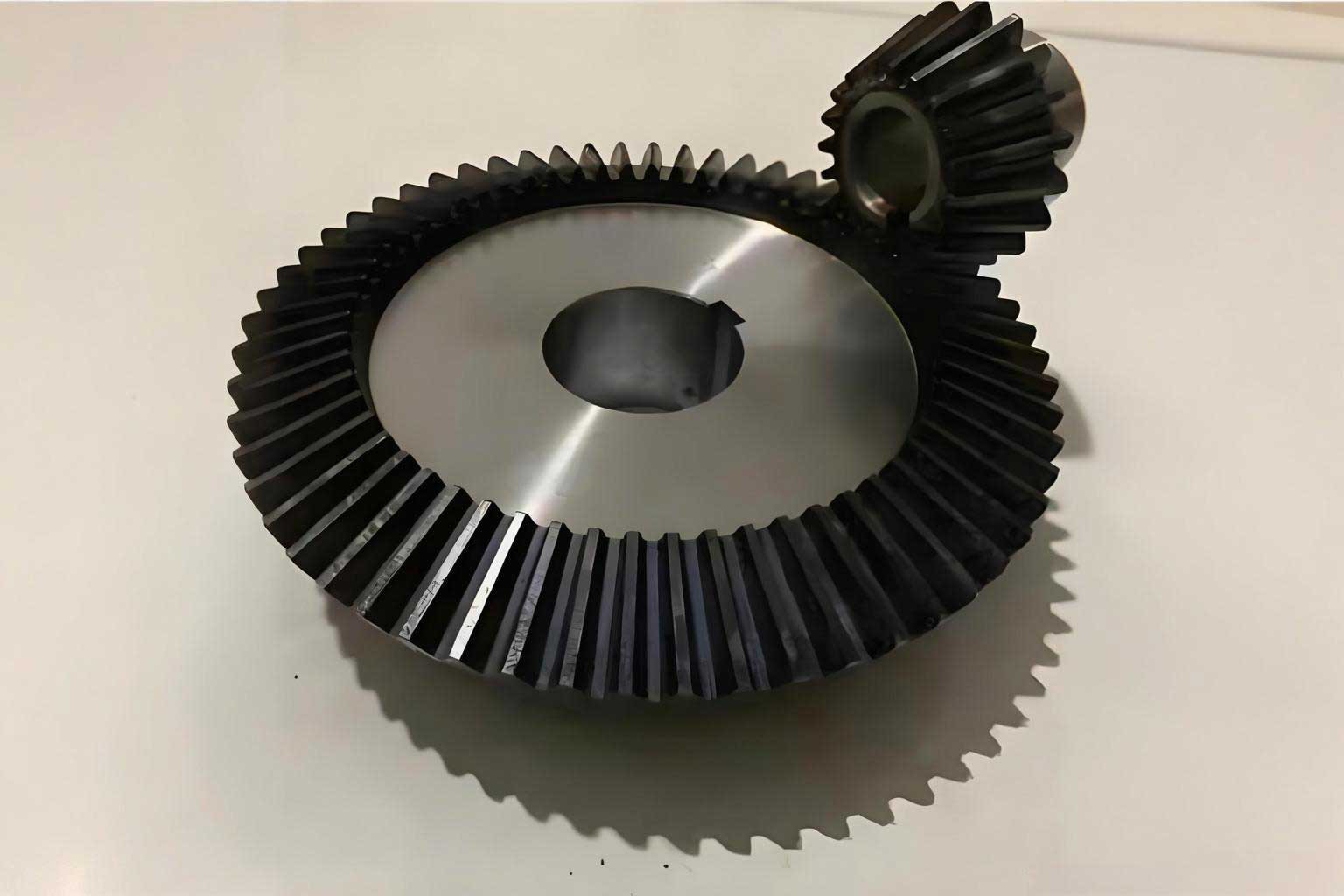
The image above illustrates a typical miter gear, highlighting its conical form. When producing such miter gears, the blank—the raw piece before tooth cutting—must be machined to exact specifications. The following sections delve into specific blank errors and their effects on miter gear accuracy.
Shaft/Bore Diameter Errors and Face Runout
In miter gear production, errors in the shaft diameter (for shaft-type gears) or bore diameter (for bore-type gears), combined with runout of the reference face, are primary sources of inaccuracies. These errors introduce installation eccentricity, often termed geometric eccentricity, which causes periodic errors, pitch cumulative errors, and tooth trace runout in the finished miter gear. From my observations, this eccentricity arises from multiple sources in the manufacturing setup, such as radial runout of the machine tool spindle, inaccuracies in the mandrel, fitting clearances between the blank and mandrel, face runout of the tool support, face runout of the blank itself, tilting of the machine spindle, and axial runout of the spindle. The total installation eccentricity, denoted as \( e \), can be expressed as the sum of contributions from these sources:
$$ e = \sum_{i=1}^{7} e_i $$
where \( e_i \) represents the eccentricity from each source. This eccentricity directly affects the tooth spacing and alignment. For instance, the periodic error in tooth pitch \( \Delta P \) due to eccentricity \( e \) can be approximated by:
$$ \Delta P \approx 2e \sin\left(\frac{2\pi}{Z}\right) $$
where \( Z \) is the number of teeth on the miter gear. Detection of these errors involves using limit gauges for diameter checks and dial indicators on a runout tester for face runout. For high-precision miter gears, I recommend keeping face runout under 0.01 mm to minimize subsequent errors.
Outside Diameter Errors
The outside diameter of the miter gear blank influences the tooth tip height after cutting. If the outside diameter deviates from the nominal value, it alters the tip clearance in the gear mesh, potentially leading to interference or excessive backlash. In my practice, I always set the upper deviation of the outside diameter to zero to avoid reducing the tip clearance below design specifications. The error in outside diameter, \( \Delta D \), affects the tip height \( h_a \) as:
$$ \Delta h_a \approx \frac{\Delta D}{2} $$
Detection can be done with micrometers, limit gauges, or specialized measuring instruments. For critical miter gear applications, I often use coordinate measuring machines (CMM) to verify outside diameter within tight tolerances, typically ±0.02 mm for precision gears.
Top Cone Generatrix Runout
Runout of the top cone generatrix, measured perpendicular to the generatrix, is crucial for ensuring uniform tooth depth and proper engagement in miter gears. This runout, if excessive, causes uneven loading and noise. During inspection on a runout tester with centers or a mandrel, I use a dial indicator to measure this runout, keeping it below 0.015 mm for most industrial miter gears. The relationship between top cone generatrix runout \( \Delta G \) and resulting tooth depth variation \( \Delta h_d \) can be expressed as:
$$ \Delta h_d = \Delta G \cos(\delta_a) $$
where \( \delta_a \) is the top cone angle. For miter gears that undergo heat treatment with fixture quenching, controlling this runout is even more critical to ensure proper contact with the quenching fixture.
Theoretical Mounting Distance and Crown Distance
The theoretical mounting distance and crown distance are pivotal dimensions in miter gear design and manufacturing. The mounting distance determines the axial position of the gear during assembly, while the crown distance, measured from the crown point to the back face, indirectly controls the tooth surface location. From my experience, errors in these distances lead to misalignment and shifted contact patterns. The crown distance \( H_a \) is calculated from other gear parameters:
$$ H_a = R – \frac{h_a}{\cos(\delta_a)} $$
where \( R \) is the cone distance, \( h_a \) is the tip height, and \( \delta_a \) is the top cone angle. I always specify the upper deviation of crown distance as zero to maintain design tip clearance. The error in crown distance \( \Delta H_a \) affects the tip height change \( \Delta h_a \) as:
$$ \Delta h_a = \Delta H_a \tan(\delta_a) $$
This, in turn, influences the chordal tooth thickness \( s \) at the pitch circle. The change in chordal thickness \( \Delta s \) due to crown distance error is approximately:
$$ \Delta s \approx \frac{\Delta h_a}{\tan(\alpha)} = \frac{\Delta H_a \tan(\delta_a)}{\tan(\alpha)} $$
where \( \alpha \) is the pressure angle of the miter gear. Detection methods include using special calipers, limit gauges, or comparative measurement with a dial indicator. When using a dial indicator, the measured value \( \Delta L \) relates to crown distance error \( \Delta H_a \) and top cone angle error \( \Delta \delta_a \) by:
$$ \Delta L = \Delta H_a \cos(\delta_a) + L \Delta \delta_a \sin(\delta_a) $$
where \( L \) is the distance from the measurement point to the large end of the blank. To minimize angle error effects, I place the dial indicator contact point as close as possible to the large end.
Top Cone Angle Errors
The top cone angle of the miter gear blank must be tightly controlled, as errors here affect tooth geometry and mesh conditions. I set the lower deviation of the top cone angle to zero to prevent insufficient tip clearance at the small end of the gear. The error in top cone angle \( \Delta \delta_a \) influences the crown distance measurement, as noted above, and also affects the tooth trace direction when measured relative to the top cone. Specifically, the error in tooth trace measurement \( \Delta \beta \) due to top cone angle error is:
$$ \Delta \beta \approx \Delta \delta_a \tan(\alpha_c) $$
where \( \alpha_c \) is the pressure angle at the tip circle. For a miter gear with face width \( b \), this translates to a linear deviation along the tooth. Detection is typically done with universal angle gauges or special templates. In high-volume production, I use optical comparators to verify top cone angle within ±0.05 degrees for precision miter gears.
Tooth Thickness and Profile Errors
Tooth thickness and profile on the miter gear are directly influenced by blank dimensions, particularly when measurements are taken on the back cone. Errors in back cone angle \( \Delta \delta_b \) affect the measured tooth thickness and profile. From my analysis, the change in chordal tooth thickness at the pitch circle \( \Delta s \) due to back cone angle error is:
$$ \Delta s \approx R \Delta \delta_b $$
where \( R \) is the cone distance. Similarly, the profile error \( \Delta f \) at the large end can be approximated as:
$$ \Delta f \approx \frac{b}{2} \cdot \frac{\Delta s}{h} \cdot \cos(\alpha_f) $$
where \( b \) is the face width, \( h \) is the whole depth, and \( \alpha_f \) is the root pressure angle. In practice, I control back cone angle using angle gauges or special calipers that also check outside diameter, ensuring integrated control over multiple blank parameters for miter gears.
Chamfer Width Considerations
Chamfer width, often referred to as “倒带宽度” in some contexts, is the width of the chamfer at the tooth tips on the blank. If present, it increases the tip height except at the large end face, potentially reducing tip clearance in the mesh. In my manufacturing process, I limit chamfer width to no more than 0.5 mm for standard miter gears. The increase in tip height \( \Delta h_c \) due to chamfer width \( c \) varies along the tooth; at a point distance \( x \) from the large end, it can be estimated as:
$$ \Delta h_c \approx c \left( \frac{\tan(\delta_a) – \tan(\delta)}{2} \right) $$
where \( \delta \) is the pitch cone angle. Detection is via special gauges or visual inspection. For small batches, I often use comparators to ensure chamfer consistency across miter gear blanks.
Summary of Detection Methods and Tolerances
Based on my experience, here is a consolidated table summarizing key blank precision items for miter gears, their typical tolerances, and recommended detection methods:
| Blank Precision Item | Typical Tolerance (for Precision Miter Gears) | Detection Method | Impact on Miter Gear |
|---|---|---|---|
| Shaft/Bore Diameter | ±0.01 mm | Limit Gauges, Micrometers | Installation Eccentricity, Periodic Errors |
| Face Runout | ≤0.01 mm | Dial Indicator on Runout Tester | Tooth Trace Runout, Pitch Accumulation |
| Outside Diameter | 0 to -0.02 mm (Upper=0) | Micrometers, CMM | Tip Clearance, Tooth Height |
| Top Cone Generatrix Runout | ≤0.015 mm | Dial Indicator on Centers | Uneven Tooth Depth, Noise |
| Crown Distance | ±0.02 mm (Upper=0) | Special Calipers, Dial Indicator Comparison | Tooth Surface Position, Mesh Alignment |
| Mounting Distance | ±0.02 mm | Special Gauges, CMM | Assembly Position, Contact Pattern |
| Top Cone Angle | ±0.05 degrees | Universal Angle Gauge, Optical Comparator | Tip Clearance, Tooth Trace Direction |
| Back Cone Angle | ±0.1 degrees | Angle Gauge, Special Template | Measured Tooth Thickness, Profile |
| Chamfer Width | ≤0.5 mm | Visual Inspection, Comparators | Tip Height Increase, Clearance Reduction |
This table serves as a guideline for quality control in miter gear blank manufacturing. Note that tolerances may vary based on gear size and application requirements.
Key Formulas for Error Calculation
To facilitate analysis, I often use the following formulas to estimate errors in miter gears due to blank inaccuracies. These are derived from geometric relationships and practical observations:
1. Installation Eccentricity: Total eccentricity \( e \) from multiple sources: $$ e = \sum e_i $$ where \( e_i \) are individual eccentricities (e.g., spindle runout, mandrel error).
2. Crown Distance Error Effect on Tip Height: $$ \Delta h_a = \Delta H_a \tan(\delta_a) $$ This is crucial for predicting tip clearance changes in miter gear meshes.
3. Tooth Thickness Change due to Crown Distance Error: $$ \Delta s \approx \frac{\Delta H_a \tan(\delta_a)}{\tan(\alpha)} $$ where \( \alpha \) is the pressure angle. This helps in adjusting cutting tools for miter gear production.
4. Tooth Trace Error from Top Cone Angle Error: $$ \Delta \beta \approx \Delta \delta_a \tan(\alpha_c) $$ This quantifies the deviation in tooth orientation, affecting load distribution.
5. Back Cone Angle Error Effect on Tooth Thickness: $$ \Delta s \approx R \Delta \delta_b $$ Useful when measuring tooth thickness on the back cone of miter gears.
6. Chamfer Width Impact on Tip Height: At a distance \( x \) from large end: $$ \Delta h_c \approx c \left( \frac{\tan(\delta_a) – \tan(\delta)}{2} \right) $$ This ensures tip clearance is maintained in finished miter gears.
These formulas enable proactive adjustments during blank machining and gear cutting, reducing scrap and improving consistency in miter gear manufacturing.
Practical Insights for Miter Gear Blank Production
From my hands-on work, I emphasize integrating blank inspection with process control. For instance, when producing miter gears in large batches, I set up in-process gauging to monitor crown distance and top cone angle continuously. This real-time feedback allows for immediate corrective actions, minimizing downstream errors. Additionally, for high-precision miter gears used in aerospace or automotive differentials, I employ statistical process control (SPC) to track blank dimensions over time, ensuring long-term stability.
Another key aspect is the selection of measurement instruments. For miter gear blanks, I prefer using digital dial indicators with resolution of 0.001 mm and CMMs for comprehensive checks. When measuring crown distance, I design custom fixtures that reference the back face and top cone simultaneously, reducing setup errors. For angle measurements, I rely on optical projectors that can magnify the blank profile, allowing visual comparison with master templates.
Moreover, the interaction between blank errors must be considered. For example, a combined error in top cone angle and crown distance can compound tooth thickness variations. I often use sensitivity analysis, based on the formulas above, to determine which blank parameters require tighter control for a given miter gear design. This holistic approach ensures that the blank precision aligns with the functional requirements of the miter gear pair.
Conclusion
In summary, the precision of miter gear blanks is a cornerstone of successful gear manufacturing. Through meticulous control of dimensions such as shaft/bore diameter, face runout, outside diameter, top cone generatrix runout, mounting distance, crown distance, top cone angle, and tooth-related features, we can achieve high-quality miter gears with accurate tooth geometry, proper mesh alignment, and optimal performance. The detection methods and formulas discussed here provide practical tools for engineers to assess and mitigate errors. By prioritizing blank accuracy, manufacturers can reduce waste, enhance reliability, and meet the demanding standards of modern applications involving miter gears. As technology advances, integrating automated inspection and data analytics will further refine blank precision, pushing the boundaries of what is possible in miter gear production.
Throughout this article, I have shared insights grounded in practical experience, emphasizing that every micron matters in blank manufacturing for miter gears. Whether for industrial machinery or precision instruments, attention to these details ensures that miter gears perform seamlessly in their intended roles, transmitting motion efficiently and durably.