
In the realm of mechanical power transmission, miter gears hold a pivotal role as essential components for transferring motion and force between intersecting shafts. As an engineer deeply involved in gear manufacturing research, I have often encountered the challenges associated with producing high-precision miter gears efficiently. Traditional methods, such as generating planing on specialized machines like bevel gear planers or gear shaping machines, are not only costly but also suffer from inherent limitations in productivity and accuracy. These processes typically involve intermittent, tooth-by-tooth cutting, where the tool must disengage, reverse, and index for each tooth, leading to prolonged cycle times and potential accumulation of errors. In this article, I aim to present a novel approach—hobbing miter gears—that leverages the continuous cutting action of gear hobbing to enhance both efficiency and precision. This method utilizes a variable-modulus hob, a concept I have developed and refined through practical experimentation and theoretical analysis. I will delve into the principles, design considerations, and mathematical foundations of this technique, providing detailed formulas and tables to summarize key aspects. Throughout this discussion, I will frequently emphasize the application to miter gears, underscoring their significance in various industrial contexts.
The conventional machining of miter gears, a subset of bevel gears with a 1:1 ratio and typically 90-degree shaft angles, has long relied on dedicated equipment. These machines, while effective, impose significant capital investment and operational constraints. The intermittent nature of processes like generating planing results in lower production rates due to the non-cutting time spent on tool retraction and indexing. Moreover, achieving consistent accuracy across all teeth can be challenging, as each tooth is cut independently, potentially leading to variations in tooth profile and spacing. From my perspective, this calls for an innovative shift towards continuous generation methods, akin to those used for cylindrical gears. Hobbing, a widely adopted process for spur and helical gears, offers a promising alternative. It involves a continuous rotational interplay between the hob and the workpiece, enabling simultaneous cutting of multiple tooth spaces and thus higher material removal rates. However, adapting hobbing to miter gears is not straightforward due to their conical geometry and varying tooth dimensions along the face width. This is where the concept of a variable-modulus hob comes into play, which I propose as a solution to bridge this gap.
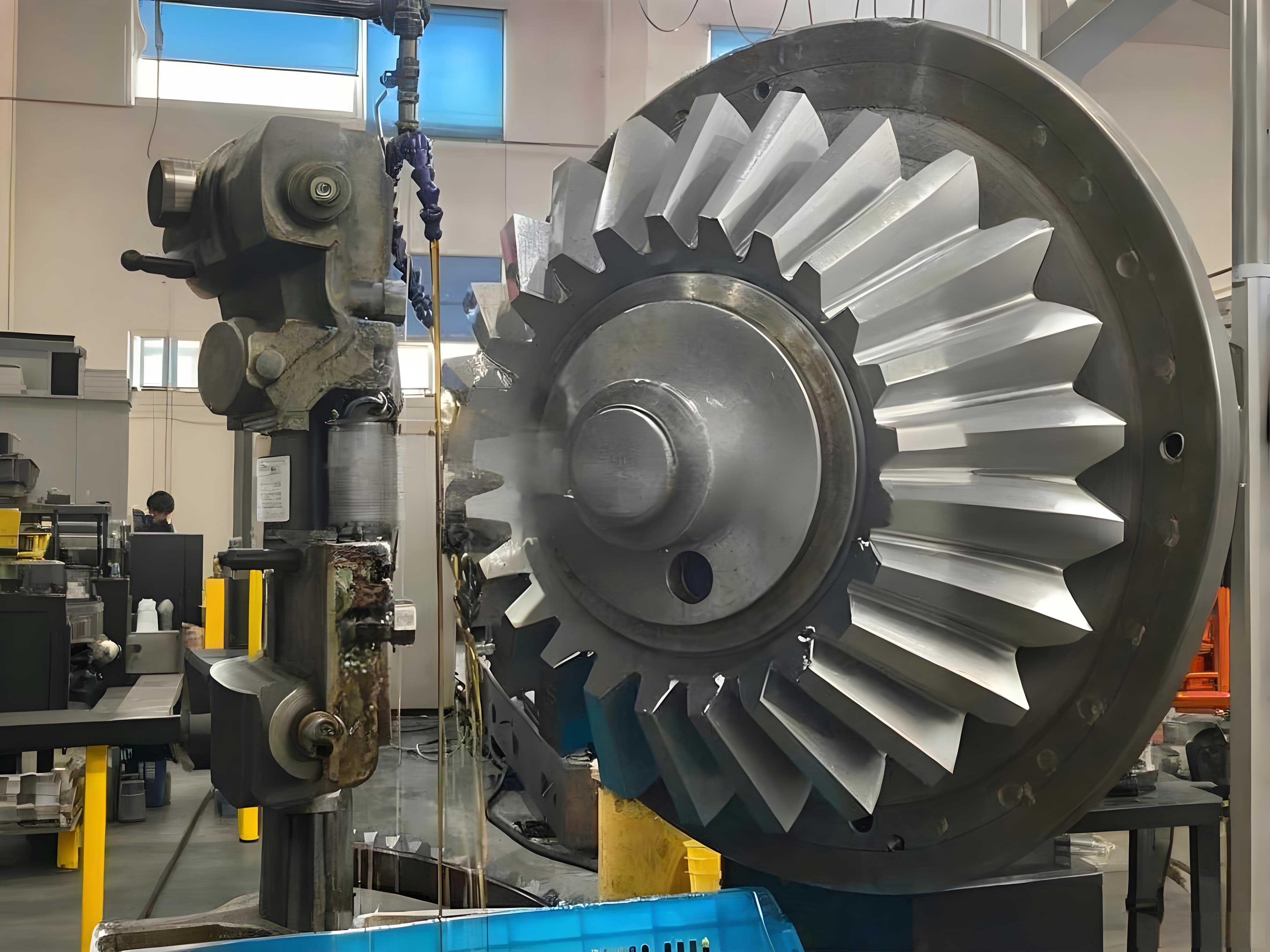
The fundamental principle behind hobbing miter gears can be understood by drawing an analogy to cylindrical gear hobbing. In standard hobbing of a spur gear, the hob—a threaded cutting tool with gashed teeth—rotates at a speed \( n_h \) while the workpiece rotates at a speed \( n_w \), with a fixed velocity ratio determined by the number of hob starts and the gear tooth count. The hob also advances axially along the workpiece at a feed rate \( f_v \) to cover the face width. For a miter gear, the key difference lies in its conical form: the pitch cone angle \( \delta \) and the module (or diametral pitch) vary linearly from the small end to the large end. To accommodate this, the hobbing process must incorporate an additional coordinated motion that generates this taper. I conceptualize this by considering the miter gear as a superposition of infinitesimal cylindrical gears, each with a constant module at a given cross-section perpendicular to the axis. As the hob progresses along the axis, the effective module of the gear being cut changes continuously. Therefore, the hob itself must possess a corresponding variation in tooth spacing or pitch to maintain correct meshing conditions throughout the cut. This leads to the idea of a variable-modulus hob, also termed a variable-pitch hob.
Mathematically, the relationship between the linear feed motion and the changing pitch can be derived. Let \( m_s \) and \( m_l \) represent the modules at the small and large ends of the miter gear, respectively. The corresponding normal pitches are \( p_s = \pi m_s \) and \( p_l = \pi m_l \). As the hob advances axially by a distance \( z \) from the small end, the local module \( m(z) \) varies linearly with the cone distance \( R(z) \):
$$ m(z) = m_s + \frac{(m_l – m_s)}{L} z $$
where \( L \) is the face width of the miter gear. The hob’s tooth pitch must match this local pitch at every instant. In a traditional hob, the pitch is constant, but for a variable-modulus hob, the pitch along the hob’s threaded body must change accordingly. This requires a sophisticated design where individual cutting teeth are mounted on a central shaft with adjustable positions or are part of a specially manufactured threaded sleeve with varying lead.
To elaborate on the hob design, I propose a structure comprising a central mandrel and separable tooth segments. The mandrel, similar to a splined shaft, transmits torque via a keyway connection to the machine spindle. Its outer surface features rectangular slots that house individual hob teeth. Each tooth is manufactured as an independent insert with a straight-sided profile, resembling a rack tooth. The tooth height is proportional to the large-end module \( m_l \) to ensure sufficient depth of cut, while the tooth thickness is proportional to the small-end module \( m_s \) to maintain proper engagement at the start of the cut. This modular approach allows for precise control and replacement of worn teeth. The critical aspect is how these teeth are arranged along the hob axis to achieve the variable pitch. I envision a threaded sleeve mechanism that imparts a helical path to each tooth, with the lead of the helix varying continuously. The teeth are positioned such that their cutting edges lie on a helical surface whose pitch changes from \( p_s \) to \( p_l \) over the active length of the hob.
The calculation of the corresponding pitches for each hob tooth is essential for manufacturing accuracy. Suppose the hob has \( N \) teeth distributed over one nominal pitch length. For a miter gear with specified \( p_s \) and \( p_l \), the pitch variation must be linear with axial displacement. When the hob is engaged, its vertical feed motion \( f_v \) (along the gear axis) and a synchronized horizontal motion of the workpiece (or tool) create the taper. The hob’s threaded sleeve must rotate at a controlled speed to adjust the tooth positions dynamically. Let \( \Delta p \) be the incremental change in pitch per tooth. If tooth \( i \) is located at axial position \( z_i \), its required pitch \( p_i \) is:
$$ p_i = p_s + \frac{(p_l – p_s)}{L} z_i $$
For a hob with \( N \) teeth, the axial distance between adjacent teeth is approximately \( p_{avg} / N \), where \( p_{avg} \) is the average pitch. However, due to the continuous variation, the exact positioning must account for the helical progression. A more precise formulation involves the helix angle \( \lambda \) of the hob. The lead \( L_h \) of the hob’s thread is related to the pitch by \( L_h = \frac{p}{\tan \lambda} \). Since \( \lambda \) may vary, designing the sleeve requires solving differential equations for the thread profile.
For practical implementation, I have developed a simplified model assuming a linear pitch change. Consider a hob with \( N = 10 \) teeth, indexing from \(-4\) to \(+5\) around a central tooth labeled \(0\). The central tooth corresponds to the pitch at a reference axial location, typically the small end. As the hob feeds, each tooth displaces axially by an amount proportional to its index. Let \( \Delta z \) be the axial feed per revolution of the hob. Then, the displacement for tooth \( i \) after time \( t \) is \( z_i = i \cdot \Delta z \cdot t \). The instantaneous pitch for that tooth becomes:
$$ p_i(t) = p_s + \frac{(p_l – p_s)}{L} (z_0 + i \cdot \Delta z \cdot t) $$
where \( z_0 \) is the initial position. To ensure continuous generation, the rotation of the threaded sleeve must compensate for these displacements, effectively changing the phase of each tooth relative to the workpiece. This compensation can be expressed as an additional angular rotation \( \theta_c \) of the sleeve:
$$ \theta_c = \frac{2\pi}{L_h} \sum_{i} \Delta p_i $$
where \( \Delta p_i \) is the pitch deviation for tooth \( i \). In practice, machine adjustments like differential gearing or CNC axis coordination are needed to realize this motion.
To summarize the key parameters and relationships, I present the following tables:
| Method | Process Type | Typical Accuracy | Production Rate | Equipment Cost | Suitability for Miter Gears |
|---|---|---|---|---|---|
| Generating Planing | Intermittent, tooth-by-tooth | Moderate to High | Low | High | Well-established, but slow |
| Gear Shaping | Intermittent, reciprocating | Moderate | Medium | Medium | Limited to certain sizes |
| Hobbing with Variable-Modulus Hob | Continuous, simultaneous multi-tooth | Potentially High | High | Medium (if retrofitted) | Promising for batch production |
| Parameter | Symbol | Formula | Example Values for a Miter Gear |
|---|---|---|---|
| Small-end module | \( m_s \) | Given by gear design | 2 mm |
| Large-end module | \( m_l \) | Given by gear design | 3 mm |
| Face width | \( L \) | Given by gear design | 20 mm |
| Number of hob teeth | \( N \) | Chosen based on pitch range | 10 |
| Axial feed per hob revolution | \( \Delta z \) | \( f_v / n_h \) | 0.5 mm/rev |
| Pitch variation rate | \( k_p \) | \( \frac{p_l – p_s}{L} \) | \( \frac{\pi}{20} \) mm/mm |
| Sleeve compensation angle | \( \theta_c \) | \( \frac{2\pi k_p \Delta z t}{p_{avg}} \) | Function of time |
The successful application of hobbing to miter gears hinges on meticulous machine setup and process optimization. Beyond the hob design, the hobbing machine must be capable of synchronizing multiple axes: the rotary motions of the hob and workpiece, the vertical feed along the gear axis, and an additional radial or horizontal feed to generate the taper. For conventional mechanical hobbing machines, this may involve designing special attachment or modifying the differential gear train. In modern CNC hobbing machines, the required motions can be programmed directly, offering greater flexibility. The kinematic chain must ensure that the relationship between the hob rotation \( n_h \), workpiece rotation \( n_w \), vertical feed \( f_v \), and horizontal feed \( f_h \) adheres to the following equation derived from the generating principle:
$$ \frac{n_w}{n_h} = \frac{Z_h}{Z_g} + \frac{f_v \tan \delta}{\pi m_z} $$
where \( Z_h \) is the number of hob starts (usually 1), \( Z_g \) is the number of teeth on the miter gear, \( \delta \) is the pitch cone angle, and \( m_z \) is the mean module. The horizontal feed \( f_h \) is set to produce the desired cone angle, typically \( f_h = f_v \tan \delta \). These formulas must be adjusted based on the specific machine geometry and tool parameters.
Cutting parameters also play a crucial role in achieving good surface finish and tool life. For miter gears made of common materials like steel or cast iron, I recommend starting with conservative cutting speeds \( V_c \) in the range of 50-100 m/min for high-speed steel hobs, or higher for carbide-tipped hobs. The feed rate should be chosen to balance productivity and chip load; a typical value might be 0.5-2 mm per revolution of the workpiece. Coolant application is essential to dissipate heat and flush chips, especially given the continuous cutting action. Additionally, the hob teeth must be properly sharpened and aligned to avoid profile errors. Since the variable-modulus hob has teeth with varying positions, each tooth’s setting angle and relief angles must be individually verified. This complexity underscores the importance of precision manufacturing and assembly of the hob itself.
In my experience, one of the main challenges in implementing this method is the calibration of the pitch variation mechanism. The theoretical linear pitch change may require correction due to factors like machine deflection, tool wear, and thermal expansion. Therefore, I propose incorporating a correction coefficient \( \gamma \) into the pitch calculation:
$$ p_i(z) = p_s + \gamma \frac{(p_l – p_s)}{L} z $$
where \( \gamma \) is determined empirically through trial cuts and measurement of the produced miter gear. This iterative adjustment is common in gear manufacturing to attain the desired quality. Moreover, the initial engagement position—whether starting from the small end or large end—can affect the cutting forces and accuracy. Starting from the small end is generally preferable as it allows gradual engagement and reduces shock loading on the tool.
The advantages of hobbing miter gears with a variable-modulus hob are manifold. Firstly, the continuous cutting process significantly reduces non-productive time compared to intermittent methods, potentially doubling or tripling production rates. Secondly, the simultaneous generation of multiple tooth flanks leads to better consistency in tooth spacing and profile, enhancing the overall accuracy of the miter gear. Thirdly, this method can be adapted to existing hobbing machines with appropriate modifications, lowering the barrier to adoption compared to purchasing dedicated bevel gear equipment. However, it is not without limitations. The design and fabrication of the variable-modulus hob are complex and costly, making it more suitable for medium to large batch production. Additionally, the process may be less flexible for very large or small miter gears due to physical constraints on hob size and machine travel.
Looking forward, further research could explore advanced materials for hob teeth, such as cubic boron nitride (CBN) coatings, to enable high-speed dry hobbing of hardened miter gears. Simulation software could also be developed to model the cutting forces and thermal effects, optimizing the process parameters virtually before physical trials. The integration of in-process measurement systems, like laser scanners, could provide real-time feedback to adjust the pitch variation dynamically, compensating for errors and wear. These advancements would solidify hobbing as a mainstream method for producing high-quality miter gears across industries such as automotive, aerospace, and robotics.
In conclusion, the hobbing of miter gears using a variable-modulus hob represents a significant leap forward in gear manufacturing technology. By transforming a traditionally intermittent process into a continuous one, it addresses the perennial trade-off between productivity and precision. The mathematical framework and design principles I have outlined provide a foundation for engineers to develop and implement this method. While practical hurdles remain, the potential benefits in terms of efficiency and accuracy make it a compelling avenue for innovation. As demand for high-performance miter gears grows in precision applications, embracing such advanced machining techniques will be key to staying competitive. I encourage fellow researchers and practitioners to experiment with this approach, refine the tool designs, and share insights to collectively advance the state of the art in miter gear production.
To aid further study, below is a summary of essential formulas in LaTeX format:
Key equations for hobbing miter gears:
1. Local module variation: $$ m(z) = m_s + \frac{(m_l – m_s)}{L} z $$
2. Corresponding pitch: $$ p(z) = \pi m(z) $$
3. Hob tooth pitch for tooth \( i \): $$ p_i = p_s + \frac{(p_l – p_s)}{L} (z_0 + i \cdot \Delta z \cdot t) $$
4. Velocity ratio with taper compensation: $$ \frac{n_w}{n_h} = \frac{Z_h}{Z_g} + \frac{f_v \tan \delta}{\pi m_z} $$
5. Horizontal feed for cone generation: $$ f_h = f_v \tan \delta $$
6. Sleeve rotation compensation angle: $$ \theta_c = \frac{2\pi k_p \Delta z t}{p_{avg}} \quad \text{where} \quad k_p = \frac{p_l – p_s}{L} $$
These formulas, combined with the tables provided, offer a comprehensive toolkit for designing and optimizing the hobbing process for miter gears. Through diligent application and continuous improvement, the manufacturing of miter gears can achieve new heights of efficiency and quality.