
The machining of large-scale miter gears, a critical component in heavy machinery such as power generation equipment, ship propulsion, and mining apparatus, presents significant manufacturing challenges. Traditional methods often rely on specialized machine tools and custom-made form cutters, which are costly and inflexible. The split structure has become a common solution for manufacturing extra-large miter gears, but it introduces further complexity in machining due to the displacement of the gear blank’s geometric center from the machine tool’s rotary axis. This paper explores an alternative methodology: employing a standard end mill for the side milling (or flank milling) finishing operation of split miter gear teeth. A precise mathematical model for calculating the cutter location (CL) data—specifically the tool center point (TCP) coordinates and the tool axis vector (TAV)—is developed and validated through simulation and physical machining experiments.
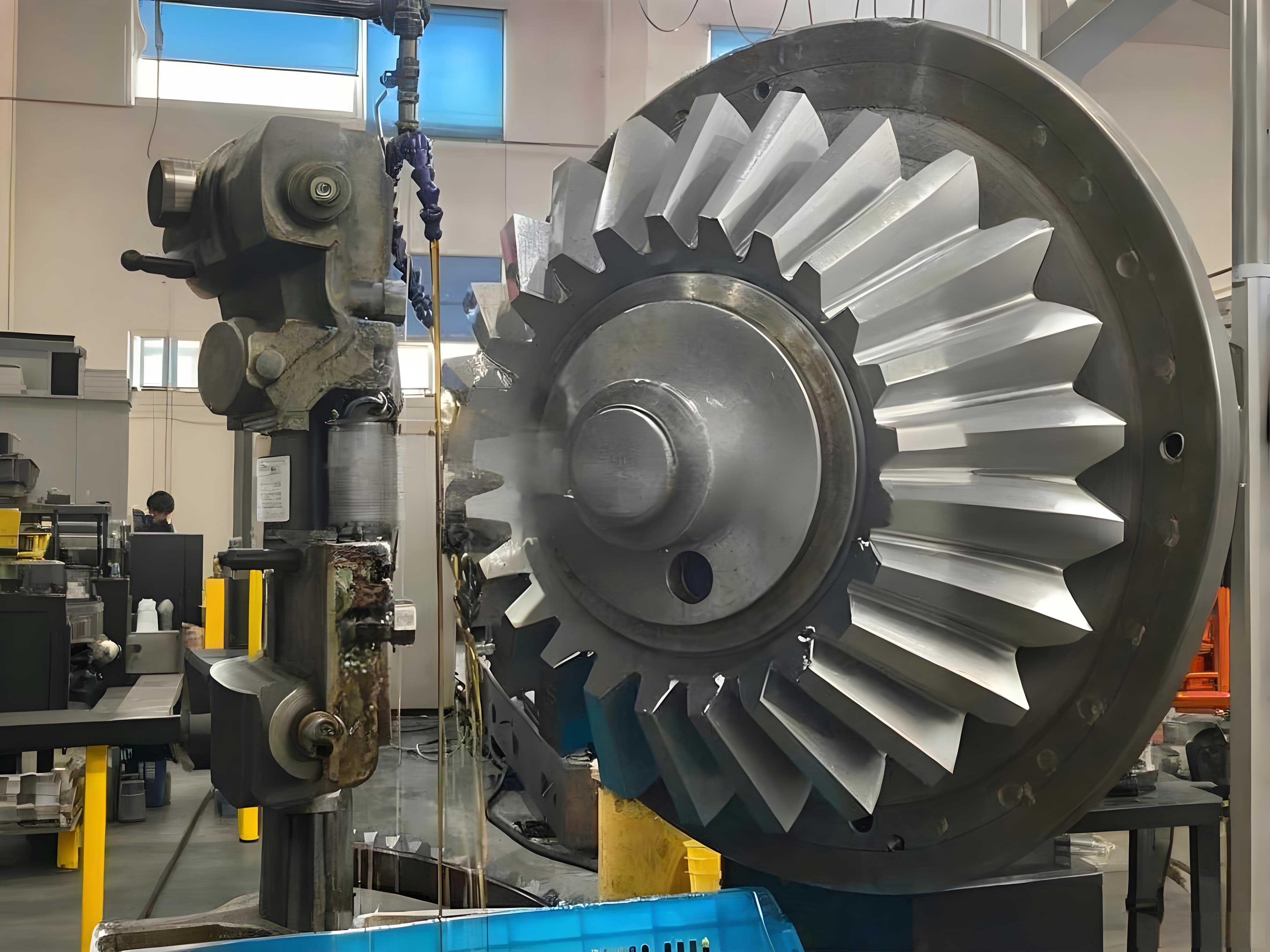
The core challenge in free-form machining of a surface like that of a miter gear lies in accurately determining the spatial position and orientation of the tool. For side milling with an end mill, the cylindrical surface of the tool is intended to be tangent to the designed tooth flank. Therefore, the tool path is defined by a series of discrete points where the tool’s axis is perpendicular to the surface normal at the corresponding contact point on the ideal miter gear tooth flank. The foundational geometry of a straight bevel gear, a specific type of miter gear where the teeth are straight and converge at the apex, can be effectively modeled as a ruled surface. This representation is crucial for deriving the necessary equations for tool path generation. A ruled surface is generated by the movement of a straight line along two directrices. In the case of a miter gear tooth, these directrices are the tooth profiles at the heel (large end) and the toe (small end). The mathematical representation is given by:
$$
\mathbf{S}(r, \phi) = (1 – r) \mathbf{W}(\phi) + r \mathbf{Q}(\phi)
$$
where $\mathbf{W}(\phi)$ is the parametric equation of the small-end profile, $\mathbf{Q}(\phi)$ is the parametric equation of the large-end profile, $r$ is a parameter varying from 0 (toe) to 1 (heel), and $\phi$ is a parameter related to the angular position on the base cone. This model accurately describes the geometry of the miter gear tooth surface targeted for machining.
The success of the side milling operation hinges on a well-defined machining coordinate system and a strategic tool path. For a split miter gear blank, the gear’s own coordinate system $S_O(O_o; X_o, Y_o, Z_o)$ is not concentric with the machine’s rotary table. The origin $O_o$ is placed at the cone apex of the gear blank, with the $Z_o$-axis passing through the center of the base cone’s bottom. The tool coordinate system $S_c(O_c; i_c, j_c, k_c)$ is attached to the end mill, with its origin at the tool center and the $k_c$-axis aligned with the instantaneous tool axis vector. The transformation between these systems defines the tool’s position and orientation in the machine workspace.
The tool path for finishing is planned as a zig-zag pattern along the length of the tooth, from heel to toe and back, following the conical element direction of the miter gear. This strategy, moving parallel to the tooth’s ruling line, offers advantages in terms of consistent cutting conditions, easier control over surface finish (scallop height), and reduced non-cutting airtime compared to other patterns. The step-over distance between successive passes is determined by the required surface quality and tolerance.
The central task of this research is the analytical solution for the CL data. The process begins by determining the surface normal at any given point $\mathbf{S}(r, \phi)$ on the miter gear tooth flank. This requires calculating the partial derivatives of the surface vector with respect to parameters $r$ and $\phi$:
$$
\mathbf{S}_r = \frac{\partial \mathbf{S}}{\partial r} = \mathbf{Q}(\phi) – \mathbf{W}(\phi)
$$
$$
\mathbf{S}_\phi = \frac{\partial \mathbf{S}}{\partial \phi} = (1 – r) \mathbf{W}'(\phi) + r \mathbf{Q}'(\phi)
$$
The surface normal vector $\mathbf{F}_s$ is then obtained from the cross product of these tangent vectors:
$$
\mathbf{F}_s = \mathbf{S}_r \times \mathbf{S}_\phi = [f_x, f_y, f_z]^T
$$
This vector is then normalized to obtain the unit surface normal $\mathbf{\hat{n}}$:
$$
\mathbf{\hat{n}} = \frac{\mathbf{F}_s}{\|\mathbf{F}_s\|} = [a_x, a_y, a_z]^T
$$
For side milling, the tool center point $\mathbf{O_c}$ is located at a distance equal to the tool radius $R_d$ from the surface point $\mathbf{S}$, along the direction opposite to the surface normal (for conventional milling). Therefore, the TCP coordinates in the gear coordinate system $S_O$ are:
$$
\mathbf{O_c} = \mathbf{S} + R_d \cdot \mathbf{\hat{n}}
$$
Explicitly, the coordinates $(x_o, y_o, z_o)$ can be written as functions of $R$ (reference cone distance), $\delta_b$ (base cone angle), $\phi$, $r$, and $R_d$. The tool axis vector $\mathbf{P}$ must be perpendicular to the surface normal at the contact point. A natural and effective choice is to align the tool axis with the direction of the ruling line, which is given by $\mathbf{S}_r$, and then rotate it to ensure proper engagement. A typical approach is to take the direction of $\mathbf{S}_r$ as a preliminary axis and then rotate it by -90° about the Y-axis of the machining plane to get the final TAV. This rotation ensures the tool’s cylindrical surface aligns tangentially along the tooth length. Thus, the tool axis vector $\mathbf{P} = [p_x, p_y, p_z]^T$ is calculated as:
$$
\mathbf{P} = \mathbf{Rot_Y}(-90^\circ) \cdot \frac{\mathbf{S}_r}{\|\mathbf{S}_r\|}
$$
Where $\mathbf{Rot_Y}(-90^\circ)$ is the standard 3×3 rotation matrix about the Y-axis. The explicit form of $\mathbf{P}$ is derived by applying this rotation to the components of $\mathbf{S}_r$. The resulting set of $(\mathbf{O_c}, \mathbf{P})$ for all discrete $(r, \phi)$ pairs along the planned path constitutes the complete CL data file for machining the miter gear tooth flank.
| Coordinate System | Symbol | Origin | Key Axes & Purpose |
|---|---|---|---|
| Gear Blank System | $$S_O$$ | Cone Apex ($$O_o$$) | $$Z_o$$-axis through base cone center. Defines the ideal miter gear geometry. |
| Tool System | $$S_c$$ | Tool Center Point ($$O_c$$) | $$k_c$$-axis along the Tool Axis Vector (TAV). Defines cutter location and orientation. |
| Machine World System | $$S_M$$ | Machine Zero | Fixed to the machine. All transformations ultimately referenced here for CNC code. |
To validate the derived mathematical model, a comprehensive digital simulation was conducted. A specific miter gear design was selected for this purpose. The basic parameters of this split miter gear are summarized in Table 2 below. These parameters are essential inputs for the surface equation $\mathbf{S}(r, \phi)$ and the subsequent CL calculations.
| Parameter Name | Symbol | Value |
|---|---|---|
| Module (at large end) | $$m_n$$ | 20 mm |
| Number of Teeth | $$Z$$ | 72 |
| Pressure Angle | $$\alpha_n$$ | 20° |
| Face Width | $$B$$ | 100 mm |
| Reference Cone Distance | $$R$$ | 720 mm |
| Shaft Angle (for miter gear) | $$\Sigma$$ | 90° |
The machining process was simulated in two stages. A roughing operation was first performed using a form cutter (e.g., a finger mill) on a 3-axis CNC to remove the bulk of material from the tooth space. Subsequently, the finishing operation using the side milling strategy with a $$\phi$$10 mm end mill was simulated. The CL data generated from the derived equations underwent a standard post-processing step to convert it into machine-specific G-code for a 5-axis CNC milling center (DMU100 model was used as a reference). This code was then imported into VERICUT™, a powerful CNC simulation and optimization software. A virtual machine model matching the kinematic chain of a typical 5-axis mill was constructed within VERICUT. The simulation successfully executed the tool path, showing material removal according to the planned zig-zag pattern along the miter gear tooth flank.
The final and critical step in simulation was the automated comparison analysis. The as-machined virtual part (from VERCUT) was compared against the ideal CAD model of the miter gear tooth. The comparison tolerance for both overcut and undercut was set to 0.05 mm. The analysis results, visualized in VERICUT, indicated that the majority of the finished tooth surface coincided with the theoretical model. Minor, isolated points of undercut (material left) were observed on the tooth flank, and very slight overcut was present at the extreme heel of the tooth. The root fillet area showed undercut, as it was not targeted in this finishing path. Crucially, the results confirmed that the fundamental principle and the calculated CL data for side milling the split miter gear were correct and feasible, with errors within an acceptable range for a semi-finishing or finishing operation.
| Process Stage | Tool Type | Strategy | Machine | Software Validation |
|---|---|---|---|---|
| Roughing | Form Cutter / Finger Mill | Form Milling | 3-Axis CNC | Not Focused |
| Finishing | $$\phi$$10 mm End Mill | Side Milling (Zig-Zag) | 5-Axis CNC | VERICUT (Over/Undercut Analysis) |
Following the successful simulation, physical machining experiments were conducted to provide definitive proof of the method’s validity. A split miter gear blank with the parameters listed in Table 2 was prepared. The roughing operation was performed first. For the finishing operation, the G-code generated from our CL solution was loaded onto a DMU100 5-axis machining center. A $$\phi$$10 mm carbide end mill was used for the side milling of the tooth flanks. The machining proceeded smoothly, accurately translating the calculated tool positions and orientations into physical cuts on the miter gear blank. The surface finish and geometric fidelity were visually satisfactory.
To quantitatively assess the accuracy of the machined split miter gear, a comprehensive inspection was carried out using a high-precision coordinate measuring machine (CMM). The gear was carefully aligned on the CMM table, and a measurement program was developed to probe numerous points on the tooth flanks. The collected point cloud data was then compared against the theoretical tooth surface model. Key gear accuracy metrics were evaluated according to the ISO/GB standard (GB/T 10095.1). The detailed measurement results are compiled in Table 4. The analysis shows that all evaluated error values for the prototype miter gear are well within the limits specified for a Grade 7 gear according to the standard. This grade is considered a high precision level for large gears. Specifically, the profile deviations, pitch deviations, and runout values all confirm that the side milling process with the calculated tool path achieved excellent geometrical accuracy.
| Accuracy Parameter | Symbol | Measured Value | Standard (Grade 7 approx.) | Assessment |
|---|---|---|---|---|
| Single Pitch Deviation | $$f_{pt}$$ | 25.3 μm | < 32 μm | Conforms |
| Total Cumulative Pitch Deviation | $$F_p$$ | 21.8 μm | < 50 μm | Conforms |
| Radial Runout | $$F_r$$ | 38.3 μm | < 63 μm | Conforms |
| Total Profile Deviation | $$F_\alpha$$ | 5.6 μm (max) | < 12 μm | Conforms |
| Profile Form Deviation | $$f_{f\alpha}$$ | 2.6 μm (max) | < 8 μm | Conforms |
In conclusion, this research successfully developed and validated a novel method for finishing split miter gears using a standard end mill in a side milling configuration. The core contribution is the derivation of an explicit mathematical model for calculating the tool center point and tool axis vector, which are critical for generating the CNC tool path. The model is based on the ruled surface representation of the straight bevel miter gear tooth flank. The proposed zig-zag tool path strategy along the tooth’s conical elements is both efficient and effective. The methodology was rigorously verified through detailed digital simulation in VERICUT, which showed minimal deviation from the ideal model, and through physical machining of a prototype split miter gear. The subsequent high-precision CMM inspection confirmed that all major gear accuracy indices met a high precision standard (Grade 7). This approach offers a significant advantage by enabling the machining of very large split miter gears on standard, more readily available 5-axis CNC machining centers, eliminating the absolute need for expensive, dedicated gear-cutting machines and special form tools for finishing. It provides a flexible, cost-effective, and precise alternative for manufacturing and potentially repairing large miter gears in industries such as mining, heavy machinery, and marine propulsion. Future work may focus on optimizing the tool path for even higher surface quality, adapting the model for crowned or profile-modified miter gears, and integrating the process into a fully automated digital manufacturing chain.