
Miter gear drives, a specific subtype of bevel gears with a 1:1 ratio and typically 90° shaft intersection, find extensive application in various mechanical power transmission systems where a change in the direction of shaft rotation is required. Similar to all gear systems, their fundamental design criteria are governed by strength conditions, primarily the surface contact fatigue strength and the root bending fatigue strength. Verification of these strengths is performed according to established standards such as GB/T10062-2003, which outlines the calculation methods for the load capacity of bevel gears. Conventional design procedures are well-documented in technical handbooks and literature. The realm of optimal design for these components has seen significant research activity. Previous studies have employed Genetic Algorithms (GA) to optimize spiral bevel gear drives and controllable spiral angle bevel gear drives. Other approaches have considered the discrete nature of design variables, utilizing enumeration methods for optimizing straight bevel gear drives, or applied hybrid discrete complex methods for spiral bevel gear optimization. Fundamentally, these optimization efforts concentrate on applying suitable solving algorithms to construct and solve mathematical optimization models tailored to the specific engineering problem.
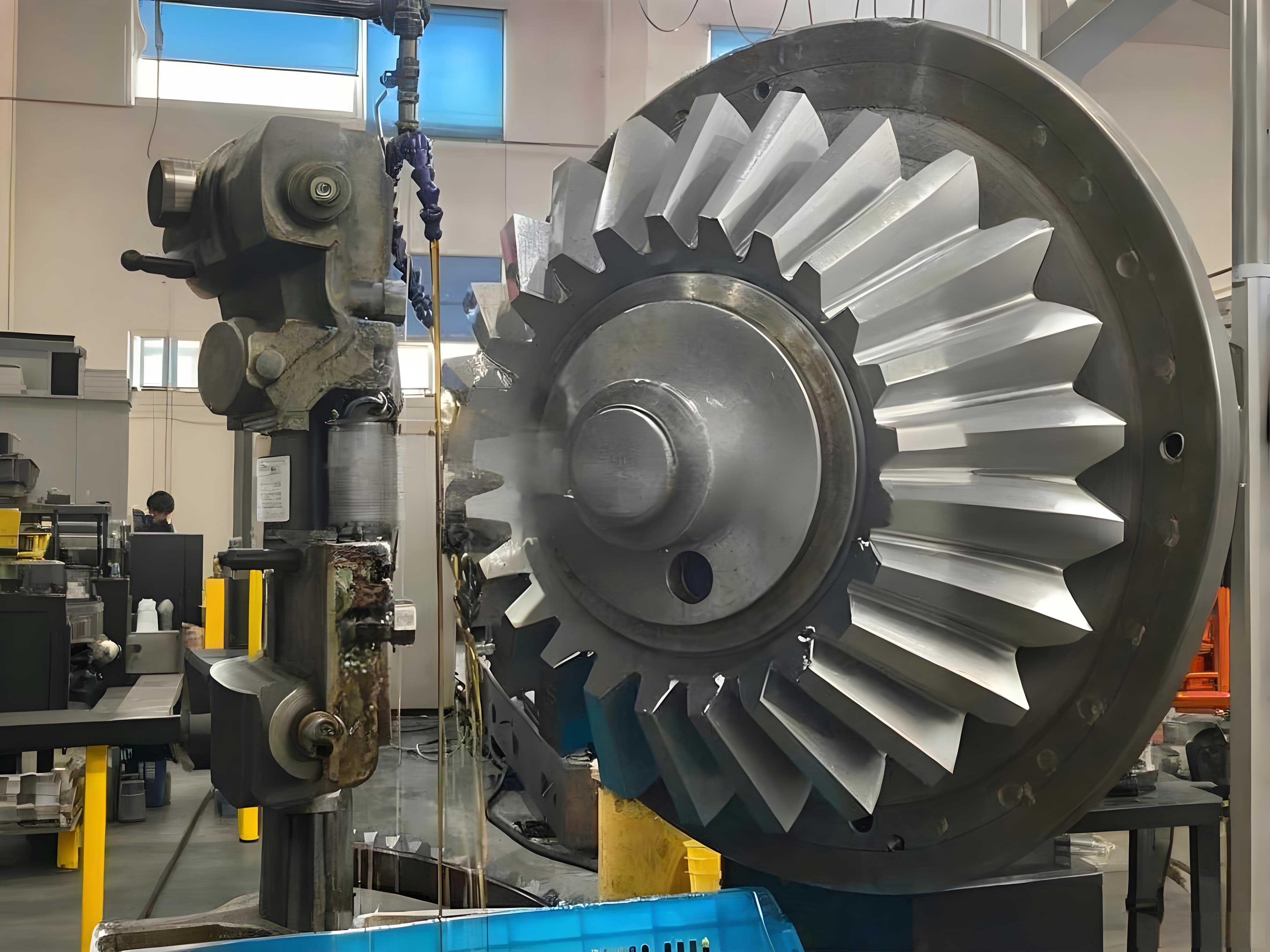
This article focuses on the optimization of straight miter gear drives. The design variables selected are the transverse module at the large end (met), the number of teeth on the pinion (z1), and the face width (b). The optimization objective is to minimize the sum of the volumes of the two miter gears. Boundary constraints and strength constraints are defined to formulate a comprehensive optimization model. The solution process involves two stages: first, a continuous variable optimization is performed using MATLAB, and subsequently, a discrete variable optimization is carried out using LINGO. A comprehensive analysis of the results yields an optimal design scheme. The optimization results demonstrate a significant reduction of approximately 32% in the total gear volume compared to the initial conventional design, providing valuable reference for design selection and material efficiency.
1. Establishment of the Optimization Mathematical Model
1.1 Design Variables
In a typical design scenario for a miter gear drive, operational parameters such as the applied load, the torque transmitted by the pinion (T1), the gear ratio (u, which is 1 for a miter gear), and the pinion speed (n1) are predetermined. The basic geometrical parameters include the transverse module at the large end (met), the number of teeth on the pinion (z1) and gear (z2), the face width (b) or the face width coefficient (ΦR), the shaft angle (Σ, typically 90°), and the pitch cone angles for the pinion (δ1) and gear (δ2). For a standard miter gear with a 90° shaft angle and a 1:1 ratio, the relationship is simplified: z1 = z2 and δ1 = δ2 = 45°. Therefore, if Σ is fixed, the independent design variables are precisely the transverse module at the large end (met), the number of teeth on the pinion (z1) – which also defines the gear teeth, and the face width (b). Thus, the design variable vector is:
$$ X = [met, z1, b]^T = [x_1, x_2, x_3]^T $$
1.2 Objective Function
The goal is to conserve material while satisfying all design conditions. Therefore, the objective function is defined as minimizing the total volume of the pinion and gear in the straight miter gear drive. Given the complex geometry of a bevel gear, an exact volumetric expression is intricate. A common and effective approximation is to calculate the volume of the frustum of a cone lying between the large-end and small-end pitch circles. The volume for one miter gear (pinion or gear, they are identical) can be expressed as:
$$ V = \frac{\pi b \cos \delta}{3} \left[ \left( \frac{d_e}{2} \right)^2 + \left( \frac{d_e}{2} \right) \left( \frac{d_e}{2} \cdot \frac{R_e – b}{R_e} \right) + \left( \frac{d_e}{2} \cdot \frac{R_e – b}{R_e} \right)^2 \right] $$
For a miter gear, δ = 45°, cos δ = √2/2. The pitch diameter at the large end is $d_e = met \cdot z1$. The outer cone distance $R_e$ is calculated as:
$$ R_e = \frac{met \cdot z1}{2 \sin \delta} = \frac{met \cdot z1}{2 \cdot (\sqrt{2}/2)} = \frac{met \cdot z1}{\sqrt{2}} $$
Since there are two identical gears, the total objective function to be minimized is:
$$ \min f(X) = 2V = \frac{2\pi b \cos \delta}{3} \left[ \left( \frac{met \cdot z1}{2} \right)^2 + \left( \frac{met \cdot z1}{2} \right) \left( \frac{met \cdot z1}{2} \cdot \frac{R_e – b}{R_e} \right) + \left( \frac{met \cdot z1}{2} \cdot \frac{R_e – b}{R_e} \right)^2 \right] $$
Substituting the expressions for cos δ and $R_e$ provides the final objective function in terms of the design variables $x_1, x_2, x_3$.
1.3 Constraint Conditions
The optimization is subject to a set of boundary and performance constraints to ensure practicality, manufacturability, and safety.
1.3.1 Transverse Module Constraint
The transverse module $met$ must conform to standard preferred values. A typical range is specified, leading to inequality constraints:
$$ g_1(X) = 2 – x_1 \leq 0 $$
$$ g_2(X) = x_1 – 10 \leq 0 $$
1.3.2 Pinion Teeth Number Constraint
The number of teeth on the pinion $z1$ is usually constrained to avoid undercutting and ensure smooth operation, commonly within:
$$ g_3(X) = 16 – x_2 \leq 0 $$
$$ g_4(X) = x_2 – 30 \leq 0 $$
1.3.3 Face Width Constraint
The face width $b$ is related to the outer cone distance via the face width coefficient $Φ_R = b / R_e$. For straight miter gears, this coefficient is typically bounded:
$$ g_5(X) = 0.25 – \frac{x_3}{R_e} \leq 0 $$
$$ g_6(X) = \frac{x_3}{R_e} – 0.33 \leq 0 $$
Where $R_e = x_1 x_2 / \sqrt{2}$.
1.3.4 Surface Contact Fatigue Strength Constraint
According to standards like GB/T10062-2003/ISO 10300, the contact stress $\sigma_H$ must not exceed the permissible contact stress $\sigma_{HP}$.
$$ \sigma_H = \sqrt{ \frac{F_{mt} K_A K_V K_{H\beta} K_{H\alpha}}{d_{m1} l_{bm}} \cdot \frac{\sqrt{u^2 + 1}}{u} } \cdot Z_{M-B} Z_H Z_E Z_{LS} Z_{\beta} Z_K \leq \sigma_{HP} $$
Therefore, the constraint is:
$$ g_7(X) = \sigma_H – \sigma_{HP} \leq 0 $$
For a miter gear drive (u=1, Σ=90°), many factors simplify. The tangential force at the mean diameter $F_{mt}$, mean diameter $d_{m1}$, and mean contact line length $l_{bm}$ are functions of the design variables and applied torque $T_1$. Coefficients $K_A, K_V, K_{H\beta}, K_{H\alpha}, Z_{M-B}, Z_H, Z_E, Z_{LS}, Z_{\beta}, Z_K$ are determined based on gear geometry, material, and operating conditions from relevant standards or handbooks.
1.3.5 Root Bending Fatigue Strength Constraint
Similarly, the root bending stress $\sigma_F$ must not exceed the permissible bending stress $\sigma_{FP}$.
$$ \sigma_F = \frac{F_{mt}}{b m_{mn}} \cdot Y_{Fa} Y_{Sa} Y_{\epsilon} Y_K Y_{LS} K_A K_V K_{F\beta} K_{F\alpha} \leq \sigma_{FP} $$
Thus, the constraint is:
$$ g_8(X) = \sigma_F – \sigma_{FP} \leq 0 $$
Here, $m_{mn}$ is the mean normal module. The geometrical factor $Y_{Fa}$, stress correction factor $Y_{Sa}$, contact ratio factor $Y_{\epsilon}$, bevel gear factor $Y_K$, load sharing factor $Y_{LS}$, and load distribution factors $K_{F\beta}, K_{F\alpha}$ are also determined from standards based on the specific design variables.
2. Design Example and Conventional Design Result
Consider the design of a closed-drive straight miter gear transmission with the following known parameters:
| Parameter | Symbol | Value | Unit |
|---|---|---|---|
| Pinion Torque | $T_1$ | 400 | N·m |
| Pinion Speed | $n_1$ | 960 | rpm |
| Gear Ratio | $u$ | 1 | – |
| Shaft Angle | $\Sigma$ | 90 | ° |
| Material (Both Gears) | – | 20Cr, Carburized & Hardened | – |
| Surface Hardness | – | 58-63 | HRC |
| Permissible Contact Stress | $\sigma_{HP}$ | 1087 | MPa |
| Permissible Bending Stress | $\sigma_{FP}$ | 450 | MPa |
Following conventional design procedures—starting with an initial tooth number selection, estimating the minimum pinion diameter via a surface strength formula, determining the module and face width, and finally verifying both strength criteria—yields the following conventional design result:
| Parameter | Symbol | Conventional Value |
|---|---|---|
| Transverse Module | $met$ | 5.5 mm |
| Number of Teeth (Pinion & Gear) | $z1, z2$ | 19 |
| Face Width | $b$ | 50 mm |
| Outer Cone Distance | $R_e$ | ~165.23 mm |
| Face Width Coefficient | $Φ_R$ | ~0.3026 |
| Large-End Pitch Diameter | $d_e$ | 104.5 mm |
| Calculated Contact Stress | $\sigma_H$ | 906.8 MPa |
| Calculated Bending Stress | $\sigma_F$ | 275.4 MPa |
| Total Volume (Approx.) | $f(X)$ | 11.8455 × 10⁵ mm³ |
3. Optimization Solution
3.1 Continuous Variable Optimization
In this approach, the design variables are treated as continuous real numbers. After obtaining the optimal solution, the values are rounded to the nearest standard or integer values to yield a practical design. Two methods within MATLAB are employed for comparison.
3.1.1 Optimization using `fmincon` Function
MATLAB’s `fmincon` function is designed for solving constrained nonlinear multivariable optimization problems. The objective function (`aim_1.m`) and nonlinear constraint function (`const_1.m`) are programmed, incorporating all formulas for stress calculation. Using the conventional design as the initial point `x0 = [5.5, 19, 50]`, with lower bounds `[2, 16, 10]` and upper bounds `[10, 30, 100]`, the solver is executed.
Continuous Solution from fmincon:
$$ X_{cont1} = [met, z1, b] = [4.5214, 21.0216, 38.4166] $$
3.1.2 Optimization using Particle Swarm Optimization (PSO)
As a comparison, a global search algorithm, Particle Swarm Optimization (PSO), is implemented in MATLAB. The algorithm is configured with a suitable population size and iteration count to explore the design space thoroughly.
Continuous Solution from PSO:
$$ X_{cont2} = [met, z1, b] = [4.5218, 21.0240, 38.4365] $$
The PSO algorithm’s fitness convergence curve typically shows a rapid initial decrease in total volume, which stabilizes after a number of iterations, indicating convergence. The results from `fmincon` and PSO are remarkably close, validating the location of the optimum in the continuous domain.
3.1.3 Rounding the Continuous Solution
The continuous solutions must be adapted for manufacturing. The module must be a standard value, and teeth number and face width are integers. Rounding $X_{cont1}$ gives: $X_{round} = [met=4.5, z1=21, b=39]$. However, this rounded set must be checked against all constraints, especially the strength limits, as rounding can sometimes violate them.
3.2 Discrete Variable Optimization
Recognizing that $met$, $z1$, and $b$ are inherently discrete (standard modules, integer teeth, and often integer face widths), a discrete optimization is more rigorous. LINGO software is particularly suited for this, as it allows variables to be defined as discrete or within specific sets directly in the model formulation.
In LINGO, the model is formulated with the same objective and constraints. The discrete nature is enforced by:
- Defining $met$ (x1) to belong to a set of standard module values (e.g., {2, 2.25, 2.5, …, 10}).
- Declaring $z1$ (x2) and $b$ (x3) as general integers using `@GIN` function.
Solving this discrete optimization model yields a result that is immediately manufacturable without need for rounding.
Discrete Solution from LINGO:
$$ X_{disc} = [met, z1, b] = [4.5, 21, 40] $$
4. Results Comparison and Analysis
The following table consolidates the conventional design and the various optimization results:
| Design Scheme | $met$ (mm) | $z1$ | $b$ (mm) | $Φ_R$ | $\sigma_H$ (MPa) | $\sigma_F$ (MPa) | Total Volume $f(X)$ (×10⁵ mm³) | Volume Reduction |
|---|---|---|---|---|---|---|---|---|
| Conventional | 5.5 | 19 | 50 | 0.3026 | 906.8 | 275.4 | 11.8455 | Base |
| Continuous (fmincon) | 4.5214 | 21.0216 | 38.4166 | 0.2556 | 1087.0* | 450.0* | 7.9246 | 33.1% |
| Continuous (PSO) | 4.5218 | 21.0240 | 38.4365 | 0.2557 | 1086.8* | 449.7* | 7.9314 | 33.0% |
| Rounded Continuous (Xround) | 4.5 | 21 | 39 | 0.2610 | 1088.7 | 450.6 | 7.9064 | 33.2% |
| Discrete (Xdisc) | 4.5 | 21 | 40 | 0.2677 | 1079.0 | 442.6 | 8.0505 | 32.0% |
*Note: The continuous solver pushes stresses to the constraint limits. The rounded solution (4.5, 21, 39) shows a slight violation of the strength constraints (stresses > permissible), which may be acceptable within a small margin of error but is technically infeasible. The discrete optimization result (4.5, 21, 40) provides a directly manufacturable solution that fully satisfies all constraints, with stresses safely below the allowable limits. This solution achieves a substantial 32% reduction in total miter gear volume compared to the conventional design, demonstrating significant material savings and optimization efficacy.
5. Conclusion
This study successfully applies optimization design theory and methodology to the design of straight miter gear drives. By formulating a mathematical model with the minimization of total miter gear volume as the objective and incorporating boundary and strength constraints, a systematic approach to improving design efficiency is established. The comparative solving strategy—using MATLAB for continuous variable optimization and LINGO for discrete variable optimization—highlights the importance of treating design variables according to their inherent nature. The continuous solution identifies the optimal region of the design space, while the discrete solution provides a practical, manufacturable optimum. The results from the design example confirm that significant material savings (approximately 32%) are achievable through optimization while meeting all performance requirements, offering a valuable reference for the design and selection of efficient straight miter gear drives.
| Method | Variable Treatment | Software Tool | Advantages | Disadvantages/Considerations | Best For |
|---|---|---|---|---|---|
| Conventional Design | Manual selection, iterative check | Handbooks, Calculators | Simple, intuitive, based on experience. | Time-consuming, not guaranteed to be optimal, relies heavily on initial guesses. | Initial sizing, educational purposes. |
| Continuous Optimization (e.g., fmincon, PSO) | Variables as continuous real numbers | MATLAB, Python (SciPy) | Finds the theoretical optimum in the continuous space. Efficient for complex constraints. PSO avoids local minima. | Solution requires rounding to standard/discrete values, which may violate constraints (infeasible design). | Identifying the optimal region, sensitivity analysis, when variable discreteness is not critical. |
| Discrete Optimization | Variables as discrete sets (standard modules, integers) | LINGO, GAMS, specialized algorithms | Yields directly manufacturable, feasible solutions. More realistic model of the problem. | Computationally more challenging for large sets (combinatorial complexity). | Final design specification, ensuring constraint satisfaction with standard parts. |
| Hybrid Approach (as demonstrated) | Continuous search followed by discrete validation/optimization | MATLAB & LINGO | Leverages speed of continuous solvers to find promising region, then uses discrete solver to find feasible optimum. Comprehensive. | Requires multiple software tools or environments. | Comprehensive design projects where both optimality and manufacturability are paramount. |