
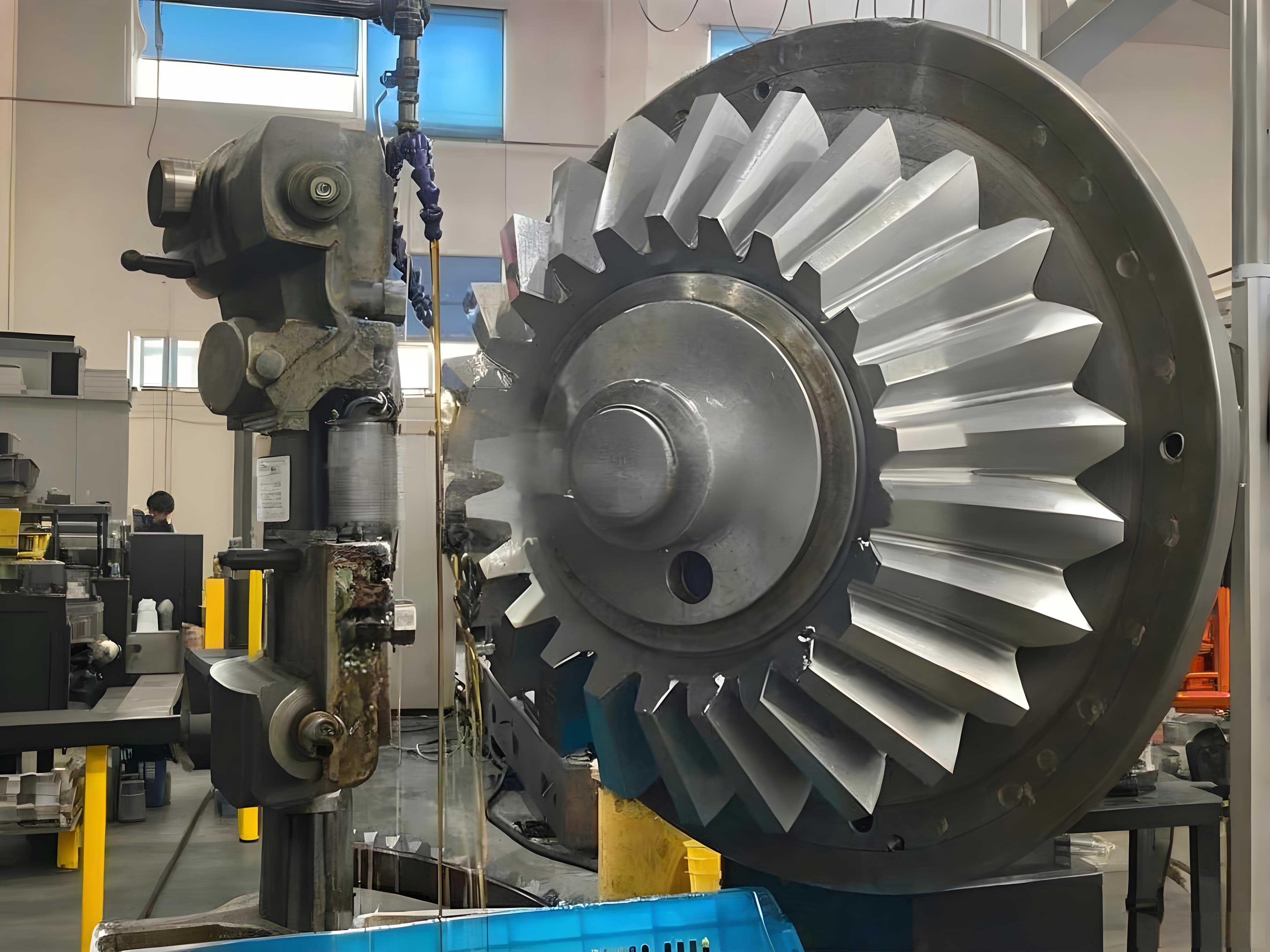
In the precision manufacturing of miter gears, profile errors are a critical concern that directly impacts gear performance, including transmission efficiency, noise levels, and longevity. As an engineer with extensive experience in gear production, I have encountered numerous instances where subtle deviations in tooth profiles lead to significant operational issues. Miter gears, being a type of bevel gear with intersecting shafts—often at 90 degrees—require meticulous attention to tooth geometry. This article delves into the analysis of profile errors in miter gears, exploring their forms, underlying causes, theoretical foundations, and practical correction methods. I will emphasize quantitative approaches using formulas and tables to summarize key points, aiming to provide a comprehensive guide for professionals in the field. The focus will remain on miter gears throughout, highlighting their unique characteristics and error mechanisms.
Forms and Causes of Profile Errors in Miter Gears
Profile errors in miter gears can be broadly classified into systematic errors, which arise from consistent machine or tool inaccuracies, and accidental errors, which result from random factors during manufacturing. Understanding these errors is essential for effective quality control. Below, I outline common error forms and their root causes, based on my observations and industry practices.
| Error Form | Description | Primary Causes |
|---|---|---|
| Top-Fat and Root-Thin | The tooth profile appears thicker at the tip and thinner at the root, sometimes approaching a rectangular shape. This error affects the meshing engagement of miter gears, leading to improper contact patterns. |
|
| Top-Thin and Root-Fat | The tooth profile is thinner at the tip and thicker at the root, potentially resembling a triangular shape. This can cause weak tooth tips and increased root stress in miter gears. |
|
| Unilateral Error (One Side Acceptable, Other Defective) | One flank of the miter gear tooth meets specifications, while the opposite flank is either too fat (large pressure angle) or too thin (small pressure angle). This asymmetry disrupts smooth operation. |
|
| Localized Defects at Tooth Top or Root | Concave or convex irregularities at the tooth tip or root, especially at the small or large end of the miter gear. These defects can initiate cracks under load. |
|
| Varied Errors Across Teeth | Inconsistent profile error measurements from one tooth to another on the same miter gear. This often indicates installation or dynamic issues. |
|
These errors, if left uncorrected, can compromise the performance of miter gears in applications like differential drives, steering systems, and precision machinery. From my experience, systematic errors are often easier to diagnose and correct through machine adjustments, while accidental errors may require process optimization.
Theoretical Foundation of Profile Errors in Miter Gears
The generation of miter gear teeth on a planing machine operates on the principle of gear generation, where a virtual cylindrical gear (representing the miter gear) meshes with a rack cutter (simulating a flat-top gear). During this process, the tooth profile is progressively cut while simultaneously forming the base circle. Any inaccuracies in the machine, tool, fixture, or adjustments lead to errors in the base circle, which directly translate to profile errors due to the nature of the involute curve. Fundamentally, the profile error corresponds to the maximum deviation in the arc length of the base circle over the tooth profile’s unfolding angle range. This is equivalent to the error in the radius of curvature of the involute at any point.
For a miter gear, we consider the base circle radius increment $\Delta r_O$ based on the increment $\Delta r_{OT}$ of the virtual cylindrical gear’s base circle radius. The unfolding angle at the tooth tip, denoted as $\varphi_{eT}$ (in degrees), is given by:
$$\varphi_{eT} = \frac{2\pi\varepsilon \cos\delta}{z}$$
Here, $\varepsilon$ is the contact ratio (a measure of meshing overlap), $\delta$ is the pitch cone angle of the miter gear workpiece, and $z$ is the number of teeth. The profile error $\Delta f_f$ can then be expressed as:
$$\Delta f_f = \Delta r_{OT} \frac{2\pi\varepsilon \cos\delta}{z} \quad (1)$$
This equation highlights that the profile error in miter gears is proportional to the base circle radius error and the geometric parameters of the gear. It serves as the cornerstone for quantitative error analysis. In practice, $\Delta r_{OT}$ arises from various sources, such as tool positioning or machine kinematics, which we will explore in correction methods.
Quantitative Analysis and Correction Methods for Miter Gear Profile Errors
Based on the theoretical framework, I have developed and applied several correction techniques to address profile errors in miter gears. These methods involve adjusting machine parameters to compensate for the base circle deviations. Below, I detail each method with supporting formulas and practical considerations.
Adjusting the Sector Gear Plate Force Arm
When a miter gear exhibits symmetrical top-fat and root-thin errors, reducing the force arm length $L$ of the sector gear plate on the planing machine can correct the profile. Conversely, for top-thin and root-fat errors, increasing $L$ is effective. The underlying geometry relates the force arm adjustment to the base circle change. From the machine kinematics, the change in the virtual pitch circle radius $\Delta r_T$ due to an angular adjustment $\Delta\delta$ (in radians) is:
$$\Delta r_T = L \sin\Delta\delta$$
The corresponding change in the base circle radius $\Delta r_{OT}$ is:
$$\Delta r_{OT} = \Delta r_T \cos\alpha = L \sin\Delta\delta \cos\alpha \quad (2)$$
where $\alpha$ is the pressure angle of the miter gear. Substituting equation (2) into equation (1), we derive the profile error in terms of the force arm adjustment:
$$\Delta f_f = \frac{2\pi\varepsilon L \sin\Delta\delta \cos\alpha \cos\delta}{z}$$
To facilitate practical use, convert $\Delta\delta$ to degrees (where $1 \text{ rad} \approx 57.2958^\circ$), resulting in:
$$\Delta f_f = \frac{0.0174 \times 2\pi\varepsilon L \Delta\delta \cos\alpha \cos\delta}{z} \quad (3)$$
This formula allows engineers to calculate the required angular adjustment $\Delta\delta$ (or force arm change) for a given measured profile error $\Delta f_f$ in miter gears. For instance, if a miter gear shows a profile error of 0.02 mm, equation (3) can be rearranged to solve for $\Delta\delta$.
Adjusting the Planing Tool Pressure Angle
Unilateral profile errors in miter gears often stem from incorrect pressure angles on the planing tools. By adjusting the wedge on the tool holder, the effective pressure angle can be modified—typically, each notch movement changes the angle by 20 arcminutes. The relationship between the pressure angle change $\Delta\alpha$ (in radians) and the profile error is given by:
$$\Delta f_f = \pi m \varepsilon \Delta\alpha \sin\alpha \quad (4)$$
where $m$ is the module of the miter gear. This equation quantifies how a small change in tool pressure angle impacts the tooth profile. For example, if the left flank of a miter gear is too thin, increasing the pressure angle on that side’s tool can compensate. It is crucial to use precise grinding fixtures to maintain the tool’s rake angle (often set at 12°) during sharpening, as variations can introduce additional errors.
Adjusting the Planing Tool Installation Length
Another common correction involves modifying the installation length $\Delta h$ of the planing tool. When the tooth height is fixed but the profile shows top-fat and root-thin errors, shortening $\Delta h$ can help. To maintain the correct tooth height, the workpiece spindle must be advanced by a corresponding amount $\Delta A$:
$$\Delta A = \frac{\Delta h \sin\delta_H}{\gamma}$$
Here, $\delta_H$ is the workpiece cutting angle, and $\gamma$ is a tool angle parameter. From geometric analysis, the change in the rolling radius $\Delta r$ due to tool length adjustment is:
$$\Delta r = \Delta h \cos(\delta – \gamma)$$
The virtual pitch circle radius change $\Delta r_T$ is:
$$\Delta r_T = \Delta h \cos(\delta – \gamma) \cos\delta$$
Thus, the base circle change becomes:
$$\Delta r_{OT} = \Delta r_T \cos\alpha = \Delta h \cos(\delta – \gamma) \cos\alpha \cos\delta \quad (5)$$
Substituting into equation (1), the profile error correction formula is:
$$\Delta f_f = \frac{\Delta h \cos(\delta – \gamma) \cos\alpha \cdot 2\pi\varepsilon \cos\delta}{z \cos\delta} = \frac{2\pi\varepsilon \Delta h \cos(\delta – \gamma) \cos\alpha}{z} \quad (6)$$
This enables calculation of the required tool length adjustment for specific profile errors in miter gears. Similarly, adjusting the tool carriage’s forward termination position can yield comparable results, as it alters the effective tool engagement.
| Error Scenario | Correction Method | Key Formula | Practical Notes |
|---|---|---|---|
| Symmetrical top-fat/root-thin | Decrease sector gear plate force arm | $\Delta f_f = \frac{0.0174 \times 2\pi\varepsilon L \Delta\delta \cos\alpha \cos\delta}{z}$ | Measure $\Delta f_f$ and solve for $\Delta\delta$; adjust $L$ accordingly. Ensure machine stability. |
| Symmetrical top-thin/root-fat | Increase sector gear plate force arm | Same as above | Reverse the adjustment direction; verify with profile testing. |
| Unilateral error (e.g., left flank too fat) | Adjust planing tool pressure angle | $\Delta f_f = \pi m \varepsilon \Delta\alpha \sin\alpha$ | Use wedge notches (20′ per notch); recalibrate tool alignment for miter gears. |
| Tool-length-related error with fixed tooth height | Adjust tool installation length | $\Delta f_f = \frac{2\pi\varepsilon \Delta h \cos(\delta – \gamma) \cos\alpha}{z}$ | Compensate spindle position $\Delta A$; check tooth height after adjustment. |
| Combined errors | Sequential adjustments | Apply formulas iteratively | Prioritize dominant error sources; use trial cuts for validation. |
Extended Discussion on Miter Gear Error Impacts and Advanced Considerations
Beyond the basic error forms, profile deviations in miter gears can have cascading effects on system performance. In my work, I have observed that even minor errors can lead to increased vibration, noise, and accelerated wear in high-speed applications. For instance, top-fat errors cause premature contact at the tooth tips, leading to pitting, while root-thin errors weaken the tooth structure, risking fractures. Additionally, unilateral errors create uneven loading, which is particularly detrimental in precision miter gear pairs used in robotics or aerospace.
To further analyze these impacts, consider the contact stress on miter gear teeth, which can be approximated using the Hertzian contact formula. For two miter gears in mesh, the maximum contact pressure $p_{\text{max}}$ is related to the profile error $\Delta f_f$ by:
$$p_{\text{max}} \propto \sqrt{\frac{F}{\rho_{\text{eff}}} + \Delta f_f}$$
where $F$ is the normal load and $\rho_{\text{eff}}$ is the effective radius of curvature. This shows that profile errors increase contact pressure, exacerbating wear. Therefore, controlling $\Delta f_f$ is essential for durability.
Moreover, modern manufacturing of miter gears involves CNC planing or grinding machines, where error compensation can be digitally programmed. The theoretical formulas I presented can be integrated into these systems for automated corrections. For example, equation (3) can be adapted to generate correction offsets in CNC code, enhancing consistency across production batches.
Another aspect is the measurement of profile errors in miter gears. While traditional methods use gear testers with involute probes, optical scanning and coordinate measuring machines (CMMs) now offer high-resolution data. These technologies allow for detailed error mapping, enabling targeted corrections based on the formulas above. I recommend combining multiple measurement techniques to capture both systematic and accidental errors in miter gears.
Conclusion
In conclusion, profile errors in miter gears are multifaceted issues stemming from machine adjustments, tool parameters, and process variables. Through theoretical analysis, we have established that these errors equate to base circle arc length deviations, quantifiable using equations like (1). Practical correction methods—such as adjusting the sector gear plate force arm, planing tool pressure angle, and installation length—provide effective means to rectify common error forms. The formulas and tables presented here, derived from both theory and hands-on experience, serve as a valuable toolkit for engineers working with miter gears. By applying these principles, manufacturers can achieve tighter tolerances, improved performance, and longer service life for miter gears in diverse applications. Future advancements in digital manufacturing and metrology will further enhance our ability to control these errors, pushing the precision of miter gears to new heights.