
In my extensive experience with gear manufacturing, particularly in the realm of bevel gears, I have often encountered the challenge of processing straight bevel gears, commonly referred to as miter gears, with non-standard pressure angles. The conventional methods on gear cutting machines are typically designed for standard pressure angles, but industrial applications frequently demand custom geometries. This article delves into a specialized technique we developed for machining such miter gears on a specific gear planer, utilizing a modified rolling generation method. The core innovation lies in using tools with a fixed cutter pressure angle to produce gears with varying working pressure angles through precise machine adjustments. This process not only expands the versatility of existing equipment but also ensures high precision in the production of custom miter gears for specialized machinery.
The fundamental principle behind this method is the rolling generation process, where the workpiece gear engages in a simulated meshing motion with an imaginary generating gear, known as the virtual crown gear or flat-top gear. In the context of straight bevel gear generation, particularly for miter gears, the virtual crown gear is conceptualized as a flat gear with its cone apex coinciding with that of the workpiece gear. During the cutting process, two tool blades, which represent a single tooth of this virtual crown gear, reciprocate to carve out the tooth spaces on the workpiece. The synchronization of this motion is critical for achieving the correct tooth profile. The mathematical relationship governing this meshing condition is paramount. For successful generation, the virtual crown gear and the workpiece gear must satisfy the fundamental equation of gear generation, which relates their diametral pitches and pressure angles. The condition for proper mesh between the workpiece gear and the virtual crown gear is expressed as:
$$
\frac{P_{work}}{P_{virt}} = \frac{\cos \alpha_{virt}}{\cos \alpha_{work}}
$$
where \( P_{work} \) is the diametral pitch of the workpiece (the miter gear being cut), \( P_{virt} \) is the diametral pitch of the virtual crown gear, \( \alpha_{work} \) is the pressure angle of the workpiece gear, and \( \alpha_{virt} \) is the pressure angle of the virtual crown gear, which is essentially the pressure angle of the cutting tool blades. This equation ensures that the kinematic relationship during the rolling motion produces the desired tooth form on the miter gear.
When the pressure angle of the miter gear (\( \alpha_{work} \)) differs from the tool pressure angle (\( \alpha_{virt} \)), the machine cannot be set up in the standard manner. Instead of changing the tool, we adjust the machine’s kinematic chain to alter the effective diametral pitch of the virtual crown gear. By manipulating the included angle between the two cutter heads, we can satisfy the above equation. Specifically, the required virtual diametral pitch is calculated as:
$$
P_{virt} = P_{work} \cdot \frac{\cos \alpha_{work}}{\cos \alpha_{virt}}
$$
This calculated \( P_{virt} \) is used exclusively for setting up the machine’s rolling motion and other related adjustments, such as the tooth depth settings. Importantly, for calculating the full tooth depth of the miter gear, the actual workpiece diametral pitch \( P_{work} \) is used, ensuring the correct gear geometry. This distinction is crucial for maintaining the strength and functionality of the final miter gear.
The machine adjustments on the gear planer, such as the Y236 or similar models, deviate significantly from standard procedures. The primary adjustments involve the rolling motion ratio and the setting angle for the cutter heads. Let’s break down these calculations in detail. First, the rolling motion adjustment, which determines the speed ratio between the workpiece rotation and the cutter carriage swing, is based on the virtual diametral pitch. The formula for the rolling change gear ratio (\( i_{roll} \)) is:
$$
i_{roll} = K \cdot P_{virt}
$$
where \( K \) is a machine constant specific to the gear planer model. This ratio ensures that the workpiece and the virtual crown gear roll together without slip, simulating the correct mating action. Second, the cutter head tilt angle, often called the root angle setting or machine root angle (\( \gamma_m \)), must be adjusted to account for the difference between the standard and actual gear parameters. This angle ensures that the tool cuts at the correct orientation relative to the gear blank. The adjustment formula is:
$$
\gamma_m = \gamma_0 + \Delta \gamma
$$
where \( \gamma_0 \) is the standard machine setting angle for a reference pressure angle, and \( \Delta \gamma \) is a correction factor derived from the gear geometry. A more precise form, considering the pitch cone distance and tooth depth, is:
$$
\gamma_m = \arctan\left( \frac{R \cdot \sin \gamma_0 – h_{f}}{R \cdot \cos \gamma_0} \right)
$$
Here, \( R \) is the pitch cone distance of the miter gear, \( \gamma_0 \) is the nominal pitch cone angle (often 45° for miter gears), and \( h_{f} \) is the dedendum (tooth root height) of the workpiece gear. The dedendum is calculated using the workpiece diametral pitch \( P_{work} \) and the addendum coefficient. For a standard full-depth tooth, \( h_f = \frac{1.157}{P_{work}} \) (assuming a dedendum coefficient of 1.157). However, for custom miter gears, this may vary based on design specifications.
To encapsulate these adjustments for various scenarios, especially when producing a family of miter gears with different pressure angles but the same module or diametral pitch, the following table summarizes key parameters and machine settings. This table serves as a quick reference for machinists and engineers.
| Workpiece Pressure Angle, \( \alpha_{work} \) (degrees) | Tool Pressure Angle, \( \alpha_{virt} \) (degrees) | Workpiece Diametral Pitch, \( P_{work} \) (in⁻¹) | Calculated Virtual Pitch, \( P_{virt} \) (in⁻¹) | Rolling Gear Ratio, \( i_{roll} \) | Cutter Head Tilt Adjustment, \( \Delta \gamma \) (minutes) |
|---|---|---|---|---|---|
| 14.5 | 20 | 10 | 9.32 | 93.2 | +15 |
| 20 | 20 | 10 | 10.00 | 100.0 | 0 |
| 22.5 | 20 | 10 | 10.33 | 103.3 | -12 |
| 25 | 20 | 10 | 10.63 | 106.3 | -25 |
| 14.5 | 20 | 8 | 7.46 | 74.6 | +18 |
| 20 | 20 | 8 | 8.00 | 80.0 | 0 |
| 25 | 20 | 8 | 8.50 | 85.0 | -30 |
Note: The values in this table are illustrative, assuming a machine constant \( K = 10 \) for the rolling ratio calculation, and based on standard gear geometry formulas. Actual settings may require fine-tuning based on machine calibration and specific gear design. The cutter head tilt adjustment \( \Delta \gamma \) is given in arc minutes relative to the standard setting for a 20° pressure angle miter gear.
The process of setting up the machine involves several steps. First, the gear blank for the miter gear is mounted on the workpiece spindle, aligned precisely using a dial indicator to ensure minimal runout. The pitch cone angle is set according to the design; for a standard miter gear with a 1:1 ratio, this is typically 45 degrees. Next, the tooling is installed. We use a pair of planer tools with a fixed pressure angle, usually 20°, as it is a common standard for cutter blades. The tools are sharpened and set in the cutter heads with careful attention to their projection and alignment. The included angle between the two cutter heads is then adjusted based on the calculated virtual diametral pitch. This adjustment alters the effective tooth spacing of the virtual crown gear, compensating for the pressure angle difference. The rolling change gears are selected according to the computed \( i_{roll} \) value. These gears are installed in the machine’s differential or rolling train to establish the correct motion ratio. Subsequently, the cutter head tilt angle \( \gamma_m \) is set using the machine’s angular adjustment scales or sine bars. This ensures the tools approach the blank at the correct angle to generate the proper tooth depth and profile along the face width of the miter gear.
During the cutting operation, the machine simulates the rolling engagement. The workpiece rotates incrementally while the cutter carriage swings, causing the tools to carve out the tooth space. Each stroke of the tools removes material, and after each cycle, the workpiece indexes to the next tooth position. For miter gears, which are often used in right-angle drives, symmetry and precision are critical to ensure smooth operation and minimal backlash. The process may require roughing and finishing passes, especially for hardened or high-precision miter gears. After cutting, the gears are typically deburred and inspected for tooth profile accuracy, pitch error, and surface finish.
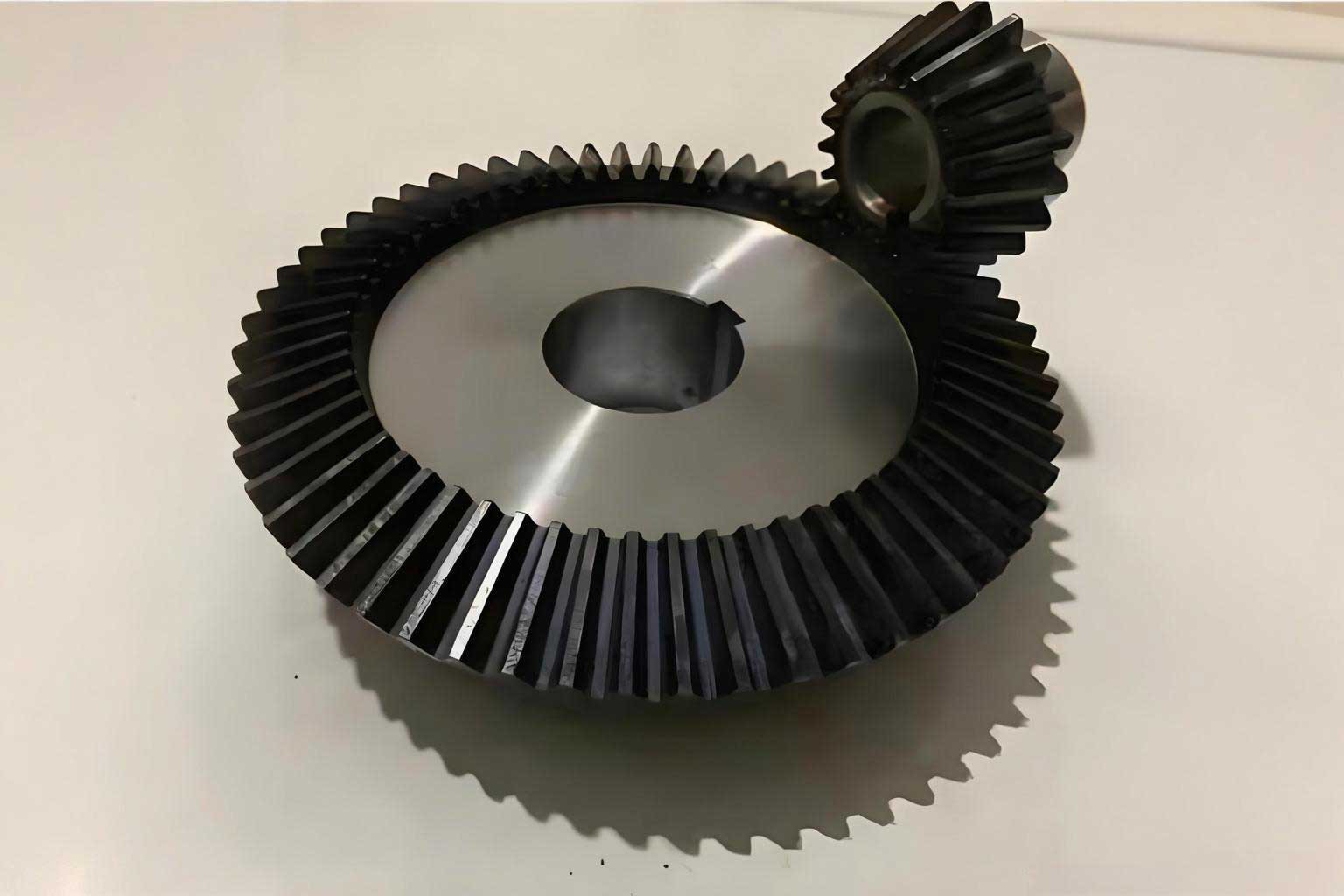
The insertion of this image here provides a visual reference for a typical miter gear, highlighting its conical shape and straight teeth. Such visual aids are invaluable for understanding the geometry being discussed. In practice, the successful machining of miter gears with varied pressure angles relies not only on correct machine settings but also on an in-depth understanding of gear theory. Let’s explore the underlying mathematics further. The basic gear generation equation can be derived from the condition of conjugate action. For a crown gear with a pressure angle \( \alpha_{virt} \), the normal base pitch must match that of the generated gear. This leads to the relationship:
$$
p_{b, work} = p_{b, virt}
$$
where the base pitch \( p_b = \frac{\pi}{P} \cos \alpha \). Substituting, we get:
$$
\frac{\pi}{P_{work}} \cos \alpha_{work} = \frac{\pi}{P_{virt}} \cos \alpha_{virt}
$$
Simplifying yields the earlier equation \( \frac{P_{work}}{P_{virt}} = \frac{\cos \alpha_{virt}}{\cos \alpha_{work}} \). This derivation underscores the importance of the base pitch invariance in gear generation. For miter gears, additional considerations arise due to the conical geometry. The transverse pressure angle on the pitch cone must be considered, but for straight bevel gears, the pressure angle is typically specified in the normal plane at the mid-face width. However, in the generation process using a flat crown gear, the relationship holds as described.
To address potential errors and optimize the process, we must consider factors like tool wear, machine deflection, and thermal effects. For instance, if the tool pressure angle is 20°, but we need to produce a miter gear with a 14.5° pressure angle, the calculated virtual pitch \( P_{virt} \) will be less than \( P_{work} \). This means the machine’s rolling motion must be slower relative to the cutter swing, effectively making the virtual crown gear have finer teeth. Consequently, the generated teeth on the miter gear will have a shallower pressure angle. The inverse occurs for pressure angles greater than the tool angle. The following table expands on the geometric implications for tooth dimensions of the miter gear, based on the American Gear Manufacturers Association (AGMA) standards for bevel gears.
| Parameter | Symbol | Formula | Remarks for Miter Gears |
|---|---|---|---|
| Pitch Diameter | \( d \) | \( d = \frac{N}{P_{work}} \) | For miter gears, often equal for both members in a pair. |
| Pitch Cone Distance | \( R \) | \( R = \frac{d}{2 \sin \gamma} \) | With \( \gamma = 45^\circ \), \( R = \frac{d}{\sqrt{2}} \). |
| Addendum | \( h_a \) | \( h_a = \frac{1}{P_{work}} \) (std) | May be modified for clearance or strength. |
| Dedendum | \( h_f \) | \( h_f = \frac{1.157}{P_{work}} \) (std) | Used for full tooth depth calculation. |
| Tooth Depth | \( h_t \) | \( h_t = h_a + h_f \) | Critical for setting cutter penetration. |
| Circular Tooth Thickness | \( t \) | \( t = \frac{\pi}{2 P_{work}} \) (std) | Affected by backlash requirements. |
| Pressure Angle Correction Factor | \( C \) | \( C = \frac{\cos \alpha_{work}}{\cos \alpha_{virt}} \) | Essentially the ratio \( P_{virt} / P_{work} \). |
These formulas are essential for designing and verifying the miter gear before cutting. In practice, we often create a setup sheet that lists all calculated parameters for each job. For a batch of miter gears with varying pressure angles, this sheet ensures consistency and reduces setup errors. Moreover, the use of a fixed tool pressure angle simplifies inventory management, as only one set of cutter blades is needed for a range of gear designs. This is particularly advantageous in job-shop environments where flexibility is key.
The rolling generation method for miter gears also has implications for tooth contact analysis. The resulting tooth profile is an octoidal form rather than an involute, which is typical for bevel gears generated by a crown gear. The shape is influenced by the machine kinematics and tool geometry. When the pressure angles differ, the contact pattern on the finished miter gear may shift slightly. Therefore, after cutting, we often conduct a contact check using bearing compound or blue ink to ensure the pattern is centered on the tooth flank. Adjustments to the machine settings, such as slight modifications to the cutter head tilt or the rolling ratio, can be made to correct any deviations. This iterative process highlights the art and science of gear manufacturing.
From a broader perspective, the ability to machine miter gears with custom pressure angles opens up design possibilities for engineers. For example, in applications requiring reduced noise or higher load capacity, pressure angles other than the standard 20° may be preferred. A lower pressure angle like 14.5° can provide smoother engagement but with lower bending strength, while a higher angle like 25° offers stronger teeth but potentially more noise. The method described here allows for such customization without requiring specialized tooling for each pressure angle. This flexibility is crucial for prototyping and low-volume production of specialized miter gears used in aerospace, automotive differentials, and industrial machinery.
In conclusion, the technique of using a fixed tool pressure angle to generate miter gears with various working pressure angles is a powerful adaptation of standard gear planning machinery. By leveraging the fundamental meshing equation and making precise adjustments to the machine’s kinematic chain—specifically the virtual diametral pitch and cutter head orientation—we can produce accurate and functional straight bevel gears for diverse applications. This approach not only economizes on tooling costs but also enhances the versatility of manufacturing facilities. As gear technology advances, such methods underscore the importance of deep process knowledge and computational precision in achieving high-quality miter gears that meet exacting design specifications. The continued refinement of these techniques, coupled with computer numerical control (CNC) integration, promises even greater capabilities in the future of bevel gear production.