
In the field of gear engineering, miter gears, which are straight bevel gears with a shaft angle of 90 degrees, play a crucial role in transmitting motion between intersecting axes. However, traditional methods for generating these gears often result in poor tooth contact quality, leading to noise, vibration, and reduced efficiency. In this article, I will explore a novel approach for machining miter gears with localized tooth contact, which significantly improves contact patterns. Specifically, I will delve into the undercutting phenomena and variations in tooth thickness that arise from this new method. By using mathematical models, formulas, and tables, I aim to provide a comprehensive guide for designing and manufacturing high-performance miter gears. The focus will be on how the localized contact method affects gear geometry, particularly in terms of undercutting risks and tooth strength enhancements.
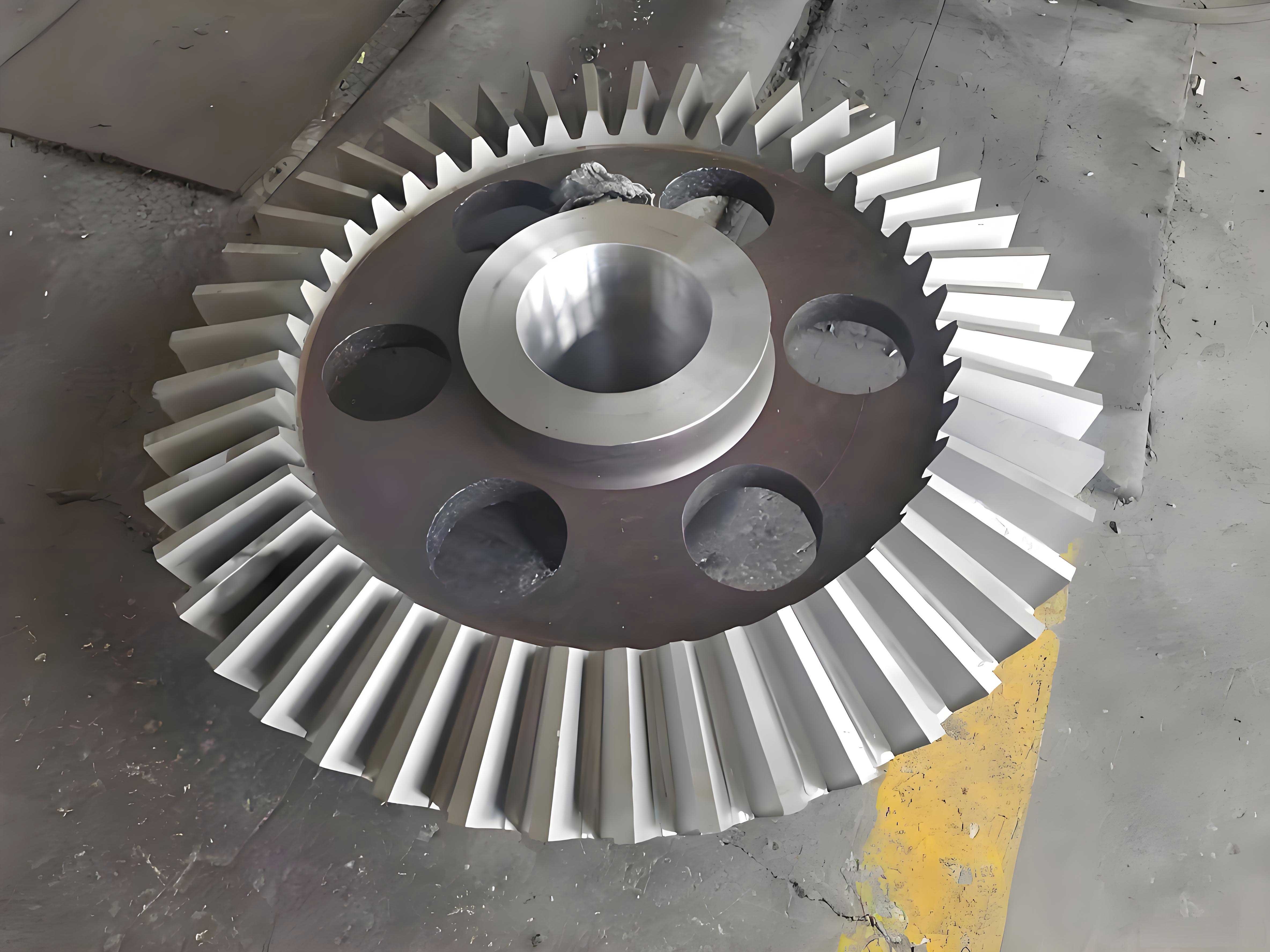
Miter gears are widely used in applications such as automotive differentials, industrial machinery, and robotics. Traditional machining methods, such as the conventional planing technique, often produce gears with unsatisfactory contact areas, leading to stress concentrations and premature failure. The new localized contact method introduces adjustments in tool position and machine settings, resulting in a controlled contact region similar to a crowned tooth surface. This improvement not only enhances contact quality but also influences gear geometry, including undercutting and tooth thickness. In this analysis, I will systematically investigate these aspects, offering new methods for undercutting verification and tooth thickness calculation. The goal is to ensure that miter gears manufactured with this approach meet strength and durability requirements while optimizing performance.
Undercutting is a critical issue in gear design, as it weakens the tooth root and can lead to catastrophic failure. For miter gears, the risk of undercutting varies along the tooth profile, and the new machining method alters this risk distribution. I will begin by examining the undercutting mechanism in localized contact miter gears. In gear generation, undercutting occurs when the tool interferes with the tooth surface during the cutting process, removing material from the root. This is often associated with the curvature interference boundary on the generating surface. Using the concept of the generating surface, I can analyze the conditions for undercutting.
Consider the setup for planing a miter gear with a flat-top generating gear. Let me define coordinate systems: a fixed coordinate system attached to the machine frame and moving coordinate systems attached to the generating gear and the workpiece. The equation for the conjugate curve of the curvature interference boundary on the generating surface can be derived. For a point on this surface, the parameters include the tool profile coordinates and motion variables. The equations are as follows:
$$ x_1 = R_m \sin(\phi_1) – u_1 \cos(\phi_1), $$
$$ y_1 = R_m \cos(\phi_1) + u_1 \sin(\phi_1), $$
where \( R_m \) is the mean cone distance, \( \phi_1 \) is the rotation angle of the generating gear, and \( u_1 \) is the tool profile parameter. The condition for undercutting is that this conjugate curve lies within the effective region of the generating surface. By solving these equations, I can determine whether undercutting occurs at specific points on the tooth.
Through extensive calculations for miter gears with various parameters, I have found that the most critical location for undercutting is at the toe (small end) of the tooth in traditional methods, but in the new localized contact method, the heel (large end) becomes more susceptible. This shift is due to the adjustments in tool position and contact length factor. For example, consider a miter gear with module \( m = 5 \, \text{mm} \), shaft angle \( \Sigma = 90^\circ \), and pressure angle \( \alpha = 20^\circ \). Using the new method with a contact length factor \( \zeta = 0.8 \), the undercutting risk increases at the heel. Table 1 summarizes the undercutting analysis for different gear configurations.
| Gear Pair | Number of Teeth (Pinion) | Contact Length Factor | Undercutting Risk at Heel | Undercutting Risk at Toe |
|---|---|---|---|---|
| Example 1 | 15 | 0.8 | High | Low |
| Example 2 | 20 | 0.6 | Moderate | Very Low |
| Example 3 | 10 | 1.0 | Very High | Moderate |
To prevent undercutting, I need to calculate the minimum modification coefficient. For miter gears, this can be approximated using the equivalent spur gear concept. The formula is:
$$ x_{\min} = \frac{z_v}{2} \left( \frac{1}{\sin^2 \alpha} – 1 \right) + h_a^* + c^*, $$
where \( z_v \) is the virtual number of teeth, \( \alpha \) is the pressure angle, \( h_a^* \) is the addendum coefficient, and \( c^* \) is the clearance coefficient. However, for localized contact miter gears, this coefficient also depends on machine adjustments. A more precise method involves checking the heel region directly. I can use the following condition: if the radial distance \( R \) at the heel satisfies \( R < R_{\text{limit}} \), undercutting occurs. The limit value is derived from the generating surface geometry.
For practical design, I recommend performing undercutting verification at the heel for miter gears machined with the new method. This involves calculating the conjugate curve parameters and comparing them with the effective tool boundary. The equations for this verification are:
$$ \Delta = \sqrt{(x_1 – x_0)^2 + (y_1 – y_0)^2}, $$
$$ \text{If } \Delta < \delta, \text{ undercutting is present}, $$
where \( x_0, y_0 \) are coordinates of the tool tip, and \( \delta \) is a tolerance based on the tool geometry. This approach ensures that miter gears are free from undercutting, enhancing their load-carrying capacity.
Now, let’s move to tooth thickness variations. The new machining method alters the tooth profile, affecting both the toe and heel regions. Tooth thickness is crucial for bending strength and meshing performance. I will derive formulas for calculating the arc tooth thickness on the back cone, which is a common reference for measurement. The tooth surface equation can be expressed in the workpiece coordinate system as:
$$ \mathbf{r}_2 = \mathbf{M}_{21} \cdot \mathbf{r}_1, $$
where \( \mathbf{M}_{21} \) is the transformation matrix from the generating gear to the workpiece, and \( \mathbf{r}_1 \) is the tool surface vector. For a point on the tooth surface, the radial position \( R \) and axial position \( Z \) are determined by parameters \( u_1 \) and \( \phi_1 \). The arc tooth thickness \( s \) at a given cone distance \( R_b \) on the back cone can be calculated as:
$$ s = R_b \cdot \theta, $$
where \( \theta \) is the angular span between the two tooth flanks. To compute \( \theta \), I need to solve for the tool parameters at the specified point. Using iterative methods, I can obtain \( u_1 \) and \( \phi_1 \), and then find \( \theta \) from the coordinate transformations.
For miter gears, the tooth thickness varies along the face width. With the new method, the toe experiences thinning at the tip but thickening at the root, while the heel shows minimal changes. This variation improves bending strength at the toe, which is often the critical section. Table 2 illustrates tooth thickness changes for a miter gear pair with module \( m = 4 \, \text{mm} \), pinion teeth \( z_1 = 16 \), gear teeth \( z_2 = 24 \), and face width \( b = 30 \, \text{mm} \). The data compare traditional and new methods, with different tool offset values \( \Delta h \).
| Location | Tooth Height | Traditional Method (mm) | New Method, \( \Delta h = 0 \) (mm) | New Method, \( \Delta h = +0.1 \) (mm) |
|---|---|---|---|---|
| Heel | Tip | 3.15 | 3.14 | 3.14 |
| Pitch | 6.28 | 6.27 | 6.27 | |
| Root | 7.50 | 7.48 | 7.48 | |
| Toe | Tip | 2.85 | 2.70 | 2.75 |
| Pitch | 5.70 | 5.65 | 5.68 | |
| Root | 6.80 | 7.10 | 7.05 |
From Table 2, it is evident that for miter gears, the new method reduces tip thickness at the toe but increases root thickness, which enhances bending strength. The tool offset \( \Delta h \) can be adjusted to control tooth thickness; a positive offset increases pinion toe thickness, while a negative offset decreases it. This flexibility allows designers to optimize gear geometry for specific applications. The formulas for calculating these thicknesses are based on the generating process. For a given point, I can compute the coordinates using:
$$ x_2 = R \cos(\psi), \quad y_2 = R \sin(\psi), $$
where \( \psi \) is the angle on the back cone. The arc tooth thickness is then \( s = R (\psi_2 – \psi_1) \), with \( \psi_1 \) and \( \psi_2 \) for the two flanks obtained from the tool equations.
Another important aspect is tooth tip sharpening at the toe. For miter gears with small tooth numbers or high modification coefficients, the toe tip may become too thin, leading to weak resistance to wear and breakage. I need to verify this by calculating the tip thickness at the toe. Using the same equations, for the toe point with cone distance \( R_t \), I can find the tip thickness \( s_t \). The condition to avoid sharpening is:
$$ s_t \geq k \cdot m, $$
where \( k \) is a factor typically between 0.25 and 0.3, and \( m \) is the module. If \( s_t \) is below the allowable value, I can increase the contact length factor or adjust the tool offset to thicken the tip. This ensures that miter gears maintain sufficient tip strength for reliable operation.
For measurement purposes, the chordal tooth thickness at the heel is often used. Considering chamfering at the heel, the measurement point is offset from the theoretical pitch circle. The chordal thickness \( \bar{s} \) and chordal height \( \bar{h} \) can be calculated as:
$$ \bar{s} = 2R_b \sin\left(\frac{s}{2R_b}\right), $$
$$ \bar{h} = h_a + R_b \left(1 – \cos\left(\frac{s}{2R_b}\right)\right), $$
where \( h_a \) is the addendum at the heel. These formulas account for the localized contact adjustments, ensuring accurate quality control during miter gear production.
In addition to undercutting and tooth thickness, the transition curve between the tooth surface and root fillet is affected by the new method. For miter gears, this curve determines the stress concentration factor. With the new method, the transition curve shifts toward the toe root and heel tip, expanding the usable tooth surface area. This reduces the risk of meshing interference, as the contact region is localized. The position of the transition curve can be computed using the same generating equations, by finding the intersection between the tooth surface and the fillet radius. Table 3 shows the shift in transition curve positions for a miter gear pair under different machining methods.
| Gear | Machining Method | Transition Curve at Heel (mm from pitch) | Transition Curve at Toe (mm from pitch) |
|---|---|---|---|
| Pinion | Traditional | -1.2 | +0.8 |
| Pinion | New Method | -0.9 | +1.1 |
| Gear | Traditional | -1.0 | +0.6 |
| Gear | New Method | -0.7 | +0.9 |
The negative values indicate movement toward the root, and positive values toward the tip. This shift enhances the gear’s performance by providing a smoother load transition. For miter gears, this is particularly beneficial in high-torque applications where stress peaks must be minimized.
To summarize, the localized contact method for miter gears offers significant advantages over traditional planing. By controlling the contact pattern, it improves meshing quality and reduces noise. However, it requires careful analysis of undercutting and tooth thickness variations. I have presented methods for undercutting verification at the heel, tooth thickness calculation, and tip sharpening check. The formulas and tables provided serve as a practical guide for engineers. For undercutting, the key is to use the minimum modification coefficient based on heel geometry. For tooth thickness, the new method generally increases root thickness at the toe, boosting bending strength. Adjusting tool offset allows fine-tuning of thickness distribution.
In conclusion, miter gears machined with the localized contact method are superior in terms of contact quality and durability. The risk of undercutting is manageable through heel-focused design, and tooth thickness variations can be optimized for strength. I recommend adopting this method in production, as it leverages standard machines with simple adjustments. Future work could involve dynamic analysis of these miter gears under load, but for now, the geometric insights provided here form a solid foundation. By implementing these principles, manufacturers can produce miter gears that meet the demands of modern mechanical systems, ensuring efficient and reliable power transmission.
Throughout this article, I have emphasized the importance of miter gears in various industries. The localized contact method not only addresses traditional limitations but also opens new possibilities for gear design. With continued research and application, miter gears will continue to evolve, offering enhanced performance in compact and efficient drivetrains. I hope this analysis provides valuable insights for gear designers and engineers working with miter gears.