
The design and precise mathematical description of tooth surfaces for straight bevel gears represent a significant and enduring challenge in gear theory and mechanical design. Traditional approaches are predominantly tied to specific, pre-defined curve geometries—most commonly spherical involutes or circular arcs—which serve as the generating profile. While effective, this paradigm inherently limits the exploration and synthesis of novel tooth surface geometries that might offer superior performance characteristics such as reduced noise, higher load capacity, or improved efficiency under specific operating conditions. The active design of tooth surfaces for straight bevel and miter gear pairs, where the shaft angle is 90 degrees, thus remains a multifaceted problem requiring a more fundamental and flexible framework.
This work establishes a novel, generalized methodology for the generation and analysis of straight bevel gear tooth surfaces. The core innovation lies in shifting the descriptive focus from the direct parametric equation of the surface to the properties of its normal vector. By characterizing the tooth surface through the evolution of its normal vector’s direction and magnitude relative to the gear’s fundamental coordinate systems, we unlock a direct and logical pathway to surface generation. This method is inherently universal; it is not constrained to involute or any other specific profile. Instead, it provides a foundational mathematical canvas upon which an infinite variety of tooth surfaces can be actively designed by prescribing the behavior of the normal vector. The subsequent sections will detail the theoretical derivation of this normal vector-based framework, present the general solution algorithm, and demonstrate its application through concrete examples, including the classical spherical involute and novel polynomial-defined surfaces, with particular attention to the geometry of the miter gear.
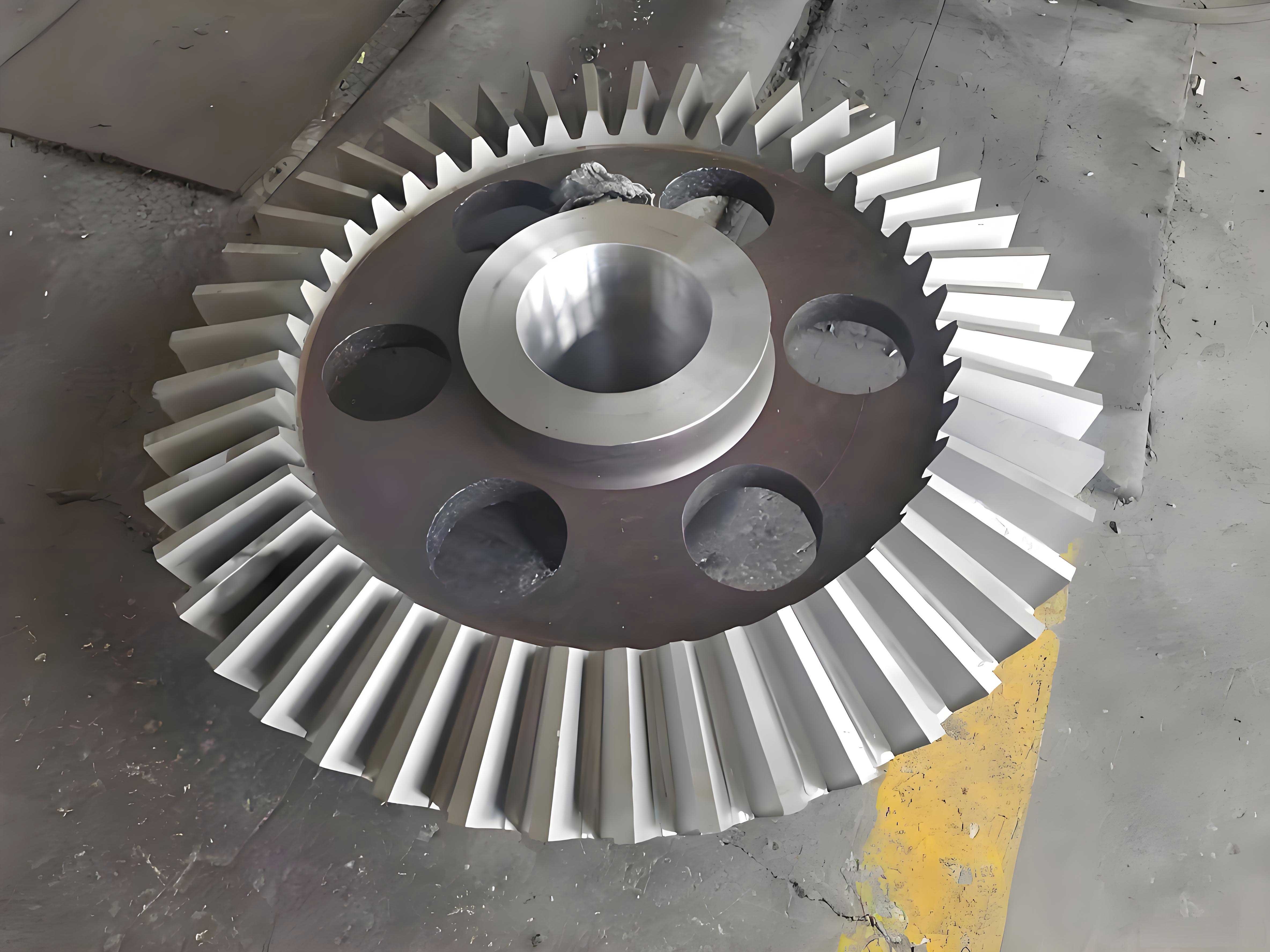
1. Theoretical Foundation: The Tooth Surface Normal Vector
The central concept of this methodology is the detailed characterization of the unit normal vector at any point on the tooth surface of a straight bevel gear. Consider a point \( M \) on the tooth surface \( \Sigma \). The line perpendicular to the surface at \( M \) is the surface normal. We define a specific vector \( \vec{l} \) along this normal, originating from the pitch point \( O_m \) on the pitch cone surface and terminating at the surface point \( M \). The length of this vector, \( l = |\vec{l}| = \overline{O_m M} \), is termed the normal line length.
To describe the orientation of \( \vec{l} \), we establish a right-handed Cartesian coordinate system \( O_m x_m y_m z_m \) at the pitch point \( O_m \). The \( z_m \)-axis is aligned parallel to the gear axis. The \( y_m \)-axis is oriented tangentially to the pitch cone surface. The geometry of the normal vector can then be defined by two angles, \( \beta \) and \( \lambda \), which uniquely determine its direction relative to this local frame. The definitions are as follows:
- The angle \( \beta \) is measured from the positive \( y_m \)-axis to the vector \( \vec{l} \).
- The angle \( \lambda \) is the projection angle of \( \vec{l} \) onto the \( O_m x_m z_m \) plane, measured from the positive \( x_m \)-axis.
The direction cosines of the unit normal vector \( \vec{n}_l \) (i.e., the unit vector in the direction of \( \vec{l} \)) are therefore given by:
$$ \vec{n}_l = \begin{pmatrix}
\sin \beta \cos \lambda \\
\cos \beta \\
-\sin \beta \sin \lambda
\end{pmatrix}. $$
Consequently, the normal vector itself is:
$$ \vec{l} = l \, \vec{n}_l = \begin{pmatrix}
l \sin \beta \cos \lambda \\
l \cos \beta \\
-l \sin \beta \sin \lambda
\end{pmatrix}. $$
The parameters are bounded as: \( 0 \leq \beta \leq \pi \), \( -\pi \leq \lambda \leq \pi \), and \( l \geq 0 \). The complete description of the tooth surface geometry at any point is thus encapsulated by the functions \( l(\phi, u) \), \( \beta(\phi, u) \), and \( \lambda(\phi, u) \), where \( \phi \) and \( u \) are the fundamental motion parameters introduced in the next section.
2. Coordinate Systems and Kinematic Transformation
The generation of the tooth surface is a kinematic process, best described using multiple coordinate systems. The figure below illustrates the setup, which involves two fixed and two moving frames.
Fixed Coordinate Systems:
- \( Oxyz \): The primary global frame.
- \( O_t x_t y_t z_t \): A parallel frame offset along the gear axis by a distance \( u = OO_t \). This parameter \( u \) controls the axial position of the gear blank.
Moving Coordinate Systems:
- \( O_n x_n y_n z_n \): A frame whose origin \( O_n \) is fixed on the pitch cone generatrix. This frame translates along the pitch cone but maintains its orientation parallel to the fixed frames \( Oxyz \) and \( O_t x_t y_t z_t \).
- \( O_m x_m y_m z_m \): The previously defined local frame attached to the instantaneous pitch point \( O_m \). It rotates about the gear axis (the \( z \)-direction) relative to \( O_n x_n y_n z_n \) by an angle \( \phi \). The \( y_m \)-axis remains tangent to the pitch cone surface during this rotation.
The position vector \( \vec{R} \) of a surface point \( M \) in the global frame \( Oxyz \) is found through a sequence of transformations:
- Rotation: From the local normal vector frame \( O_m x_m y_m z_m \) to the translating frame \( O_n x_n y_n z_n \). This accounts for the gear’s angular position \( \phi \).
- Translation: From \( O_n x_n y_n z_n \) to the axial offset frame \( O_t x_t y_t z_t \). This accounts for the radial position on the pitch cone, where \( r = u \tan \delta \), and \( \delta \) is the pitch cone angle. For a miter gear, \( \delta = 45^\circ \).
- Translation: From \( O_t x_t y_t z_t \) back to the global origin \( Oxyz \). This accounts for the axial shift \( u \).
Mathematically, this is expressed as:
$$ \vec{R}(\phi, u) = \mathbf{M}_{nm}(\phi) \, \vec{l} \;+\; \mathbf{M}_{tn}(r) \;+\; \mathbf{M}_{st}(u). $$
The transformation matrices are:
$$ \mathbf{M}_{nm}(\phi) = \begin{pmatrix}
\sin \phi & -\cos \phi & 0 \\
\cos \phi & \sin \phi & 0 \\
0 & 0 & 1
\end{pmatrix}, \quad \mathbf{M}_{tn}(r) = \begin{pmatrix}
r \sin \phi \\
r \cos \phi \\
0
\end{pmatrix}, \quad \mathbf{M}_{st}(u) = \begin{pmatrix}
0 \\
0 \\
u
\end{pmatrix}. $$
Similarly, the unit normal vector \( \vec{n} \) at point \( M \) in the global frame is obtained by rotating the local unit normal:
$$ \vec{n}(\phi, u) = \mathbf{M}_{nm}(\phi) \, \vec{n}_l. $$
3. General Solution Framework via the Theory of Gearing
According to the fundamental theorem of gearing, for a surface generated by a coordinated motion of parameters \( \phi \) and \( u \), the generated surface \( \vec{R}(\phi, u) \) must satisfy the equation of meshing. This condition ensures that the surface normal is perpendicular to the relative velocity direction, which in the case of generation is equivalent to the normals being perpendicular to the tangents of the coordinate curves. The mathematical conditions are:
$$ \frac{\partial \vec{R}}{\partial \phi} \cdot \vec{n} = 0, \qquad \frac{\partial \vec{R}}{\partial u} \cdot \vec{n} = 0. $$
Substituting the expressions for \( \vec{R} \) and \( \vec{n} \) into these conditions and performing the algebra yields two crucial partial differential equations that govern the relationship between the normal vector parameters \( (l, \beta, \lambda) \) and the motion parameters \( (\phi, u) \):
$$ \frac{\partial l}{\partial \phi} = r \cos \beta = u \tan \delta \cos \beta, \tag{1} $$
$$ \frac{\partial l}{\partial u} = \sin \beta \frac{\cos \delta}{\sin(\lambda – \delta)}. \tag{2} $$
Equations (1) and (2) form the cornerstone of the proposed methodology. They reveal that the tooth surface geometry is not arbitrary but is strictly governed by the interplay between the normal line length \( l \) and its direction angles \( \beta \) and \( \lambda \).
The power of this framework lies in its flexibility. To generate a specific tooth surface for a straight bevel or miter gear, one can actively prescribe one of the following relationships:
- The functional form of the normal line length: \( l = f(\phi, u) \).
- The functional form of the direction angle \( \beta \): \( \beta = g(\phi, u) \).
- The functional form of the direction angle \( \lambda \): \( \lambda = h(\phi, u) \).
This prescription, along with the boundary condition \( l(\phi=0) = l_0 \), allows for the integration of equations (1) and (2) to solve for the remaining unknown parameters. The final tooth surface coordinates are then obtained directly from the transformation equation \( \vec{R}(\phi, u) \). This process is summarized in the following table, which contrasts the traditional and proposed approaches.
| Aspect | Traditional Profile-Based Method | Proposed Normal Vector-Based Method |
|---|---|---|
| Starting Point | A pre-defined planar or spatial curve (e.g., involute, arc). | The mathematical properties of the surface normal vector \( \vec{l} \). |
| Core Equation | Parametric equation of the profile curve, swept along a path. | The governing PDEs: \( \partial l/\partial \phi = u \tan \delta \cos \beta \) and \( \partial l/\partial u = \sin \beta \cos \delta / \sin(\lambda – \delta) \). |
| Design Freedom | Limited to the chosen profile family. Modifications are often ad-hoc. | High. Any physically valid function \( l(\phi,u) \), \( \beta(\phi,u) \), or \( \lambda(\phi,u) \) defines a viable surface. |
| Application Scope | Specific to gears derived from the chosen profile (e.g., involute bevel gears). | Universal. Applicable to straight bevel gears, miter gears, and potentially other gear types. |
| Primary Output | Tooth surface coordinates \( \vec{R} \). | Tooth surface coordinates \( \vec{R} \) and its unit normal field \( \vec{n} \). |
4. Application Examples
To demonstrate the universality and practical application of the normal vector-based method, we apply it to two distinct cases: the classical spherical involute surface and a novel surface defined by a bivariate polynomial.
4.1. Case 1: Spherical Involute Straight Bevel Gear
The spherical involute is the standard tooth profile for straight bevel gears. Its geometry is derived from the spherical analog of unwrapping a taut string from a base cone with angle \( \delta_b \). From this definition, the relationship between the normal line length \( l \) and the motion parameters is known to be:
$$ l = u \frac{\cos \delta}{\sin(\phi \sin \delta_b)}. \tag{3} $$
Here, \( \psi = \phi \sin \delta_b \) is the spherical involute roll angle. This equation serves as our prescribed function \( l = f(\phi, u) \). We now use our general framework to derive the corresponding normal vector angles \( \beta \) and \( \lambda \).
First, substitute equation (3) into the governing PDE (1):
$$ \frac{\partial l}{\partial \phi} = u \cos \delta \cdot \frac{-\sin \delta_b \cos(\phi \sin \delta_b)}{\sin^2(\phi \sin \delta_b)} = u \tan \delta \cos \beta. $$
Solving for \( \cos \beta \) yields:
$$ \cos \beta = \frac{\sin \delta_b}{\sin \delta} \cos(\phi \sin \delta_b). \tag{4} $$
Next, substitute equations (3) and (4) into the governing PDE (2):
$$ \frac{\partial l}{\partial u} = \frac{\cos \delta}{\sin(\phi \sin \delta_b)} = \sin \beta \frac{\cos \delta}{\sin(\lambda – \delta)}. $$
Solving for \( \sin(\lambda – \delta) \) gives:
$$ \sin(\lambda – \delta) = \frac{\sin(\phi \sin \delta_b)}{\sin \beta}. \tag{5} $$
Equations (3), (4), and (5) fully define the normal vector parameters \( (l, \beta, \lambda) \) for the spherical involute. Substituting them into the coordinate transformation \( \vec{R}(\phi, u) \) recovers the well-known parametric equations for the spherical involute tooth surface. This exercise validates that the proposed method correctly encompasses the classical solution.
4.2. Case 2: Bivariate Polynomial-Defined Surface
This example showcases the active design capability of the method. Suppose we wish to design a straight bevel gear where the direction angle \( \beta \) varies in a specific, non-standard way across the tooth face width and height. We can prescribe \( \beta \) as a bivariate polynomial function of \( \phi \) and \( u \). For simplicity and demonstration, consider a first-order polynomial:
$$ \beta(\phi, u) = a_0 + a_1 u + a_2 \phi + a_3 u \phi. $$
Here, \( a_0, a_1, a_2, a_3 \) are design constants. The design process is as follows:
- Prescribe \( \beta \): Choose values for the coefficients. For instance:
- Constant: \( a_0 = 0.349 \, \text{rad} (20^\circ), a_1=a_2=a_3=0 \).
- Linear in \( \phi \): \( a_0 = 0.349, a_2 = 0.3, a_1=a_3=0 \).
- Linear in \( u \): \( a_0 = 0.349, a_1 = 0.01, a_2=a_3=0 \).
- Solve for \( l \): Integrate governing equation (1) with respect to \( \phi \), using the prescribed \( \beta(\phi, u) \) and an initial condition \( l_0 \):
$$ l(\phi, u) = l_0 + u \tan \delta \int_{0}^{\phi} \cos \beta(\xi, u) \, d\xi. $$
For a polynomial \( \beta \), this integral can be evaluated analytically or numerically. - Solve for \( \lambda \): Use governing equation (2) to solve for \( \lambda \):
$$ \lambda(\phi, u) = \delta + \arcsin\left( \frac{\sin \beta(\phi, u) \cos \delta}{\partial l / \partial u} \right). $$
The partial derivative \( \partial l / \partial u \) is obtained from the expression for \( l(\phi, u) \) found in step 2.
Substituting the resulting functions \( l(\phi,u) \), \( \beta(\phi,u) \), and \( \lambda(\phi,u) \) into the coordinate transformation \( \vec{R}(\phi, u) \) yields the entirely new tooth surface. The tooth geometry will differ significantly based on the chosen polynomial coefficients, enabling the designer to tailor the surface for specific contact or strength properties. This approach is equally applicable to designing a specialized miter gear with a non-involute profile optimized for a particular application.
| Design Case | Prescribed \( \beta(\phi, u) \) | Physical Interpretation | Potential Application |
|---|---|---|---|
| Standard Involute | \( \beta \) from Eq. (4) | Constant pressure angle along a profile line. | General-purpose power transmission. |
| Constant \( \beta \) Design | \( \beta = 20^\circ \) | Uniform normal vector inclination. Simple geometry. | Basic, low-speed miter gear applications. |
| Axially Tapered \( \beta \) | \( \beta = 20^\circ + 0.01u \) | Pressure angle increases slightly from heel to toe of the tooth. | To compensate for deflection under load to maintain even contact. |
| Circumferentially Modulated \( \beta \) | \( \beta = 20^\circ + 0.3\phi \) | Tooth flank curvature changes systematically from root to tip. | To optimize stress distribution or modify mesh stiffness. |
5. Discussion and Advantages
The normal vector-based methodology presented herein fundamentally reorients the problem of gear tooth surface generation from one of profile following to one of normal field design. This shift offers several profound advantages for the design and analysis of straight bevel gears, including miter gears.
1. Unification and Generalization: The framework provides a single, unified mathematical structure that describes all possible tooth surfaces for straight bevel gears. Classical profiles like the spherical involute emerge as specific solutions to the governing PDEs when the appropriate boundary function (e.g., \( l(\phi,u) \)) is supplied. This eliminates the need for separate, ad-hoc derivations for each new type of profile.
2. Active Design Capability: The most significant contribution is the enablement of active surface design. By treating the functions \( l(\phi,u) \), \( \beta(\phi,u) \), or \( \lambda(\phi,u) \) as design variables, an engineer can directly sculpt the tooth surface geometry to meet specific functional objectives. For example, one could design a surface to achieve a prescribed parabolic function of transmission errors for noise reduction, or to maximize the contact ellipse size under load within a given space constraint.
3. Direct Link to Manufacturing and Analysis: The method yields both the surface position \( \vec{R} \) and its unit normal \( \vec{n} \) as primary outputs. The normal vector field is directly essential for subsequent steps in the gear lifecycle:
- CNC Tool Path Generation: The surface normal defines the required orientation of a milling or grinding tool for precise 5-axis machining.
- Contact Analysis (TCA): Tooth contact analysis relies on the alignment and gap between the normal vectors of conjugate surfaces. Having \( \vec{n} \) explicitly calculated simplifies and speeds up TCA simulations.
- Finite Element Analysis (FEA): Accurate surface normals are critical for applying normal contact forces and boundary conditions in structural FEA models.
4. Foundation for Advanced Geometries: This approach naturally extends beyond simple straight bevel gears. The core principle—describing a surface via the evolution of its normal vector relative to a generating motion—can be adapted to develop new types of gears. Logical next steps include the application of this method to:
- Non-90-Degree Shaft Angles: General bevel gears with arbitrary shaft angles.
- Spiral Bevel Gears: By introducing a third motion parameter related to the cutter head rotation or a helical motion.
- Non-Circular and Hybrid Gears: Where the pitch surface is not a cone but a more general surface of revolution.
6. Conclusion
This work has established a novel and powerful methodology for the generation, analysis, and active design of tooth surfaces for straight bevel and miter gears. By introducing the tooth surface normal vector—characterized by its length \( l \) and direction angles \( \beta \) and \( \lambda \)—as the fundamental descriptor, we derive a set of governing partial differential equations that universally constrain the geometry of any generated tooth surface. The solution process involves prescribing the functional behavior of one of these normal vector parameters, which then allows for the systematic and logical determination of the complete tooth surface coordinates and its normal field.
The method is rigorously validated by successfully deriving the equations for the standard spherical involute profile. More importantly, it unlocks a new paradigm in gear design, as demonstrated by the generation of tooth surfaces defined by bivariate polynomial functions for the normal direction angle. This capability moves gear design from selecting a pre-existing profile to actively engineering a surface with desired performance characteristics.
In conclusion, the normal vector-based approach provides a universal, flexible, and computationally direct framework. It serves not only as an analytical tool for understanding existing gear geometries but, more significantly, as a generative tool for innovating new ones. This methodology offers a clear and systematic new pathway for the solid modeling, advanced manufacturing, and performance optimization of straight bevel gears, paving the way for next-generation gear designs with tailored functional properties.