
In the field of wheeled vehicle transmission systems, the differential is a critical component responsible for allowing wheels to rotate at different speeds during cornering. Among various configurations, the differential employing straight bevel miter gears is particularly favored due to its simple construction, ease of manufacturing, and straightforward maintenance. A typical structure is illustrated below. The traditional design process for such a differential, encompassing parameter calculation and drafting, is often protracted, computationally intensive, and graphically laborious.
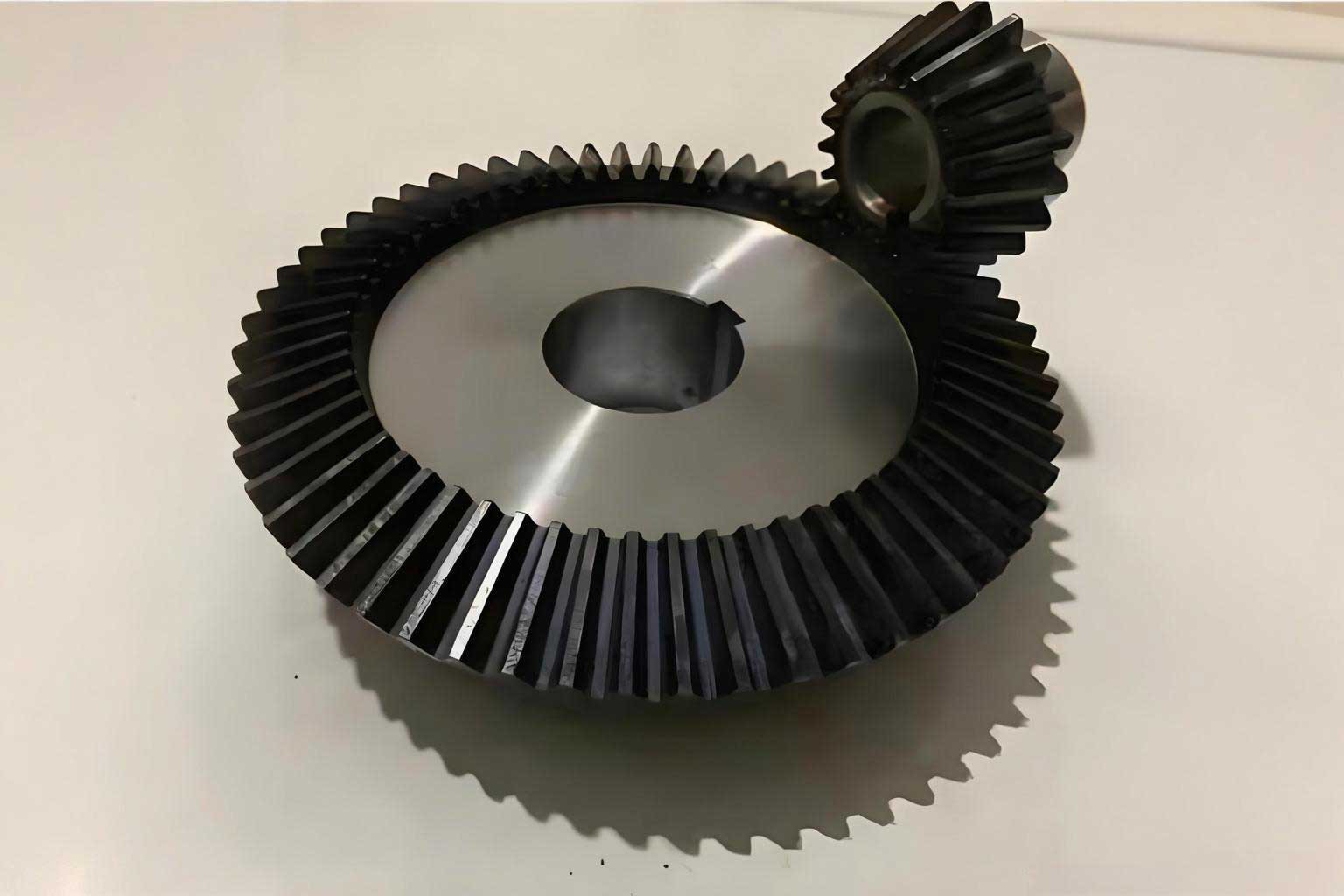
The advent of Computer-Aided Design (CAD) has revolutionized engineering practice. By integrating computer technology, modern design methodologies, and other scientific advancements, CAD has become one of the most sophisticated engineering design tools available. Its application to differential design promises to significantly shorten development cycles, enhance precision and reliability, and ultimately achieve optimization and automation of the design process. Building upon foundational work in single-pair straight bevel gear optimization, this research focuses on developing a comprehensive CAD system specifically for the design of straight bevel miter gear differentials. This paper details the system’s architecture, its core mathematical models for optimization, key implementation strategies, and presents a practical design case.
System Architecture and Functional Overview
The developed CAD system is architected to handle the design of differentials for various wheeled vehicles, accommodating both open and enclosed structural configurations. To cater to diverse user requirements, the system integrates multiple functional modules:
- Geometric Parameter Calculation: Automatically computes all critical dimensions of the differential assembly.
- Strength Verification: Performs comprehensive strength checks on the miter gears, planetary shafts, and half-axles.
- Optimization Design: Executes multi-objective optimization to find the best design parameters under specified constraints.
- Automated Drafting: Generates detailed working drawings for key components, such as the planetary and side miter gears.
The system employs a natural language-style human-computer interface with bilingual (English/Chinese) support. It is developed using the Fortran language and implemented on a PC/XT platform. Due to the system’s scale—incorporating over 6000 statements, optimization libraries, graphics packages, and font libraries—a batch processing approach was adopted to manage memory constraints effectively.
The program is structured as a collection of interconnected modules. The control flow is managed by a main program which calls various subroutines based on user input regarding calculation type and optimization goals. The core structure is outlined in the following program block diagram.
The system’s logic begins with a main program that initializes the process. User input via an input subroutine determines the path: either direct geometric/strength calculation or an optimization routine. For optimization, a dedicated method (e.g., a constrained quasi-Newton algorithm) is called from a library. The core calculations for geometry, strength (gear bending, shaft crushing, axle torsion), and variable adjustment (rounding, standardization) are encapsulated in specific subroutines. The function value for the optimizer is computed in a dedicated subroutine that aggregates results from these core modules.
Mathematical Models for Optimization Design
Definition of Objective Functions
The choice of optimization objective depends heavily on the design priorities within the vehicle’s overall drivetrain. Common goals include matching the strength and lifespan of other drivetrain components, minimizing the differential’s envelope dimensions for better packaging and vehicle ground clearance, and achieving optimal torque biasing characteristics. This research primarily formulates objectives concerning the differential’s physical volume and its torque capacity.
1. Minimization of Differential Volume: Given a required torque capacity, the objective is to minimize the overall volume of the differential while ensuring the strength of the miter gears, planetary shafts, and half-axles. The volume can be approximated as a function of key dimensions. Furthermore, for miter gears using profile shifting (angle modification), maximizing the sum of the shift coefficients is also desirable to improve gear meshing quality. A combined objective function using a weighted sum approach can be constructed.
The volume-based objective function \( F_1(\vec{X}) \) is given by:
$$ F_1(\vec{X}) = \frac{\pi}{4} \left[ B (d_{a1}^2 + d_{a2}^2) + n_p L D_p^2 + D_s^2 L_s \right] $$
Where:
- \( m \): Module at the gear outer end.
- \( z_1, z_2 \): Number of teeth on the planetary and side miter gears, respectively.
- \( \delta_1, \delta_2 \): Pitch cone angles of the planetary and side gears.
- \( B \): Face width of the miter gears.
- \( R \): Cone distance.
- \( d_{a1}, d_{a2} \): Outer pitch diameters of the planetary and side gears.
- \( D_p, D_s \): Diameters of the planetary shaft and half-axle.
- \( n_p \): Number of planetary gears.
The combined objective function \( F_2(\vec{X}) \) incorporating volume and shift coefficients is:
$$ F_2(\vec{X}) = w_1 \cdot F_1(\vec{X}) – w_2 \cdot (x_{1\nu} + x_{2\nu}) $$
Where \( x_{1\nu}, x_{2\nu} \) are the angular profile shift coefficients for the planetary and side miter gears, and \( w_1, w_2 \) are weighting factors.
2. Maximization of Transmissible Torque: When the design space is constrained, the objective shifts to maximizing the torque capacity of the differential assembly. Since the miter gears in a differential experience relatively few load cycles, pitting fatigue is often not the limiting factor. Therefore, the maximum torque \( T_{max} \) is governed by gear bending strength, planetary shaft bearing (crushing) strength, and half-axle torsional strength.
$$ F_3(\vec{X}) = T_{max} = \min(T_{bend}, T_{crush}, T_{torsion}) $$
Where:
- \( T_{bend} \): Maximum torque derived from the bending strength of the miter gears.
- \( T_{crush} \): Maximum torque derived from the crushing strength of the planetary shaft.
- \( T_{torsion} \): Maximum torque derived from the torsional strength of the half-axle.
Selection of Design Variables
The fundamental parameters defining a differential’s geometry include: planetary gear tooth count \( z_1 \), side gear tooth count \( z_2 \), face width factor \( \phi_R \) (ratio of face width to cone distance), module \( m \), planetary shaft diameter \( D_p \), and half-axle diameter \( D_s \). To reduce problem dimensionality, \( z_1 \) and \( z_2 \) are often treated as discrete input parameters iterated within a specified range (e.g., \( z_1 \) from 10 to 14). The pressure angle also influences the choice of variables. For a standard \( 20^\circ \) pressure angle, only tangential and addendum modifications are typically applied, with coefficients obtained from look-up tables. For a \( 22.5^\circ \) or \( 25^\circ \) pressure angle, angular profile shift coefficients are introduced as additional design variables. The specific set of design variables \( \vec{X} \) varies with the objective and fixed parameters, as summarized below:
| Pressure Angle | Fixed Parameter | Design Variable Vector \( \vec{X} \) |
|---|---|---|
| 20° | Torque (Volume Min.) | \( [\phi_R, m, D_p, D_s]^T \) |
| 20° | Cone Distance \( R \) (Torque Max.) | \( [\phi_R, m, D_p, D_s]^T \) (Note: \( R \) fixed, \( B=\phi_R \cdot R \)) |
| 22.5°/25° | Torque (Volume Min.) | \( [\phi_R, m, x_{1\nu}, x_{2\nu}, D_p, D_s]^T \) |
| 22.5°/25° | Cone Distance \( R \) (Torque Max.) | \( [\phi_R, m, x_{1\nu}, x_{2\nu}, D_p, D_s]^T \) |
Formulation of Constraint Functions
To ensure the feasibility and performance of the design, the design variables must satisfy a set of constraints derived from mechanical principles, manufacturing limits, and assembly requirements. These constraints are formulated as inequality functions \( g_j(\vec{X}) \leq 0 \).
1. Gear Tooth Count Limits:
$$ g_1(\vec{X}) = 10 – z_1 \leq 0, \quad g_2(\vec{X}) = z_1 – 14 \leq 0 $$
$$ g_3(\vec{X}) = 14 – z_2 \leq 0, \quad g_4(\vec{X}) = z_2 – 25 \leq 0 \text{ (Open)} $$
$$ g_5(\vec{X}) = 16 – z_2 \leq 0, \quad g_6(\vec{X}) = z_2 – 25 \leq 0 \text{ (Enclosed)} $$
2. Face Width Factor Limits: To ensure proper gear tooth proportions.
$$ g_7(\vec{X}) = 0.25 – \phi_R \leq 0, \quad g_8(\vec{X}) = \phi_R – 0.3 \leq 0 $$
3. Module Limits: Based on available tooling and size considerations.
$$ g_9(\vec{X}) = m_{min} – m \leq 0, \quad g_{10}(\vec{X}) = m – m_{max} \leq 0 $$
4. Bending Strength Constraint for Miter Gears: The calculated bending safety factor must exceed the allowable value.
$$ g_{11}(\vec{X}) = S_{F\ min} – \min(S_{F1}, S_{F2}) \leq 0 $$
Where \( S_{F1}, S_{F2} \) are the bending safety factors for the planetary and side miter gears, and \( S_{F\ min} \) is the allowable safety factor.
5. Planetary Shaft Crushing Constraint:
$$ g_{12}(\vec{X}) = \sigma_{crush} – [\sigma_{crush}] \leq 0 $$
Where \( \sigma_{crush} \) and \( [\sigma_{crush}] \) are the calculated and allowable contact crushing stresses, respectively.
6. Half-Axle Torsional Strength Constraint:
$$ g_{13}(\vec{X}) = \tau_{torsion} – [\tau_{torsion}] \leq 0 $$
Where \( \tau_{torsion} \) and \( [\tau_{torsion}] \) are the calculated and allowable torsional shear stresses.
7. Gear Meshing Quality Constraints (for Angular Profile Shift): When angular profile shift is used, constraints based on the virtual spur gears must be enforced to prevent undercutting, ensure sufficient contact ratio, maintain adequate tip thickness, and avoid interference.
- Undercut Prevention: \( x_{\nu} \geq h_{a0}^* – \frac{z_v \sin^2 \alpha_0}{2} \) for each miter gear.
- Contact Ratio: \( \epsilon_{\alpha} \geq [\epsilon_{\alpha}] \). The transverse contact ratio for the virtual gears is calculated as:
$$ \epsilon_{\alpha} = \frac{1}{2\pi} [ z_{v1} (\tan \alpha_{va1} – \tan \alpha’) + z_{v2} (\tan \alpha_{va2} – \tan \alpha’) ] $$
where \( z_v \) is the virtual tooth number, \( \alpha_{va} \) is the tip pressure angle, and \( \alpha’ \) is the operating pressure angle. - Tip Thickness: \( s_a \geq [s_a] \). The tip tooth thickness \( s_a \) is given by:
$$ s_a = s \frac{r_a}{r} – 2r_a (\text{inv} \alpha_a – \text{inv} \alpha) $$
Implementation Strategies in the CAD System
Optimization Algorithm and Problem Conditioning
Given the computational expense of evaluating the objective and constraint functions for the miter gear differential, which involves numerous geometric and strength calculations, an efficient constrained optimization algorithm is essential. The system employs a constrained quasi-Newton method (specifically, a form of the Sequential Quadratic Programming algorithm) from an optimization library. This method is well-suited for problems with nonlinear constraints and a moderate number of variables, as it builds an approximation to the Hessian of the Lagrangian.
A critical implementation detail is the conditioning of the optimization problem. Design variables like the face width factor \( \phi_R \) (range ~0.25-0.30) and the planetary shaft diameter \( D_p \) (range ~20-40 mm) differ by orders of magnitude. This disparity can cause ill-conditioning in the search process. To mitigate this, variable scaling is applied. For instance, \( \phi_R \) and \( D_p \) are scaled as follows before being passed to the optimizer:
$$ \phi_R’ = \phi_R \times 10^2, \quad D_p’ = D_p \times 10^{-1} $$
Similarly, constraint functions are normalized to a range around [-1, 1] to ensure balanced influence from all constraints. For a constraint \( g_j(\vec{X}) \leq b \), it is reformulated as \( g_j'(\vec{X}) = (g_j(\vec{X}) / b) – 1 \leq 0 \).
Data Handling: Curve Fitting and Parameter Management
The design process relies heavily on empirical data, such as tables for tangential shift coefficients, form factors, and stress concentration factors. To integrate this data seamlessly into the automated system, all curves and tables are fitted using the least squares method. The resulting polynomial or spline functions are stored, ensuring evaluation errors are less than 1%. For example, the tangential shift coefficient \( x_t \) for a \( 20^\circ \) pressure angle and a tooth count \( z \) is fitted to a function like \( x_t = a_0 + a_1 z + a_2 z^2 \).
The system manages a vast amount of data, including initial parameters, geometric results, material properties, and tolerance standards. A hybrid approach is used: persistent data (like standard part dimensions) is stored in formatted disk files, keeping it independent of the program logic. Transient data needed during specific calculations (like iterative search values) is managed internally via COMMON blocks in Fortran, allowing efficient data retrieval and passing between subroutines.
Parameter Rounding, Standardization, and Post-Processing
Optimal solutions from the continuous-variable optimizer often yield non-standard values for parameters like module \( m \), shaft diameters \( D_p, D_s \), and even tooth counts. A dedicated post-processing module handles the rounding and standardization of these parameters to commercially available or manufacturable values. The method involves creating a discrete grid of integer or standardized values in the neighborhood of the continuous optimum. All grid points satisfying the core constraints are evaluated using the objective function, and the point yielding the best objective value is selected as the final, manufacturable design.
This rounding process must account for two critical assembly constraints specific to the planetary miter gear train:
1. Assembly Condition (for simple planetary): For a symmetric differential with two planetary gears (\( n_p=2 \)), the tooth counts must satisfy:
$$ \frac{z_1 + z_2}{n_p} = \text{Integer} $$
This ensures the gears can be assembled with uniform spacing.
2. Cone Distance Tolerance: When optimizing for maximum torque with a fixed cone distance \( R \), rounding the module and other parameters will alter the actual calculated cone distance \( R’ \). The relative change must be within a small tolerance \( \delta_R \):
$$ \frac{|R’ – R|}{R} \leq \delta_R $$
Parametric Automated Drafting Technology
The automated drafting module is a cornerstone of the CAD system’s practicality. It generates dimensioned, annotated working drawings for components like the planetary miter gear. The module is built using a commercial graphics package (e.g., a precursor to modern CAD APIs) as its foundation. To achieve parameterization, the low-level drawing commands of this package are wrapped into a library of Fortran-callable subroutines. This library includes routines for file management, basic geometric entities (lines, circles, arcs), and specialized mechanical drawing functions (dimension lines, tolerance annotation).
The drafting program flow is as follows:
- Open the data file containing the finalized design parameters from the optimization/calculation module.
- Establish a coordinate system and calculate the coordinates of all key points in the drawing (e.g., tooth profiles, shaft centers, keyway corners) based on the parametric input.
- Iteratively call the basic drawing subroutines to construct the geometry of the part.
- Iteratively call the dimensioning and annotation subroutines to add all necessary dimensions, geometric tolerances, and surface finish symbols.
- Write the title block, gear data table, and technical notes.
The power lies in treating all coordinate calculations as functions of the input parameters (module, tooth number, face width, etc.). Changing the input data file automatically generates a new, correctly proportioned drawing, fulfilling the promise of true parametric CAD for the miter gear differential components.
Design Case Study and System Performance
The system was validated using a practical design case: the differential for a commercial vehicle requiring high reliability. The known input parameters were:
- Input torque from the main reducer: ~1500 Nm.
- Input speed: ~2500 rpm.
- Main reducer ratio: ~4.5.
- Required gear life: >5000 hours.
- Material for all gears and shafts: 20CrMnTi, carburized and hardened.
- Gear accuracy grade: 7-8-7 per Chinese standards.
- Planetary gear count: \( n_p = 2 \).
The system was executed on a PC/XT platform. Two optimization runs were performed: one minimizing volume and another maximizing torque capacity. Key results are compared in the table below, demonstrating the effectiveness of the optimization approach.
| Design Parameter / Result | Original Design | Optimized Design (Minimize Volume) | Optimized Design (Maximize Torque) | Improvement / Note |
|---|---|---|---|---|
| Planetary Gear Teeth (\( z_1 \)) | 11 | 10 | 11 | Discrete variable explored. |
| Side Gear Teeth (\( z_2 \)) | 18 | 20 | 18 | Assembly condition checked. |
| Module \( m \) (mm) | 5.5 | 5.0 | 5.75 | Rounded to standard value. |
| Face Width Factor \( \phi_R \) | 0.28 | 0.265 | 0.295 | Within allowable range. |
| Calculated Volume (approx., cm³) | — | Minimized | Larger than Min. Vol. design | Objective achieved. |
| Max. Transmissible Torque \( T_{max} \) (Nm) | Reference | Meets Required Torque | Maximized | Objective achieved. |
| Planetary Shaft Diameter \( D_p \) (mm) | 22 | 20 | 24 | Strength constraints active. |
| Bending Safety Factor \( S_F \) | ~1.5 | > 1.8 | > 1.6 | All satisfy \( S_{F\ min}=1.5 \). |
The total computation time for a complete optimization run, including post-processing, was approximately 2 minutes and 30 seconds. The subsequent generation of a detailed working drawing for the planetary miter gear—complete with a full gear data table, tolerances, and technical notes—required an additional 1 minute and 20 seconds. This represents a dramatic reduction compared to manual design and drafting methods.
Conclusion
This research successfully developed and demonstrated a functional Computer-Aided Design system for straight bevel miter gear differentials. The system integrates several advanced engineering tools: a robust optimization framework with flexible objective functions (volume minimization, torque maximization), a comprehensive library of mechanical constraints tailored to miter gear planetary trains, and a parametric automated drafting module. Key implementation challenges, such as problem conditioning via variable scaling, data management through curve fitting and file systems, and the post-processing of optimized parameters for manufacturability, were effectively addressed.
The design case study confirms the system’s utility and performance. It produces feasible, optimized designs that outperform initial manual designs in the targeted metric, all within a fraction of the traditional time. The ability to automatically generate production-ready drawings directly from the optimized parameters closes the loop between design computation and manufacturing preparation. The system’s modular architecture allows for future expansion, such as the inclusion of more complex durability models (e.g., for tooth pitting under high-cycle conditions) or multi-disciplinary optimization objectives involving thermal or NVH (Noise, Vibration, and Harshness) performance. While further refinement and extensive validation are necessary to transition the system into a commercial-grade CAD product, this work provides a solid foundation for automating and optimizing the design of a ubiquitous and critical vehicle component—the straight bevel miter gear differential.