
In my years of experience as a machinist, I have frequently encountered the challenge of machining miter gears, especially when the number of teeth requires a division that is not feasible with simple indexing methods. Miter gears, which are bevel gears with a 1:1 ratio and typically 90-degree shaft axes, are essential components in various mechanical systems for transmitting motion between intersecting shafts. Their precise fabrication is critical, yet traditional milling approaches often fall short when dealing with prime or large tooth counts that cannot be indexed using standard dividing heads. This led me to explore and implement differential indexing as a practical solution, bypassing the need for expensive custom fixtures and enhancing machining flexibility. In this article, I will delve into the principles, setup, and applications of differential indexing specifically for miter gear加工, incorporating mathematical formulas and tables to provide a comprehensive guide.
The core issue arises because simple indexing relies on a dividing head with a worm gear ratio, usually 40:1, meaning 40 turns of the handle rotate the workpiece one full revolution. For a miter gear with Z teeth, the handle turns per division N is given by N = 40 / Z. However, when Z is a prime number or does not factor nicely into the available plate holes, simple indexing fails. Differential indexing overcomes this by introducing a compensatory mechanism through a train of gears connecting the dividing head spindle to the index plate, allowing for continuous rotation and accurate division. The fundamental formula for differential indexing involves selecting an approximate number of teeth Z’ close to Z that can be simply indexed, then calculating the differential gear ratio i to correct the error. The relationship is expressed as:
$$ i = \frac{K (Z’ – Z)}{Z’} $$
where K is the dividing head constant (typically 40). The handle turns for indexing become N = 40 / Z’, and the gear train setup ensures that as the handle is turned, the index plate rotates slightly, compensating for the difference between Z’ and Z. This method is well-established for cylindrical gears, but its application to miter gears requires modifications due to the need to account for the root cone angle during machining.
Traditionally, when milling a miter gear, the dividing head is tilted upward by the root cone angle δ (often equal to the pitch cone angle for standard miter gears), aligning the gear blank’s axis with the cutter’s orientation. This setup, while straightforward, immobilizes the dividing head’s ability to engage the differential mechanism because the tilt disrupts the gear train alignment. As a result, differential indexing cannot be applied, forcing machinists to resort to approximate indexing, which introduces cumulative errors, or costly custom fixtures. In my practice, I have found that by reorienting the dividing head itself, we can maintain the necessary angular relationship while keeping the spindle parallel to the worktable, thus enabling differential indexing.
The innovative approach involves mounting the dividing head on an angle plate or directly on the machine table such that its spindle axis is parallel to the table surface, but the entire head is skewed so that the workpiece centerline forms the root cone angle δ with the table. Simultaneously, the milling machine’s arbor or toolholder is set vertically, and an angle milling cutter is attached, ensuring the cutter’s axis is perpendicular to the table. By carefully aligning the cutter to the workpiece’s side center, the effective cutting angle matches the root cone angle, replicating the traditional tilted setup without actually tilting the dividing head spindle. This configuration preserves the integrity of the differential gear train, allowing it to function normally. The geometric relationship can be summarized as follows: let the workpiece axis be oriented at angle δ relative to the table, and the cutter axis be vertical; then, the cutting plane corresponds to the tooth flank of the miter gear. The key parameters are tabulated below:
| Parameter | Symbol | Typical Value/Range | Description |
|---|---|---|---|
| Number of Teeth | Z | 20 to 100 (common for miter gears) | Total teeth on the gear; determines indexing. |
| Dividing Head Constant | K | 40 | Turns of handle per full workpiece revolution. |
| Root Cone Angle | δ | 45° for standard 90° miter gears | Angle between gear axis and tooth root line. |
| Approximate Teeth | Z’ | Chosen near Z (e.g., Z=43, Z’=40) | Teeth count for simple indexing in differential method. |
| Differential Gear Ratio | i | Calculated via formula | Ratio of gears in differential train. |
| Index Handle Turns | N | N = 40 / Z’ | Handle turns per division during machining. |
To illustrate the setup mathematically, consider a miter gear with Z = 43 teeth and a root cone angle δ = 45°. Since 43 is prime, simple indexing is impossible. We choose Z’ = 40, which is close and allows simple indexing with N = 40 / 40 = 1 turn per division. The differential gear ratio is calculated as:
$$ i = \frac{40 (40 – 43)}{40} = \frac{40 \times (-3)}{40} = -3 $$
The negative sign indicates that the index plate must rotate in the opposite direction to the handle, which is achieved by adding an idler gear in the train. The actual gear selection depends on the available gears, but a common setup might use gears with teeth numbers a, b, c, d such that i = (a/b) * (c/d) = -3. For instance, using gears 60, 20, 50, and 25: (60/20) * (50/25) = 3 * 2 = 6, which is not -3; so alternative combinations like (90/30) * (40/40) = 3 * 1 = 3 with an idler for negative rotation. In practice, gear trains are selected from standard sets, and the following table provides examples for common miter gear tooth counts:
| Actual Teeth (Z) | Approximate Teeth (Z’) | Handle Turns (N) | Differential Ratio (i) | Sample Gear Train (Driver/Driven) |
|---|---|---|---|---|
| 43 | 40 | 1 | -3 | 60:20, 60:20 (with idler) |
| 47 | 48 | 40/48 = 5/6 | 40*(48-47)/48 = 40/48 ≈ 0.8333 | 50:60, 40:40 |
| 53 | 50 | 40/50 = 0.8 | 40*(50-53)/50 = -120/50 = -2.4 | 72:30, 50:50 (with idler) |
| 59 | 60 | 40/60 = 2/3 | 40*(60-59)/60 = 40/60 ≈ 0.6667 | 40:60, 50:50 |
The physical installation requires careful alignment. First, secure the dividing head to the worktable or an angle plate so that its spindle is horizontal and parallel to the table’s longitudinal axis. Then, adjust the entire head’s orientation by swinging it around a vertical axis until the workpiece centerline, when held in the chuck, makes an angle δ with the table surface. This can be measured using a protractor or sine bar. For a standard miter gear with δ = 45°, the dividing head might be rotated 45° relative to the table’s edge. Next, mount the gear blank on the dividing head spindle, ensuring it is concentric. On a vertical milling machine or a horizontal mill with vertical attachment, install an angle milling cutter—typically a single-angle cutter with the correct pressure angle for miter gears—on a vertical arbor. Position the cutter so that its cutting edge aligns with the workpiece’s side center, and set the depth of cut based on the tooth depth. This alignment ensures that the cutter generates the correct tooth profile relative to the root cone.
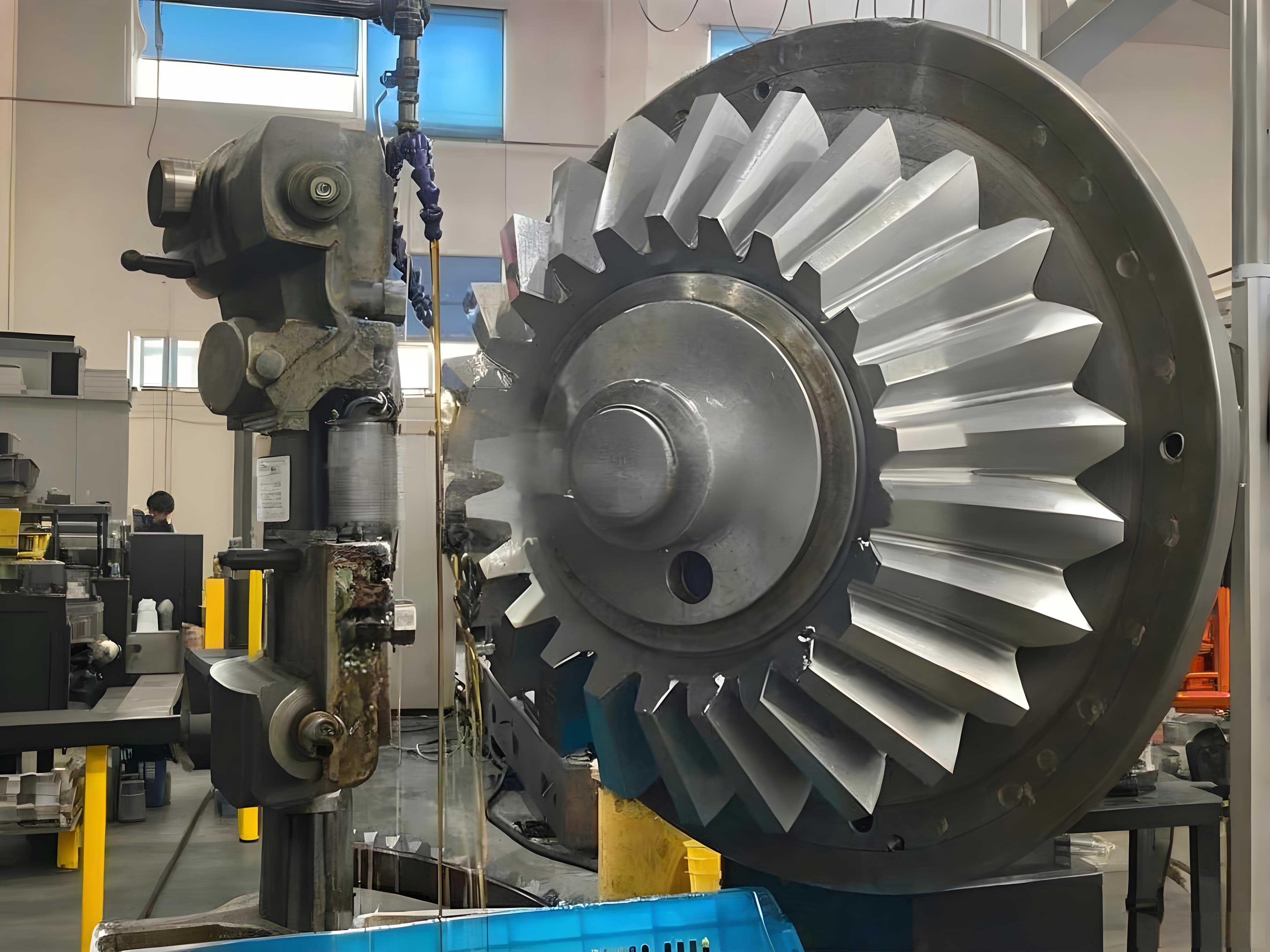
The image above illustrates a typical pair of miter gears, highlighting their intersecting axes and straight teeth. In our machining context, such gears require precise indexing to ensure smooth meshing and load distribution. With the setup described, we can now engage the differential indexing mechanism. The dividing head’s change gears are configured according to the calculated ratio i, connecting the spindle to the index plate. As we turn the handle through N turns for each tooth, the differential action automatically adjusts the plate’s position, yielding accurate divisions even for challenging tooth counts. This method effectively brings the versatility of differential indexing to miter gear production, a realm where it was previously hindered by geometric constraints.
One significant advantage of this approach is enhanced rigidity and safety. By keeping the dividing head untitled, the entire setup is more stable, able to withstand higher cutting forces without vibration or deflection. This is particularly beneficial when machining large or hard-material miter gears. Additionally, it eliminates the error inherent in approximate indexing, which, though small per tooth, can accumulate over many teeth, leading to poor gear performance. With differential indexing, the accuracy is mathematically exact, provided the gear train is correctly calculated and installed. Furthermore, this method is economical, as it utilizes standard dividing heads and milling machines without requiring special fixtures. However, certain precautions are necessary. If cutting forces are excessive, the workpiece can be supported by a tailstock center to prevent deflection. For workpieces larger than the dividing head’s center height, the head can be raised on blocks or a sub-table, maintaining the root cone angle through careful shimming and alignment.
To delve deeper into the mathematics, let’s consider the geometry of miter gears. The root cone angle δ is related to the pitch cone angle Γ, which for a 90° intersection and equal gears is 45°. The tooth depth h and outer cone distance R are key dimensions. For a miter gear with module m and teeth Z, the pitch diameter d = mZ, and the cone distance R = d / (2 sin Γ). The root angle δ is often slightly less than Γ due to dedendum angle, but for simplicity, we often take δ ≈ Γ. In machining, the cutter must be set to this angle relative to the workpiece axis. Our setup ensures this by the spatial orientation rather than spindle tilt. The formula for calculating the setting angle θ for the dividing head mounting, relative to the table, is θ = 90° – δ when the cutter is vertical. For δ = 45°, θ = 45°, meaning the dividing head is rotated 45° from the table’s axis.
In terms of indexing calculations, the differential gear train must account for the direction of rotation. The sign of i determines whether an idler gear is needed. Generally, if i is positive, the plate rotates with the handle; if negative, it rotates opposite. This can be expressed using the gear train formula with intermediate gears. Let the driver gears on the spindle have teeth A and C, and the driven gears on the worm shaft have teeth B and D, then the ratio i = (A/B) * (C/D). The number of idlers affects the direction. A comprehensive table for common miter gear modules and tooth counts can aid machinists:
| Module (mm) | Teeth (Z) | Pitch Diameter (mm) | Root Cone Angle δ (°) | Recommended Cutter Type |
|---|---|---|---|---|
| 2 | 30 | 60 | 45 | Single-angle 45° cutter |
| 3 | 25 | 75 | 45 | Single-angle 45° cutter |
| 4 | 40 | 160 | 45 | Double-angle cutter for clearance |
| 5 | 50 | 250 | 45 | Single-angle with specific pressure angle |
The process for machining a miter gear using this method involves sequential steps: First, calculate the required indexing parameters (Z’, N, i) based on Z. Second, set up the dividing head on the machine table at angle θ = 90° – δ, ensuring the spindle is horizontal. Third, install the gear blank and align it true. Fourth, mount the angle cutter vertically and position it at the workpiece center. Fifth, configure the differential gear train according to i. Sixth, perform trial indexing to verify alignment, then begin milling each tooth slot, adjusting depth incrementally. It is advisable to perform a roughing cut followed by a finishing cut for accuracy. Throughout, coolant should be applied to manage heat, especially when cutting steel miter gears.
The benefits of applying differential indexing to miter gear machining extend beyond mere divisibility. It allows for the production of custom miter gears with non-standard tooth counts, which might be needed in specialized machinery. For instance, in aerospace or automotive applications, specific gear ratios might require prime tooth counts to avoid resonance or to meet space constraints. This method empowers machinists to tackle such tasks with standard equipment. Moreover, the improved rigidity reduces tool wear and improves surface finish, leading to longer-lasting miter gears. In my own shop, I have successfully machined miter gears with teeth counts like 61, 71, and 79 using this approach, achieving tolerances within AGMA standards.
To further illustrate, let’s walk through a detailed example. Suppose we need to machine a miter gear with Z = 73 teeth, module m = 2.5 mm, and root cone angle δ = 45°. Since 73 is prime, we choose Z’ = 72 for approximation. Then, N = 40 / 72 = 5/9 turn per division, which translates to using a circle with holes divisible by 9, e.g., 18 holes per turn for 10 holes (since 5/9 = 10/18). The differential ratio i = 40*(72-73)/72 = 40*(-1)/72 = -40/72 = -5/9 ≈ -0.5556. We need a gear train that yields this ratio. Using a standard gear set with teeth numbers like 24, 36, 40, 50, etc., we can try combinations: (40/72) * (30/30) = 40/72 = 5/9, but that gives positive 5/9. To get negative, add an idler. Alternatively, (50/90) * (40/40) = 50/90 = 5/9. So, drivers: 50 and 40; drivens: 90 and 40, with one idler to reverse direction. Then, set the dividing head at 45° to the table (since θ = 90° – 45° = 45°). After mounting, we index by moving 10 holes on an 18-hole circle for each tooth, and the differential action compensates for the 1-tooth error over 73 divisions.
In conclusion, the integration of differential indexing into miter gear machining through innovative dividing head mounting offers a robust, accurate, and economical solution. By reorienting the entire head rather than tilting the spindle, we preserve the functionality of the differential mechanism, enabling precise division for any tooth count. This method enhances rigidity, safety, and accuracy, making it ideal for both prototype and production runs of miter gears. The mathematical foundations, supported by formulas and tables, provide a clear framework for implementation. As machinery evolves, such adaptive techniques underscore the ingenuity required in manufacturing, ensuring that even complex components like miter gears can be produced with precision using standard tools. I encourage fellow machinists to explore this method, as it has consistently proven valuable in my work, expanding the possibilities for gear fabrication without resorting to costly alternatives.