
In the field of mechanical transmission, miter gears play a crucial role in transferring motion and power between intersecting shafts. As a common type of straight bevel gear, miter gears are widely used in various industrial applications due to their efficiency and reliability. Traditional manufacturing methods for miter gears often rely on specialized machine tools, which limit flexibility and increase costs. To address this, I have developed a parameterized 3D design approach based on the forming process, leveraging Autolisp programming within AutoCAD to create dynamic simulations and efficient models. This method not only enhances design accuracy but also allows for rapid generation of miter gears with different parameters, such as module and number of teeth. In this article, I will detail the theoretical foundations, mathematical models, and implementation steps, emphasizing the use of forming processes and parameterization to streamline the design workflow.
The design of miter gears involves complex geometric considerations, as their tooth profiles are theoretically based on spherical involutes. However, in practical applications, spherical involutes are challenging to model and manufacture due to their non-developable nature. Therefore, I adopt an approximation using conical involutes derived from the back cone transformation. This approach simplifies the design by converting the miter gear into an equivalent spur gear, known as the virtual gear, which allows for standard gear calculations. The forming process, which uses a shaped milling cutter to machine the teeth, is simulated to replicate actual manufacturing steps. By parameterizing key design variables, I enable quick modifications and adaptations, making this method highly versatile for engineering projects.
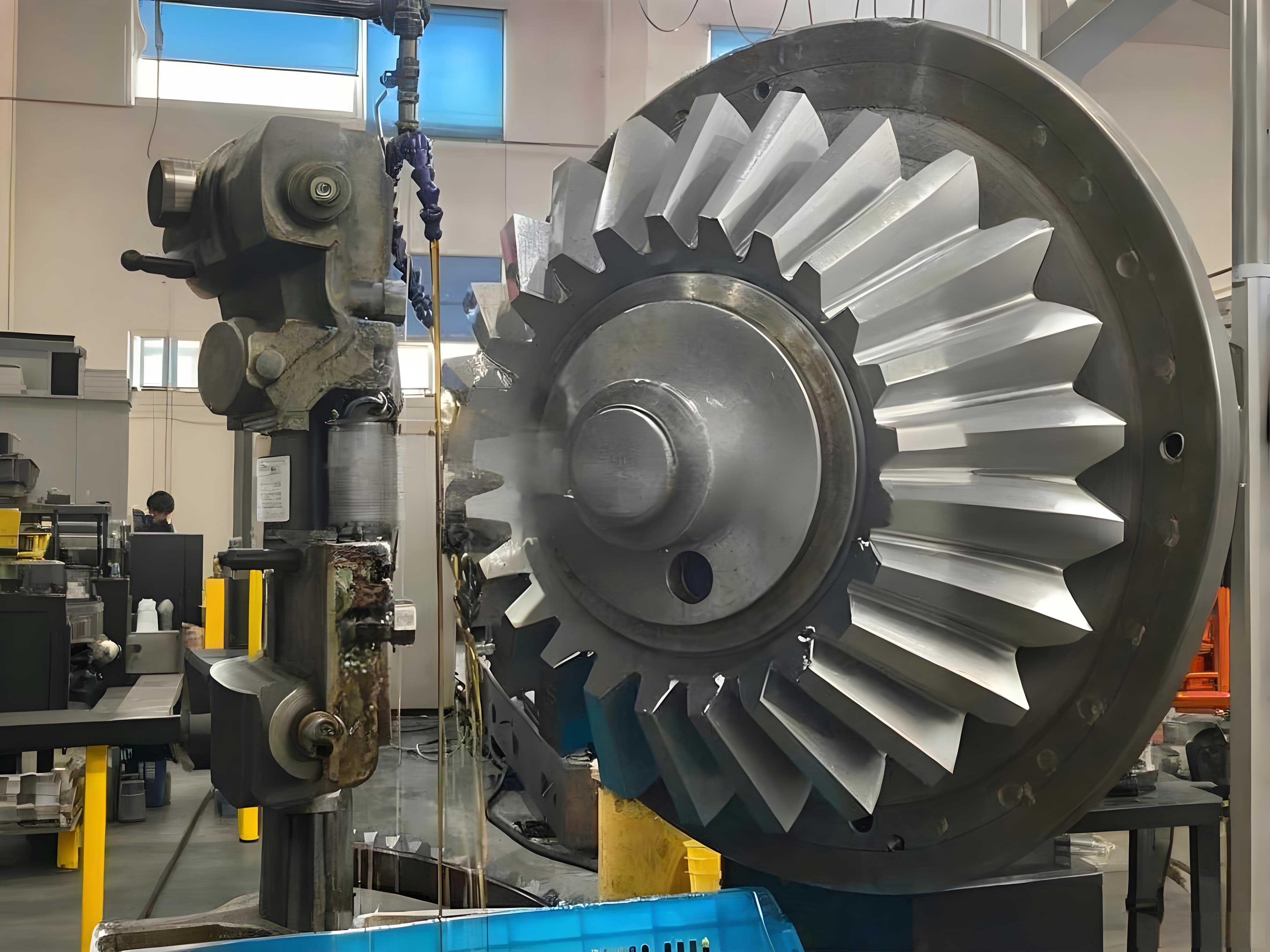
To begin, I analyze the tooth form theory and cutting principles for miter gears. The forming process involves using a disc-type milling cutter whose profile matches the gear tooth shape. This cutter moves along a predefined path to carve out the tooth spaces on a gear blank. The accuracy of the miter gear depends largely on the cutter’s geometry, which is derived from the virtual gear’s involute curve. In my approach, I model this curve using parametric equations in a Cartesian coordinate system. For the virtual gear, the base circle radius \( R_c \) and pressure angle \( \alpha \) are key parameters. The involute curve can be expressed as: $$ X_a = R_c (\cos \theta + \theta \sin \theta) $$ $$ Y_a = R_c (\sin \theta – \theta \cos \theta) $$ where \( \theta \) is the roll angle. By varying \( \theta \) from the base circle to the addendum circle, I generate multiple points to approximate the curve, which is then mirrored to form the complete tooth profile. This profile serves as the basis for the milling cutter design, ensuring precise tooth generation in the simulation.
The parameterization of miter gears relies on a set of input variables that define their dimensions and performance. I establish mathematical relationships between these variables to automate the design process. The primary parameters include the module \( M \), number of teeth \( Z_1 \), mating gear teeth \( Z_2 \), face width \( B \), pressure angle \( \alpha \), addendum coefficient \( H_{ax} \), and clearance coefficient \( C_x \). From these, I compute other critical dimensions using gear design formulas. For instance, the pitch cone angle \( \delta \) is given by: $$ \delta = \arctan\left(\frac{Z_1}{Z_2}\right) $$ The virtual gear’s number of teeth \( Z_{y1} \) is calculated as: $$ Z_{y1} = \frac{Z_1}{\cos \delta} $$ This allows me to determine diameters such as the pitch diameter \( d \), base diameter \( d_b \), and root diameter \( d_f \), as summarized in Table 1.
| Parameter | Symbol | Formula |
|---|---|---|
| Module | \( M \) | Input variable |
| Number of Teeth | \( Z_1 \) | Input variable |
| Pitch Cone Angle | \( \delta \) | $$ \delta = \arctan\left(\frac{Z_1}{Z_2}\right) $$ |
| Virtual Teeth | \( Z_{y1} \) | $$ Z_{y1} = \frac{Z_1}{\cos \delta} $$ |
| Pitch Diameter | \( d \) | $$ d = M \times Z_{y1} $$ |
| Base Diameter | \( d_b \) | $$ d_b = d \times \cos \alpha $$ |
| Addendum | \( h_a \) | $$ h_a = (1 + H_{ax}) \times M $$ |
| Dedendum | \( h_f \) | $$ h_f = (1 + C_x) \times M $$ |
| Outer Cone Distance | \( R \) | $$ R = \frac{M}{2} \times \sqrt{Z_1^2 + Z_2^2} $$ |
With these formulas, I create a parameterized model where changes in input variables automatically update the miter gear geometry. This is implemented through an Autolisp program that generates a dialog box for user input, as shown in the simulation interface. The dialog allows users to specify values for \( M \), \( Z_1 \), \( Z_2 \), \( B \), \( \alpha \), \( H_{ax} \), and \( C_x \), facilitating interactive design. Once the parameters are set, the program computes all derived dimensions and proceeds to model the gear blank and cutting tool. The gear blank is constructed as a conical solid using Boolean operations on truncated cones, while the milling cutter is designed based on the involute profile derived from the virtual gear. This parametric approach ensures that the miter gear can be quickly regenerated for different specifications, saving time in the design phase.
The dynamic simulation of the forming process is a core aspect of my method. I program the tool path and motion sequences to mimic actual machining. The milling cutter follows a circular trajectory divided into four stages: approach, cutting, retraction, and reset. During cutting, the gear blank remains fixed at its center, while the cutter rotates and translates to remove material. After each tooth space is machined, the blank rotates by an angle \( \Psi \), given by: $$ \Psi = \frac{2\pi}{Z_1} $$ This stepwise rotation continues until all teeth are formed, completing the miter gear. I use nested while loops in Autolisp to control these movements, invoking commands like “rotate”, “copy”, “region”, and “subtract” to simulate material removal. The process is visualized in real-time, allowing users to observe the gradual formation of the gear teeth. This simulation not only validates the design but also provides insights into manufacturing feasibility, such as checking for tool interference or incomplete cuts.
To elaborate on the cutter design, I employ curve fitting to generate the involute profile. Starting from the root circle, I calculate points along the curve using the parametric equations and connect them with a polyline. The resulting profile is then mirrored to create a symmetric tooth shape, which is extruded into a 3D solid. For a disc-type cutter, I array multiple teeth around its circumference and perform Boolean unions to form the complete tool. The cutter’s thickness is determined based on the small-end tooth space width of the miter gear, ensuring accurate machining across the face width. Table 2 summarizes the cutter specifications and motion parameters used in the simulation.
| Component | Parameter | Value or Formula |
|---|---|---|
| Milling Cutter | Profile Type | Involute based on virtual gear |
| Thickness | Based on small-end space width | |
| Number of Teeth | Depends on cutter diameter | |
| Tool Path | Approach Segment | Linear move from start to cutting point |
| Cutting Segment | Circular arc along gear blank | |
| Retraction Segment | Linear move away from blank | |
| Reset Segment | Return to initial position | |
| Blank Rotation | Angle per tooth \( \Psi \) | $$ \Psi = \frac{2\pi}{Z_1} $$ |
| Simulation Steps | Iterations per tooth | 8 (as per programming loop) |
The Autolisp programming involves several functions to handle geometry creation and motion control. For example, the function for generating the involute curve includes calculations for point coordinates and commands to draw polylines. Here is a snippet of the logic used: after setting parameters like \( R_c \) and \( \alpha \), I compute points \( P_a \) using the involute equations, then use the “pline” command to connect them. The cutter is then formed by extruding and arraying this profile. For the dynamic simulation, I initialize the gear blank and cutter positions, then enter a loop where the blank rotates incrementally, and the cutter moves along its path, with Boolean subtraction performed at each step to simulate cutting. This process repeats until all teeth are machined, resulting in a complete 3D model of the miter gear. Additionally, I include subroutines for adding features like bore holes and keyways, making the model ready for engineering applications.
The parameterized design of miter gears offers significant advantages in terms of efficiency and adaptability. By modifying input parameters, users can generate a wide range of miter gear configurations without manual redesign. For instance, changing the module \( M \) from 2 to 3 mm instantly updates all related dimensions, and the simulation reruns to produce the new gear. This flexibility is particularly useful in iterative design processes, where multiple variants must be evaluated. Moreover, the use of forming process simulation ensures that the designed miter gears are manufacturable with standard milling equipment, reducing reliance on specialized machinery. The integration of Autolisp with AutoCAD provides a familiar environment for engineers, lowering the learning curve and promoting adoption in industry settings.
In terms of mathematical rigor, I derive the gear dimensions from first principles to ensure accuracy. The virtual gear concept simplifies calculations by projecting the conical geometry onto a plane. The addendum and dedendum heights are computed using the coefficients \( H_{ax} \) and \( C_x \), which are typically set to standard values (e.g., 1 and 0.25, respectively). The outer cone distance \( R \) is crucial for determining the gear blank size, and it is derived from the pitch diameters of both gears in the pair. For the miter gear, since the shafts intersect at 90 degrees, the pitch cone angles sum to 90°, simplifying some formulas. However, my method generalizes to any shaft angle by adjusting the virtual gear calculations accordingly. The equations are implemented in the Autolisp program as variable relationships, allowing for dynamic updates during simulation.
To further illustrate the parameterization, consider the relationship between the miter gear’s face width \( B \) and the cutter path. The cutter must machine the entire width, so its motion is calibrated based on \( B \) and the cone distance. In the simulation, I model this by scaling the cutter’s translation along the gear axis. The step angle \( \Psi \) ensures uniform tooth spacing, and the number of simulation steps per tooth (set to 8 in my code) controls the smoothness of the cutting action. Higher step counts yield finer simulations but increase computation time. I optimize this balance by using iterative loops that update the geometry incrementally, as shown in the dynamic simulation code snippet. The final output is a 3D solid model that can be exported for analysis or manufacturing, such as for CNC programming or finite element analysis.
The application of this parameterized design method extends beyond miter gears to other gear types, such as spiral bevel gears or hypoid gears, with modifications to the tooth profile equations. The core principles of forming process simulation and parametric modeling remain applicable, demonstrating the generality of the approach. In practice, I have used this method to design miter gears for automotive differentials and industrial machinery, where quick prototyping and customization are essential. The ability to simulate the machining process also aids in identifying potential issues, like tool wear or gear tooth undercutting, early in the design phase, reducing costly errors.
In conclusion, my parameterized 3D design approach for miter gears based on the forming process leverages Autolisp programming to create efficient and accurate models. By integrating theoretical analysis, mathematical modeling, and dynamic simulation, I enable rapid generation of miter gears with variable parameters. The use of tables and formulas, as summarized in this article, clarifies the relationships between design variables and gear dimensions. This method not only enhances design productivity but also supports manufacturing preparedness by simulating actual cutting operations. Future work could involve extending the simulation to include more complex tool geometries or integrating with other CAD software for broader compatibility. Overall, parameterized design represents a powerful tool for advancing gear engineering, and I believe it will continue to evolve with advancements in computational methods.