
Gear drives represent one of the most critical forms of mechanical transmission, renowned for their compact structure, high transmission efficiency, precision, and long service life. Among these, bevel gears hold an exceptionally important position across various sectors including automotive, aerospace, and defense. The demand for high-quality, efficiently produced small module miter gears is particularly pressing in precision industries. Traditionally, the machining of small module miter gears has been hampered by low efficiency, primarily due to reliance on methods like gear planing which involve non-cutting time for tool retraction and indexing.
This article presents a significant advancement in the machining technology for small module miter gears. I will detail the development and implementation of a high-speed hob-milling process executed on a modified multi-axis Computer Numerical Control (CNC) spiral bevel gear cutting machine. The core of this innovation lies in adapting the continuous indexing and form-cutting principle of hobbing—common for cylindrical gears—to the conical geometry of a miter gear. By leveraging a carbide-tipped single-position hob and the flexible, simultaneous multi-axis control of a CNC platform, we have achieved a dramatic increase in production rate while maintaining high geometrical accuracy, effectively solving the longstanding efficiency bottleneck in small module miter gear manufacturing.
1. Principles of Hob-Milling for Miter Gears
The proposed hob-milling process for miter gears is fundamentally a form-cutting method employing continuous indexing. It utilizes a special tool known as a single-position or “form” hob. Unlike generating hobs for cylindrical gears, the tooth profile of this hob is designed based on the expanded profile of the miter gear at its large end on the back cone. Consequently, the gear tooth generated is theoretically correct only at the large end; towards the small end, the tooth profile deviates, becoming slightly fuller (“fat”) at the tip compared to the ideal involute. The acceptability of this deviation is governed by the gear’s geometry. For small module miter gears (face module < 4 mm) where the face width is less than 25% of the outer cone distance, the impact of this profile deviation on the meshing performance of the gear pair is negligible for many applications, making the method highly practical.
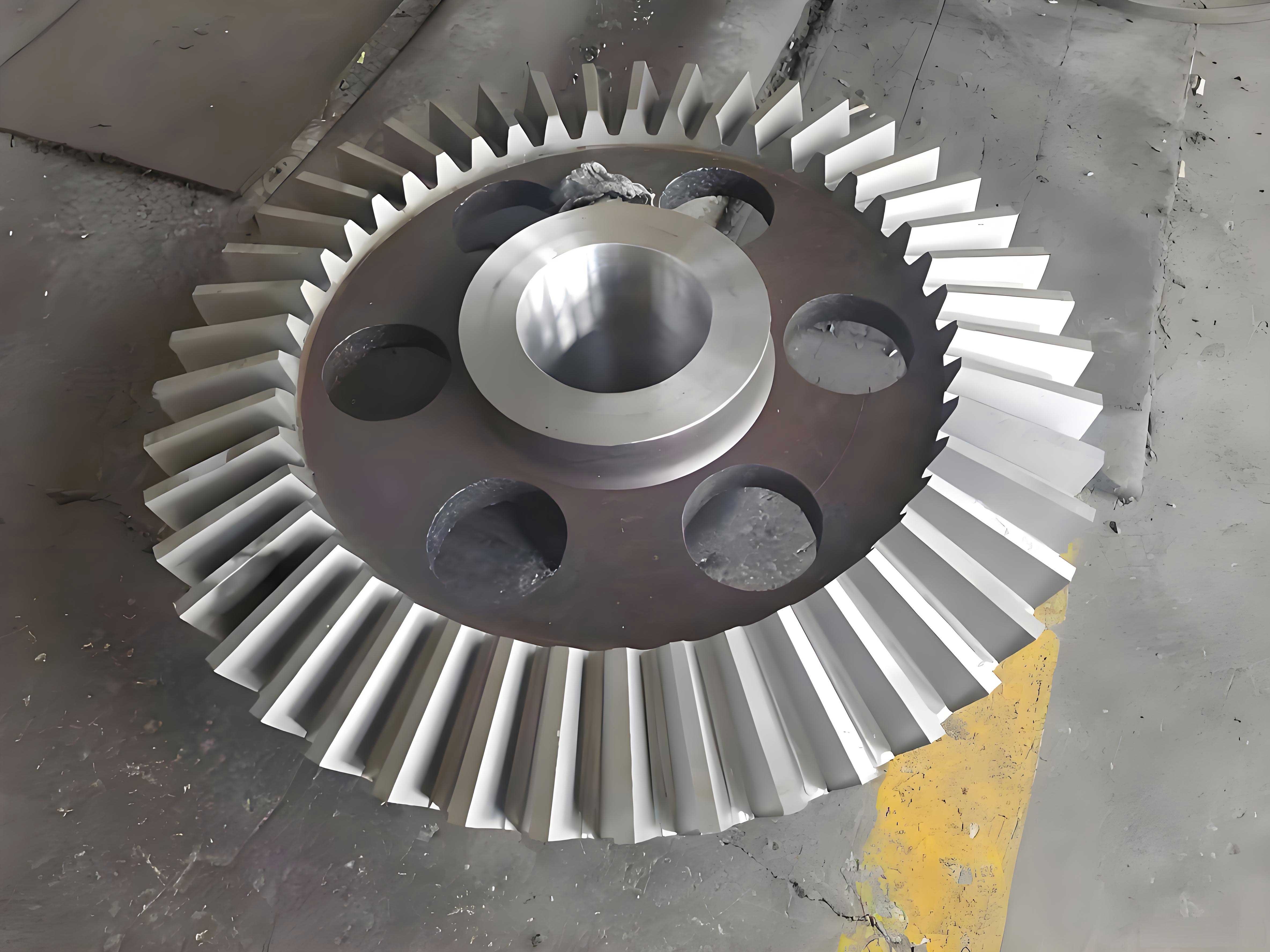
The kinematics of the process are relatively straightforward yet highly efficient due to continuous motion. The hob rotates continuously at a high speed (C-axis). The workpiece (miter gear blank), mounted on the workpiece spindle (A-axis), rotates synchronously at a fixed ratio relative to the hob. This ratio is defined by the number of gashes on the hob and the number of teeth on the miter gear. If the hob has Zh gashes and the miter gear has Zg teeth, the relationship for one complete workpiece revolution is:
$$ N_h \cdot Z_h = N_g \cdot Z_g $$
where $N_h$ is the number of hob revolutions and $N_g$ is the number of workpiece revolutions. Typically, for a single-start hob with Zh gashes, one full hob revolution advances the workpiece by Zh/Zg of a revolution. The continuous nature of this indexing eliminates the non-productive time associated with tool withdrawal and workpiece indexing found in single-indexing methods like planing, which is a primary source of its efficiency gain.
To prevent interference, the hob’s basic worm thread is limited to a single turn. Hobs are typically of the staggered-tooth design with 5 or 7 gashes. Opposing gashes are offset axially by half the pitch of the hob thread; each pair of opposing gashes is responsible for cutting the left and right flanks of a miter gear tooth space, respectively. The hob tooth profile itself is often an approximation. While it can be precisely calculated as the conjugate of the miter gear’s back-cone involute, this leads to complex grinding wheel profiling. In practice, for small module gears, the profile is frequently approximated by circular arcs, which offers a favorable balance between accuracy and manufacturing feasibility. A single hob of a given module can often be used to cut miter gears within a range of tooth numbers (similar to the grouping system for bevel gear milling cutters), reducing tooling inventory. Table 1 summarizes the key characteristics of the hob-milling process compared to traditional planing for miter gears.
| Feature | Traditional Planing (Generating) | Proposed Hob-Milling (Form Cutting) |
|---|---|---|
| Indexing Method | Single Index (Stop/Start) | Continuous Index |
| Cutting Motion | Reciprocating Stroke | Continuous Rotation |
| Tool Type | Planing Tool (HSS) | Single-Position Hob (Carbide) |
| Process Nature | Generating (Enveloping) | Form Cutting (Reproducing) |
| Non-Cutting Time | High (Retract, Index, Engage) | Very Low |
| Primary Advantage | Theoretically precise profile | Very High Productivity |
| Limitation | Low cutting speed, low efficiency | Profile error at small end (acceptable for small face width) |
2. CNC Machine Platform: Adaptation and Capabilities
The successful implementation of this high-speed miter gear process hinges on a flexible, multi-axis CNC platform. Our work is based on a commercially available six-axis, five-linkage CNC spiral bevel gear cutting machine. This machine’s inherent architecture provides the necessary degrees of freedom to orchestrate the complex spatial relationship between the rotating hob and the conical miter gear workpiece.
The machine configuration consists of three linear axes (X, Y, Z) and three rotational axes (A, B, C). The workpiece (miter gear blank) is mounted on the A-axis. The hob is mounted on the high-speed C-axis spindle. The B-axis is crucial as it sets the angle between the workpiece axis (A) and the tool axis (C), effectively positioning the miter gear’s root cone tangent to the hob’s cutting plane. The linear axes provide the feed motions necessary to move the hob through the gear blank along a defined tool path. The coordinated movement of these axes, governed by a dedicated CNC program, enables the precise generation of the miter gear tooth spaces. The specifications of this machine platform, which make it suitable for small module miter gear production, are detailed in Table 2.
| Parameter Category | Parameter | Specification |
|---|---|---|
| Workpiece (Miter Gear) | Maximum Gear Outer Diameter | 120 mm |
| Maximum Face Module | 4 mm | |
| Maximum Face Width | 30 mm | |
| Tooth Number Range | 1 – 200 | |
| Tool (Hob) | Maximum Tool Diameter | 101.6 mm |
| Minimum Tool Diameter | 25.4 mm | |
| Axis Travel / Range | X, Y, Z Linear Axes | ±210 mm, (-100 to +45) mm, (-25 to +240) mm |
| B Axis (Tilt) | -95° to +95° | |
| A, C Rotary Axes Speed | 0-200 rpm, 0-3500 rpm |
To adapt this machine for miter gear hob-milling, a dedicated CNC program module was developed. This program calculates the complete toolpath based on user inputs including miter gear geometric parameters (number of teeth, module, pressure angle, face width, pitch angle), hob parameters (diameter, number of gashes, spiral angle), and setup parameters (workpiece offset, tool offset). The toolpath for a single tooth space typically consists of two distinct linear feed motions coordinated with the continuous rotation of the hob and workpiece, as illustrated in Figure 1 and described by the following sequence:
Phase 1: Radial Infeed. The hob moves along a direction perpendicular to the pitch cone element at the large end of the miter gear (from point 1 to point 2). This motion cuts the gear tooth to the full depth at the large end.
$$ \text{Feed Path}_1: \vec{F}_1 = f_{r1} \cdot \vec{u}_{radial} $$
where $f_{r1}$ is the radial feed rate and $\vec{u}_{radial}$ is the unit vector for radial infeeding.
Phase 2: Longitudinal Feed. The hob then moves along the direction of the pitch cone element (from point 2 to point 3). This motion completes the cutting of the full face width of the miter gear tooth space.
$$ \text{Feed Path}_2: \vec{F}_2 = f_{l2} \cdot \vec{u}_{longitudinal} $$
where $f_{l2}$ is the longitudinal feed rate and $\vec{u}_{longitudinal}$ is the unit vector along the cone element.
The synchronized rotations are governed by:
$$ \frac{\omega_{workpiece}}{\omega_{hob}} = \frac{N_h}{Z_g} = \frac{1}{Z_g} \quad \text{(for a single-start hob with $N_h=1$ per tooth)} $$
This kinematic chain, executed precisely by the CNC, is what enables the high-speed, continuous generation of the miter gear.
3. Virtual Machining Simulation and Program Verification
Prior to physical cutting, a comprehensive virtual machining process was undertaken using VERICUT software to validate the CNC program logic, verify machine kinematics, and prevent potential collisions. This step is critical for developing a reliable process for precision components like miter gears. The workflow encompassed several stages:
First, detailed 3D models of the CNC machine’s major components (column, bed, slides, spindles) and the specific single-position hob were created in CAD software. These models were then imported into VERICUT. Within the simulation environment, the kinematic chain of the machine was accurately defined by establishing the topological relationship between all axes, mirroring the actual machine’s structure. The tool model was installed in the virtual spindle with correct tool length and diameter definitions.
Next, the CNC program generated for the miter gear was loaded into the virtual machine’s control system. A solid model representing the gear blank was also placed in the workpiece holding fixture. The simulation was then run. VERICUT’s material removal function dynamically displayed the cutting process, showing the hob progressively generating each tooth space of the miter gear. The simulation allowed for real-time observation of the entire machining cycle, confirming the absence of axis limit violations, fixture collisions, or improper tool-workpiece engagements. The successful completion of the virtual machining of a complete miter gear, as shown in the simulation screenshot, provided strong preliminary verification of the correctness of the post-processor logic, the toolpath calculation, and the overall feasibility of performing this operation on the target CNC platform. This virtual validation is an indispensable step for mitigating risks and reducing development time for new machining strategies, especially for complex parts like a miter gear.
4. Physical Machining Results and Performance Analysis
Following successful simulation, physical cutting trials were conducted on the CNC machine to validate the process in practice and measure the resulting miter gear quality. A pair of small module miter gears was selected for the test, with parameters listed in Table 3. A carbide-tipped, staggered-tooth single-position hob with a diameter of 25.4 mm and a 1-degree spiral angle was used. The hob spindle speed was set to 1500 rpm.
| Parameter | Pinion | Gear |
|---|---|---|
| Number of Teeth (Z) | 37 | 74 |
| Face Module (mn) | 0.5 mm | |
| Pressure Angle (α) | 20° | |
| Face Width (b) | 5 mm | |
The machining times were recorded and compared directly with those from a conventional high-precision mechanical planing machine (similar to a HARBECK 12H). The results were dramatic, as summarized in Table 4. The efficiency gain for the miter gear pair is overwhelmingly in favor of the hob-milling process, reducing machining time to a small fraction of that required by planing.
| Machine / Process | Machining Time per Gear | Efficiency Ratio (Hob-milling : Planing) |
|---|---|---|
| CNC Hob-Milling | 6 minutes | 1 : 10 |
| Mechanical Planing (Gear) | 60 minutes | |
| CNC Hob-Milling | 6 minutes | 1 : 7.5 |
| Mechanical Planing (Pinion) | 45 minutes |
To assess quality, the finished miter gears were measured on a high-precision gear measuring center. Key accuracy indicators were evaluated: single pitch deviation ($f_p$), total cumulative pitch deviation ($F_p$), and tooth flank form deviation. The measurement results, detailed in Table 5, confirm that the gears produced by the high-speed hob-milling process meet high accuracy standards. The pitch accuracy achieved corresponds to DIN Class 4. Most significantly, the maximum form deviation between the actual hob-milled tooth flank and the theoretical involute profile was found to be less than 7.5 μm for both members of the miter gear pair. This level of form accuracy, combined with the excellent pitch control, validates that the form-cutting principle with a precision hob does not compromise the functional geometry of small module miter gears with limited face width. Subsequent assembly and functional testing of the gear pair by the end-user confirmed satisfactory performance in the intended application, meeting all operational requirements.
| Measurement Item | Pinion (37 Teeth) | Gear (74 Teeth) | Standard / Target |
|---|---|---|---|
| Single Pitch Deviation, $f_p$ (max) | Within DIN 4 limits | Within DIN 4 limits | DIN 3965 Class 4 |
| Total Pitch Deviation, $F_p$ (max) | Within DIN 4 limits | Within DIN 4 limits | DIN 3965 Class 4 |
| Tooth Flank Form Error (max) | < 7.4 μm | < 5.4 μm | – |
5. Conclusions and Outlook
In conclusion, the integration of a high-speed hob-milling process for small module miter gears onto a multi-axis CNC spiral bevel gear cutting machine has been successfully demonstrated. The development of a dedicated CNC program module enables the machine to perform continuous-index form cutting using a carbide-tipped single-position hob. The key outcomes of this work are:
- Radical Efficiency Improvement: The process eliminates the non-productive time inherent in single-index methods. For the test miter gears, machining time was reduced to merely 10% (for the gear) and 13.3% (for the pinion) of the time required by conventional planing, representing an order-of-magnitude increase in productivity for small module miter gear manufacturing.
- Validation of Accuracy: Despite being a form-cutting process, the achieved geometric accuracy is high. The hob-milled miter gears consistently met DIN Class 4 pitch accuracy, and the maximum tooth flank form error was contained within 7.5 μm, which is functionally acceptable for applications employing small module miter gears with a face width less than 25% of the cone distance.
- Process Reliability: The use of virtual machining simulation (VERICUT) proved essential for verifying CNC program correctness and machine kinematics before physical cutting, ensuring a robust and collision-free process.
This technological advancement provides a highly competitive solution for the batch production of precision small module miter gears. It effectively bridges the gap between the high flexibility of modern multi-axis CNC platforms and the need for specialized, high-volume gear manufacturing processes. Future work may explore the optimization of hob geometry for further accuracy improvement, adaptive cutting strategies for different materials, and the extension of this principle to other types of straight bevel gears or even very small spiral bevel gears, continually pushing the boundaries of efficient gear manufacturing.