
As a fundamental component in transmitting motion and power between intersecting shafts, the miter gear, characterized by a 1:1 ratio and equal shaft angles, plays a critical role in various mechanical systems. The dynamic performance of a gear transmission system is profoundly influenced by internal excitations, among which the fluctuation of the gear mesh stiffness—known as time-varying meshing stiffness (TVMS)—is a primary source of vibration and noise. Accurate prediction of this parameter is therefore paramount for dynamic modeling, vibration analysis, and noise control in geared systems. While extensive research has yielded robust methods for calculating the TVMS of parallel axis gears like spur and helical gears, the case for bevel gears, particularly the miter gear, remains more challenging due to the complex geometry of their tapered teeth. This work presents an efficient analytical model for rapidly calculating the TVMS of straight miter gears, balancing computational accuracy with the speed required for iterative design optimization in system-level dynamics.
The primary difficulty stems from the fact that the teeth of a straight miter gear are tapered, with their cross-section varying continuously along the face width. This precludes the direct application of simple cantilever beam models used for spur gears. While the finite element method (FEM) offers high accuracy, it is computationally expensive and time-consuming, making it less ideal for rapid design iterations or integration into larger dynamic system simulations. This paper addresses this gap by developing a semi-analytical model based on a micro-segmentation strategy and the principle of energy equivalence.
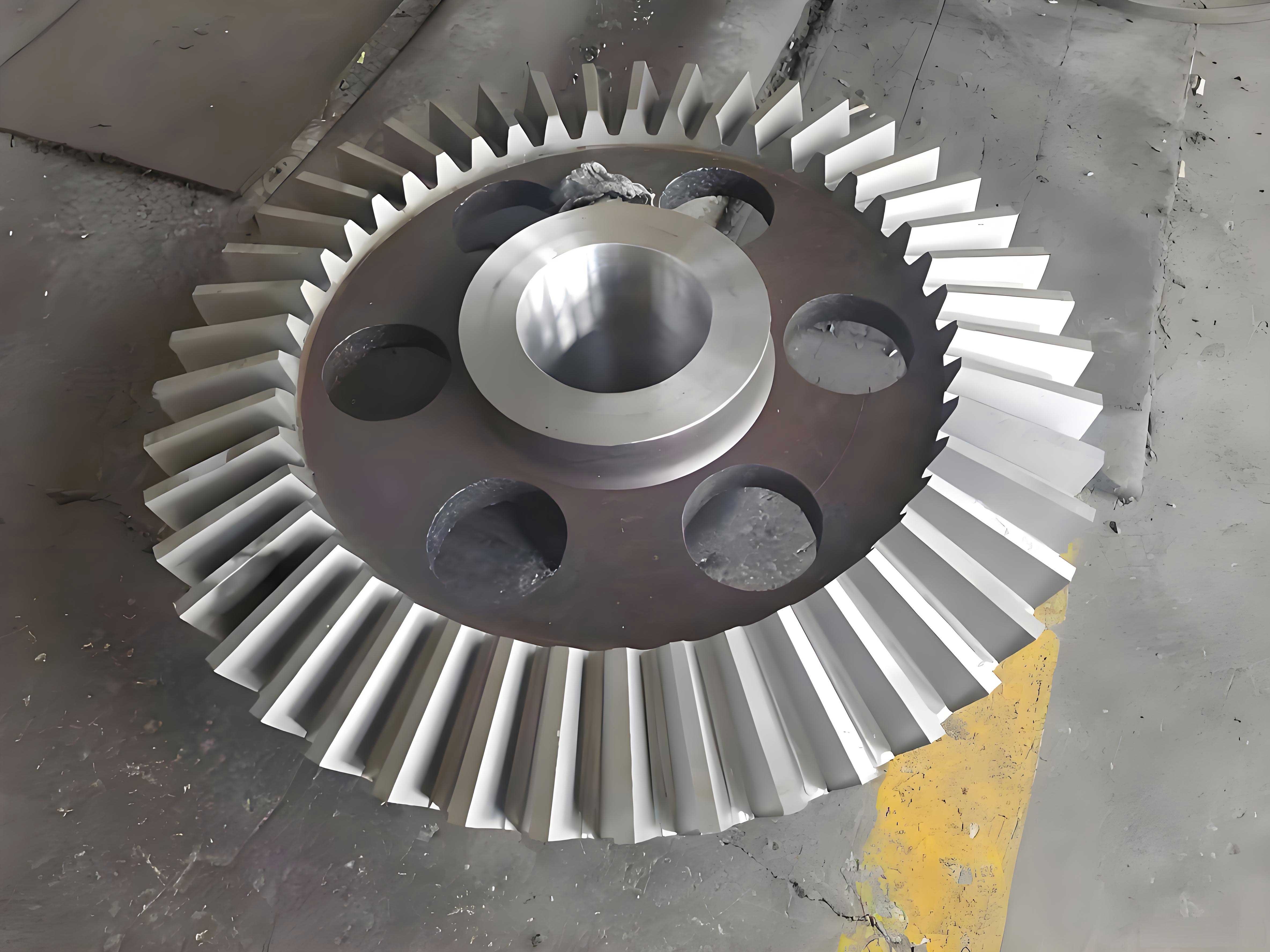
The core idea is to discretize the variable-section tooth into a series of sufficiently thin, constant-section micro-segments along the face width. For each micro-segment, the tooth profile on the back cone is approximated by a standard involute. The compliance (inverse of stiffness) of each segment is then derived by considering the strain energy stored under load. According to Castigliano’s theorem, the total strain energy $U$ in a linear elastic body subjected to a force $F_n$ is related to the corresponding deflection $\delta$ and stiffness $K$ by:
$$ U = \frac{1}{2} F_n \delta = \frac{F_n^2}{2K} $$
Thus, by formulating the strain energy components for a given deformation mode, the equivalent stiffness for that mode can be extracted as $K = F_n^2 / (2U)$.
For a single tooth micro-segment modeled as a variable-section cantilever beam fixed at the root and loaded at a point on the involute profile, the total strain energy is decomposed into four primary components: Hertzian contact energy $U_h$, bending energy $U_b$, shear energy $U_s$, and axial compressive energy $U_a$. The force $F_n$ is the normal contact force at the meshing point, which can be resolved into components relative to the tooth centerline.
The geometry of a miter gear tooth is defined by its parameters at the large end and small end. Using the back cone development, key radii for any micro-segment $i$ with a width $db$ can be expressed. For instance, the base circle radius $r_{b,x}^*$ and $r_{b,d}^*$ for the small and large ends of the segment are:
$$ r_{b,d}^* = \frac{d_b – 2(i-1) \cdot db \cdot \sin(\delta – \theta_b)/\cos \theta_b}{2 \cos \delta} $$
$$ r_{b,x}^* = \frac{d_b – 2i \cdot db \cdot \sin(\delta – \theta_b)/\cos \theta_b}{2 \cos \delta} $$
where $d_b$ is the base diameter, $\delta$ is the pitch cone angle, and $\theta_b$ is the base angle. When $db$ is small enough, the involute profile across the segment’s width is considered constant, evaluated at an average radius.
The coordinates of the load point $(x_{ps}, h_{ps})$ and a generic point $(x, h_x)$ on the tooth profile within the segment are given in parametric form based on the involute function:
$$ x_{ps} = r_b [\cos \theta_k + (\theta_k + \theta_b)\sin \theta_k] – r_f \cos \theta_F + \gamma $$
$$ h_{ps} = r_b [ (\theta_k + \theta_b) \cos \theta_k – \sin \theta_k ] $$
$$ x = r_b [\cos \theta_x + (\theta_x + \theta_b)\sin \theta_x] – r_f \cos \theta_F $$
$$ h_x = r_b [ (\theta_x + \theta_b) \cos \theta_x – \sin \theta_x ] $$
Here, $\theta_k$ and $\theta_x$ are the involute angles at the load point and integration point, respectively, $r_b$ is the base radius, $r_f$ is the root radius, $\theta_F$ is the angle at the root, and $\gamma$ is a term accounting for the segment’s position along the face width.
The energy components for a micro-segment are calculated by integrating the strain energy density along the tooth height from the root to the load point, and then across the segment’s face width $db$. The corresponding stiffness components (bending $K_b$, shear $K_s$, axial $K_a$) for a full tooth are obtained by integrating the compliance contributions of all micro-segments along the entire face width $B$. The expressions are as follows:
Bending Stiffness:
$$ \frac{1}{K_b} = \int_0^B \left[ \int_0^{x_{ps}} \frac{3[(x_{ps}-x)\cos\alpha_1 – h_{ps}\sin\alpha_1]^2}{2E h_x^3} \, dx \right] db $$
Shear Stiffness:
$$ \frac{1}{K_s} = \int_0^B \left[ \int_0^{x_{ps}} \frac{1.2 \cos^2\alpha_1}{2G h_x} \, dx \right] db $$
Axial Compressive Stiffness:
$$ \frac{1}{K_a} = \int_0^B \left[ \int_0^{x_{ps}} \frac{\sin^2\alpha_1}{2E h_x} \, dx \right] db $$
Hertzian Contact Stiffness:
$$ K_h = \frac{\pi E B}{4(1-\nu^2)} $$
where $E$ is Young’s modulus, $G$ is the shear modulus, $\nu$ is Poisson’s ratio, and $\alpha_1$ is the angle between the normal force and the tooth centerline.
Additionally, the flexibility of the gear body (wheel) is considered by modeling it as a series of thin, hollow circular disks along the face width. The torsional stiffness $K_t$ contributed by the gear body is calculated by integrating the stiffness of each disk slice:
$$ dK_t = \frac{G \pi (D^4 – d_k^4)}{32} $$
$$ \frac{1}{K_t} = \int \frac{1}{dK_t} $$
where $D$ and $d_k$ are the outer and inner diameters of the disk slice, which vary along the gear’s back-cone distance.
Finally, the mesh stiffness for a single gear tooth pair $K_e$ is obtained by combining all compliances in series for both the pinion and gear:
$$ K_e = \left( \frac{1}{K_{b1}+K_{s1}+K_{a1}+K_{t1}} + \frac{1}{K_{b2}+K_{s2}+K_{a2}+K_{t2}} + \frac{1}{K_h} \right)^{-1} $$
This $K_e$ varies as the contact point moves from the root to the tip along the face width, giving the single-tooth mesh stiffness curve.
However, gears operate with a contact ratio $\epsilon_\alpha$ greater than one, leading to alternating single and double-tooth contact zones. The total TVMS $K_{total}$ of the miter gear pair must account for this. The contact ratio for a straight miter gear is calculated based on the angular parameters of the developed tooth profiles:
$$ \epsilon_\alpha = \frac{Z_1}{360^\circ \sin \delta_{b1}} (\psi_1 + \psi_2 – \psi_{m1} – \psi_{m2}) $$
where $Z_1$ is the number of teeth, $\delta_b$ is the base cone angle, and $\psi$, $\psi_m$ are specific angular parameters on the pitch cone and involute start point, respectively.
In the double-tooth contact zones, two pairs of teeth share the load. The force distribution between them is determined by satisfying two fundamental conditions: 1) Force Equilibrium: The sum of the individual tooth pair forces equals the total transmitted normal load $F_n$. 2) Deformation Compatibility: The angular deflection of the driven gear $\theta$ is the same for all contacting tooth pairs. For the $i$-th tooth pair in contact, the linear deflection $\delta_i$ along the line of action is related to the gear rotation by:
$$ \delta_i = L_i \theta \cos \alpha_i $$
where $L_i$ is the distance from the mesh point to the gear center, and $\alpha_i$ is the pressure angle at that mesh point. The force on that tooth pair is $F_i = K_{e,i} \delta_i$, where $K_{e,i}$ is its single-pair stiffness. Let tooth pair $j$ have the largest deflection. Combining the equilibrium and compatibility equations yields the formula for the total mesh stiffness in a multi-tooth contact zone:
$$ K_{total} = \frac{F_n}{\delta_z} = \sum_{i=1}^{N} K_{e,i} \cdot \frac{L_i \cos \alpha_i}{L_j \cos \alpha_j} $$
where $N$ is the number of tooth pairs in contact (1 or 2), and $\delta_z$ is the total deflection along the line of action. This formulation smoothly transitions between single and double-tooth contact, generating a periodic TVMS curve.
Furthermore, the loaded transmission error $TE$, a key excitation source, can be derived from the TVMS. Given the input torque $T$ and the mean cone distance $R_m$, the transmitted tangential force is $F_t = T/R_m$. The normal force is $F_n = F_t / \cos \alpha$. The static transmission error due to compliance is then:
$$ TE = 2 \arcsin \left( \sin\left( \frac{F_n}{K_{total} \cdot L_p} / 2 \right) \cdot \frac{L_p}{R_m} \right) $$
where $L_p$ is a characteristic length related to the contact point position.
To validate the proposed analytical model, its predictions are compared against results from detailed 3D nonlinear finite element analysis for several miter gear pairs with different geometries. The gear parameters used for validation are summarized below:
| Parameter | Set 1 | Set 2 | Set 3 | Set 4 |
|---|---|---|---|---|
| Module, m (mm) | 2 | 4 | 4 | 2.5 |
| Pinion Teeth, z1 | 17 | 19 | 20 | 16 |
| Gear Teeth, z2 | 19 | 34 | 25 | 28 |
| Face Width, B (mm) | 8 | 23 | 20 | 12 |
| Pressure Angle, α (°) | 20 | 20 | 20 | 20 |
| Young’s Modulus, E (GPa) | 206 | 206 | 206 | 206 |
| Poisson’s Ratio, ν | 0.3 | 0.3 | 0.3 | 0.3 |
The finite element models were built using hexahedral elements, with refined mesh in the contact regions to ensure accuracy. Boundary conditions applied torque to one gear while constraining the other, and a surface-to-surface contact formulation was used. The single-pair stiffness $K_e$ was extracted from the FEM solution by relating the applied torque to the relative angular displacement of the two gears in a single-tooth contact configuration. The TVMS was obtained by simulating the roll angle through the mesh cycle.
The comparison between the analytical model and FEM results shows excellent agreement. The single-tooth stiffness curves exhibit the characteristic shape: lower stiffness near the points of initial contact and recess, and higher stiffness near the pitch point. The TVMS curves clearly display the periodic transitions between the higher stiffness in double-tooth contact and the lower stiffness in single-tooth contact. The calculated transmission error also matches well, showing larger error in the single-tooth zone and smaller error in the double-tooth zone, with magnitude scaling proportionally with applied torque.
The quantitative comparison of key results and computational effort is presented in the following table:
| Gear Parameter Set | Method | Max Single-Tooth Stiffness (kN/mm) | Avg. TVMS (kN/mm) | Relative Error in TVMS | Computation Time |
|---|---|---|---|---|---|
| Set 1 (m=2, z1=17) | FEM | 313 | 505 | – | ~4 hours |
| Proposed Model | 314.6 | 497.5 | 1.48% | ~21 seconds | |
| Set 2 (m=4, z1=19) | FEM | 835 | 1409 | – | ~6.5 hours |
| Proposed Model | 846 | 1389.4 | 1.39% | ~46 seconds | |
| Set 3 (m=4, z1=20) | FEM | 758 | 1288 | – | ~5.9 hours |
| Proposed Model | 770 | 1266.7 | 1.65% | ~39 seconds | |
| Set 4 (m=2.5, z1=16) | FEM | 448 | 734 | – | ~4.8 hours |
| Proposed Model | 453 | 723.6 | 1.42% | ~23 seconds |
The results demonstrate that the proposed analytical model achieves high accuracy, with errors in average TVMS consistently below 2% compared to the computationally intensive FEM benchmark. More significantly, it accomplishes this at a fraction of the computational cost, reducing calculation times from several hours to tens of seconds. This makes the model highly suitable for dynamic system simulations and rapid design optimization cycles where quick evaluation of gear mesh stiffness is essential.
The minor discrepancies between the analytical and FEM results can be attributed to several simplifying assumptions: 1) The approximation of the spherical involute tooth profile of the miter gear by a planar involute on the back cone. 2) Neglecting the elastic coupling between adjacent micro-segments. 3) Assuming a uniform load distribution across the face width within each micro-segment. 4) Using a geometrically determined contact ratio rather than one derived from loaded tooth contact analysis. Despite these simplifications, the model’s accuracy is remarkably high for engineering purposes.
In conclusion, this paper has developed an efficient and accurate semi-analytical methodology for calculating the time-varying meshing stiffness of straight miter gears. The core innovation lies in the integration of the micro-segmentation strategy for handling tapered teeth with the energy equivalence principle for stiffness derivation, coupled with force-deformation compatibility conditions for multi-tooth contact. The model successfully bridges the gap between the high accuracy of finite element analysis and the need for computational speed in system dynamics studies. It provides a practical and reliable tool for predicting the primary internal excitation in miter gear transmissions, thereby facilitating better dynamic design, vibration analysis, and acoustic optimization of systems employing these essential right-angle drive components.