
In the field of gear manufacturing, the accurate machining of spiral bevel gears is crucial for high-performance transmission systems. Spiral bevel gears are widely used in automotive, aerospace, and industrial applications due to their smooth operation and high load capacity. The precise dual spiral method is an advanced technique for generating tooth surfaces of spiral bevel gears, ensuring optimal contact patterns and minimal noise. In this article, I will delve into the mathematical foundations of this method, focusing on the establishment of coordinate systems, derivation of tooth surface equations, determination of reference points, and curvature analysis. Throughout, I will emphasize the importance of spiral bevel gears in modern engineering and provide detailed formulations using tables and LaTeX equations.
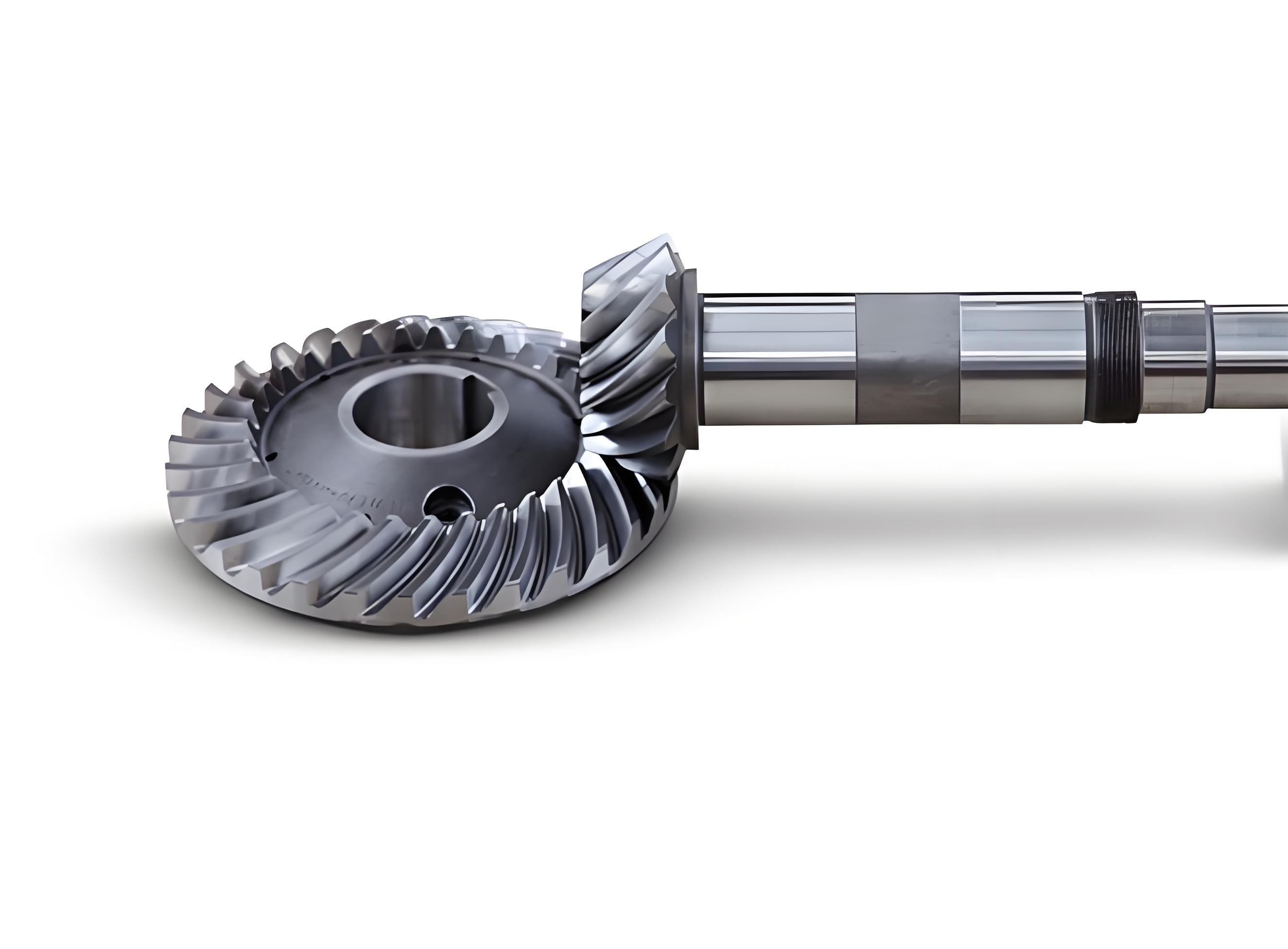
The precise dual spiral method involves a systematic approach to machining the gear teeth, starting with the large wheel (gear) and then the small wheel (pinion). This process relies on the concept of conjugate surfaces, where the tool surface (cutter head) envelopes the gear tooth surface through relative motion. I will begin by describing the coordinate systems used during the cutting process for the large wheel of spiral bevel gears. Establishing these systems is essential for defining the geometric and kinematic parameters accurately.
To model the cutting process, I define a fixed coordinate system \( S_f \) associated with the machine tool. The origin \( O_f \) is located on the axis of the cradle (or swing frame), which simulates the generating gear. The coordinate plane \( X_fY_f \) is perpendicular to the cradle axis, positioned in the horizontal cross-section of the cradle, and points toward the back of the cradle. In this system, I introduce unit vectors that describe the cutting motion parameters. Let \( \mathbf{i}_f \), \( \mathbf{j}_f \), and \( \mathbf{k}_f \) be the unit vectors along the \( X_f \), \( Y_f \), and \( Z_f \) axes, respectively. The workpiece installation angle during large wheel machining is denoted by \( \delta \). The axis direction of the cradle (or generating gear) is represented by \( \mathbf{k}_c \), and the axis direction of the large wheel is \( \mathbf{k}_g \). These vectors are expressed as follows:
$$ \mathbf{k}_c = \begin{bmatrix} 0 \\ 0 \\ 1 \end{bmatrix}, \quad \mathbf{k}_g = \begin{bmatrix} -\sin \delta \\ 0 \\ \cos \delta \end{bmatrix}. $$
Next, I consider a moving coordinate system \( S_t \) attached to the cutter head. The origin \( O_t \) coincides with the cutter center, and the coordinate plane \( X_tY_t \) is coplanar with \( X_fY_f \). The unit vector \( \mathbf{i}_t \) aligns with the radial direction of the cutter, and \( \mathbf{k}_t \) is along the cutter axis. The geometric features of the generating surface (cutter surface) are defined in \( S_t \). For a point \( P_0 \) on the cutter edge, I define the unit tangent vector \( \mathbf{t}_0 \) along the straight generating line, the unit normal vector \( \mathbf{n}_0 \), and the position vector \( \mathbf{R}_0 \). These depend on cutter parameters such as the blade angle \( \alpha \), cutter radius \( r_0 \), and mean radius \( r_m \). The relationships are summarized in Table 1.
| Parameter | Symbol | Description |
|---|---|---|
| Blade angle | \( \alpha \) | Angle of the cutter blade relative to the axis |
| Cutter radius | \( r_0 \) | Radius at the blade tip |
| Mean radius | \( r_m \) | Average radius of the cutter |
| Unit tangent vector | \( \mathbf{t}_0 \) | \( \mathbf{t}_0 = \begin{bmatrix} \cos \lambda \cos \theta \\ \sin \lambda \cos \theta \\ \sin \theta \end{bmatrix} \) |
| Unit normal vector | \( \mathbf{n}_0 \) | \( \mathbf{n}_0 = \begin{bmatrix} -\cos \lambda \sin \theta \\ -\sin \lambda \sin \theta \\ \cos \theta \end{bmatrix} \) |
| Cutter axis vector | \( \mathbf{k}_t \) | \( \mathbf{k}_t = \begin{bmatrix} 0 \\ 0 \\ 1 \end{bmatrix} \) |
Here, \( \lambda \) is the rotation angle of the cutter about its axis, and \( \theta \) is the tilt angle. The position vector \( \mathbf{R}_0 \) in \( S_t \) for point \( P_0 \) is given by:
$$ \mathbf{R}_0 = \begin{bmatrix} r_0 \cos \lambda \\ r_0 \sin \lambda \\ 0 \end{bmatrix}. $$
To relate the cutter surface to the gear tooth surface, I transform these vectors into the fixed coordinate system \( S_f \) using rotation matrices. Let \( \mathbf{T}_{tf} \) be the transformation matrix from \( S_t \) to \( S_f \), which depends on the cradle rotation angle \( \phi \). The transformed unit vectors and position vectors are:
$$ \mathbf{t}_f = \mathbf{T}_{tf} \mathbf{t}_0, \quad \mathbf{n}_f = \mathbf{T}_{tf} \mathbf{n}_0, \quad \mathbf{R}_f = \mathbf{T}_{tf} \mathbf{R}_0 + \mathbf{d}, $$
where \( \mathbf{d} \) is the vector from \( O_f \) to \( O_t \), representing the radial cutter location. The generating surface of the cutter in \( S_f \) can be expressed parametrically. Let \( u \) be the distance along the generating line from \( P_0 \) to any point on the surface. Then, the position vector \( \mathbf{r}_f \) for a point on the generating surface is:
$$ \mathbf{r}_f(u, \lambda) = \mathbf{R}_f + u \mathbf{t}_f. $$
This equation represents the cutter surface as a ruled surface, which is essential for enveloping the tooth surface of spiral bevel gears. The machining of spiral bevel gears involves a generating process where the cutter surface and gear surface are in continuous contact, following the law of gearing.
The tooth surface of the large wheel is derived from the conjugate relationship with the cutter surface. According to the theory of gearing, the condition for contact is that the relative velocity between the surfaces is perpendicular to the common normal vector. I denote the angular velocity of the cradle as \( \boldsymbol{\omega}_c \) and that of the large wheel as \( \boldsymbol{\omega}_g \). The relative angular velocity \( \boldsymbol{\omega}_{cg} \) and relative velocity \( \mathbf{v}_{cg} \) are calculated as:
$$ \boldsymbol{\omega}_{cg} = \boldsymbol{\omega}_c – \boldsymbol{\omega}_g, \quad \mathbf{v}_{cg} = \boldsymbol{\omega}_{cg} \times \mathbf{r}_f – \boldsymbol{\omega}_g \times \mathbf{d}_g, $$
where \( \mathbf{d}_g \) is the vector from the gear axis intersection point to the cutter origin. The meshing equation is given by:
$$ \mathbf{n}_f \cdot \mathbf{v}_{cg} = 0. $$
Solving this equation yields the relationship between parameters \( u \) and \( \lambda \), which defines the contact line on the cutter surface for each cradle position. The tooth surface of the large wheel is then the locus of these contact lines over the full range of cradle rotation. The position vector \( \mathbf{r}_g \) of a point on the large wheel tooth surface in the gear coordinate system \( S_g \) is obtained by transforming \( \mathbf{r}_f \) using the machine kinematics. The transformation involves the machine settings such as the ratio of roll \( R \), spiral motion coefficient \( \sigma \), and others. For spiral bevel gears, the axes of the cradle and gear intersect, simplifying some expressions. The general form of the tooth surface equation is:
$$ \mathbf{r}_g(\phi, \lambda) = \mathbf{T}_{fg}(\phi) \mathbf{r}_f(u(\phi, \lambda), \lambda), $$
where \( \mathbf{T}_{fg} \) is the transformation matrix from \( S_f \) to \( S_g \), and \( u(\phi, \lambda) \) is determined from the meshing equation. This parametric equation defines the tooth surface of the large wheel in terms of cradle angle \( \phi \) and cutter rotation angle \( \lambda \). The detailed derivation involves substituting the specific parameters for spiral bevel gears, leading to a set of nonlinear equations that can be solved numerically.
To illustrate the parameters involved in machining spiral bevel gears, I provide Table 2, which summarizes key machine settings and geometric variables.
| Variable | Symbol | Typical Value/Range |
|---|---|---|
| Cradle angle | \( \phi \) | Varies during cutting |
| Cutter rotation angle | \( \lambda \) | 0 to 360° |
| Blade angle | \( \alpha \) | 20° to 25° |
| Workpiece installation angle | \( \delta \) | Equal to pitch angle |
| Ratio of roll | \( R \) | Depends on gear design |
| Spiral motion coefficient | \( \sigma \) | 0 for generating process |
| Radial cutter location | \( \mathbf{d} \) | Adjustable for tooth depth |
Once the tooth surface equation is established, the next step is to determine the reference point on the large wheel tooth surface for machining the small wheel. In the precise dual spiral method, the midpoint of the tooth surface is often used as the calculation point. This point is defined by its radial distance \( R_g \) from the gear axis and its axial distance \( L_g \) from the pitch cone apex. For spiral bevel gears, these distances are calculated based on gear geometry. Let \( R_m \) be the mean cone distance, \( h_a \) the addendum, \( h_f \) the dedendum, \( \Gamma \) the pitch angle, \( \Gamma_f \) the root angle, and \( \Delta L \) the distance from pitch apex to root apex. Then, the coordinates of the midpoint are:
$$ R_g = R_m – h_f \sin \Gamma, \quad L_g = \frac{R_m}{\tan \Gamma} – \Delta L, $$
where \( \Delta L = h_f \cos \Gamma \). Given \( R_g \) and \( L_g \), I can solve for the corresponding surface parameters \( \phi \) and \( \lambda \) through an iterative process. The condition for iteration is to minimize the error between the calculated position and the desired point. I set up the following system:
$$ F_1(\phi, \lambda) = |\mathbf{r}_g| – R_g = 0, \quad F_2(\phi, \lambda) = \mathbf{r}_g \cdot \mathbf{k}_g – L_g = 0, $$
where \( \mathbf{k}_g \) is the unit vector along the gear axis. Using numerical methods such as Newton-Raphson, I find \( \phi_0 \) and \( \lambda_0 \) that satisfy these equations. At this point, I obtain the position vector \( \mathbf{r}_{g0} \), normal vector \( \mathbf{n}_{g0} \), and other relevant vectors for curvature analysis. This reference point is crucial for setting up the machining of the small wheel, ensuring proper conjugation between the spiral bevel gears.
The curvature at the calculation point on the large wheel tooth surface is essential for predicting contact stresses and transmission errors. I compute the normal curvature and geodesic torsion (twist) along specific directions. First, I establish a local coordinate system \( S_p \) at the point, with unit vectors \( \mathbf{e}_1 \), \( \mathbf{e}_2 \), and \( \mathbf{e}_3 \) aligned with the tooth lengthwise, profile, and normal directions, respectively. These are derived from the transformed cutter vectors. In \( S_p \), I express the relative velocity and acceleration vectors. The relative angular velocity \( \boldsymbol{\omega}_{cg} \) and relative velocity \( \mathbf{v}_{cg} \) have been defined earlier. The relative acceleration \( \mathbf{a}_{cg} \) is calculated as the time derivative of \( \mathbf{v}_{cg} \), considering the motion parameters.
On the cutter generating surface, the normal curvature \( \kappa_n^{(t)} \) and geodesic torsion \( \tau_g^{(t)} \) along the generating line direction are known from the cutter geometry. For a straight generating line, the normal curvature is zero, and the geodesic torsion depends on the blade angle. However, due to the generating motion, these curvatures are transferred to the gear tooth surface. According to the theory of enveloping, the normal curvature \( \kappa_n^{(g)} \) and geodesic torsion \( \tau_g^{(g)} \) on the gear surface along the same direction can be derived using the following formulas:
$$ \kappa_n^{(g)} = \kappa_n^{(t)} + \frac{(\boldsymbol{\omega}_{cg} \times \mathbf{t}_f) \cdot \mathbf{n}_f}{\|\mathbf{v}_{cg}\|}, \quad \tau_g^{(g)} = \tau_g^{(t)} + \frac{(\boldsymbol{\omega}_{cg} \times \mathbf{n}_f) \cdot \mathbf{t}_f}{\|\mathbf{v}_{cg}\|}. $$
In practice, for spiral bevel gears, the cutter surface is a cone, so \( \kappa_n^{(t)} = 0 \) along the generating line, and \( \tau_g^{(t)} = \frac{\sin \alpha}{r_0} \). Substituting the expressions for relative kinematics, I obtain the curvatures on the gear tooth surface. These calculations involve vector operations and derivatives, which I can summarize in a table for clarity. Table 3 lists the key vectors and their expressions at the calculation point.
| Vector | Symbol | Expression |
|---|---|---|
| Position vector | \( \mathbf{r}_{g0} \) | From iterative solution |
| Normal vector | \( \mathbf{n}_{g0} \) | \( \mathbf{n}_{g0} = \mathbf{T}_{fg} \mathbf{n}_f \) |
| Tangent vector along generating line | \( \mathbf{t}_{g0} \) | \( \mathbf{t}_{g0} = \mathbf{T}_{fg} \mathbf{t}_f \) |
| Relative angular velocity | \( \boldsymbol{\omega}_{cg} \) | \( \boldsymbol{\omega}_{cg} = \omega_c \mathbf{k}_c – \omega_g \mathbf{k}_g \) |
| Relative velocity | \( \mathbf{v}_{cg} \) | \( \mathbf{v}_{cg} = \boldsymbol{\omega}_{cg} \times \mathbf{r}_{g0} – \omega_g \mathbf{k}_g \times \mathbf{d}_g \) |
| Relative acceleration | \( \mathbf{a}_{cg} \) | \( \mathbf{a}_{cg} = \frac{d\mathbf{v}_{cg}}{dt} \) |
The normal curvature \( \kappa_n^{(g)} \) and geodesic torsion \( \tau_g^{(g)} \) are then computed using the formulas above. For spiral bevel gears, these values influence the contact ellipse size and orientation during gear operation. I can express the results in terms of the machine settings and cutter parameters. For example, after algebraic manipulation, the normal curvature along the tooth length direction is:
$$ \kappa_n^{(g)} = \frac{1}{R_m} \left( \sin^2 \Gamma + \cos^2 \Gamma \cos \alpha \right) + \text{terms involving } \phi \text{ and } \lambda. $$
Similarly, the geodesic torsion is:
$$ \tau_g^{(g)} = \frac{\sin \alpha}{r_0} + \frac{\omega_c \cos \delta}{\|\mathbf{v}_{cg}\|}. $$
These expressions are approximate; the exact values require numerical evaluation based on specific gear data. The curvature analysis is vital for optimizing the tooth surface of spiral bevel gears to reduce stress concentrations and improve durability.
To further elaborate on the precise dual spiral method, I will discuss the application to the small wheel machining. After determining the large wheel tooth surface and its reference point, the small wheel is machined using a similar generating process but with modified settings to achieve conjugate action. The small wheel tooth surface is derived from the large wheel surface via the gear mating condition. This involves solving a system of equations that ensure continuous contact along the tooth flank. The mathematical framework mirrors that of the large wheel, with adjustments for the pinion geometry. The key is to use the calculated point on the large wheel as a reference for setting the small wheel cutter location and orientation. This ensures that the spiral bevel gears mesh properly with minimal transmission error.
In practice, the manufacturing of spiral bevel gears requires precise control over multiple parameters. Table 4 summarizes the steps involved in the precise dual spiral method for both wheels.
| Step | Large Wheel | Small Wheel |
|---|---|---|
| 1. Establish coordinate systems | Define \( S_f \), \( S_t \), \( S_g \) | Define similar systems for pinion |
| 2. Determine cutter geometry | Blade angle, radius, tilt | Adjust cutter for pinion |
| 3. Derive generating surface equation | \( \mathbf{r}_f(u, \lambda) \) | Based on large wheel surface |
| 4. Apply meshing equation | \( \mathbf{n}_f \cdot \mathbf{v}_{cg} = 0 \) | Modified for pinion motion |
| 5. Obtain tooth surface equation | \( \mathbf{r}_g(\phi, \lambda) \) | \( \mathbf{r}_p(\phi_p, \lambda_p) \) |
| 6. Find reference point | Midpoint via iteration | Using conjugation condition |
| 7. Compute curvature | Normal curvature and torsion | For contact analysis |
The precise dual spiral method enhances the accuracy of spiral bevel gears by accounting for the complex kinematics of the generating process. It allows for the design of tooth surfaces that optimize load distribution and reduce noise. In modern gear production, this method is implemented using CNC machines that control the cutter path and workpiece rotation with high precision. The mathematical models I have described form the basis for computer-aided design (CAD) and manufacturing (CAM) software for spiral bevel gears.
To conclude, I have detailed the precise dual spiral method for machining spiral bevel gears, focusing on the large wheel tooth surface generation. The process involves establishing coordinate systems, defining cutter geometry, deriving tooth surface equations through conjugate theory, determining reference points, and calculating curvatures. The use of tables and LaTeX equations helps summarize the complex relationships. Spiral bevel gears are critical components in many mechanical systems, and this method ensures their high performance. Future work may involve extending the method to include tooth surface modifications for further optimization. The continuous advancement in manufacturing technologies will further improve the precision and efficiency of producing spiral bevel gears.
Throughout this article, I have emphasized the importance of spiral bevel gears in engineering applications. The precise dual spiral method is a testament to the sophistication required in gear manufacturing, blending geometry, kinematics, and calculus. By understanding and applying these principles, engineers can produce spiral bevel gears that meet the demanding requirements of modern machinery.