
In mechanical transmission systems, such as those used in agricultural machinery, spiral bevel gears play a critical role due to their high load-carrying capacity, smooth operation, and efficiency in transmitting power between intersecting shafts. However, excessive contact stress during meshing can lead to gear failure, compromising reliability. While improving manufacturing and installation precision is one approach, it often increases costs without fully addressing performance demands. Therefore, gear micro-modification, or tooth flank modification, has emerged as a key technology to enhance load distribution, reduce stress, and extend service life. In this study, we focus on optimizing modification parameters for spiral bevel gears to minimize contact stress, thereby improving durability and performance. We aim to explore the influence of various modification parameters on meshing stress and develop an optimization framework to achieve optimal gear geometry.
The complexity of spiral bevel gears arises from their curved tooth surfaces and dynamic meshing behavior, making stress analysis and modification design challenging. Traditional methods often rely on experimental trials or simplified analytical models, but with advancements in computational techniques, finite element analysis (FEA) has become a powerful tool for simulating gear meshing under realistic conditions. In this work, we establish a transient dynamic finite element model to analyze the contact stress during the meshing process of spiral bevel gears. We then investigate the effects of five modification directions—helix angle modification, pressure angle modification, lengthwise curvature modification, profile curvature modification, and surface torsion modification—on the maximum contact stress. By building a surrogate model and applying a multi-objective optimization algorithm, we identify optimal modification parameters that significantly reduce stress levels. This approach not only enhances the reliability of spiral bevel gears but also provides insights for industrial applications.
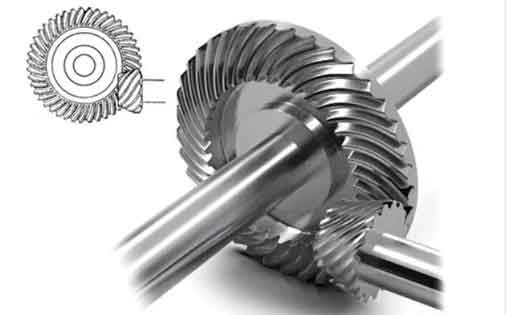
To begin, we developed a detailed geometric model of the spiral bevel gear pair based on standard design parameters. The gears are used for power transmission between vertical axes, and their specifications are summarized in Table 1. The active gear (pinion) and driven gear (wheel) have distinct tooth counts and geometric features, which influence the meshing characteristics. The material selected for both gears is 20CrMnTi, a common alloy steel in gear applications, with properties including density, elastic modulus, and Poisson’s ratio as listed. Accurate modeling of these parameters is essential for realistic stress simulations, as material behavior directly affects contact mechanics and deformation during operation.
| Parameter | Pinion (Active) | Wheel (Driven) |
|---|---|---|
| Number of Teeth | 14 | 25 |
| Module at Large End (mm) | 3.5 | 3.5 |
| Helix Angle (°), Direction | 35, Right-hand | 35, Left-hand |
| Face Width (mm) | 16 | 16 |
| Normal Pressure Angle (°) | 20 | 20 |
| Shaft Angle (°) | 90 | 90 |
| Pitch Cone Angle (°) | 29.249 | 60.751 |
| Root Cone Angle (°) | 26.171 | 55.544 |
| Face Cone Angle (°) | 34.456 | 63.829 |
| Cone Distance (mm) | 50.143 | 50.143 |
| Whole Depth (mm) | 6.608 | 6.608 |
| Tangential Shift Coefficient | 0.025 | -0.025 |
| Radial Shift Coefficient | 0.27 | -0.27 |
We constructed a transient dynamic finite element model using LS-DYNA software to simulate the meshing process of the spiral bevel gears. The gear geometry was discretized with hexahedral elements to ensure accuracy in stress calculations. A mesh independence study was conducted to determine the appropriate element size, resulting in a mesh scheme with 70 elements along the tooth profile and 50 elements along the tooth width, totaling 1,308,220 elements for the entire gear pair. This fine mesh captures the intricate contact behavior without excessive computational cost. The contact pair was defined between the tooth flanks of the pinion (contact surface) and wheel (target surface), with a frictionless contact type as recommended by ISO 10300-1:2023 for spiral bevel gear load capacity calculations, where friction is neglected to simplify analysis while maintaining relevance.
Boundary conditions were applied to replicate real operating conditions. The pinion was assigned a rotational speed, and the wheel was subjected to a load torque, both applied as ramp functions over 0.002 seconds to ensure smooth engagement. The total simulation time was set to 0.017 seconds, covering one complete revolution of the gear (0.015 seconds) plus the loading phase. The initial gear positions were adjusted to achieve contact at the start of meshing, ensuring convergence and accurate stress distribution. The material properties were incorporated into the model, with density $\rho = 7800 \, \text{kg/m}^3$, elastic modulus $E = 207 \, \text{GPa}$, and Poisson’s ratio $\nu = 0.25$. These settings allow for a realistic representation of the dynamic response of spiral bevel gears under load.
Upon simulating the unmodified spiral bevel gears, we analyzed the contact stress distribution during meshing. The stress patterns on the pinion were examined, as they are representative of both gears due to similar meshing dynamics. The contact stress cloud plots revealed that edge contact occurred, particularly at the tooth tip during the meshing-out phase, leading to localized high stress concentrations. The maximum contact stress reached 5595 MPa, which is critically high and likely to cause premature failure such as pitting or tooth breakage. This underscores the necessity for modification to alleviate edge contact and improve stress distribution. The stress variation over time showed periodic fluctuations corresponding to the gear meshing frequency, indicating dynamic load sharing issues inherent in unmodified spiral bevel gears.
To address this, we implemented tooth flank modification on the pinion, as it has fewer teeth and offers more adjustable parameters for efficient modification. The modification is based on a second-order surface approximation to represent deviations from the original tooth flank. This approach decomposes the modification into five directional components: helix angle modification ($a_1$), pressure angle modification ($a_2$), lengthwise curvature modification ($a_3$), profile curvature modification ($a_4$), and surface torsion modification ($a_5$). By varying these coefficients, we can control the tooth flank topology to optimize contact conditions. The ranges for these modification parameters were set based on practical limits: $a_1 \in [-20, 20] \, \mu\text{m}$, $a_2 \in [0, 55] \, \mu\text{m}$, $a_3 \in [0, 20] \, \mu\text{m}$, $a_4 \in [0, 55] \, \mu\text{m}$, and $a_5 \in [-55, 5] \, \mu\text{m}$. These ranges ensure that modifications are within manufacturable tolerances while allowing sufficient flexibility for optimization.
The optimization problem is formulated to minimize the maximum contact stress ($f_1$) during meshing. The objective function and constraints are expressed as follows:
$$ \text{Minimize } f_1(A) $$
$$ \text{subject to: } A = \{a_1, a_2, a_3, a_4, a_5\} $$
$$ -20 \leq a_1 \leq 20 $$
$$ 0 \leq a_2 \leq 55 $$
$$ 0 \leq a_3 \leq 20 $$
$$ 0 \leq a_4 \leq 55 $$
$$ -55 \leq a_5 \leq 5 $$
To explore the design space, we performed Design of Experiments (DOE) using Optimal Latin Hypercube Sampling. The number of design points was determined by the formula $N = (n+1)(n+2)/2$, where $n=5$ is the number of design variables, yielding $N=21$ points. For better surrogate model accuracy, we increased this to 30 points. At each design point, we generated the modified gear model, ran transient dynamic FEA simulations, and extracted the maximum contact stress. This data forms the basis for sensitivity analysis and surrogate modeling, enabling us to understand the influence of each modification parameter on stress reduction in spiral bevel gears.
We conducted a sensitivity analysis to quantify the impact of each modification parameter on the maximum contact stress. The results, expressed as percentage contributions, are summarized in Table 2. A positive value indicates that an increase in the parameter raises stress, while a negative value suggests stress reduction with an increase. The profile curvature modification ($a_4$) has the most significant effect, accounting for 42.57% of the stress sensitivity, highlighting its importance in controlling contact patterns. Surface torsion modification ($a_5$) follows at 22.07%, indicating its role in mitigating edge contact. Pressure angle modification ($a_2$) and helix angle modification ($a_1$) contribute 15.29% and 14.48%, respectively, while lengthwise curvature modification ($a_3$) has a smaller but notable influence at 5.59%. All parameters show sensitivities above 5%, confirming that each plays a crucial role in optimizing spiral bevel gear performance.
| Modification Parameter | Symbol | Sensitivity Percentage (%) | Effect |
|---|---|---|---|
| Helix Angle Modification | $a_1$ | 14.48 | Negative |
| Pressure Angle Modification | $a_2$ | 15.29 | Negative |
| Lengthwise Curvature Modification | $a_3$ | 5.59 | Negative |
| Profile Curvature Modification | $a_4$ | 42.57 | Negative |
| Surface Torsion Modification | $a_5$ | 22.07 | Negative |
Based on the DOE results, we constructed a surrogate model using the Kriging method with a Gaussian correlation function to approximate the relationship between modification parameters and maximum contact stress. The model’s goodness-of-fit was evaluated using the coefficient of determination ($R^2$) and mean relative error. The $R^2$ value achieved was 0.933, and the mean relative error was 0.051, indicating high accuracy and reliability for optimization purposes. This surrogate model allows for rapid prediction of stress responses without running computationally expensive FEA simulations, facilitating efficient exploration of the design space for spiral bevel gears.
With the surrogate model in place, we employed the Non-dominated Sorting Genetic Algorithm II (NSGA-II) to solve the optimization problem. NSGA-II is a multi-objective evolutionary algorithm known for its ability to handle complex, nonlinear problems with multiple constraints. We set the algorithm parameters as follows: population size of 40, generations of 400, crossover probability of 0.9, crossover distribution index of 10, and mutation distribution index of 20. The optimization process iteratively searched for modification parameter combinations that minimize the maximum contact stress, considering the constraints defined earlier. After convergence, the algorithm yielded a Pareto-optimal set of solutions, from which we selected the best compromise solution based on the lowest stress value.
The optimal modification parameters obtained from NSGA-II are: $a_1 = -12.5 \, \mu\text{m}$, $a_2 = 28.3 \, \mu\text{m}$, $a_3 = 8.7 \, \mu\text{m}$, $a_4 = 45.2 \, \mu\text{m}$, and $a_5 = -32.1 \, \mu\text{m}$. These values represent a balanced modification scheme that effectively redistributes contact pressure across the tooth flank. To verify the results, we created a gear model with these parameters and performed a transient dynamic FEA simulation. The contact stress distribution showed a marked improvement: the edge contact was eliminated, and the contact pattern became elliptical, centered on the tooth flank. The maximum contact stress reduced to 1120 MPa, a significant decrease from the initial 5595 MPa. This demonstrates the efficacy of our optimization approach in enhancing the performance of spiral bevel gears.
We further analyzed the stress variation over the meshing cycle for both unmodified and modified spiral bevel gears. As shown in Table 3, the modified gears exhibit lower stress levels throughout meshing, with the peak stress occurring at the center of the contact ellipse rather than at the edges. The periodic fluctuations persist but with reduced amplitude, indicating smoother load transmission. The contact stress reduction ratio, calculated as $(5595 – 1120)/5595 \times 100\% = 80\%$, underscores the substantial benefit of modification. Additionally, the contact area increased, leading to better load distribution and reduced risk of failure. These outcomes align with industry goals for improving the reliability and longevity of spiral bevel gears in demanding applications.
| Condition | Maximum Contact Stress (MPa) | Contact Pattern | Stress Reduction (%) |
|---|---|---|---|
| Unmodified Spiral Bevel Gears | 5595 | Edge contact, high localization | 0 |
| Modified Spiral Bevel Gears | 1120 | Elliptical, centered on flank | 80 |
The optimization process also revealed insights into the interaction between modification parameters. For instance, profile curvature modification ($a_4$) and surface torsion modification ($a_5$) work synergistically to control both the shape and position of the contact ellipse. The negative value of $a_5$ indicates a twisting effect that helps avoid edge contact, while the positive $a_4$ adds crown to the tooth profile, further spreading the load. The helix angle modification ($a_1$) and pressure angle modification ($a_2$) adjust the meshing kinematics, influencing the entry and exit conditions. These interactions are captured by the surrogate model and exploited by NSGA-II to find optimal combinations. This holistic approach ensures that the modified spiral bevel gears not only reduce stress but also maintain or improve other performance metrics, such as transmission error and vibration, though those were not explicitly optimized in this study.
From a practical perspective, the proposed modification parameters are feasible for manufacturing using modern gear cutting or grinding techniques. The modification amounts are within typical tolerance ranges for spiral bevel gears, allowing for implementation without significant cost increases. Moreover, the optimization framework can be adapted to other gear types or operating conditions by adjusting the design variables and constraints. For example, in applications with higher loads or different materials, the modification ranges might be expanded, and additional objectives like bending stress or noise could be incorporated. This flexibility makes the methodology valuable for engineers designing reliable transmission systems with spiral bevel gears.
In conclusion, we have developed a comprehensive approach to optimize modification parameters for spiral bevel gears, focusing on reducing contact stress. Through transient dynamic finite element modeling, we identified that unmodified gears suffer from edge contact, leading to excessive stress up to 5595 MPa. By decomposing modification into five directional components and conducting sensitivity analysis, we found that profile curvature modification has the greatest influence on stress reduction. Using DOE and Kriging surrogate modeling, we built an accurate relationship between parameters and stress, enabling efficient optimization with NSGA-II. The optimal modification parameters successfully lowered the maximum contact stress to 1120 MPa, an 80% reduction, while promoting a centered elliptical contact pattern. This work highlights the importance of systematic modification design in enhancing the reliability and performance of spiral bevel gears, offering a pathway for future research on multi-objective optimization including dynamics and wear considerations.
The implications of this study extend beyond academic interest; they provide actionable insights for industries reliant on spiral bevel gears, such as automotive, aerospace, and agricultural machinery. By adopting similar optimization techniques, manufacturers can achieve better gear designs that withstand higher loads and operate more quietly and efficiently. Future work could explore the effects of modification on other failure modes, such as bending fatigue or micropitting, and incorporate real-world variability in manufacturing errors. Additionally, experimental validation through rig tests would further confirm the numerical findings. Overall, our methodology demonstrates the power of computational tools in advancing gear technology, ensuring that spiral bevel gears continue to meet evolving engineering demands for durability and precision.
To elaborate on the mathematical foundations, the second-order surface approximation for tooth flank modification can be expressed as a function of local coordinates on the gear tooth. Let $(u, v)$ represent the lengthwise and profile directions, respectively. The deviation $\Delta z(u,v)$ from the original tooth surface due to modification is given by:
$$ \Delta z(u,v) = a_1 u + a_2 v + a_3 u^2 + a_4 v^2 + a_5 uv $$
This equation captures the linear and quadratic effects of the modification parameters, where $a_1$ and $a_2$ account for helix and pressure angle changes, $a_3$ and $a_4$ for lengthwise and profile curvature, and $a_5$ for surface torsion. By adjusting these coefficients, we can tailor the tooth flank topography to achieve desired contact characteristics. In our FEA model, this deviation was applied to the pinion tooth surface before meshing, ensuring that the modified geometry is accurately represented in simulations. The optimization then seeks to find the set of coefficients that minimizes the maximum contact stress $f_1$, computed as:
$$ f_1 = \max_{t \in [0,T]} \sigma_c(t) $$
where $\sigma_c(t)$ is the contact stress at time $t$ during the meshing cycle of duration $T$. The NSGA-II algorithm optimizes this by evaluating the surrogate model, which approximates $f_1$ as a function of $A = \{a_1, a_2, a_3, a_4, a_5\}$. The algorithm’s fitness function incorporates constraints through penalty methods, ensuring that only feasible solutions are considered. This mathematical framework ensures rigorous optimization for spiral bevel gears.
Furthermore, the sensitivity analysis was conducted using variance-based methods, where the total variance of $f_1$ is decomposed into contributions from each parameter. The sensitivity index $S_i$ for parameter $i$ is calculated as:
$$ S_i = \frac{\text{Var}_{A_i}(E_{A_{\sim i}}[f_1 | A_i])}{\text{Var}(f_1)} $$
where $E_{A_{\sim i}}[f_1 | A_i]$ is the expected value of $f_1$ conditioned on $A_i$, and $A_{\sim i}$ denotes all parameters except $i$. The percentages in Table 2 are derived from these indices, normalized to sum to 100%. This quantitative approach confirms the relative importance of each modification direction for spiral bevel gears.
In summary, this study underscores the critical role of modification in managing contact stress for spiral bevel gears. Through a blend of advanced simulation, statistical design, and evolutionary optimization, we have demonstrated a pathway to significantly enhance gear performance. The repeated emphasis on spiral bevel gears throughout this article reflects their prominence in engineering systems, and the methodologies presented here can be adapted to other gear types as well. As transmission systems evolve towards higher efficiency and reliability, such optimization efforts will remain indispensable for achieving superior design outcomes.