
In my extensive research and practical experience in gear manufacturing, I have focused on the development of efficient and flexible CNC machining processes for spiral bevel gears. These gears are critical components in various high-performance applications due to their superior load-bearing capacity, smooth transmission, and low noise. Traditionally, spiral bevel gears are produced using dedicated gear-cutting machines, such as those from Gleason or Klingelnberg, which limit flexibility and increase costs for small-batch production. My work explores the use of multi-axis CNC machining centers to overcome these limitations, enabling precise and adaptable manufacturing of spiral bevel gears. This article details my methodology, from machine selection to post-processing, emphasizing the integration of CAD/CAM tools like UG to generate accurate tool paths and NC codes.
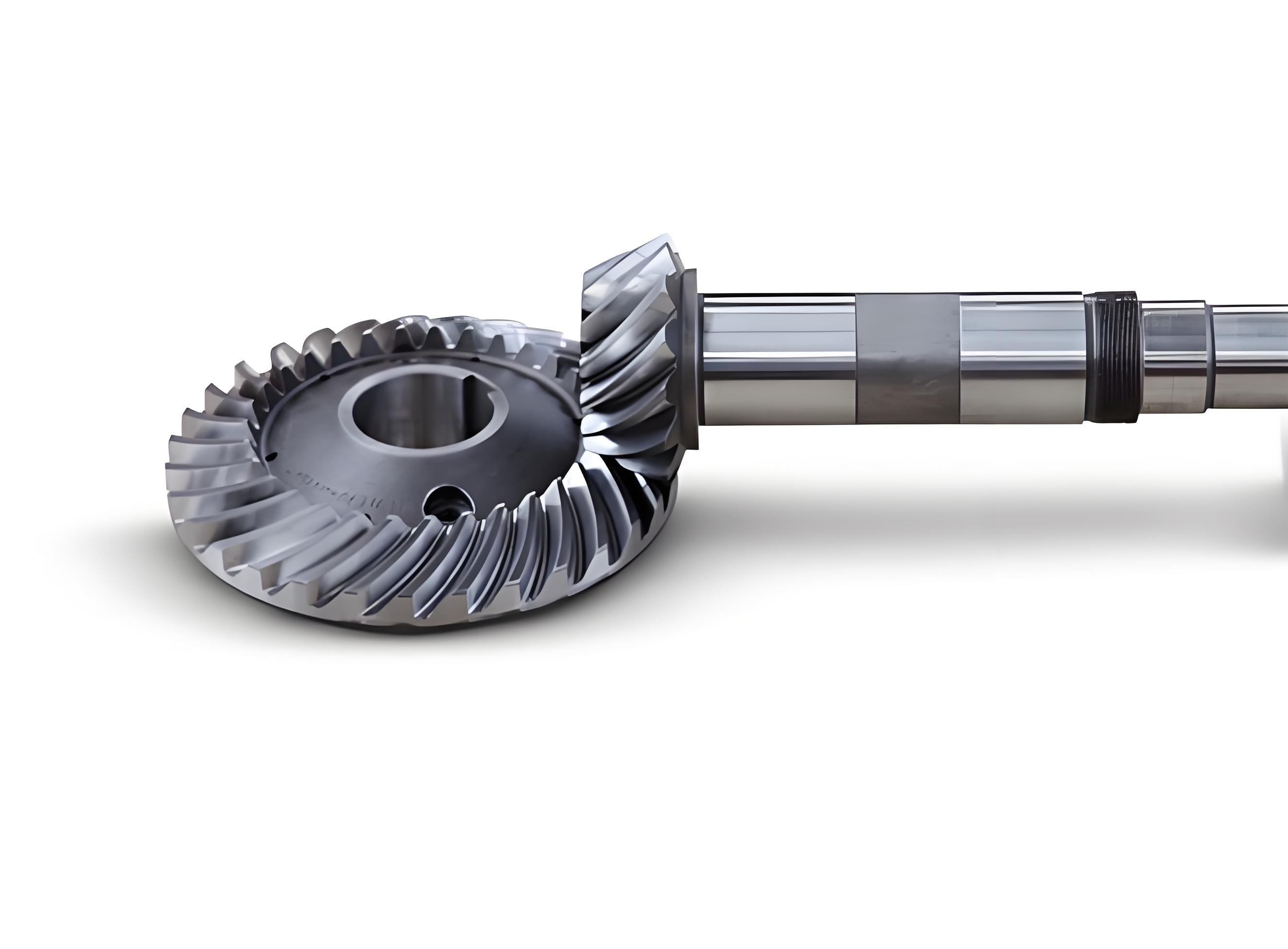
The complexity of spiral bevel gears arises from their curved tooth surfaces, which are defined by nonlinear equations. In my approach, I leverage CNC technology to handle this complexity, allowing for custom modifications and near-net-shape manufacturing. The core of my process involves using a four-axis machining center equipped with a rotary table, which provides the necessary rotational motion for the workpiece while three linear axes control tool interpolation. This setup reduces costs compared to five-axis machines and avoids interference issues in large-diameter spiral bevel gears. However, it requires careful planning in tooling, fixture design, and software processing to achieve full tooth surface machining. I will elaborate on each aspect, supported by tables and formulas to summarize key parameters and relationships.
My investigation begins with machine selection. While five-axis machining centers offer full flexibility, they are expensive and complex to operate. I prefer a four-axis rotary table machining center, as it meets the minimum requirement of one rotational axis for the workpiece and three linear axes for tool movement. To ensure proper machining of the tooth root surface, I design a specialized fixture that tilts the rotary table, aligning the gear’s root cone horizontally. This adjustment is crucial for avoiding undercutting and ensuring complete tooth profile generation. The fixture angle, denoted as $\theta_f$, is set equal to the root cone angle of the spiral bevel gear, typically derived from gear design parameters. For a spiral bevel gear with pitch cone angle $\Gamma$ and dedendum angle $\delta$, the root cone angle can be expressed as:
$$\theta_f = \Gamma – \delta$$
This simple relationship ensures that during machining, the tool axis remains perpendicular to the root cone, facilitating efficient material removal. The table below summarizes the comparison between four-axis and five-axis setups for machining spiral bevel gears:
| Aspect | Four-Axis Machining Center | Five-Axis Machining Center |
|---|---|---|
| Cost | Lower, more affordable for small shops | High, especially for dual-rotary models |
| Complexity | Moderate, easier to program and operate | High, requires advanced post-processing |
| Interference Risk | Minimized with proper fixture design | Potential for collision in large gears |
| Flexibility | Suitable for most spiral bevel gears | Ideal for complex free-form surfaces |
Next, I consider tool selection. The choice of cutter significantly impacts the quality and efficiency of machining spiral bevel gears. I evaluate two primary types: conical end mills and disk-type milling cutters. Conical end mills are versatile and suitable for both pinion and gear machining, but they may have strength limitations due to small diameters. Disk-type cutters offer higher rigidity and faster material removal, but they require careful positioning to avoid interference. For spiral bevel gears, I often use conical end mills for pinions and disk-type cutters for gears, depending on tooth spacing and gear size. The tool geometry is defined by parameters such as cone angle $\alpha_t$ for conical tools or diameter $D_t$ for disk tools, which must be optimized based on gear geometry. The effective cutting radius $R_e$ at any point on the tooth surface can be calculated using the gear’s local curvature and tool orientation. For a conical tool with cone angle $\alpha_t$ and nominal radius $r_t$, the effective radius when tilted relative to the surface normal $\mathbf{n}$ is:
$$R_e = r_t + \frac{h}{\tan(\alpha_t)}$$
where $h$ is the engagement depth. This formula helps in avoiding gouging and ensuring smooth tool paths. The following table outlines the pros and cons of each tool type for spiral bevel gears:
| Tool Type | Advantages | Disadvantages |
|---|---|---|
| Conical End Mill | Adaptable to tight tooth spaces, good for pinions | Low strength, prone to wear, slower feed rates |
| Disk-Type Milling Cutter | High rigidity, fast material removal, suitable for gears | Risk of interference, requires long tool holders for large gears |
In my CAM process, I utilize UG software to generate tool paths for spiral bevel gears. The curved tooth surfaces are modeled based on gear design equations, often involving complex mathematical representations. For instance, the tooth surface of a spiral bevel gear can be approximated using parametric equations derived from gear theory. In a coordinate system attached to the gear, the surface point $\mathbf{P}(u, v)$ may be expressed as:
$$\mathbf{P}(u, v) = \begin{bmatrix} x(u, v) \\ y(u, v) \\ z(u, v) \end{bmatrix}$$
where $u$ and $v$ are parameters related to tooth width and profile curvature. For a spiral bevel gear with spiral angle $\beta$, pitch radius $R_p$, and mean cone distance $A_m$, a simplified form for tool path generation is:
$$x(u, v) = A_m \sin(\Gamma) + u \cos(\beta) \\ y(u, v) = v \\ z(u, v) = A_m \cos(\Gamma) + u \sin(\beta)$$
These equations guide the multi-axis milling operations in UG. I employ the multi-axis milling module to create roughing and finishing tool paths, ensuring continuous tool engagement and minimal air cutting. Simulation and interference checking are performed within UG to verify tool paths before post-processing. A key challenge is that the four-axis machine requires the rotary axis to be fixed at a tilted angle due to the fixture, whereas UG typically outputs variable rotary angles for five-axis paths. To address this, I exploit the fact that when simulating a five-axis setup in UG, the rotary axis angles vary minimally around the fixture tilt angle. By setting the fixture angle as a constant offset in the machine configuration, I can generate tool paths that are compatible with the four-axis system. This involves customizing the tool axis control to limit rotary motion to a narrow range, effectively emulating a fixed tilt.
Post-processing is a critical step in my methodology for spiral bevel gears. The NC code must be tailored to the specific four-axis machining center, which does not accept simultaneous multi-axis rotary commands. In UG’s post-processor, I use custom commands to suppress the output of the rotary axis (often labeled as B-axis) and retain only the linear motions and the constant rotary position. This is achieved by modifying the post-processor settings to treat the rotary axis as a fixed offset, corresponding to the fixture angle $\theta_f$. The resulting NC code contains only X, Y, Z linear movements and a constant A-axis rotation (if applicable), suitable for the four-axis machine. For example, a segment of code for machining a spiral bevel gear with a disk-type cutter might look like:
N0010 G40 G17 G94 G90
N0020 G91 G28 Z0.0
N0030 T01 M06
N0040 G1 G90 X61.5738 Y-43.4321 Z-20.6923 A0.011 F250. S0 M03 M08
...
Here, the A-axis values are near constant, reflecting the fixed tilt. This approach ensures that the machine interprets the code correctly, moving the tool along the programmed path while the workpiece rotates uniformly. To optimize the process, I often adjust feed rates and spindle speeds based on tool engagement calculations. The material removal rate $Q$ for milling spiral bevel gears can be estimated using:
$$Q = a_p \times a_e \times v_f$$
where $a_p$ is the axial depth of cut, $a_e$ is the radial engagement, and $v_f$ is the feed rate. For spiral bevel gears with complex curvatures, I use adaptive tool paths that vary these parameters dynamically to maintain consistent cutting forces and improve surface finish.
The applications of this CNC machining method for spiral bevel gears are diverse. Beyond prototype and small-batch production, it enables gear modification, such as tip relief or root fillet optimization, which enhances performance under load. Additionally, by replacing the milling cutter with a grinding wheel, the same setup can be used for precision grinding of spiral bevel gears, achieving higher accuracy and surface quality. This is particularly valuable for aerospace and automotive industries where gear tolerances are stringent. Moreover, the technology supports near-net-shape manufacturing, where pre-formed gear blanks are finished with minimal material removal, reducing waste and cost. The table below highlights key application areas:
| Application | Benefits | Considerations |
|---|---|---|
| Gear Prototyping | Rapid iteration, design validation | Higher unit cost compared to mass production |
| Gear Modification | Custom tooth profiles, improved durability | Requires precise CAM programming |
| Precision Grinding | High surface finish, tight tolerances | Wheel wear compensation needed |
| Near-Net-Shape Manufacturing | Material savings, reduced machining time | Dependent on blank accuracy |
Throughout my work, I emphasize the importance of integrating software and hardware for spiral bevel gears. The UG environment provides robust tools for modeling and simulation, but successful machining relies on careful setup and parameter tuning. I often conduct trials to validate tool paths and adjust fixtures for different gear sizes. For instance, the fixture angle must be recalculated for each spiral bevel gear design, based on its specific root cone angle. This iterative process ensures that the tooth surfaces are machined accurately without undercutting or overcutting. Additionally, I monitor tool wear and surface roughness during machining, using sensors and inspection data to refine the process. The surface roughness $R_a$ can be correlated with feed per tooth $f_z$ and tool radius $r_t$ through empirical formulas like:
$$R_a \approx \frac{f_z^2}{8 r_t}$$
This helps in selecting optimal cutting parameters for spiral bevel gears.
In conclusion, my research demonstrates that four-axis CNC machining centers, when combined with tailored fixtures and advanced CAM techniques, offer a viable solution for producing high-quality spiral bevel gears. This method enhances flexibility and reduces dependency on dedicated gear-cutting machines, making it accessible for small to medium enterprises. The key lies in the synergistic use of software for path generation and post-processing, along with hardware adjustments to accommodate gear geometry. Future work may involve integrating real-time adaptive control and AI-driven optimization to further improve efficiency and accuracy for spiral bevel gears. As industries demand more customized and high-performance gears, such CNC approaches will play an increasingly vital role in gear manufacturing.
To summarize the entire process, I have compiled a step-by-step procedure for machining spiral bevel gears on a four-axis CNC center:
- Design the spiral bevel gear using CAD software, defining tooth geometry parameters.
- Select the appropriate tool (conical or disk-type) based on gear size and tooth spacing.
- Design and set up a fixture to tilt the rotary table by the root cone angle.
- Generate tool paths in UG CAM, using multi-axis milling strategies and simulating for interference.
- Customize the post-processor to suppress rotary axis output and generate four-axis NC code.
- Load the NC code onto the machining center, perform dry runs, and machine the gear.
- Inspect the finished spiral bevel gear for dimensional accuracy and surface quality.
This comprehensive approach ensures that spiral bevel gears are manufactured with precision, leveraging the full potential of CNC technology. The ability to machine complex geometries like spiral bevel gears opens new possibilities for innovation in transmission systems, contributing to advancements in machinery and vehicles worldwide.