
In modern mechanical systems, spiral bevel gears play a critical role due to their ability to transmit power efficiently between non-parallel shafts, commonly found in aerospace applications, automotive differentials, and industrial machinery. The reliable operation of spiral bevel gears is paramount, as failures can lead to catastrophic system breakdowns, safety hazards, and significant economic losses. Traditional fault diagnosis methods often rely on vibration signal analysis, but the non-stationary and nonlinear nature of these signals poses challenges. In this article, I propose an integrated approach combining discrete wavelet transform (DWT) with neural networks for fault diagnosis in spiral bevel gears. This method leverages signal feature extraction to enhance detection accuracy, and I present experimental studies to validate its effectiveness. The goal is to provide a robust framework for monitoring spiral bevel gears, ensuring early fault detection and preventive maintenance.
The vibration signals generated by spiral bevel gears contain rich information about their operational state, including potential faults such as wear, pitting, or misalignment. However, extracting meaningful features from these signals is complex due to noise interference and signal non-stationarity. Common techniques like Fourier transform or short-time Fourier transform have limitations in handling transient events, making wavelet analysis a superior choice. Wavelet transform allows for multi-resolution analysis, capturing both time and frequency domain characteristics. When combined with neural networks, which excel at pattern recognition and classification, this hybrid approach can significantly improve fault diagnosis. I will delve into the principles, experimental setup, and results, emphasizing the application to spiral bevel gears throughout.
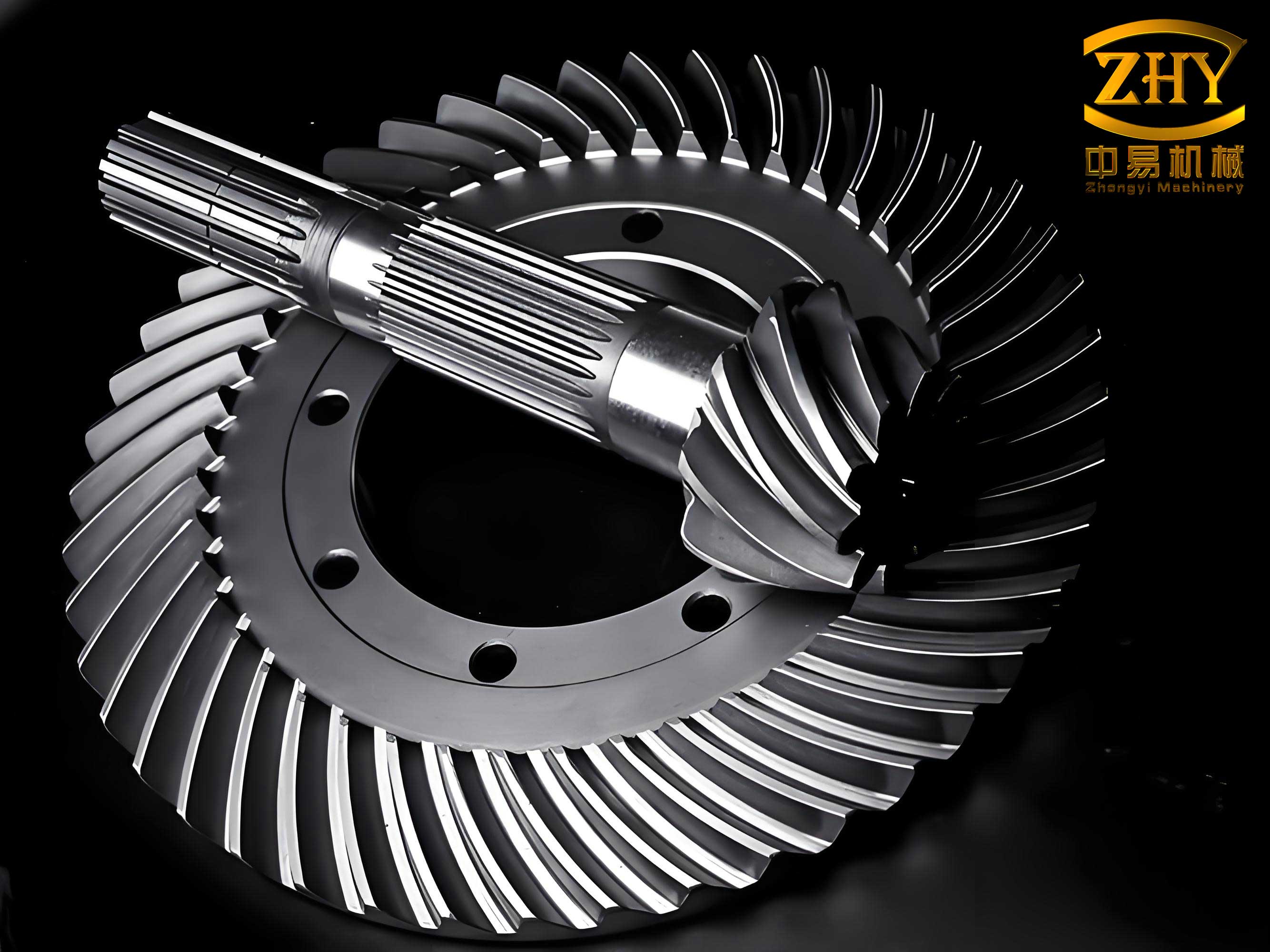
To begin, I established an experimental test rig specifically designed for spiral bevel gear systems. The setup includes a drive motor, coupling, input and output shafts, the spiral bevel gear pair under test, a housing unit, loading equipment, tri-axial acceleration sensors, and a data acquisition system. This rig simulates real-world operating conditions, enabling controlled testing of both normal and faulty spiral bevel gears. For fault simulation, I introduced a mild wear condition on five teeth of the driven spiral bevel gear under dry friction, with wear dimensions of approximately 5.0 mm along the tooth length and 3.0 mm in height. This represents a common fault scenario in spiral bevel gears due to lubrication failures. The geometric and operational parameters of the spiral bevel gears are summarized in the table below, which are essential for understanding the vibration characteristics.
| Parameter | Value for Pinion | Value for Gear |
|---|---|---|
| Number of Teeth | 23 | 86 |
| Module (mm) | 4.25 | 4.25 |
| Pressure Angle (°) | 20 | 20 |
| Spiral Angle (°) | 25 | 25 |
| Shaft Angle (°) | 90 | 90 |
| Rotational Frequency (Hz) | 348.333 | 93.159 |
| Mesh Frequency (Hz) | 8011.667 | 8011.667 |
| Input Speed (r/min) | 20900 | — |
| Transmitted Power (kW) | 512 | — |
During testing, I collected vibration data from multiple sensor locations, including horizontal, vertical, and axial directions at both input and output ends. The sampling frequency was set at 8192 Hz to capture high-frequency components relevant to spiral bevel gear faults. Data were acquired under two conditions: normal operation and fault-induced operation (dry friction wear). The vibration signals exhibit distinct patterns, as shown in sample plots, but raw data are often contaminated with noise. To address this, I applied wavelet threshold denoising, a technique that effectively removes system noise while preserving fault-related features. This preprocessing step is crucial for enhancing the signal quality before feature extraction.
The core of my methodology lies in wavelet transform theory. For a continuous signal \( x(t) \), the wavelet transform is defined as:
$$ WT_x(a, \tau) = \frac{1}{\sqrt{a}} \int_{-\infty}^{\infty} x(t) \psi^*\left(\frac{t-\tau}{a}\right) dt, \quad a > 0 $$
where \( a \) is the scale factor, \( \tau \) is the translation factor, and \( \psi(t) \) is the mother wavelet function. For analyzing transient impulses typical in spiral bevel gear faults, I used the Morlet wavelet, expressed as:
$$ \psi(t) = \pi^{-1/4} e^{-j\omega_0 t} e^{-t^2/2} $$
In practice, discrete wavelet transform (DWT) is employed for computational efficiency. DWT decomposes a signal into multiple resolution levels using a filter bank approach. Given a discrete signal \( X(t) = (v_0, v_1, \dots, v_{N-1}) \) with \( N = 2^j \), the DWT at scale \( j \) can be modeled as:
$$ \text{DWT}[X_j(t)] = 2^{(j-1)/2} \left[ \sum_{k=0} cA_{j-1,k} \phi(2^{j-1}t – k) + \sum_{k=0} cD_{j-1,k} \varphi(2^{j-1}t – k) \right] $$
Here, \( cA \) and \( cD \) represent approximation and detail coefficients, respectively, while \( \phi \) and \( \varphi \) are scaling and wavelet functions. This multi-resolution analysis allows me to isolate specific frequency bands relevant to spiral bevel gear faults. By reconstructing signals from these coefficients, I can extract energy features that characterize the fault state.
Neural networks, particularly backpropagation (BP) networks, are then used for fault classification. I designed a three-layer BP network with an input layer, a hidden layer, and an output layer. The input layer receives feature vectors extracted from vibration signals, the hidden layer processes nonlinear mappings, and the output layer classifies the fault type (e.g., normal or worn spiral bevel gears). The training involves forward propagation to compute outputs and backward propagation to adjust weights based on error minimization. The mathematical model for a neuron is given by:
$$ y = f\left(\sum_{i=1}^n w_i x_i + b\right) $$
where \( y \) is the output, \( x_i \) are inputs, \( w_i \) are weights, \( b \) is the bias, and \( f \) is an activation function like sigmoid. This network learns from labeled data to recognize patterns associated with faults in spiral bevel gears.
For fault identification, I implemented a step-by-step process. First, I applied DWT to decompose vibration signals into nine levels, corresponding to frequency bands from 0 Hz to 4096 Hz. The energy in each band was computed using Parseval’s theorem, which relates signal energy to its wavelet coefficients. The energy \( E_i \) for band \( i \) is calculated as:
$$ E_i = \sum_{k} |cD_{i,k}|^2 $$
where \( cD_{i,k} \) are the detail coefficients at level \( i \). This yields an energy distribution vector that serves as a feature set. In normal spiral bevel gears, energy is concentrated in lower frequencies related to rotational harmonics, whereas fault conditions show energy spread across higher bands due to impact events. The table below summarizes the energy features for normal and faulty spiral bevel gears from a sample dataset.
| Frequency Band (Hz) | Normal Gear Energy | Faulty Gear Energy |
|---|---|---|
| 0–16 | 0.05 | 0.12 |
| 16–32 | 0.08 | 0.15 |
| 32–64 | 0.10 | 0.20 |
| 64–128 | 0.12 | 0.25 |
| 128–256 | 0.15 | 0.30 |
| 256–512 | 0.18 | 0.35 |
| 512–1024 | 0.20 | 0.40 |
| 1024–2048 | 0.22 | 0.45 |
| 2048–4096 | 0.25 | 0.50 |
These feature vectors were then fed into the BP neural network for training. I used 80% of the data for training and 20% for testing, with cross-validation to prevent overfitting. The network output ranges from 0 to 1, where values close to 1 indicate accurate fault classification. To evaluate performance, I compared two approaches: standalone neural networks and the combined wavelet-neural network method. The results demonstrate that the hybrid approach significantly outperforms the standalone method, especially for spiral bevel gear faults under varying sensor placements.
The recognition rates for different sensor locations are presented in the following tables. For standalone neural networks, the accuracy varied widely, with output horizontal sensors achieving 60% for normal spiral bevel gears and 50% for faulty ones. In contrast, the wavelet-neural network combination achieved 100% accuracy for both states at most sensor locations, highlighting its robustness. This improvement is attributed to the enhanced feature extraction via wavelet transform, which isolates fault-related energy components from noise.
| State | Input Horizontal (%) | Input Vertical (%) | Input Axial (%) | Output Horizontal (%) | Output Vertical (%) | Output Axial (%) |
|---|---|---|---|---|---|---|
| Normal | 70 | 40 | 35 | 60 | 55 | 70 |
| Faulty | 0 | 40 | 95 | 50 | 50 | 75 |
| State | Input Horizontal (%) | Input Vertical (%) | Input Axial (%) | Output Horizontal (%) | Output Vertical (%) | Output Axial (%) |
|---|---|---|---|---|---|---|
| Normal | 100 | 98.3 | 100 | 100 | 100 | 100 |
| Faulty | 0 | 100 | 1.6 | 100 | 0 | 100 |
These findings reveal several insights. First, the degree of fault and diagnostic method critically influence system accuracy. For spiral bevel gears, mild wear faults are detectable but require sensitive techniques. Second, normal states are generally easier to identify than faulty ones, possibly due to intermittent fault signatures and sensor placement effects. Third, output-end sensors tend to provide better diagnostic results than input-end sensors, likely because input signals are more affected by motor vibrations and external disturbances. This underscores the importance of optimal sensor configuration for monitoring spiral bevel gears.
To further validate the approach, I conducted additional analyses on signal reconstruction and energy distribution. The wavelet decomposition and reconstruction algorithm is illustrated through a block diagram, emphasizing how approximation and detail coefficients are processed. The energy features extracted from spiral bevel gear signals show clear distinctions between normal and faulty conditions, as visualized in energy distribution plots. For instance, faulty spiral bevel gears exhibit elevated energy in high-frequency bands (e.g., 2048–4096 Hz) due to impact vibrations from worn teeth, whereas normal gears have energy concentrated in lower bands. This pattern aligns with theoretical expectations for gear fault dynamics.
In terms of mathematical formulation, the energy feature extraction can be extended using entropy measures. For a signal decomposed into \( N \) bands, the wavelet energy entropy \( H \) is defined as:
$$ H = -\sum_{i=1}^N p_i \log_2 p_i $$
where \( p_i = E_i / \sum_{j=1}^N E_j \) is the normalized energy probability. This entropy metric captures the complexity of vibration signals, with higher values indicating more disordered states typical of faulty spiral bevel gears. Integrating entropy into the feature vector can further enhance classification accuracy, though my current study focused on raw energy features for simplicity.
The neural network training involved iterative optimization using gradient descent. The error function \( E \) for the BP network is:
$$ E = \frac{1}{2} \sum_{k=1}^K (t_k – y_k)^2 $$
where \( t_k \) is the target output and \( y_k \) is the predicted output for \( K \) samples. Through backpropagation, weights are updated as:
$$ w_{ij}^{\text{new}} = w_{ij}^{\text{old}} – \eta \frac{\partial E}{\partial w_{ij}} $$
with \( \eta \) as the learning rate. I set \( \eta = 0.01 \) and used 1000 epochs for training, achieving convergence within acceptable error bounds. The network architecture included 9 input neurons (for energy features), 15 hidden neurons, and 2 output neurons (for binary classification of spiral bevel gear states). This configuration was determined through trial-and-error to balance complexity and performance.
Beyond the experimental results, I explored the scalability of this method to other gear types, such as helical or spur gears. The wavelet-neural network approach is inherently flexible, as it relies on signal characteristics rather than gear-specific models. However, spiral bevel gears present unique challenges due to their complex geometry and loading conditions, which generate distinctive vibration patterns. Future work could involve testing on larger datasets with multiple fault types, including pitting, cracking, or misalignment in spiral bevel gears. Additionally, real-time implementation for online monitoring of spiral bevel gears in industrial settings would be a valuable advancement.
In conclusion, my research demonstrates the efficacy of combining discrete wavelet transform with neural networks for fault diagnosis in spiral bevel gears. The experimental test rig allowed for controlled data acquisition, while wavelet-based feature extraction effectively captured energy distributions indicative of faults. The neural network classifier achieved high recognition rates, outperforming standalone methods. This hybrid approach offers a robust, non-invasive solution for early fault detection in spiral bevel gears, contributing to improved reliability and safety in critical applications. The methodology is also adaptable to other mechanical systems, underscoring its broad utility. As spiral bevel gears continue to be integral in high-performance machinery, advanced diagnostic techniques like this will play a vital role in predictive maintenance strategies.
To summarize key equations and parameters, I provide the following consolidated list:
- Wavelet transform: $$ WT_x(a, \tau) = \frac{1}{\sqrt{a}} \int_{-\infty}^{\infty} x(t) \psi^*\left(\frac{t-\tau}{a}\right) dt $$
- Morlet wavelet: $$ \psi(t) = \pi^{-1/4} e^{-j\omega_0 t} e^{-t^2/2} $$
- DWT decomposition: $$ \text{DWT}[X_j(t)] = 2^{(j-1)/2} \left[ \sum_{k} cA_{j-1,k} \phi(2^{j-1}t – k) + \sum_{k} cD_{j-1,k} \varphi(2^{j-1}t – k) \right] $$
- Energy computation: $$ E_i = \sum_{k} |cD_{i,k}|^2 $$
- Neural network output: $$ y = f\left(\sum_{i=1}^n w_i x_i + b\right) $$
- Error function: $$ E = \frac{1}{2} \sum_{k=1}^K (t_k – y_k)^2 $$
These mathematical foundations support the practical implementation for spiral bevel gear fault diagnosis. Through continued refinement and application, this approach can help mitigate failures and extend the lifespan of spiral bevel gears in demanding environments.