
In the field of power transmission, especially for intersecting axes, spiral bevel gears are a critical component due to their ability to transmit high loads smoothly and efficiently. The performance of a spiral bevel gear pair is predominantly evaluated through its contact pattern and transmission error under load. Tooth Contact Analysis (TCA) has thus become an indispensable virtual tool for predicting and optimizing these characteristics before physical manufacturing, saving immense time and cost associated with trial-and-error adjustments on actual machines.
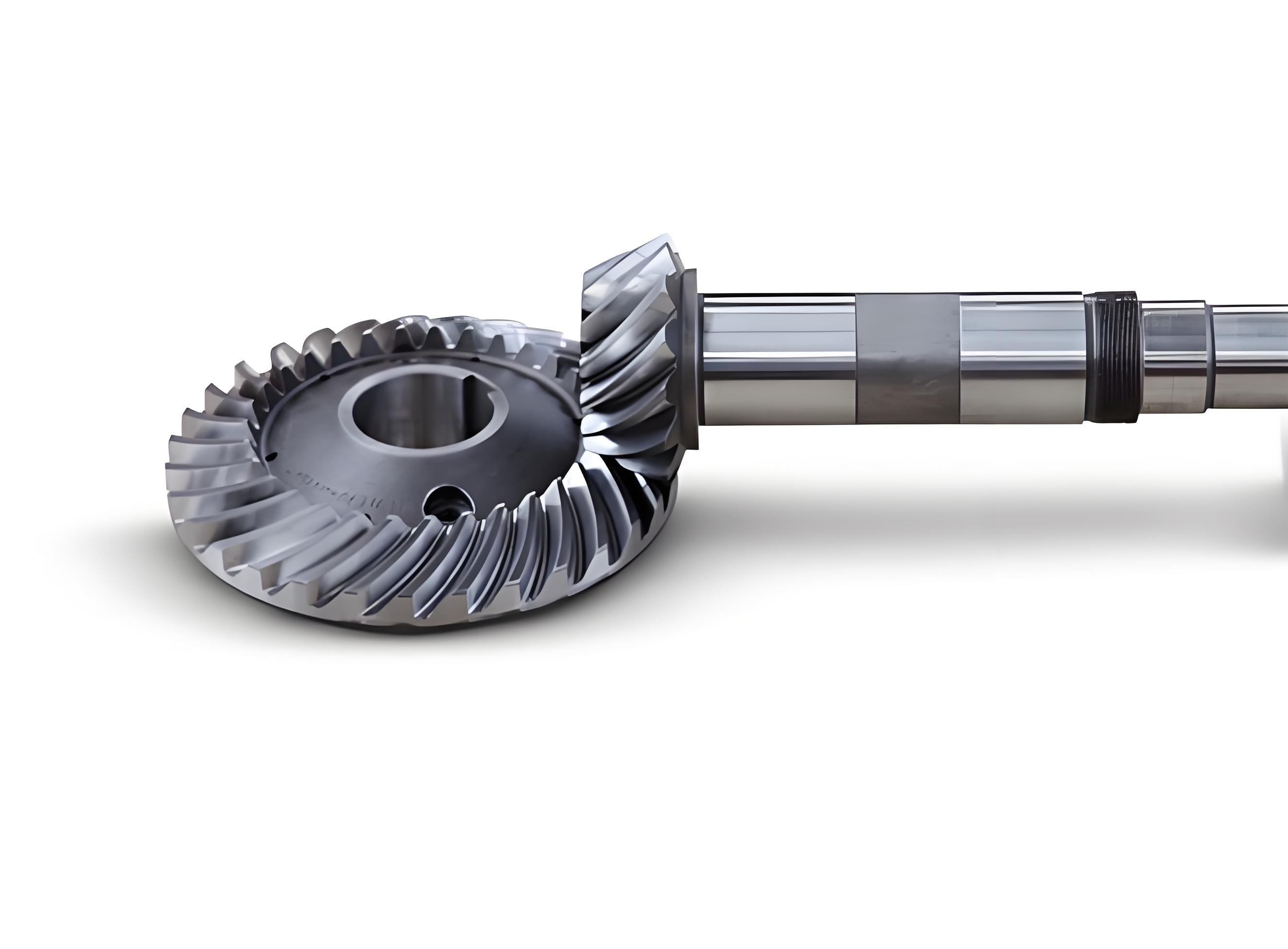
The fundamental principle of TCA for spiral bevel gears is to mathematically simulate the meshing of the pinion and gear tooth surfaces. This is achieved by solving a system of nonlinear equations derived from the condition of continuous contact: at any point of contact, the position vectors and the surface normal vectors of both teeth must coincide in a fixed global coordinate system. Mathematically, for the pinion (superscript 1) and gear (superscript 2), this is expressed as:
$$
\mathbf{r}_h^{(1)}(\theta_p, \phi_p, \varphi’_1) = \mathbf{r}_h^{(2)}(\theta_g, \phi_g, \varphi’_2)
$$
$$
\mathbf{n}_h^{(1)}(\theta_p, \phi_p, \varphi’_1) = \mathbf{n}_h^{(2)}(\theta_g, \phi_g, \varphi’_2)
$$
where $\theta_p, \phi_p$ and $\theta_g, \phi_g$ are the surface parameters defining a point on the pinion and gear tooth surface, respectively. The variables $\varphi’_1$ and $\varphi’_2$ represent the rotational angles of the pinion and gear during mesh. The transmission error, a key indicator of dynamic performance, is then calculated as the deviation of the gear’s actual rotation from its theoretical, perfectly conjugate position:
$$
\delta(\varphi’_1) = \left[ \varphi’_2 – (\varphi’_2)_0 \right] – \frac{N_1}{N_2} \left[ \varphi’_1 – (\varphi’_1)_0 \right]
$$
Here, $N_1$ and $N_2$ are the number of teeth on the pinion and gear, and $(\varphi’_1)_0$, $(\varphi’_2)_0$ are their initial angular positions. By incrementally solving these equations for a sequence of $\varphi’_1$ values, one obtains the path of contact points on the tooth flank (the contact pattern) and the corresponding transmission error curve.
A significant challenge in implementing TCA is obtaining a suitable initial guess for the nonlinear solver. In conventional methods like the “Local Synthesis” or “Local Conjugation” approach, this is elegantly resolved. A specific reference point on the gear tooth surface—typically at the mid-point of the face width and along the pitch cone—is predefined during the gear design and machining parameter calculation phase. At this reference point, the gear pair is designed to have a prescribed contact condition (e.g., zero transmission error and a defined direction of the contact path). The surface parameters $(\theta, \phi)$ and the initial rotation angles for this reference point are direct outputs of the design process and serve as the perfect initial values for launching the TCA solver. The table below contrasts this traditional approach with the problem posed by the Duplex Spread Blade method.
| Aspect | Conventional Local Synthesis Method | Duplex Spread Blade Method |
|---|---|---|
| Reference Point in Design | Explicitly defined and used to calculate pinion machine settings. | Not defined. Pinion convex and concave sides are calculated together without a specific reference. |
| TCA Initial Value Source | Directly available from the reference point parameters. | Not available, creating a “missing link” for starting the TCA solver. |
| Primary TCA Challenge | Optimization of contact pattern location and shape. | Finding a viable method to determine an initial contact point to enable TCA. |
This brings us to the core challenge addressed in this work: the Duplex Spread Blade method for machining spiral bevel gears. This method is known for its efficiency and stability in production. However, its fundamental characteristic—the unified calculation of machining parameters for both the convex and concave sides of the pinion without stipulating a reference contact point—creates a unique problem for subsequent analysis. When attempting to perform TCA on a gear pair produced with this method, we encounter a critical roadblock: there is no pre-defined reference point data to serve as the initial guess for the system of nonlinear equations. Without a good initial guess, numerical solvers often fail to converge, making it practically impossible to predict the contact pattern and transmission error. This lack of predictive capability forces manufacturers to rely solely on physical trial cuts and testing, which is expensive and time-consuming. Therefore, the primary objective of my research is to develop and demonstrate a robust methodology to perform TCA specifically for spiral bevel gears manufactured via the Duplex Spread Blade method, thereby bridging this analytical gap.
To overcome the absence of a prescribed reference point, I propose a novel synthetic approach that constructs a suitable initial contact point by leveraging the intrinsic geometry defined by the given machining settings. The methodology is based on a bidirectional calculation scheme: a forward path starting from the gear and a reverse path starting from the pinion. The core idea is that while no single point is “designed” for contact, the very machining parameters that generated the tooth surfaces implicitly define potential contact locations. By calculating these from both members and finding their consensus, we can identify a stable and rational point to initiate the TCA process.
The first path is the Forward Design Calculation. It begins with the known gear machining parameters and tool geometry. The goal is to find a point on the gear tooth surface and its corresponding conjugate point on the pinion. I select a calculation point based on the midpoint of the gear face width, adjusted for any modifications like root tilt. Its coordinates in the gear coordinate system, $(X_L, R_L)$, are determined by its cone distance and position along the face width. The corresponding point on the gear tooth surface must satisfy its surface equation. Using the gear surface model $\mathbf{r}^{(2)}$ and setting its generating rotation $\phi_g$ to zero (the basic position), I solve for the surface parameter $\theta_g$ that satisfies:
$$
\begin{cases}
X^{(2)}(\theta_g, 0) = X_L \\
[Y^{(2)}(\theta_g, 0)]^2 + [Z^{(2)}(\theta_g, 0)]^2 = R_L^2
\end{cases}
$$
With $\theta_g$ known, the position vector $\mathbf{r}_h^{(2)}(\theta_g, 0, \varphi’_2)$ and surface normal $\mathbf{n}_h^{(2)}(\theta_g, 0, \varphi’_2)$ of this point in the fixed mesh coordinate system can be expressed as functions of the gear rotation $\varphi’_2$. The condition for this point to be a potential contact point is that it satisfies the meshing equation, which states that the relative velocity between the gear and pinion at the point is orthogonal to the common normal:
$$
f(\varphi’_2) = \mathbf{n}_h^{(2)} \cdot \mathbf{v}_h^{(12)} = 0
$$
where $\mathbf{v}_h^{(12)}$ is the relative velocity vector. Solving this equation yields the specific gear rotation angle $\varphi’_2$ at which this point could be in contact. Finally, by enforcing the condition that the pinion and gear have the same surface normal at the contact point (transformed into the pinion’s coordinate system), I solve a final set of equations to find the corresponding pinion surface parameters $(\theta_p, \phi_p=0)$ and its rotation angle $\varphi’_1$. This completes the forward calculation, yielding one set of initial values: $(\theta_g^F, \phi_g^F, \theta_p^F, \phi_p^F, {\varphi’_1}^F, {\varphi’_2}^F)$.
The second, complementary path is the Reverse Design Calculation. This path is conceptually symmetric but starts from the pinion’s perspective. Using the known pinion duplex spread blade machining parameters, I select a corresponding calculation point on the pinion tooth surface. Following an identical logical sequence—solving for the pinion surface parameter $\theta_p$, then its meshing angle $\varphi’_1$ via the meshing equation, and finally finding the matching gear point parameters $(\theta_g, \varphi’_2)$ through the surface normal alignment condition—I obtain a second, independent set of initial values: $(\theta_g^R, \phi_g^R, \theta_p^R, \phi_p^R, {\varphi’_1}^R, {\varphi’_2}^R)$.
The key step in my proposed methodology is the Synthetic Integration of these two independent calculations. The forward and reverse paths, based on different members of the gear pair, will yield slightly different numerical results for the parameters of the supposed initial contact point. This discrepancy arises from the numerical tolerances and the fact that the duplex method does not enforce perfect local conjugation at any specific point. To obtain a single, robust, and representative set of initial values for the TCA solver, I take the arithmetic mean of the two sets:
$$
\theta_g^{TCA} = \frac{\theta_g^F + \theta_g^R}{2}, \quad \theta_p^{TCA} = \frac{\theta_p^F + \theta_p^R}{2}, \quad {\varphi’_1}^{TCA} = \frac{{\varphi’_1}^F + {\varphi’_1}^R}{2}, \quad {\varphi’_2}^{TCA} = \frac{{\varphi’_2}^F + {\varphi’_2}^R}{2}
$$
with $\phi_g^{TCA} = \phi_p^{TCA} = 0$. This averaged set $(\theta_g^{TCA}, 0, \theta_p^{TCA}, 0, {\varphi’_1}^{TCA}, {\varphi’_2}^{TCA})$ represents a synthesized “best estimate” of an initial contact configuration consistent with both the gear and pinion machining data. It is this synthesized point that is used as the reference point and initial guess to solve the full nonlinear TCA equations (1) and (2). The solver then propagates from this starting point to trace the complete contact path and transmission error curve for the spiral bevel gear pair, effectively enabling TCA for the Duplex Spread Blade method.
To validate the proposed methodology, I developed a comprehensive TCA program and applied it to a sample spiral bevel gear pair. The basic geometry and the Duplex Spread Blade machining parameters for the gear set are listed in the table below.
| Gear Blank and Machining Parameters for TCA Example | |
|---|---|
| Item | Value |
| Gear Blank Data | |
| Module | 3 mm |
| Number of Teeth (Gear / Pinion) | 30 / 20 |
| Pressure Angle | 20° |
| Mean Spiral Angle | 40° |
| Hand of Spiral (Gear) | Right |
| Machining Settings (Duplex) | |
| Cutter Diameter | 88.9 mm |
| Cutter Blade Group | 11 |
| Machine Root Angle (Gear / Pinion) | 52.51677° / 31.09059° |
| Radial Setting | 58.38392 mm |
| Ratio of Roll (Gear / Pinion) | 1.20185 / 1.802776 |
Using these inputs, my program executed the forward and reverse calculations. The results of the bidirectional calculation and the final synthesized TCA initial values are shown in the following summary:
| Parameter | Forward Calculation | Reverse Calculation | Synthetic Mean (TCA Initial Value) |
|---|---|---|---|
| $\theta_g$ | 5.349393 | 5.271278 | 5.310104 |
| $\phi_g$ | 0 | 0 | 0 |
| $\theta_p$ | 0.896671 | 0.979223 | 0.937947 |
| $\phi_p$ | 0 | 0 | 0 |
| ${\varphi’_2}$ (rad) | 7.943e-3 | -2.72e-3 | 2.611e-3 |
| ${\varphi’_1}$ (rad) | -6.3e-4 | 2.81e-3 | 1.090e-3 |
These synthetic mean values were successfully used as the initial guess. The TCA solver converged robustly across the entire mesh cycle. The output provides a complete evaluation of the spiral bevel gear pair’s meshing performance. The contact pattern was calculated and visualized, showing a well-centered path across the tooth flank, which is indicative of good alignment and load distribution. Simultaneously, the transmission error curve was generated, displaying a low-amplitude, parabolic-like shape, which is desirable for low vibration and noise excitation. The successful acquisition of these results from the duplex-machined gear data conclusively demonstrates that the proposed bidirectional synthesis method effectively solves the initial value problem, thereby enabling full Tooth Contact Analysis where it was previously infeasible.
In conclusion, this work has successfully addressed a significant analytical shortcoming associated with the widely used Duplex Spread Blade manufacturing method for spiral bevel gears. The absence of a predefined reference point, which previously obstructed the application of standard TCA techniques, has been resolved through a novel bidirectional synthesis approach. By independently calculating potential initial contact parameters from the perspective of both the gear and the pinion using their respective machining settings, and then integrating these results into a robust synthetic initial guess, I have established a reliable pathway to perform full Tooth Contact Analysis. The implementation and validation on a sample gear pair confirm the method’s practicality and effectiveness. This development provides a powerful theoretical and computational tool for engineers. It allows for the virtual prediction and optimization of contact patterns and transmission errors for duplex-machined spiral bevel gears prior to physical cutting, thereby reducing reliance on costly and time-consuming trial-and-error methods in production. This advancement contributes directly to improving the design efficiency, performance predictability, and manufacturing quality of these complex and critical gear components.