
In the realm of mechanical transmission systems, spiral bevel gears stand out due to their superior performance characteristics. As a key component in applications such as aircraft engines and automotive drivetrains, spiral bevel gears offer smooth operation, high efficiency, low noise, and exceptional load-carrying capacity. My extensive experience in gear manufacturing has shown that the lifespan of spiral bevel gears can exceed three times that of chain drives, making them indispensable in high-speed, high-precision environments. However, achieving the required precision in spiral bevel gears is a multifaceted challenge, involving meticulous control over every stage of the manufacturing process. This article systematically discusses the methods, precision control techniques, and equipment involved in the production of precision spiral bevel gears, drawing from practical insights and technical analyses.
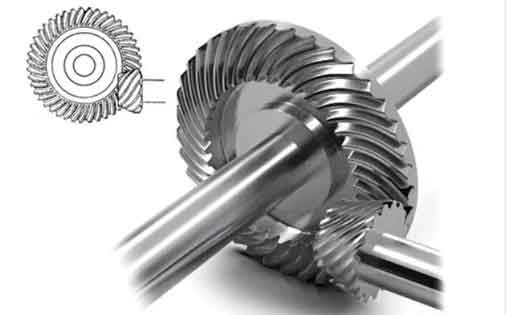
The demand for precision spiral bevel gears is particularly high in aerospace, where gears must operate at speeds up to 5500 rpm with minimal noise and vibration. Any deviation in dimensional accuracy can lead to increased transmission noise, a critical concern for end-users. Through years of production practice, process experimentation, technical攻关, tooling improvements, and studying heat treatment deformation patterns, we have developed methodologies that ensure spiral bevel gears meet stringent design specifications. This journey has underscored the importance of a holistic approach, where factors like gear blank precision, machine tool adjustment, cutting tools, clamping devices, post-cutting heat treatment, and grinding of mounting surfaces all play pivotal roles. In this discussion, I will delve into these aspects, emphasizing how they collectively contribute to the制造 of high-quality spiral bevel gears.
The manufacturing of spiral bevel gears begins with the preparation of精密 gear blanks. The blank must be machined to exacting tolerances, as any imperfections here can propagate through subsequent operations. Typically, the blank dimensions are governed by standards such as AGMA or ISO, but in precision applications, even tighter controls are applied. For instance, the runout of the blank’s mounting surfaces should be within 0.01 mm to ensure uniform clamping during cutting. This initial step sets the foundation for achieving the desired gear geometry.
Workpiece Clamping Devices
In cutting high-quality spiral bevel gears, the workpiece clamping device is of paramount importance. When mounted on the machine, the clamping device effectively becomes an extension of the spindle, so its design and制造 accuracy directly influence切齿 precision. Based on my observations, an ideal clamping device must exhibit high rigidity, excellent coaxiality, precise dimensional accuracy, and uniform gear holding force. The spindle taper, often a Morse taper, must match perfectly with the clamping arbor. During installation, the arbor should be gently inserted into the spindle hole, with an end gap between the arbor and spindle face maintained between 0.05 mm and 0.2 mm.
Key factors in arbor design include material selection (e.g., hardened steel for wear resistance) and geometric considerations to minimize deflection under cutting forces. The contact area between the arbor taper and spindle taper should achieve at least 75% to ensure stable力 transmission. After mounting, the allowable runout is critical: face runout should not exceed 0.01 mm, and radial runout should be within 0.015 mm. These tolerances are essential for maintaining the concentricity of spiral bevel gears during cutting. Below is a table summarizing the clamping device specifications:
| Parameter | Specification | Importance |
|---|---|---|
| End gap (arbor to spindle) | 0.05 mm – 0.20 mm | Prevents over-clamping and ensures proper seating |
| Taper contact area | ≥75% | Enhances stability and force distribution |
| Face runout after mounting | ≤0.01 mm | Ensures axial定位精度 for spiral bevel gears |
| Radial runout after mounting | ≤0.015 mm | Maintains concentricity of spiral bevel gears |
| Clamping force uniformity | High priority | Prevents distortion in spiral bevel gear blanks |
Moreover, the clamping force must be evenly distributed to avoid localized stresses that could deform the gear blank. In practice, we use hydraulic or pneumatic clamping systems with pressure gauges to monitor and adjust the force. The design also incorporates features like quick-change mechanisms to reduce setup time, which is crucial for batch production of spiral bevel gears.
Gear Cutting Adjustments
The切齿 process for spiral bevel gears involves precise machine adjustments to generate the correct tooth geometry. On a spiral bevel gear cutting machine, such as a precision刨齿机, several parameters must be set accurately. These include the indexing change gears, cutter stroke rate, and feed change gears. For small-module spiral bevel gears commonly found in aircraft engines, we often employ the duplex spread-blade method, where both the pinion and gear are finish-cut in one setup using dual-face cutter heads. This method enhances productivity while maintaining accuracy.
First, the indexing change gears determine the number of teeth cut. Two methods are used: single indexing and double indexing. The calculation involves the gear ratio based on the number of teeth. For a spiral bevel gear with \(N\) teeth, the indexing change gear ratio \(i_{\text{index}}\) can be expressed as:
$$ i_{\text{index}} = \frac{K}{N} $$
where \(K\) is a machine constant. For double indexing, the formula adjusts to account for two teeth per cycle. In practice, we use empirical tables to select the appropriate gears, but the underlying principle ensures precise tooth spacing on spiral bevel gears.
Second, the cutter stroke rate, typically measured in strokes per minute, affects cutting speed and surface finish. For spiral bevel gears, the stroke rate \(S\) is set based on the material hardness and cutter type. A common formula is:
$$ S = \frac{V_c \times 1000}{\pi \times D_c} $$
where \(V_c\) is the cutting speed in m/min, and \(D_c\) is the cutter diameter in mm. Higher rates may improve efficiency but require careful balance to avoid tool wear.
Third, the feed change gears control the radial infeed per stroke. The feed rate \(f\) is critical for achieving the desired tooth depth and surface quality. It is calculated as:
$$ f = \frac{F_{\text{desired}}}{i_{\text{feed}}} $$
where \(F_{\text{desired}}\) is the target feed per stroke, and \(i_{\text{feed}}\) is the feed gear ratio. For precision spiral bevel gears, we typically use fine feeds to minimize cutting forces and improve accuracy.
The following table summarizes key adjustment parameters for cutting spiral bevel gears:
| Adjustment | Parameter | Typical Value for Small-Module Spiral Bevel Gears | Notes |
|---|---|---|---|
| Indexing | Change gear ratio | Depends on tooth count (e.g., 0.02–0.05 per tooth) | Use single/double indexing methods |
| Cutter Stroke | Strokes per minute | 200–400 strokes/min | Adjust based on material (e.g., alloy steel) |
| Feed | Feed per stroke (mm) | 0.01–0.05 mm/stroke | Finer feeds for higher precision spiral bevel gears |
| Method | Duplex spread-blade | Applied for both pinion and gear | Enhances productivity in spiral bevel gear manufacturing |
During setup, we also account for machine tool errors, such as backlash in the drive train, by incorporating compensation factors. Regular calibration of the machine is essential to maintain the accuracy of spiral bevel gears over time.
Inspection and Tooth Contact Analysis
After cutting, spiral bevel gears undergo rigorous inspection to ensure compliance with specifications. Beyond checking tooth runout and thickness, the primary evaluation involves running tests on a gear检查机 to assess the tooth contact pattern. The contact pattern—the area where teeth mesh under load—is a critical indicator of gear performance. Deviations in its shape or position can lead to premature wear, noise, and failure.
The desired contact pattern for spiral bevel gears should cover 40% to 60% of the tooth length and 60% to 80% of the tooth height. This ensures even load distribution. However, the optimal area varies with application: for light loads, a larger contact area improves smoothness and reduces noise; for heavy loads, a smaller area reduces sensitivity to installation errors and contact shifts under load. The contact pattern must be continuous;断续 patterns indicate poor surface roughness, which necessitates cutter re-grinding.
Heat treatment induces变形 in spiral bevel gears, primarily altering the spiral angle. If we assume the gear’s spiral angle \(\beta_g\) remains constant, the pinion’s spiral angle \(\beta_p\) tends to decrease after heat treatment. This change \(\Delta \beta_p\) can be approximated as:
$$ \Delta \beta_p = \beta_{p,\text{initial}} – \beta_{p,\text{final}} \approx -0.1^\circ \text{ to } -0.3^\circ $$
To compensate, during切齿 adjustment, we offset the contact pattern slightly toward the toe on the convex side and toward the center on the concave side. This pre-correction ensures that post-heat treatment, the contact pattern settles into the correct position. The adjustment magnitude \(\delta\) is empirically determined, often通过 trial runs on sample spiral bevel gears.
Abnormal contact patterns, such as diagonal contact or edge contact, require re-adjustment of the cutting machine. The table below outlines common contact pattern issues and corrective actions for spiral bevel gears:
| Contact Pattern Issue | Description | Probable Cause | Corrective Action |
|---|---|---|---|
| Diagonal Contact | Pattern runs diagonally across tooth face | Incorrect machine settings or cutter alignment | Adjust cutter tilt or modify spiral angle setting |
| 偏 Contact (Edge Contact) | Pattern concentrated at tooth ends | Excessive deflection or mounting errors | Re-check clamping or modify tooth geometry |
| 断续 Pattern | Discontinuous spots or strips | Poor surface roughness or cutter wear | Re-grind cutter or optimize cutting parameters |
| Large/Small Area | Pattern outside 40–60% length range | Incorrect load distribution or heat treatment变形 | Adjust pre-correction offset or review heat treatment process |
Surface roughness is another vital metric, directly correlated with noise levels. For precision spiral bevel gears, we aim for a surface roughness \(R_a\) below 0.8 μm. If inspections reveal roughness issues, we re-sharpen the cutting tools or adjust cutting fluids. Additionally, non-destructive testing methods like magnetic particle inspection may be used to detect subsurface defects in spiral bevel gears.
Grinding of Mounting Surfaces
Post-heat treatment, the磨削 of mounting surfaces—such as bore holes,支撑 diameters, and axial定位 faces—is crucial for spiral bevel gears. This step controls the gear’s final precision, as it establishes the reference for assembly. For hub-type spiral bevel gears, we typically mount them in fixtures for grinding; for shaft-type gears, we use centers between machine顶针. In both cases, cleanliness and accuracy of the locating surfaces are paramount.
After heat treatment, workpiece center holes must be lapped to remove debris and restore geometry. Any damage here can cause erroneous runout measurements. For shaft-type spiral bevel gears, straightening may be required before grinding, but this must be done with clean centers to avoid misleading alignment checks. The grinding process itself involves selecting appropriate wheel grades and feeds. For instance, we use fine-grit wheels with coolant to achieve表面 roughness below 0.4 μm for mounting surfaces of spiral bevel gears.
The tolerances for mounting surfaces are stringent: bore diameter tolerance often falls within IT6 or better (e.g., ±0.005 mm), and runout should not exceed 0.01 mm. These ensure that spiral bevel gears rotate true when installed. The grinding parameters can be summarized as follows:
| Grinding Parameter | Typical Value for Spiral Bevel Gears | Rationale |
|---|---|---|
| Wheel grit size | 80–120 mesh | Balances material removal and surface finish |
| Feed rate | 0.002–0.01 mm/pass | Minimizes heat generation and distortion |
| Coolant type | Synthetic or emulsion | Reduces thermal effects on spiral bevel gears |
| Tolerance (bore) | IT6 (≈±0.005 mm) | Ensures precise fit for spiral bevel gears in assemblies |
| Runout allowance | ≤0.01 mm | Maintains concentricity of spiral bevel gears |
In practice, we employ in-process gauging to monitor dimensions实时, adjusting the grind based on feedback. This proactive approach minimizes scrap and enhances the consistency of spiral bevel gears.
Machining Equipment for Spiral Bevel Gears
The widespread use of spiral bevel gears in industries like automotive, aerospace, and machinery has driven the evolution of specialized加工机床. These machines can be broadly categorized into two types: those based on the form-cutting principle and those using the generating (roll-cutting) principle. Form-cutting machines, such as some铣齿机, use shaped cutters to directly produce tooth profiles, suitable for low-volume production. Generating machines, like precision刨齿机 or格里森-type machines, simulate the meshing action to create accurate tooth geometries, ideal for high-precision spiral bevel gears.
For high-accuracy requirements, spiral bevel gear磨齿机 are employed to finish teeth after heat treatment, achieving tolerances within microns. For mass production,拉齿机 offer high throughput by pulling cutters through the gear blank. Additionally, machines like鼓形齿铣齿机 are designed for manufacturing crowned teeth, which accommodate misalignments. The choice of equipment depends on factors like gear size, volume, and precision needs. Below is a comparison of common machine types for spiral bevel gears:
| Machine Type | Principle | Typical Application for Spiral Bevel Gears | Advantages |
|---|---|---|---|
| Precision刨齿机 | Generating | Small to medium batches, high precision | Excellent accuracy for spiral bevel gears; versatile adjustments |
| Grinding Machine | Form/Generating | Finish加工 after heat treatment | Achieves tight tolerances on spiral bevel gears; improves surface finish |
| 拉齿机 (Broaching) | Form-cutting | High-volume production | Fast cycle times for spiral bevel gears; suitable for large batches |
| 铣齿机 (Milling) | Form-cutting | Prototypes or custom spiral bevel gears | Flexibility in tooth geometry; lower setup cost |
| 鼓形齿 Machine | Specialized generating | Crowned teeth for misalignment补偿 | Enhances durability of spiral bevel gears under load |
Modern machines often incorporate CNC controls, allowing for automated adjustments and consistent production of spiral bevel gears. For instance, CNC spiral bevel gear cutting machines can store and recall settings for different gear designs, reducing setup errors. Additionally, simulation software is used to predict cutting forces and optimize parameters before physical加工, further enhancing the precision of spiral bevel gears.
Conclusion
Through sustained production实践 and technological refinement, spiral bevel gears have proven their superiority in transmission systems, particularly in aerospace and automotive applications. Their ability to operate smoothly under high loads and speeds makes them a preferred choice for demanding environments. The制造 of precision spiral bevel gears requires a comprehensive approach, encompassing精密 blank preparation, accurate machine adjustments, robust clamping, meticulous inspection, and careful post-heat treatment processing. Each step contributes to the final gear quality, and忽略 any aspect can compromise performance.
Looking ahead, advancements in materials, cutting tools, and machine tool technology will continue to push the boundaries of what is possible with spiral bevel gears. For example, the adoption of powder metallurgy for gear blanks could enhance material homogeneity, while laser hardening might reduce heat treatment变形. Moreover, digital twin technologies could enable real-time monitoring and adjustment during manufacturing, ensuring even higher consistency. As industries evolve towards greater efficiency and reliability, spiral bevel gears will undoubtedly play an expanding role. We are confident that ongoing research and innovation will further optimize their制造 processes, leading to broader applications and improved performance across mechanical systems.
In summary, the journey to produce precision spiral bevel gears is complex but rewarding. By adhering to stringent controls and leveraging advanced equipment, manufacturers can achieve gears that meet the most exacting standards. This discussion has highlighted key methodologies and insights, underscoring the importance of an integrated strategy in the production of spiral bevel gears. As we continue to refine these techniques, spiral bevel gears will remain at the forefront of precision传动 technology, driving progress in various engineering fields.