
The pursuit of high-performance power transmission systems, particularly in demanding sectors such as aerospace and heavy-duty vehicles, has placed stringent requirements on the manufacturing precision and operational reliability of critical components. Among these, spiral bevel gears stand out due to their ability to transmit power efficiently between intersecting or non-intersecting, non-parallel shafts with high load capacity and smooth motion. The complex geometry of spiral bevel gears, characterized by curved teeth and a progressively changing contact path, offers significant advantages in load distribution and noise reduction compared to straight bevel gears. However, this very complexity renders their manufacturing and subsequent heat treatment processes exceptionally challenging. Achieving the desired balance between geometric accuracy for optimal meshing and enhanced physical properties like surface hardness and fatigue resistance through heat treatment remains a central challenge in gear manufacturing.
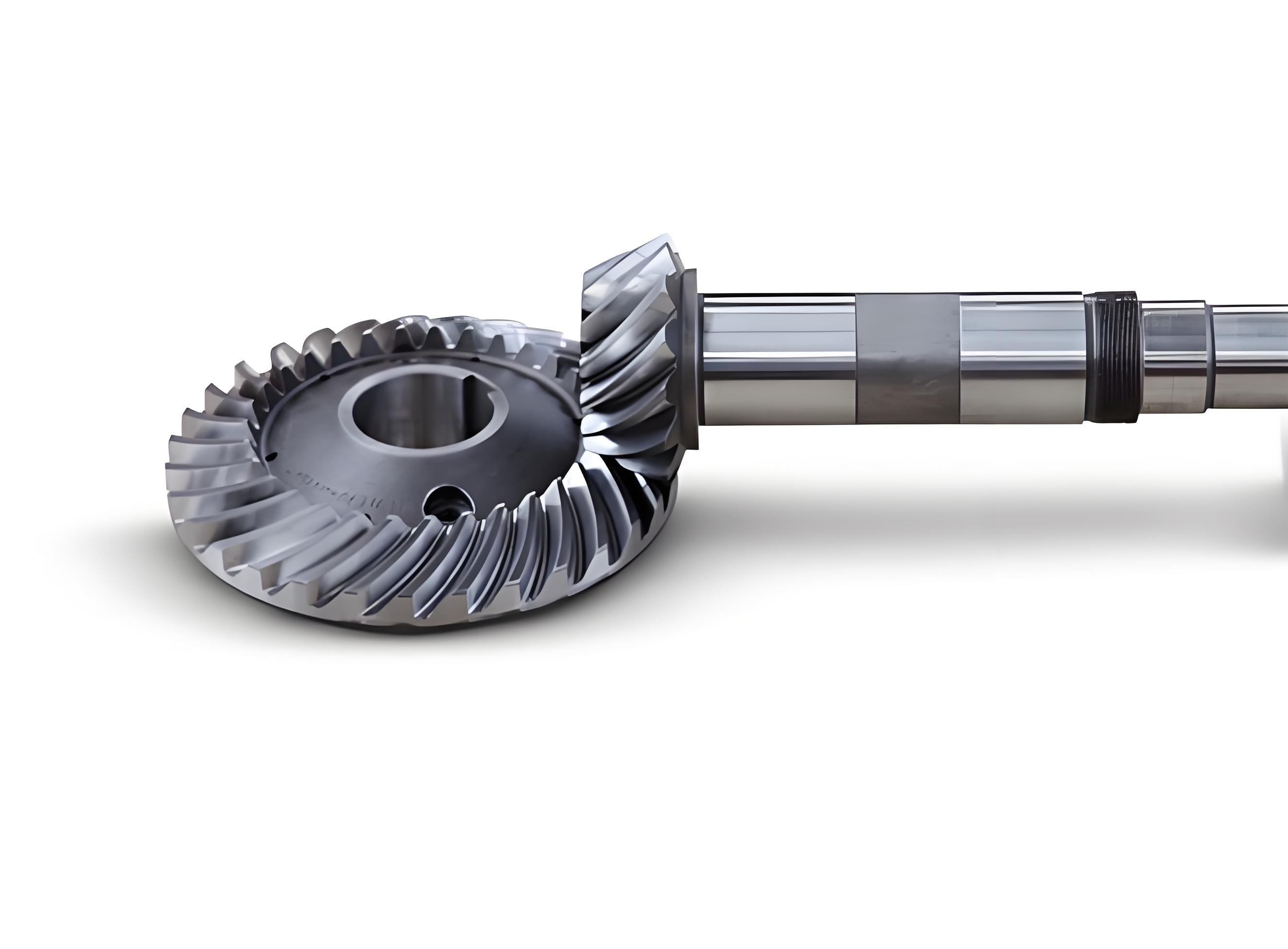
Heat treatment, specifically carburizing and quenching, is a vital process for spiral bevel gears manufactured from low-carbon alloy steels like 9310 steel, commonly used in aerospace applications. This process enriches the surface layer with carbon, which, upon quenching, transforms into a hard, wear-resistant martensitic case while maintaining a tough, ductile core. However, the associated thermal gradients and phase transformations inevitably induce distortions in the gear geometry. These post-heat-treatment deformations can deviate the final tooth surface from its designed, pre-heat-treatment form, potentially degrading the loaded contact pattern, increasing transmission error, elevating noise levels, and precipitating premature failure. Therefore, accurate prediction and subsequent compensation for these deformations are paramount for the manufacture of high-performance spiral bevel gears.
Traditional approaches to analyzing heat treatment deformation in spiral bevel gears have predominantly relied on commercial Finite Element Analysis (FEA) software. While these methods offer high solution accuracy by solving comprehensive thermo-metallurgical-mechanical coupled-field problems, they are computationally intensive and time-consuming. This high computational cost becomes a significant bottleneck, especially during iterative design optimization or manufacturing process parameter refinement where numerous simulations are required. Consequently, there exists a compelling need for methodologies that can provide a favorable trade-off between predictive accuracy and computational efficiency.
To address this gap, this work proposes a novel semi-analytical prediction method specifically designed to forecast the heat treatment deformation of spiral bevel gear tooth surfaces by explicitly accounting for the carburizing-meshing coupling effect. The core innovation lies in integrating the physics of the carburizing process with the mechanics of loaded gear contact into a unified, computationally efficient framework driven by fundamental machine tool settings. By establishing explicit functional relationships between these manufacturing parameters and the resulting thermo-mechanical deformation, the method enables rapid and precise prediction. This approach not only facilitates a deeper understanding of the interaction between the manufacturing process, the resultant microstructure, and the operational performance of spiral bevel gears but also provides a powerful tool for the synergistic design and manufacturing of gears where both geometric form and physical performance are critical.
1. Theoretical Foundation: Tooth Flank Modeling and Carburizing Principles
1.1 Mathematical Modeling of the Spiral Bevel Gear Tooth Surface
Unlike cylindrical gears with standard involute profiles, the tooth surface of a spiral bevel gear does not possess a simple closed-form mathematical expression. Its geometry is intrinsically linked to the kinematic simulation of its generation process on a hypoid gear generator. For spiral bevel gears produced via the face-hobbing or face-milling process with a dual interlocking method, the tooth surface is conceptualized as the envelope of a family of tool surfaces, represented by a series of cutting edges, as they move relative to the gear blank according to a defined set of machine tool settings.
The fundamental equation for generating a point \(\mathbf{p}\) on the gear tooth surface can be derived from the gear meshing theory and the coordinate transformation chain. The surface point in the workpiece coordinate system is given by:
$$\mathbf{p}(\phi, \mu, \theta) = [x_P, y_P, z_P]^T = \mathbf{M}_{b1}(\phi, \mathbf{\Xi}) \cdot \mathbf{r}_1(\mu, \theta)$$
where \(\mu\) and \(\theta\) are the Gaussian parameters defining a point on the cutter surface \(\mathbf{r}_1\). The parameter \(\phi\) is the machine cradle angle, which is the primary motion parameter during generation. The matrix \(\mathbf{M}_{b1}\) represents the complex coordinate transformation from the cutter coordinate system to the gear blank coordinate system. This transformation is a function of \(\phi\) and the set of basic machine tool settings denoted by the vector \(\mathbf{\Xi}\).
The kinematic chain of a modern six-axis hypoid generator, such as a Gleason Phoenix series machine, can be decomposed into a sequence of homogeneous transformation matrices. For a universal motion concept (UMC) style machine, the composite transformation matrix is:
$$\mathbf{M}_{b1}(\phi, \mathbf{\Xi}) = \mathbf{M}_{bg}(\phi_P, X_D) \cdot \mathbf{M}_{gx}(\gamma_m) \cdot \mathbf{M}_{xe}(X_B) \cdot \mathbf{M}_{em}(E_M) \cdot \mathbf{M}_{mc}(\phi, S_r) \cdot \mathbf{M}_{c1}(\sigma, \zeta)$$
Each matrix corresponds to a specific machine axis or setup parameter:
- \(\mathbf{M}_{bg}\): Transform from gear blank to the base. Incorporates the work blank rotation \(\phi_P\) (a function of \(\phi\) and the ratio of roll \(R_a\)) and the horizontal setting \(X_D\).
- \(\mathbf{M}_{gx}\): Accounts for the root angle or machine root angle \(\gamma_m\).
- \(\mathbf{M}_{xe}\): Represents the sliding base or bed setting \(X_B\).
- \(\mathbf{M}_{em}\): Incorporates the vertical offset or eccentricity \(E_M\).
- \(\mathbf{M}_{mc}\): Transforms from the cradle to the machine center. Includes the cradle rotation \(\phi\) and the radial distance \(S_r\).
- \(\mathbf{M}_{c1}\): Represents the cutter head setup, including the cutter tilt angle \(\sigma\) and the cutter swivel angle \(\zeta\).
The equation of meshing, which ensures that the cutter surface is tangent to the generated gear surface, must also be satisfied:
$$f(\phi, \mu, \theta) = \mathbf{n}_P \cdot \mathbf{v}^{(b1)} = 0$$
Here, \(\mathbf{n}_P\) is the unit normal vector to the cutter surface at the generating point, and \(\mathbf{v}^{(b1)}\) is the relative velocity vector between the cutter and the blank in the blank coordinate system. The system of equations formed by the coordinate transformation and the equation of meshing is solved numerically, typically using the Newton-Raphson method, for a grid of \((\mu, \theta)\) values to generate a discrete point cloud \(\mathbf{p}_{i,j}\) representing the theoretical tooth surface of the spiral bevel gear.
| Machine Setting Parameter | Symbol | Typical Role |
|---|---|---|
| Ratio of Roll (Basic) | \(R_a\) | Controls the rolling relationship between cradle and workpiece. |
| Radial Setting | \(S_r\) | Distance from cradle center to cutter center. |
| Vertical Offset (Eccentricity) | \(E_M\) | Vertical displacement of the workpiece. |
| Sliding Base (Bed Setting) | \(X_B\) | Axial position of the workpiece along its axis. |
| Horizontal Setting | \(X_D\) | Horizontal displacement of the workpiece. |
| Machine Root Angle | \(\gamma_m\) | Angle of the workpiece axis relative to the cradle axis. |
| Cutter Tilt Angle | \(\sigma\) | Inclination of the cutter axis. |
| Cutter Swivel Angle | \(\zeta\) | Rotation of the cutter head about its axis. |
1.2 Numerical Loaded Tooth Contact Analysis (NLTCA)
Predicting the performance of spiral bevel gears under load requires an analysis that goes beyond pure geometry. Numerical Loaded Tooth Contact Analysis (NLTCA) is employed to determine the actual contact pattern, transmission error, load distribution, and tooth deflections when the gears are subjected to an operating torque. A common and efficient approach for solving the elastic contact problem for complex surfaces like those of spiral bevel gears is the Discrete Convolution and Fast Fourier Transform (DC-FFT) method combined with a influence coefficient method.
The core of NLTCA involves solving a system of linear complementarity equations that enforce contact compatibility and global equilibrium. For a discretized potential contact region with \(N\) candidate contact points, the condition for contact is:
$$[C]\{F\} + \{D\} – \delta\{e\} \ge \{0\}$$
where:
- \([C]\) is the composite flexibility matrix (\(N \times N\)) whose elements \(C_{ij}\) represent the deflection at point \(i\) due to a unit load at point \(j\).
- \(\{F\}\) is the vector of unknown contact forces (\(N \times 1\)).
- \(\{D\}\) is the vector of initial separations (or penetrations) between the unloaded tooth surfaces (\(N \times 1\)).
- \(\delta\) is the rigid body approach of the gears under load.
- \(\{e\}\) is a vector of ones.
The inequality implies that for a point in contact, the sum of the elastic deflection and initial separation equals the rigid body approach, and the contact force is positive. For a point not in contact, the sum is greater than the rigid body approach, and the contact force is zero. This is subject to the global equilibrium condition:
$$\sum_{j=1}^{N} F_j = P \quad \text{or} \quad \{e\}^T\{F\} = P$$
where \(P\) is the total normal load derived from the input torque. This system is typically solved using linear programming algorithms like the simplex method. The resulting force distribution \(\{F\}\) and the corresponding surface deflections provide critical input for assessing gear performance and, in the context of this work, for coupling with the heat treatment analysis.
1.3 Fundamentals of the Gas Carburizing Process
Carburizing is a thermochemical diffusion process used to increase the carbon content on the surface of low-carbon steel components. For spiral bevel gears made of steels like AISI 9310, this creates a high-carbon case suitable for achieving high surface hardness after quenching. The process is typically conducted in a gaseous atmosphere rich in carbon-carrying species like carbon monoxide (CO) and hydrocarbons (e.g., CH\(_4\)).
The key reactions at the steel surface involve the generation of active carbon atoms [C]:
$$2CO \rightleftharpoons [C] + CO_2$$
$$CH_4 \rightleftharpoons [C] + 2H_2$$
These active carbon atoms are then absorbed into the austenitic lattice of the steel and diffuse inwards, driven by the concentration gradient. The diffusion of carbon in the steel during carburizing is governed by Fick’s second law for non-steady state diffusion, which, for a one-dimensional case, is:
$$\frac{\partial C}{\partial t} = \frac{\partial}{\partial x}\left( D(T, C) \frac{\partial C}{\partial x} \right)$$
Here, \(C\) is the carbon concentration (weight %), \(t\) is time, \(x\) is the distance from the surface, and \(D(T, C)\) is the carbon diffusion coefficient in austenite, which is strongly dependent on both temperature \(T\) and local carbon concentration \(C\). A commonly used empirical relationship is:
$$D(T, C) = D_{0.4} \, \exp\left(-\frac{Q}{RT}\right) \, \exp\left[-\beta(0.4 – C)\right]$$
where:
- \(D_{0.4}\) is the diffusion coefficient for a carbon content of 0.4 wt.%.
- \(Q\) is the activation energy for diffusion.
- \(R\) is the universal gas constant.
- \(\beta\) is a constant relating the effect of carbon concentration on diffusivity.
The boundary condition at the gear surface is given by a mass transfer equation linking the atmosphere potential to the surface carbon content:
$$\beta_g (C_e – C_s) = -D(T, C) \frac{\partial C}{\partial x}\bigg|_{x=0}$$
where \(\beta_g\) is the carbon transfer coefficient, \(C_e\) is the carbon potential of the atmosphere, and \(C_s\) is the instantaneous carbon concentration at the surface. The solution to this diffusion problem, often obtained via finite element analysis of the heat treatment process, yields the carbon profile \(C(x,t)\) and the associated volumetric changes due to phase transformation, which are the primary drivers of heat treatment distortion in spiral bevel gears.
| Parameter | Symbol | Value / Description |
|---|---|---|
| Base Diffusion Coefficient | \(D_{0.4}\) | ~2.0 × 10\(^{-11}\) m²/s (varies with reference) |
| Activation Energy | \(Q\) | ~137 kJ/mol |
| Concentration Coefficient | \(\beta\) | ~0.8 – 1.2 |
| Carbon Transfer Coefficient | \(\beta_g\) | ~2 × 10\(^{-7}\) m/s (function of temperature & atmosphere) |
| Typical Carburizing Temperature | \(T\) | 925 – 950 °C |
| Case Depth Target | – | 0.8 – 1.5 mm (at 550 HV) |
2. Semi-Analytical Prediction Model for Heat Treatment Deformation with Coupling Effect
The novel contribution of this work is the development of a semi-analytical framework that efficiently predicts the post-heat-treatment deformation of spiral bevel gear tooth surfaces by explicitly coupling the carburizing-induced transformation strains with the elastic contact deformations from the gear meshing state. The central hypothesis is that the final in-service geometry is not merely the sum of separate machining, heat treatment, and loading deformations, but is the result of their interaction. The carburized case layer, with its different mechanical properties (hardness, yield strength, residual stress), modifies the local contact stiffness, which in turn alters the load distribution and elastic deflection under operating torque. This altered stress-strain state interacts with the transformation-induced strains from quenching, leading to a coupled distortion.
2.1 Formulation of the Carburizing-Meshing Coupling Effect
The goal is to find a functional relationship between the fundamental manufacturing variables—the machine tool settings \(\mathbf{\Xi}\), which define the nominal tooth geometry, and the heat treatment deformation \(\mathbf{u}^{ht}\). This relationship is implicitly influenced by the operational loading condition. We denote the spatial coordinates of a point on the nominal tooth surface as \(\mathbf{p}(\mathbf{\Xi})\). Its total displacement \(\mathbf{u}\) under the combined effect of heat treatment transformation and operational load can be conceptually expressed as:
$$\mathbf{u}(\mathbf{\Xi}) := \mathbf{u}^{ht}(\mathbf{\Xi}) + \mathbf{u}^{el}(\mathbf{\Xi}, \mathbf{F}^{c})$$
where \(\mathbf{u}^{el}\) is the elastic deformation due to contact forces \(\mathbf{F}^{c}\). The coupling arises because the heat treatment deformation \(\mathbf{u}^{ht}\) changes the unloaded tooth geometry, which alters the contact condition and thus the force distribution \(\mathbf{F}^{c}\). Conversely, the presence of contact stresses during or after heat treatment (considering stress-relief or shot peening) can influence the development of transformation strains. For the purpose of this semi-analytical model, we focus on the state after heat treatment and subsequent assembly under load.
We consider the gear pair at a specific meshing position, characterized by a discretized potential contact zone \(\Omega_c\) on the tooth surface. The compatibility and equilibrium equations for the loaded contact, now accounting for an initial displacement field \(\mathbf{u}^{ht}\) from heat treatment, must be satisfied. The compatibility condition becomes:
$$[C]\{\mathbf{F}^{c}\} + \{\mathbf{D}^{‘}\} – \delta\{\mathbf{e}\} \ge \{0\}$$
Here, \(\{\mathbf{D}^{‘}\}\) is the modified initial separation vector, which now includes the geometric effect of the heat treatment deformation \(\mathbf{u}^{ht}\) projected onto the contact normal direction. Specifically, \(D^{‘}_i = D_i + (\mathbf{u}^{ht}_i^{(p)} + \mathbf{u}^{ht}_i^{(g)}) \cdot \mathbf{n}_i\), where the superscripts \((p)\) and \((g)\) denote pinion and gear, and \(\mathbf{n}_i\) is the surface normal at point \(i\).
The core of the semi-analytical approach is to treat the heat treatment deformation \(\mathbf{u}^{ht}\) not as a generic field but as one that has a functional dependence on the same parameters that govern the contact mechanics. We postulate that for a given carburizing process (fixed time-temperature profile), the local transformation strain, and hence the contribution to \(\mathbf{u}^{ht}\), is a function of the local geometry (curvature, thickness) and the nominal contact pressure distribution from the unloaded or lightly loaded geometry. This creates a closed loop: Machine Settings \(\rightarrow\) Nominal Geometry \(\rightarrow\) NLTCA (Nominal) \(\rightarrow\) Contact Pressure \(\rightarrow\) Influences Heat Treatment Strain \(\rightarrow\) Heat Treatment Deformation \(\rightarrow\) Alters Initial Geometry for Final NLTCA.
To make this tractable, we linearize the relationship around a reference state. We assume that the change in heat treatment deformation \(\Delta \mathbf{u}^{ht}\) due to a small change in the nominal contact pressure distribution \(\Delta \mathbf{p}\) (itself resulting from a small change in machine settings \(\Delta \mathbf{\Xi}\)) can be approximated by a linear sensitivity operator \([\mathbf{S}]\):
$$\Delta \mathbf{u}^{ht} \approx [\mathbf{S}] \Delta \mathbf{p}$$
The operator \([\mathbf{S}]\) can be constructed from a limited number of detailed, fully coupled thermo-metallurgical-mechanical FEA simulations of the carburizing process for different representative contact pressure patterns. These simulations are computationally expensive but are performed offline to build the semi-analytical model. Once \([\mathbf{S}]\) is established, the prediction for a new set of machine settings becomes efficient.
2.2 Semi-Analytical Solution Procedure
The complete solution algorithm for predicting the loaded tooth contact pressure and geometry considering the carburizing-meshing coupling effect is as follows:
Step 1: Nominal Analysis. For a given set of machine tool settings \(\mathbf{\Xi}_0\), generate the nominal tooth surfaces for pinion and gear. Perform a standard NLTCA to obtain the nominal contact pressure distribution \(\mathbf{p}_0\) and the nominal unloaded separations \(\mathbf{D}_0\).
Step 2: Coupling Input. Use the nominal pressure distribution \(\mathbf{p}_0\) as input to the heat treatment deformation model. Apply the sensitivity operator to estimate the heat treatment deformation field:
$$\mathbf{u}^{ht}_0 = [\mathbf{S}] \mathbf{p}_0 + \mathbf{u}^{ht}_{base}$$
where \(\mathbf{u}^{ht}_{base}\) is a base deformation field independent of contact pressure (e.g., from bulk quenching effects).
Step 3: Modified Contact Analysis. Update the initial separation vector for the contact problem to account for \(\mathbf{u}^{ht}_0\):
$$D^{‘}_{0,i} = D_{0,i} + (\mathbf{u}^{ht}_{0,i}^{(p)} + \mathbf{u}^{ht}_{0,i}^{(g)}) \cdot \mathbf{n}_i$$
Solve the modified NLTCA problem with \(\mathbf{D}^{‘}_0\) to obtain a new contact force distribution \(\mathbf{F}^{c}_1\) and pressure \(\mathbf{p}_1\).
Step 4: Iteration (Optional). For higher accuracy, an iterative scheme can be employed. The new pressure \(\mathbf{p}_1\) can be fed back to update the heat treatment deformation estimate: \(\Delta \mathbf{u}^{ht}_1 = [\mathbf{S}] (\mathbf{p}_1 – \mathbf{p}_0)\). Update the separation again and re-solve NLTCA. This loop:
$$ \mathbf{p}_{k} \rightarrow \mathbf{u}^{ht}_{k} \rightarrow \mathbf{D}^{‘}_{k} \rightarrow \mathbf{p}_{k+1} $$
continues until convergence (e.g., \(||\mathbf{p}_{k+1} – \mathbf{p}_{k}|| < \epsilon\)). In practice, for small coupling effects, Step 3 alone (one correction) often suffices.
Step 5: Prediction of Final Geometry. The final, in-service loaded tooth geometry is given by the nominal geometry displaced by the total deformation:
$$\mathbf{p}_{final} = \mathbf{p}_{nominal}(\mathbf{\Xi}_0) + \mathbf{u}^{ht}_{final} + \mathbf{u}^{el}_{final}$$
where \(\mathbf{u}^{el}_{final}\) is the elastic deformation from the final NLTCA solution (Step 3 or converged step). The unassembled, post-heat-treatment geometry (which is critical for manufacturing inspection) is \(\mathbf{p}_{nominal}(\mathbf{\Xi}_0) + \mathbf{u}^{ht}_{final}\).
The key to efficiency is that all steps except the offline creation of \([\mathbf{S}]\) involve fast operations: gear generation via closed-form equations or look-up tables, NLTCA using DC-FFT, and matrix-vector multiplications. This is in stark contrast to running a full coupled FEA for the entire gear pair for every design iteration.
3. Results and Model Verification
To demonstrate the proposed semi-analytical method, a case study was performed on a non-orthogonal spiral bevel gear pair representative of an aerospace auxiliary drive application. The basic geometric and manufacturing parameters are summarized below.
| Parameter | Pinion | Gear |
|---|---|---|
| Number of Teeth | 31 | 38 |
| Module (Normal) | 5.3 mm | 5.3 mm |
| Shaft Angle | 52° | |
| Hand of Spiral | Right Hand | Left Hand |
| Face Width | 32 mm | |
| Material | AISI 9310 Steel | |
| Applied Torque (Pinion) | 800 Nm | |
The sensitivity operator \([\mathbf{S}]\) was pre-computed using three detailed Abaqus FEA simulations of a simplified gear segment undergoing carburizing and quenching, each with a different idealized contact pressure distribution applied as a boundary condition during cooling to simulate the constraining effect of mating contact. The resulting deformation fields were used to fit the linearized model.
3.1 Predicted Deformation Components
The semi-analytical model was applied to predict the heat treatment deformation for nine key meshing positions along the path of contact, from the root to the tip of the pinion tooth. The deformation is resolved into three components relative to the gear’s local coordinate system: Radial (R), Axial (Z), and the direction normal to the nominal tooth surface (U). The total deformation magnitude is also calculated.
For the Pinion:
The predicted deformations at the instantaneous contact ellipse centers show distinct trends. The R-direction deformation, primarily associated with changes in cone distance, became increasingly negative (inward) from the toe to the heel, ranging from approximately -0.296 mm to -0.413 mm. The Z-direction deformation (along the pinion axis) showed less variation, remaining negative and between -0.211 mm and -0.185 mm. The U-direction (surface normal) deformation was the smallest in magnitude and changed sign, from a slight inward deflection (-0.021 mm) at the toe to a slight outward bulge (+0.023 mm) at the heel. The total deformation magnitude increased along the contact path, from about 0.365 mm to 0.453 mm, indicating that the heel region of the pinion tooth undergoes the most significant combined distortion.
The deformation field for the entire pinion body revealed that the maximum distortions are concentrated in the thin-rimmed tooth bodies themselves, particularly near the heel and toe edges. The gear shaft, web, and hub exhibited significantly smaller deformations, as expected due to their greater stiffness.
For the Gear (Wheel):
A similar analysis was conducted for the gear member. The trends were analogous but with different magnitudes due to the different geometry. The R-direction deformation ranged from -0.444 mm to -0.523 mm. The Z-direction deformation decreased from toe to heel. The U-direction deformation was positive and decreased from about 0.041 mm to 0.021 mm. The total deformation magnitude for the gear also increased from toe to heel, from 0.463 mm to 0.532 mm.
| Meshing Position | Pinion Total | Pinion U-Dir | Gear Total | Gear U-Dir |
|---|---|---|---|---|
| 1 (Toe) | 0.365 | -0.021 | 0.463 | 0.041 |
| 2 | 0.378 | -0.015 | 0.478 | 0.038 |
| 3 | 0.389 | -0.010 | 0.492 | 0.035 |
| 4 | 0.398 | -0.006 | 0.503 | 0.032 |
| 5 (Mid) | 0.405 | -0.001 | 0.512 | 0.029 |
| 6 | 0.416 | +0.008 | 0.521 | 0.027 |
| 7 | 0.426 | +0.015 | 0.527 | 0.024 |
| 8 | 0.438 | +0.020 | 0.531 | 0.022 |
| 9 (Heel) | 0.453 | +0.023 | 0.532 | 0.021 |
3.2 Validation and Comparative Analysis
The accuracy of the semi-analytical model was validated by comparing its predictions for the surface-normal (U-direction) deformation against results from a full, fully coupled thermo-mechanical-metallurgical FEA simulation of the entire gear pair’s heat treatment process. The full FEA, while accurate, required over 48 hours of computational time on a high-performance workstation. In contrast, the semi-analytical model, after the initial offline training phase, produced results for all nine meshing positions in under 10 minutes.
The relative error between the semi-analytical prediction and the full FEA reference was calculated for the U-direction deformation at each contact point. The maximum absolute relative error observed was less than 0.9% for both the pinion and the gear across all meshing positions. This excellent agreement confirms that the linearized coupling model encapsulated in the sensitivity operator \([\mathbf{S}]\) is sufficient for capturing the primary interaction between the carburizing-induced transformation and the meshing contact pressure for this class of spiral bevel gears.
Furthermore, a critical comparison was made between the final loaded contact pattern predicted by three methods: 1) Nominal NLTCA (ignoring heat treatment), 2) NLTCA with heat treatment deformation added as a static geometric shift (uncoupled), and 3) The proposed coupled semi-analytical model. The results demonstrated that the uncoupled approach could predict a shift in the contact pattern location but failed to accurately capture its shape and pressure intensity, particularly at the edges. The coupled model, however, predicted a contact pattern that was both shifted and subtly reshaped, showing a more uniform pressure distribution and better alignment with the pattern inferred from the full FEA results. This highlights the practical significance of the coupling effect: ignoring it can lead to an overestimation of edge loading and an incorrect prediction of transmission error.
4. Conclusion
This work has successfully developed and demonstrated a novel semi-analytical prediction method for the heat treatment deformation of spiral bevel gears that explicitly accounts for the carburizing-meshing coupling effect. The method establishes a direct functional relationship between the fundamental machine tool settings and the final in-service tooth surface geometry under load, integrating the physics of case hardening with the mechanics of gear contact.
The core achievements of the method are its computational efficiency and predictive accuracy. By leveraging a pre-computed linear sensitivity operator derived from a limited set of detailed FEA simulations, the model avoids the prohibitive computational cost of running a full coupled analysis for every design iteration. Validation against a full FEA benchmark showed a remarkably high agreement, with prediction errors for critical surface-normal deformations below 1%. This makes the method a powerful tool for the rapid evaluation and optimization of manufacturing processes for spiral bevel gears.
The analysis of a non-orthogonal aerospace spiral bevel gear pair revealed the tangible impact of the coupling effect. The predicted deformation was not uniform across the tooth surface, with the heel region generally experiencing greater total distortion. More importantly, the final loaded contact pattern and pressure distribution were meaningfully different when the coupling was considered compared to a simple superposition of independent effects. This underscores the necessity of adopting such an integrated approach for the high-precision design and manufacture of critical components where both geometric fidelity and surface durability are paramount.
The proposed framework is not limited to the prediction of geometric deformation alone. The same underlying principles and the efficient semi-analytical solver can be extended to predict other performance metrics crucial for spiral bevel gears, such as the loaded transmission error, contact stress fields, bending stress, and root fillet stresses under the influence of the carburized case. This positions the method as a cornerstone for a comprehensive, performance-driven, and efficient digital twin for the development and manufacturing of advanced spiral bevel gear systems.