
The pursuit of precision in power transmission systems, particularly those involving intersecting axes, has always been a core focus in mechanical engineering. Among the critical components in such systems, spiral bevel gears stand out due to their ability to transmit motion smoothly and efficiently at various angles with high load capacity. Their complex, spatially curved tooth surfaces are fundamental to this performance. However, this very complexity poses a significant challenge for quality control and error quantification in manufacturing. Traditional methods, often reliant on subjective rolling tests and visual inspection of contact patterns, lack the quantitative rigor needed for modern precision engineering and predictive maintenance. This gap necessitates the development of accurate, coordinate-based measurement and evaluation techniques. In this article, I will present a detailed methodology, developed and refined through practical application, for the three-dimensional measurement and rigorous assessment of tooth surface errors on spiral bevel gears using coordinate measuring machine (CMM) technology and advanced computer-aided engineering software.
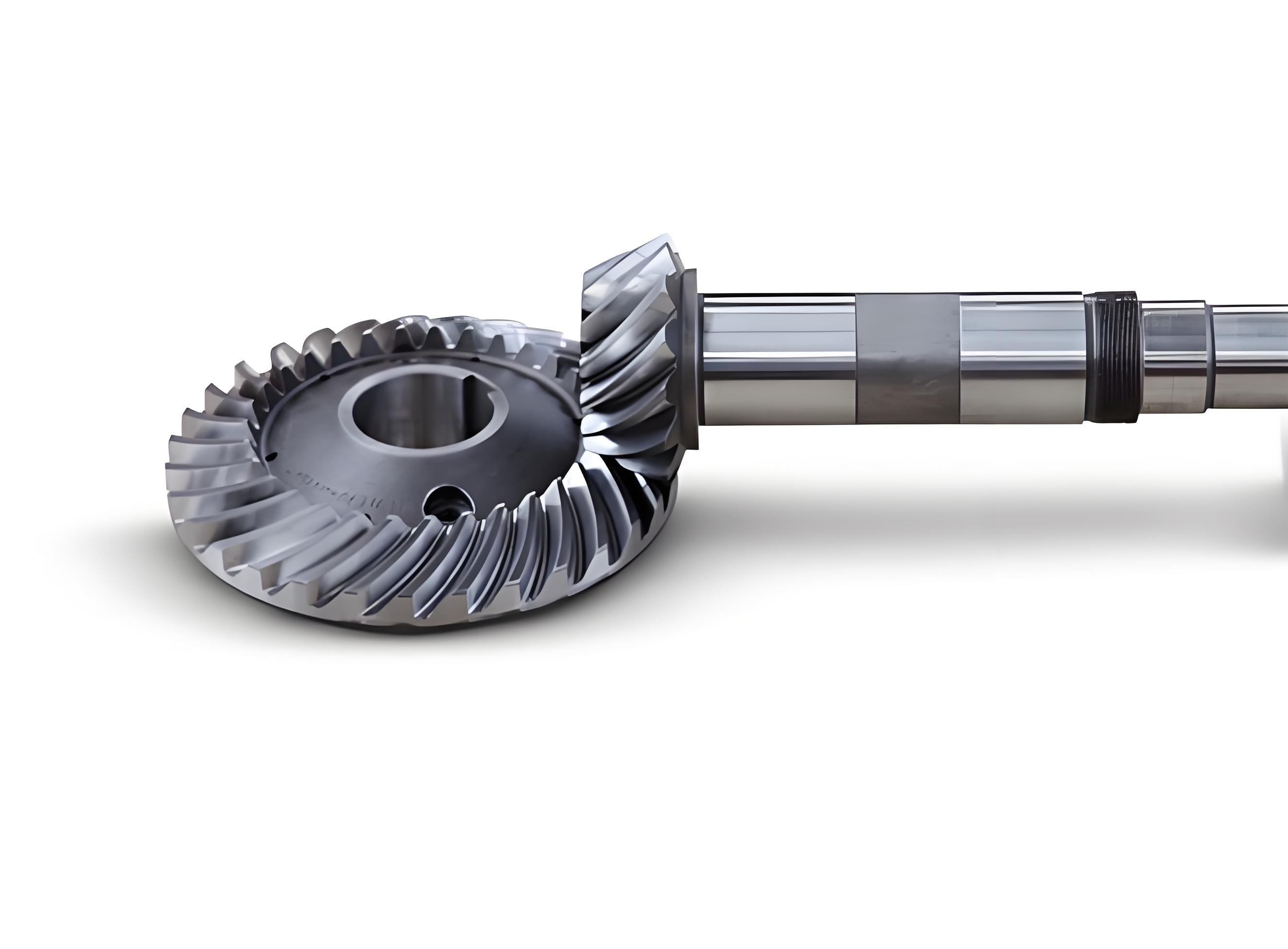
The manufacturing of spiral bevel gears is a sophisticated process, and deviations from the ideal theoretical surface geometry are inevitable. These deviations, or tooth surface errors, arise from a combination of factors including machine tool inaccuracies, cutter setting errors, workpiece deflection during cutting, and subsequent heat treatment distortions. Accurately measuring these errors is not merely an exercise in quality assurance; it provides the essential feedback required for corrective action in the manufacturing chain, enabling the fine-tuning of machine settings to achieve optimal gear performance. My approach centers on treating the gear as a precise geometrical entity. By comparing the physical, manufactured surface of a spiral bevel gear against its perfect digital twin, we can extract a comprehensive error map. This method moves beyond single-point inspections and provides a holistic view of the surface topography, which is crucial for analyzing transmission error, noise, vibration, and overall durability.
Theoretical Foundation and Digital Twin Creation
The cornerstone of any precise measurement is a reliable reference. For spiral bevel gears, this reference is the ideal theoretical tooth surface, derived from their specific geometry and manufacturing simulation. The tooth flank of a spiral bevel gear can be mathematically described as a convolute surface generated from the relative motion between the imaginary generating gear (represented by the cutter head) and the workpiece. A common parametric representation for a point on the theoretical tooth surface, in a coordinate system attached to the gear, can be expressed as a function of the machine tool settings and cutter geometry.
While the full derivation is extensive, a simplified representation of the surface vector $\mathbf{r}_s$ can be given as a function of two parameters: the cutter blade profile parameter $\theta$ and the generating roll angle $\phi$:
$$ \mathbf{r}_s(\theta, \phi) = \mathbf{T}_{wg}(\phi) \cdot \mathbf{r}_c(\theta) $$
Here, $\mathbf{r}_c(\theta)$ is the position vector of a point on the cutter blade in the cutter coordinate system, and $\mathbf{T}_{wg}(\phi)$ is the transformation matrix that maps this point into the workpiece coordinate system, incorporating all machine settings such as cutter tilt, swivel, offset, and the kinematic relationship of the generating roll.
To implement this practically, I utilize the powerful parametric modeling environment of Siemens NX (formerly Unigraphics or UG). By scripting or using dedicated gear modeling modules, I input the complete set of gear design and manufacturing parameters to construct an exact 3D solid model. This digital twin serves as the absolute reference or “ideal feature” for all subsequent measurements. The parameters for a typical automotive rear axle driven gear, which serves as our exemplary case, are listed in Table 1.
| Parameter | Value | Parameter | Value |
|---|---|---|---|
| Number of Teeth (Driven) | 38 | Cutter Diameter | 304.8 mm |
| Module | 10 mm | Blade Edge Width | 5.334 mm |
| Shaft Offset | 38 mm | Blade Tip Radius | 2.54 mm |
| Pitch Diameter | 380 mm | Pressure Angle (Mean) | 22.5° |
| Spiral Angle (Mid, Hand) | 37.1° (Right) | Pitch Angle | 78.82° |
| Face Angle | 79.32° | Root Angle | 74.78° |
| Addendum | 1.55 mm | Whole Depth | 16.01 mm |
Measurement Strategy and Path Planning
With the precise 3D model established, the next critical step is planning the measurement strategy on the CMM. The goal is to capture the geometry of the actual tooth surface at discrete points that provide a representative sample of the entire flank. I employ a grid-based measurement strategy. On the digital model of a single tooth flank (both convex and concave sides), I define a measurement grid. A common and effective pattern involves dividing the tooth length (from toe to heel) into several columns and the tooth profile (from tip to root) into several rows. For instance, a 9×5 grid provides 45 measurement points, offering a good balance between measurement time and data density for surface characterization.
Within the CAD environment, I establish a measurement coordinate system that will be replicated on the physical CMM. This system is typically aligned with the gear’s functional datum features: the mounting face (defining the X-Y plane) and the bore axis (defining the Z-axis). The origin is set at the projection of the axis onto the mounting plane. For each of the 45 grid nodes on the theoretical model, the CAD software can export the exact 3D coordinates $(x_i^T, y_i^T, z_i^T)$ and, importantly, the unit normal vector $\mathbf{n}_i$ at that point. This normal vector is crucial for directing the CMM probe during measurement to avoid probe lobing errors and to measure the error in the correct direction. A subset of these planned theoretical coordinates for the convex flank is presented in Table 2.
| Grid Node (Row, Col) | X (mm) | Y (mm) | Z (mm) |
|---|---|---|---|
| 1,1 (Toe, Tip) | 118.8815 | -87.3805 | 48.2389 |
| 3,5 (Mid, Mid) | 126.1435 | -103.5635 | 41.4858 |
| 5,9 (Heel, Root) | 131.4909 | -120.3554 | 34.4984 |
Note: The full grid for a flank consists of 45 points. Measurement path proceeds from toe to heel and tip to root.
Physical Measurement Using a Coordinate Measuring Machine
The physical measurement phase involves executing the planned path on an actual manufactured spiral bevel gear. I use a high-precision CMM, such as a Brown & Sharpe MicroXcel PFX 454 or equivalent. The gear is carefully fixtured on the CMM table, ensuring its mounting face is parallel to the table surface (defining the machine’s XY plane) and its bore axis is aligned as closely as possible to the CMM’s Z-axis. This setup replicates the theoretical measurement coordinate system established in the CAD model.
A touch-trigger probe with a stylus tip diameter appropriate for the gear’s tooth spacing and curvature is selected—often a tip diameter of 0.5 mm to 1 mm is suitable. The probe is qualified, and the measurement program is created. This program commands the CMM to move the probe to the vicinity of each theoretical point and then to approach the actual surface along the pre-calculated theoretical normal vector direction $\mathbf{n}_i$. Upon contact, the machine records the actual 3D coordinates $(x_i^A, y_i^A, z_i^A)$ of the surface point. This process is repeated for all grid nodes on multiple teeth (e.g., every 90°) to account for potential indexing errors and to obtain an average error profile. The measured coordinates for the convex flank corresponding to the points in Table 2 are shown in Table 3.
| Grid Node (Row, Col) | X (mm) | Y (mm) | Z (mm) |
|---|---|---|---|
| 1,1 (Toe, Tip) | 118.8612 | -87.4005 | 48.2187 |
| 3,5 (Mid, Mid) | 126.1435 | -103.5635 | 41.4858 |
| 5,9 (Heel, Root) | 131.5112 | -120.3358 | 34.5178 |
Data Processing and Error Calculation
The raw CMM data requires processing before meaningful error assessment can be performed. The primary goal is to calculate the deviation between the actual surface and the theoretical surface at each measurement point. The most geometrically significant deviation is the error measured along the theoretical surface normal, often called the normal error or normal deviation $\delta_i$.
First, the measured point cloud must be aligned (or “best-fit”) to the theoretical model to separate form error from spurious setup errors like a slight tilt or offset. A common method is to perform a rigid-body transformation (translation and rotation) on the measured data set to minimize the sum of squared normal deviations. A simplified alignment can be achieved by forcing coincidence at two or three strategic points. For instance, I often align the measured data so that the point at the mid-length and mid-profile of the flank coincides with its theoretical counterpart, and the overall rotation about the gear axis is minimized. This step ensures we are comparing the surface form, not the setup misalignment.
After alignment, for each measurement point $\mathbf{P}_i^A = (x_i^A, y_i^A, z_i^A)$, we find its projection onto the theoretical surface, which gives the closest theoretical point $\mathbf{P}_i^T$. The normal deviation $\delta_i$ is then the signed distance between these points, positive if the actual surface is outside the theoretical material (excess) and negative if it is inside (lack).
$$ \delta_i = \text{sign} \left( (\mathbf{P}_i^A – \mathbf{P}_i^T) \cdot \mathbf{n}_i \right) \cdot \| \mathbf{P}_i^A – \mathbf{P}_i^T \| $$
In practice, this calculation is efficiently performed within the CAD software (like NX) by importing the aligned CMM point cloud and using its analysis tools to compute point-to-surface deviations. The results for our exemplary convex flank are presented as a deviation map in Table 4.
| Row / Col | 1 | 2 | 3 | 4 | 5 | 6 | 7 | 8 | 9 |
|---|---|---|---|---|---|---|---|---|---|
| 1 (Tip) | 0.0349 | 0.0263 | 0.0209 | 0.0135 | 0.0034 | -0.0057 | -0.0136 | -0.0198 | -0.0288 |
| 2 | 0.0355 | 0.0256 | 0.0201 | 0.0132 | 0.0015 | -0.0078 | -0.0150 | -0.0206 | -0.0303 |
| 3 (Mid) | 0.0322 | 0.0254 | 0.0188 | 0.0102 | 0.0000 | -0.0087 | -0.0165 | -0.0230 | -0.0324 |
| 4 | 0.0307 | 0.0248 | 0.0184 | 0.0070 | -0.0015 | -0.0107 | -0.0173 | -0.0256 | -0.0347 |
| 5 (Root) | 0.0288 | 0.0239 | 0.0167 | 0.0058 | -0.0034 | -0.0126 | -0.0183 | -0.0256 | -0.0342 |
Note: Positive values indicate material excess; negative values indicate material lack. Pattern shows a distinct twist from positive at the toe/tip to negative at the heel/root.
Error Assessment via the Difference Surface (D-Surface)
While the deviation map in Table 4 is informative, a more powerful analytical tool is the construction of a Difference Surface (D-Surface). The D-Surface is a synthetic surface that represents the spatial distribution of the normal error $\delta$ over the entire tooth flank area. It is essentially a function $\delta(x’, y’)$ fitted to the discrete measured deviations, where $(x’, y’)$ are coordinates parameterizing the tooth flank plane (often approximated by projections onto a plane tangent to the mid-point).
For spiral bevel gears, the deviations are typically small relative to the gear dimensions, allowing them to be accurately represented by a low-order polynomial fitted to the measured $\delta_i$ values at their corresponding $(x’_i, y’_i)$ locations. A second-order polynomial model is often sufficient to capture the primary error components:
$$ \delta(x’, y’) = a_0 + a_1 x’ + a_2 y’ + a_3 x’^2 + a_4 x’y’ + a_5 y’^2 $$
The coefficients $a_0$ through $a_5$ are determined by solving a least-squares minimization problem. We define the objective function $S$ as the sum of squared residuals between the fitted model and the measured deviations $\delta_i$:
$$ S = \sum_{i=1}^{n} \left[ \delta(x’_i, y’_i) – \delta_i \right]^2 $$
Minimizing $S$ involves taking partial derivatives with respect to each coefficient and setting them to zero:
$$ \frac{\partial S}{\partial a_k} = 0, \quad \text{for } k = 0, 1, …, 5 $$
This leads to a system of six linear equations (the normal equations) which can be solved using standard matrix algebra:
$$ \mathbf{A}^T \mathbf{A} \mathbf{a} = \mathbf{A}^T \mathbf{\delta} $$
Here, $\mathbf{A}$ is the design matrix with rows $[1, x’_i, y’_i, x’_i^2, x’_i y’_i, y’_i^2]$, $\mathbf{a}$ is the vector of coefficients $[a_0, a_1, a_2, a_3, a_4, a_5]^T$, and $\mathbf{\delta}$ is the vector of measured deviations. Solving this yields the best-fit coefficients for the D-Surface. For our example data, a typical result might be: $a_1 \approx 0.0078$, $a_2 \approx 0.0091$, $a_3 \approx 0.0106$, $a_4 \approx 0.0128$, $a_5 \approx 0.0152$ (with $a_0$ representing a constant bias).
The physical interpretation of these coefficients is highly valuable for diagnosing manufacturing issues on spiral bevel gears:
- First-Order Terms ($a_1, a_2$): Primarily relate to errors in spiral angle ($a_1$ – along the length) and pressure angle ($a_2$ – along the profile). A linear slope in the D-Surface indicates a consistent lead or pressure angle error.
- Second-Order Terms ($a_3, a_4, a_5$): Represent more complex form errors. The term $a_3$ relates to profile curvature error, $a_5$ relates to lead curvature error (barreling or hourglass shape), and the mixed term $a_4$ is critically important as it quantifies the twist error—a characteristic and often critical error in spiral bevel gears where one end of the tooth is higher than the other diagonally across the flank. The deviation map in Table 4 clearly shows this twist pattern.
This D-Surface model provides a continuous, analytical representation of the error across the entire working area of the spiral bevel gear tooth. It can be visualized as a colored contour plot or a 3D surface superimposed on the theoretical flank, giving an immediate, intuitive understanding of the error magnitude and pattern.
Discussion and Practical Applications
The methodology I have described transforms the qualitative art of spiral bevel gear inspection into a quantitative science. The numerical D-Surface coefficients provide direct, actionable feedback for the gear manufacturing process. For example, a significant twist coefficient ($a_4$) might indicate an error in the machine tool’s ratio of cradle rotation to workpiece rotation during the generating process, or an issue with the cutter head tilt setting. A consistent pressure angle error (related to $a_2$) could point to an incorrect basic machine setting or cutter blade angle.
By measuring multiple gears from a production batch and analyzing the statistical trends in their D-Surface coefficients, manufacturers can identify systemic errors in their process and implement corrective adjustments to the cutting machine settings long before a large batch of non-conforming parts is produced. This proactive approach to quality control is far superior to the reactive approach of discovering poor contact patterns during final assembly testing.
Furthermore, this error data is essential for advanced analytical tasks. The measured tooth surface deviations can be used as input for loaded tooth contact analysis (LTCA) software to predict the real-world performance of the gear pair—including transmission error, stress distribution, and contact pattern shift under load—based on the as-manufactured geometry rather than the ideal design. This enables performance simulation and validation with unprecedented accuracy.
Conclusion
In this comprehensive exposition, I have detailed a robust and practical methodology for the measurement and assessment of tooth surface errors on spiral bevel gears. The process integrates advanced 3D CAD modeling for creating a precise digital reference, high-precision coordinate measurement for capturing the physical reality, and sophisticated data analysis techniques for extracting meaningful error parameters. The core of the assessment lies in the construction of a Difference Surface, a mathematical model that distills complex 3D deviations into interpretable coefficients corresponding to specific manufacturing error types such as spiral angle error, pressure angle error, and crucially, twist error.
The application of this method, as demonstrated through the exemplary automotive spiral bevel gear, confirms its effectiveness and feasibility. It provides a closed-loop feedback system for manufacturing: measure the error, interpret its cause through the D-Surface coefficients, correct the machine settings, and re-measure to verify improvement. This data-driven approach is indispensable for achieving the high levels of precision required in modern applications of spiral bevel gears, from automotive drivetrains and aerospace transmissions to high-performance industrial machinery. By moving beyond subjective assessment to objective, quantitative analysis, this methodology represents a significant step forward in the quality assurance and performance optimization of these complex and critical mechanical components.