
Spiral bevel gears are critical components in power transmission systems, especially in applications demanding high load capacity and smooth operation under intersecting or offset shafts, such as in automotive differentials, aerospace actuators, and heavy industrial machinery. The primary advantage of spiral bevel gears lies in their gradual tooth engagement, which results in higher contact ratios, reduced noise, and superior load distribution compared to straight bevel gears. However, the complexity of their three-dimensional curved tooth surfaces presents significant challenges in precise geometric design, manufacturing, and accurate performance simulation. Even minor inaccuracies in the tooth surface model can lead to substantial deviations in simulated contact stresses, transmission errors, and predicted fatigue life, compromising the reliability of the virtual prototyping process.
Traditional design methodologies for spiral bevel gears, such as those based on gear generation simulation (e.g., face-milling or face-hobbing processes), derive the tooth surface coordinates by simulating the relative motion between a virtual cutting tool and the gear blank. While practical, these methods inherently tie the gear geometry to specific machine-tool settings and cutter profiles. The resulting tooth surfaces are approximations, and the transition surfaces, particularly at the fillet, are often simplified or neglected, requiring subsequent corrective modifications like ease-off topography. This process is computationally intensive, prone to accumulation of errors, and may not yield the theoretically optimal conjugate surface pairing for maximum contact strength and minimal transmission error variation.
In contrast, a theoretical design approach based on spherical involute geometry offers a more fundamental description of the tooth form. The spherical involute is the three-dimensional analogue of the planar involute and represents the natural tooth form for conjugate action on a sphere. Spiral bevel gears designed on this principle theoretically possess beneficial intrinsic properties, including a degree of insensitivity to small assembly misalignments, such as changes in shaft angle. Despite its theoretical elegance, direct application and precise mathematical modeling of spherical involute spiral bevel gears remain challenging, often requiring further refinement to achieve the desired contact and strength characteristics.
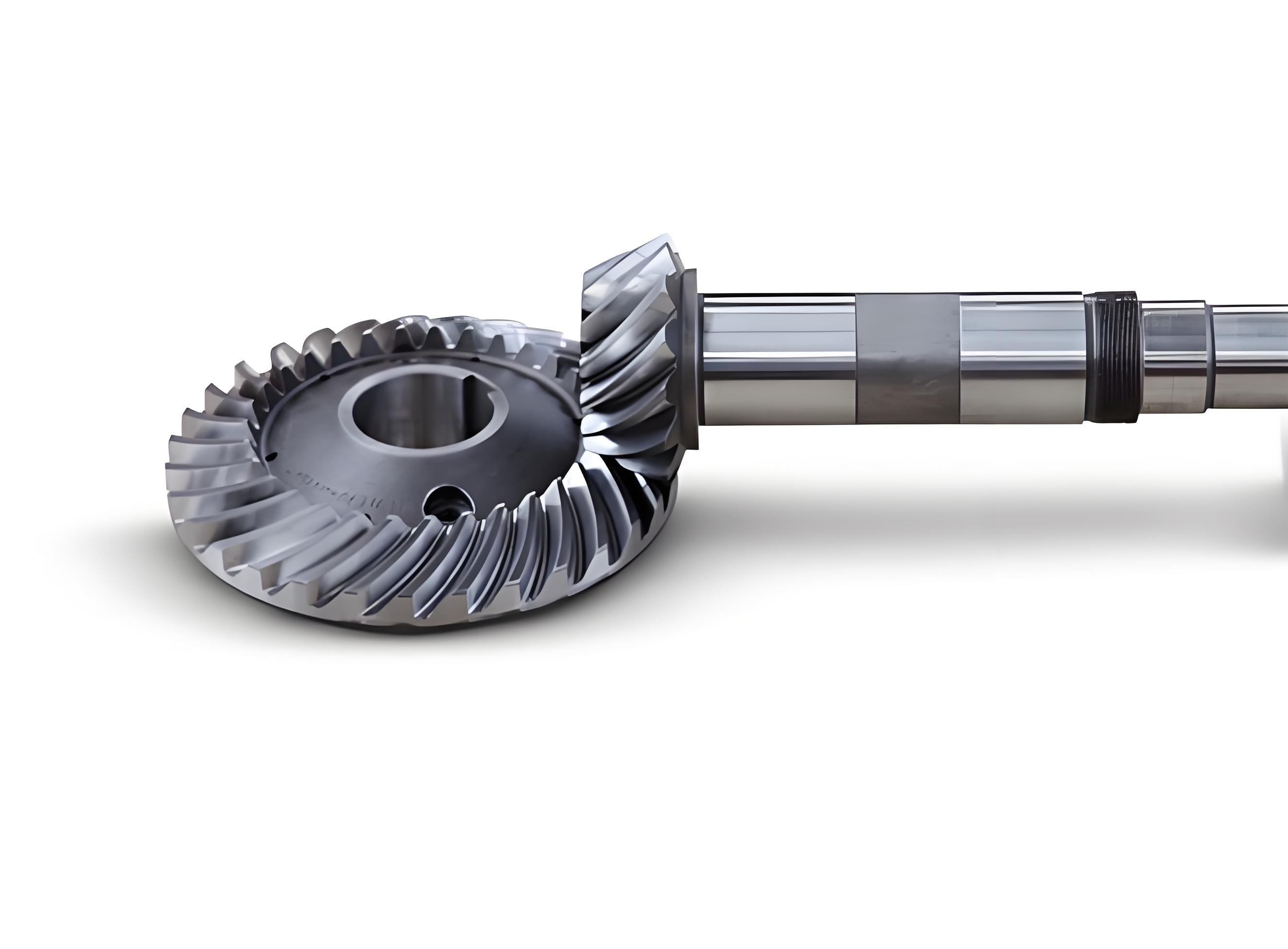
This article presents an enhanced design framework for spiral bevel gears that builds upon the spherical involute foundation by integrating the concept of logarithmic plane conjugate curves. The core objective is to develop a precise, closed-form mathematical model for the complete tooth surface—encompassing the active flank regions, the tip and root edges, and the critical root fillet transition—thereby enhancing the accuracy of subsequent Finite Element Analysis (FEA) for contact strength, bending stress, and dynamic response. The proposed method aims to improve the meshing quality and contact pattern stability of the gear pair, leading to designs with higher load-bearing capacity and reduced sensitivity to operational variances.
The fundamental geometry of a spherical involute begins with a base cone. Imagine a plane tangent to this base cone along a generating line. As this plane rolls without slipping on the base cone, a point fixed on the plane traces a curve on the surface of a sphere centered at the cone’s apex. This curve is the spherical involute. To enhance this foundation for modern spiral bevel gears design, we introduce a logarithmic element within this rolling plane. A point on this logarithmic curve, rather than a fixed point, is used to generate the tooth surface. This “logarithmic plane” is defined in its own coordinate system $S_c(x_c, y_c, z_c)$, which is tangent to the base cone along its generatrix. The position vector of a point on this logarithmic curve is given by:
$$
\mathbf{r}_{log} = \begin{bmatrix} 0 & e^{\cot\beta \cdot \theta} \sin(\phi \sin\delta_b) & e^{\cot\beta \cdot \theta} \cos(\phi \sin\delta_b) & 1 \end{bmatrix}^T
$$
where $\delta_b$ is the base cone angle (half-angle), $\beta$ is the spiral angle parameter, $\theta$ is a motion parameter related to the rolling action, and $\phi$ is an angular parameter defining the point’s location on the curve. When the rolling motion occurs, the transformation from the logarithmic plane coordinate system $S_c$ to the gear coordinate system $S_1$ attached to the base cone is described by the homogeneous transformation matrix $\mathbf{M}_{1c}$:
$$
\mathbf{M}_{1c} = \begin{bmatrix}
\cos\delta_b \sin(\phi + \theta \csc\delta_b) & -\cos(\phi + \theta \csc\delta_b) & \sin\delta_b \sin(\phi + \theta \csc\delta_b) & 0 \\
\cos\delta_b \cos(\phi + \theta \csc\delta_b) & \sin(\phi + \theta \csc\delta_b) & \sin\delta_b \cos(\phi + \theta \csc\delta_b) & 0 \\
-\sin\delta_b & 0 & \cos\delta_b & 0 \\
0 & 0 & 0 & 1
\end{bmatrix}
$$
The family of spherical involute surfaces generated from the logarithmic curve is then obtained by applying this transformation:
$$
\begin{bmatrix} x_1 & y_1 & z_1 & 1 \end{bmatrix}^T = \mathbf{M}_{1c} \cdot \mathbf{r}_{log}
$$
By varying the parameter $\phi$ across a defined range corresponding to the tooth thickness, and carefully selecting segments of the logarithmic curve, we can define discrete point loci that accurately represent the convex and concave flanks of a spiral bevel gear tooth. The flank surface $\Sigma_1$ is a ruled surface generated by the spherical involute curves. For a given point $P$ on the spherical involute corresponding to a cone distance $R$ and mean cone angle $\delta_m$, its profile angle $\beta_P$ can be derived from spherical trigonometry:
$$
\beta_P = \frac{\arccos\left( \frac{\cos\delta_k}{\cos\delta_b} \right)}{\sin\delta_b} – \arccos\left( \frac{\tan\delta_b}{\tan\delta_k} \right)
$$
where $\delta_k$ is the cone angle of the point $P$.
The accurate definition of the path of contact and the conjugate tooth surface for the mating gear is paramount. We establish coordinate systems: $S_1$ and $S_2$ are rigidly connected to the pinion and gear, respectively, with their origins coinciding at the common apex $O$. The fixed coordinate system is $S_0$. The shaft angle is $\Sigma$. The transformation from $S_1$ to $S_2$ is:
$$
\mathbf{M}_{21} = \mathbf{M}_{2p} \mathbf{M}_{p0} \mathbf{M}_{01} = \begin{bmatrix}
\cos\phi_1 \cos\phi_2 – \sin\phi_1 \sin\phi_2 \cos\Sigma & -\cos\phi_1 \sin\phi_2 – \sin\phi_1 \cos\phi_2 \cos\Sigma & \sin\phi_1 \sin\Sigma & 0 \\
\sin\phi_1 \cos\phi_2 + \cos\phi_1 \sin\phi_2 \cos\Sigma & -\sin\phi_1 \sin\phi_2 + \cos\phi_1 \cos\phi_2 \cos\Sigma & -\cos\phi_1 \sin\Sigma & 0 \\
\sin\phi_2 \sin\Sigma & \sin\Sigma \cos\phi_2 & \cos\Sigma & 0 \\
0 & 0 & 0 & 1
\end{bmatrix}
$$
where $\phi_1$ and $\phi_2 = i_{21}\phi_1$ are the rotation angles of the pinion and gear, and $i_{21}$ is the gear ratio. The condition for conjugate contact (the equation of meshing) requires that the common surface normal $\mathbf{n}$ is perpendicular to the relative velocity $\mathbf{v}^{(12)}$ at the contact point:
$$
\mathbf{n} \cdot \mathbf{v}^{(12)} = 0
$$
The relative velocity is given by $\mathbf{v}^{(12)} = \boldsymbol{\omega}^{(1)} \times \mathbf{r}^{(1)} – \boldsymbol{\omega}^{(2)} \times \mathbf{r}^{(2)}$. Applying this condition to the spherical involute surface derived from the logarithmic plane leads to a specific functional relationship between the motion parameter $\theta$ and the angular parameter $\phi$ along the contact path $\Gamma_1$:
$$
\theta(\phi) = -\frac{\log\left[ -\sin\left( \cos(\beta + \phi \sin\delta_b) \cot\delta_b + C_1 \right) \right]}{\cot\beta} + \frac{C_2 + \phi \csc(\phi \sin\delta_b)}{\cot\beta}
$$
Constants $C_1$ and $C_2$ are determined by boundary conditions at the start and end of the active profile. Once the contact path $\mathbf{r}_{\Gamma_1}(\phi)$ on the pinion is determined, the conjugate contact path on the gear $\mathbf{r}_{\Gamma_2}$ is found via the transformation: $\mathbf{r}_{\Gamma_2} = \mathbf{M}_{21} \cdot \mathbf{r}_{\Gamma_1}$.
The final tooth surface model for a spiral bevel gear is constructed in three distinct regions, each requiring precise mathematical definition.
1. Active Working Flank Surfaces: The active flanks are generated by sweeping a profile curve along the conjugate contact paths $\Gamma_i$. This profile, defined in the normal section relative to $\Gamma_i$, is typically a circular arc that provides favorable localized contact conditions. Let $\mathbf{r}_{\Gamma_i}(u)$ define the contact path on gear $i$, with unit tangent vector $\boldsymbol{\alpha}_{\Gamma_i} = d\mathbf{r}_{\Gamma_i}/du$ and unit surface normal $\mathbf{n}_{\Gamma_i}$. A local coordinate system $S_{\Gamma_i}$ is defined at each point on the path, with axes formed by $\boldsymbol{\alpha}_{\Gamma_i}$, $\mathbf{n}_{\Gamma_i}$, and $\mathbf{b}_{\Gamma_i} = \boldsymbol{\alpha}_{\Gamma_i} \times \mathbf{n}_{\Gamma_i}$. The circular arc profile $\mathbf{r}_{c}^i(v)$ is defined in this local system. The global flank surface $\Sigma_i’$ is then:
$$
\mathbf{r}_{\Sigma_i’}(u, v) = \mathbf{r}_{\Gamma_i}(u) + [\mathbf{M}_{\Gamma_i}] \cdot \mathbf{r}_{c}^i(v)
$$
where $[\mathbf{M}_{\Gamma_i}]$ is the orientation matrix formed by the local axes vectors. Applying this to both the “drive” and “coast” sides of the tooth generates the convex and concave working surfaces of the spiral bevel gears.
2. Toe and Heel Edge Curves: These are the boundary curves of the tooth surface at the inner (toe) and outer (heel) ends. They are simply the intersections of the spherical involute flank surface with spheres of radii corresponding to the toe and heel cone distances. For the heel (outer) edge, with cone distance $R_o$ and outer cone angle $\delta_o$, the points satisfy $\rho = R_o$ and $\theta = \delta_k = \delta_o$. A similar set of equations holds for the toe edge with $R_i$ and $\delta_i$.
3. Root Fillet Transition Surface: This surface connects the active flank to the root cylinder and is critical for bending stress analysis. Its design is governed by the manufacturing tool tip radius $r_t$ and clearances. The fillet is modeled as a trochoidal path generated by the tip of the imaginary cutting tool. The required tool tip radius can be calculated based on the desired root geometry. For the case where the base circle radius is larger than the root circle radius, a standard full-radius fillet is used, with $r_t$ calculated considering clearances $j_m$:
$$
\Delta\alpha = \arccos\left( \frac{r_p’ \cos\alpha}{r_p’ + h_a’} \right) – \alpha, \quad r_t = [\Delta\alpha – \sin\Delta\alpha + \tan\Delta\alpha(1-\cos\Delta\alpha)] \cdot \left( \frac{h_a’ \cos\alpha}{\Delta\alpha} \left( \frac{r_p}{h_a’} – 1 \right) + \frac{1}{1-\sin\alpha} \right)
$$
where $r_p’ = r_p – \frac{z_1 j_m}{2\sin\alpha(z_1+z_2)}$ and $h_a’ = h_a – \frac{z_1 j_m}{2\sin\alpha(z_1+z_2)}$. If the base circle is smaller, a standardized value such as $r_t = 0.3m_n$ (module) is often adopted.
The following table summarizes key parameters for an example gear pair designed using this methodology.
| Basic Parameter | Pinion | Gear |
|---|---|---|
| Number of Teeth, $z$ | 27 | 74 |
| Hand of Spiral | Left Hand | Right Hand |
| Module, $m_n$ (mm) | 3.85 | 3.85 |
| Shaft Angle, $\Sigma$ (°) | 90 | |
| Mean Spiral Angle, $\beta_m$ (°) | 30 | |
| Face Width, $b$ (mm) | 38.5 | |
| Pressure Angle, $\alpha_n$ (°) | 20 | |
| Dedendum, $h_f$ (mm) | 4.56 | 1.98 |
Using the mathematical model, point clouds for a single tooth slot (including convex flank, concave flank, and fillet surfaces) are generated programmatically. These points are imported into CAD software to create smooth surfaces via lofting and filling operations. A solid gear model is created by extruding a gear blank and performing a Boolean subtraction using the tooth slot surface body, followed by a circular pattern to create all teeth. For high-fidelity finite element analysis, a controlled meshing strategy is essential. A hex-dominant or advanced tetrahedral mesh is employed, with significant refinement in the contact zones on the flanks and at the root fillet regions where stress concentrations occur. Coarser elements can be used in the gear web and hub to reduce computational cost. The table below contrasts the key characteristics of the traditional generation-based design approach with the proposed logarithmic conjugate curve method.
| Aspect | Traditional Generation-Based Design | Proposed Conjugate Curve Design |
|---|---|---|
| Basis | Simulation of physical cutting process (machine-tool dependent). | Theoretical spherical involute modified by conjugate curve theory. |
| Surface Accuracy | Approximate, subject to simulated kinematics and tool geometry. | Precise, defined by closed-form mathematical equations. |
| Transition Surfaces | Often approximated (e.g., simple blends), requiring post-correction. | Accurately modeled as trochoidal/functional fillets from first principles. |
| Conjugacy | Optimal conjugacy not guaranteed; relies on correct machine settings. | Designed for theoretically optimal conjugate contact from the outset. |
| Computational Effort for Model Gen. | High (requires solving complex kinematic equations iteratively). | Moderate (direct calculation of surface points from formulas). |
A dynamic contact FEA simulation was conducted to validate the performance of spiral bevel gears designed with the proposed method. A gear pair (27/74 teeth) was modeled, and material properties for case-hardened steel (e.g., 20CrMnTi) were assigned: Density $\rho = 7.8\times10^{-9}$ t/mm³, Young’s Modulus $E = 205$ GPa, Poisson’s ratio $\nu = 0.3$. The pinion was driven at a constant angular velocity with a resistive torque applied to the gear. Contact analysis revealed that the proposed design exhibited a more stable and slightly lower maximum contact stress over a meshing cycle compared to a model generated via traditional simulation methods, indicating improved load distribution and higher potential contact strength.
A key theoretical advantage of spherical involute-based spiral bevel gears is their partial insensitivity to small shaft angle misalignments $\Delta\Sigma$. This characteristic was investigated by introducing a small shaft angle error ($\Delta\Sigma = 0.3$ arc-minutes) in the virtual assembly. The loaded transmission error (LTE), defined as the difference between the actual and ideal positions of the output gear, was calculated. The results showed that the transmission error function for the proposed design maintained a stable, low-amplitude pattern even with the introduced misalignment, confirming the inherent error-compensating capability of the underlying spherical involute geometry. The peak-to-peak LTE variation remained within acceptable limits, demonstrating the robustness of the design.
The integration of logarithmic plane conjugate curves into the spherical involute theory for designing spiral bevel gears provides a robust and precise framework for generating high-fidelity geometric models. This method offers several distinct advantages. Firstly, it decouples the tooth geometry from specific manufacturing simulations, leading to a more fundamental and potentially optimal conjugate surface definition. Secondly, it enables the accurate mathematical description of all tooth regions, including the critical root fillet, which is essential for reliable stress analysis. Thirdly, the models derived are computationally efficient to generate, facilitating rapid design iteration and optimization. Finally, the designs retain the beneficial property of spherical involute spiral bevel gears, such as reduced sensitivity to certain assembly errors, contributing to more stable performance in real-world applications. This enhanced design methodology serves as a powerful tool for developing high-performance, reliable spiral bevel gears for demanding power transmission applications, ensuring accuracy from the initial design phase through to virtual performance validation.