
In modern gear manufacturing, spiral bevel gears are critical components for transmitting motion and power between intersecting shafts, especially in automotive, aerospace, and industrial machinery. Achieving high performance in spiral bevel gears requires precise tooth surface modifications to minimize noise, vibration, and wear, while ensuring optimal contact patterns and load distribution. Traditional methods like the “five-cut method” have limitations in efficiency and accuracy, leading to the adoption of advanced processes such as the dual duplex spread blade method. This method allows for simultaneous cutting of both sides of the tooth, enhancing productivity and enabling dry cutting. However, designing tooth surfaces with desired meshing performance remains challenging. In this paper, we propose a synchronous bilateral modification approach for spiral bevel gears based on the dual duplex spread blade method. We focus on using the midpoint of the pinion tooth space as a reference point for modification, presetting meshing parameters for both tooth sides, and constructing a target tooth surface that meets performance requirements. Through mathematical modeling, optimization of machining parameters, and validation via tooth contact analysis and finite element analysis, we demonstrate that this method effectively controls contact patterns and transmission errors. The study contributes to the application of dual duplex methods in medium-to-high module spiral bevel gears, offering a systematic design framework for improved gear performance.
The dual duplex spread blade method is a full-process technique for machining spiral bevel gears, where both the gear and pinion are cut using a duplex spread blade approach. This method involves using a cutter head with multiple blades to simultaneously generate the convex and concave sides of the tooth. Compared to traditional methods, it offers higher efficiency and better surface finish. To understand the process, we first establish the mathematical model for gear cutting. In the dual duplex method, the machine setup includes a cradle, cutter head, and workpiece, each with associated coordinate systems. We define the machine coordinate system \( S_m \), cradle coordinate system \( S_c \), cutter coordinate system \( S_t \), and workpiece coordinate system \( S_w \). Key machining parameters include radial distance \( S_r \), angular position \( q \), machine center to back \( X_b \), horizontal offset \( X_c \), vertical offset \( E_c \), cradle angle \( \phi_c \), workpiece rotation angle \( \phi \), and machine root angle \( \gamma \). The tooth surface is generated through the relative motion between the cutter and workpiece, governed by the principles of spatial meshing.
The surface equation and normal vector for the gear tooth can be derived using coordinate transformations. For a point on the cutter surface defined by parameters \( u \) and \( \theta \), the position vector \( \mathbf{r}_t(u, \theta) \) and normal vector \( \mathbf{n}_t(u, \theta) \) are transformed to the workpiece coordinate system via transformation matrices. The meshing condition requires that the relative velocity between the cutter and workpiece is perpendicular to the surface normal, expressed as \( \mathbf{n} \cdot \mathbf{v}^{(tw)} = 0 \), where \( \mathbf{v}^{(tw)} \) is the relative velocity vector. For spiral bevel gears, this leads to a system of equations that describe the tooth surface geometry. Specifically, for the pinion, we obtain bilateral tooth surfaces: convex side \( \mathbf{r}_{1p}(u_1, \theta_1) \) and concave side \( \mathbf{r}_{1g}(u_1, \theta_1) \), with corresponding normal vectors \( \mathbf{n}_{1p} \) and \( \mathbf{n}_{1g} \). The gear tooth surface is then derived as the conjugate surface to the pinion, ensuring proper meshing.
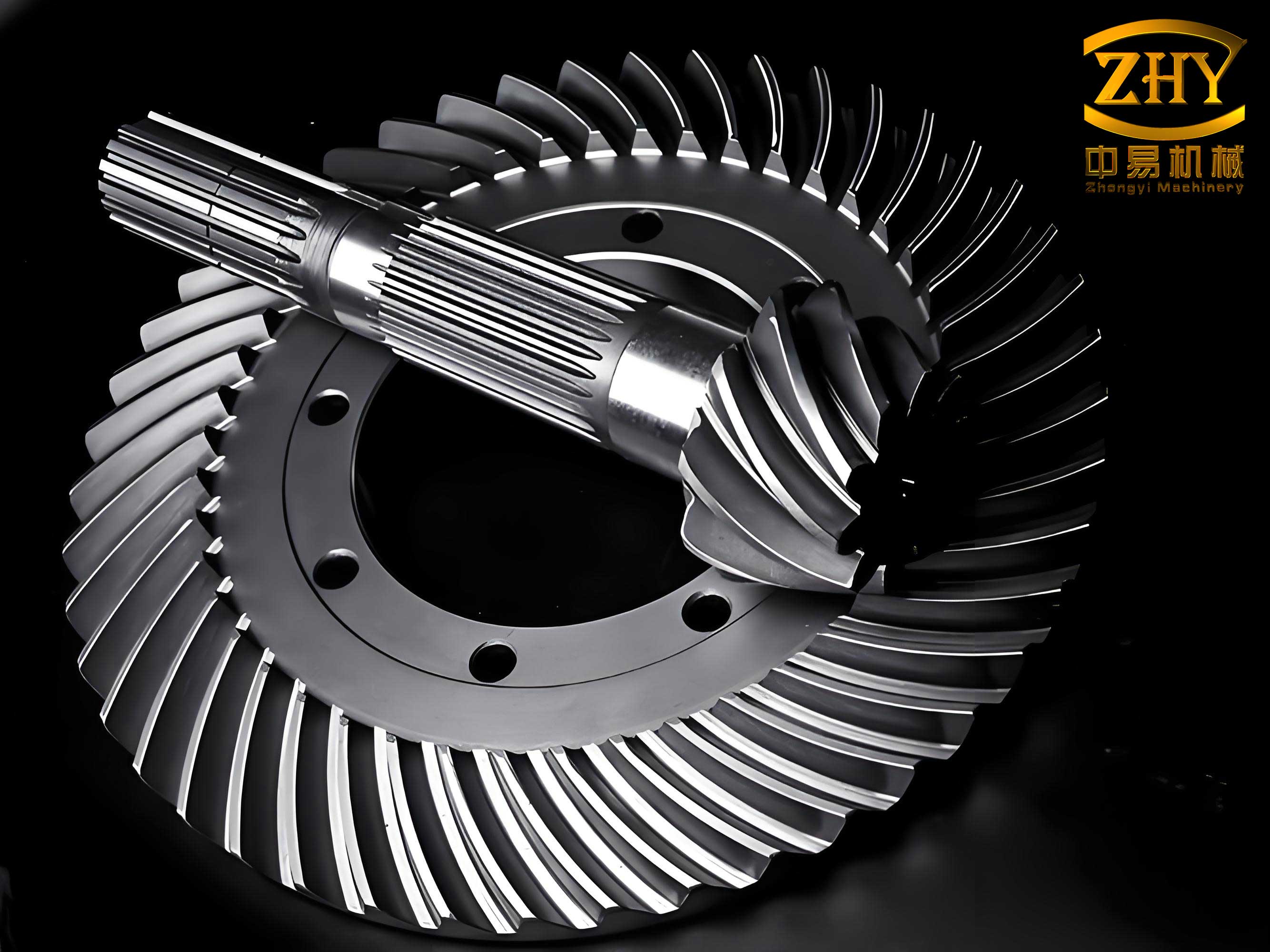
To achieve desired meshing performance, we construct a target tooth surface for the gear based on preset parameters. For spiral bevel gears, a key goal is to transform line contact into point contact, reducing sensitivity to misalignment and improving load distribution. We start by defining the reference point as the midpoint of the pinion tooth space, which serves as the basis for bilateral modification. At this point, we preset meshing parameters such as transmission error and contact path orientation. The transmission error curve is designed as a parabolic function to minimize vibration. For a gear pair with pinion teeth \( Z_1 \) and gear teeth \( Z_2 \), the transmission error \( \delta(\phi_2) \) is given by:
$$ \delta(\phi_2) = (\phi_1 – \phi_1^0) + \frac{Z_1}{Z_2} (\phi_2 – \phi_2^0) $$
where \( \phi_1 \) and \( \phi_2 \) are actual rotation angles, and \( \phi_1^0 \) and \( \phi_2^0 \) are initial angles. By combining this with the pinion tooth surface equations, we derive the fully conjugate gear tooth surface \( \mathbf{r}_{20}(u_1, \theta_1) \) and \( \mathbf{n}_{20}(u_1, \theta_1) \). However, this surface results in line contact, so we introduce modifications to achieve point contact with a predefined contact ellipse.
For active design of the gear tooth surface, we discretize the surface into a grid for numerical analysis. Using the reference point \( M(u_0, \theta_0) \), we create a grid on the rotational projection plane at the tooth space midpoint, with coordinates defined by radial distance \( R = \sqrt{x^2 + y^2} \) and length \( L \). The grid points are transformed to the machine coordinate system using:
$$ X = R \cos \gamma – L \sin \gamma + A_{tr} \cos \gamma $$
$$ Y = R \sin \gamma – L \cos \gamma + A_{tr} \sin \gamma $$
where \( A_{tr} \) is a translation offset. This grid allows us to evaluate surface deviations and apply modifications. The target tooth surface is obtained by adding a modification amount \( \Delta \) along the normal direction to the conjugate surface. The modification \( \Delta \) is defined as:
$$ \Delta = \frac{z^2}{2a} + \Delta_b $$
where \( a \) is the semi-major axis of the contact ellipse, \( z \) is the distance from any point to the preset contact path projection on the tangent plane, and \( \Delta_b \) is the elastic deformation (typically \( \Delta_b = 0.00635 \, \text{mm} \)). Thus, the target surface points become:
$$ \mathbf{r}_2^{\text{target}} = \mathbf{r}_{20} + \Delta \cdot \mathbf{n}_{20} $$
for both convex and concave sides. This approach ensures that the contact pattern is localized and transmission error is controlled.
Next, we inverse the machining parameters to achieve the target tooth surface. The actual gear tooth surface produced by the dual duplex method depends on machine settings, which we adjust to minimize deviations from the target. We define the machining parameters as variables: radial刀位 \( S_r \), angular刀位 \( q \), machine center to back \( X_b \), horizontal offset \( X_c \), vertical offset \( E_c \), and machine root angle \( \gamma \). Let the initial parameters be \( \xi_0 \), and the adjustments be \( \Delta \xi \), so the updated parameters are \( \xi = \xi_0 + \Delta \xi \). The objective function is built based on the sum of squared deviations between the actual surface and target surface at grid points. For bilateral surfaces, we define deviations for convex side \( \Delta_{ip} \) and concave side \( \Delta_{ig} \):
$$ \Delta_{ip} = \left( (\mathbf{r}_{2p} – \mathbf{r}_{2p}^{\text{target}}) \cdot \mathbf{n}_{2p} \right)^2 $$
$$ \Delta_{ig} = \left( (\mathbf{r}_{2g} – \mathbf{r}_{2g}^{\text{target}}) \cdot \mathbf{n}_{2g} \right)^2 $$
The total error function is a weighted sum:
$$ \min f = k \sum \Delta_{ip} + (1 – k) \sum \Delta_{ig} $$
where \( k \) is a weighting coefficient (e.g., \( k = 0.5 \) for equal emphasis). Constraints include the meshing equation \( \mathbf{n} \cdot \mathbf{v}^{(tw)} = 0 \), tooth thickness consistency, and bounds on parameter changes to ensure feasible machining. The tooth thickness constraint relates \( X_b \) to initial values and other parameters:
$$ X_b = X_b^0 – X_c \sin \delta + L \tan(\delta – \delta_0) $$
Additionally, grid points must satisfy \( L = 0 \) and \( R = \sqrt{x^2 + y^2} \). We use nonlinear constrained optimization algorithms, such as sequential quadratic programming, to solve for \( \Delta \xi \). The optimization process iteratively adjusts parameters until the error function is minimized, yielding the final machining settings.
To validate our method, we conduct a case study on a spiral bevel gear pair with 8 pinion teeth and 31 gear teeth. The gear parameters are listed in Table 1, and initial machining parameters are in Table 2. We preset the contact path angle at 40° for the convex side and 140° for the concave side, with transmission error amplitude of 30 arcseconds. The weighting coefficient \( k \) is set to 0.5. Using the optimization framework, we compute adjusted machining parameters. The results show that the optimized parameters shift the contact pattern toward the tooth center, avoiding edge contact. Table 2 compares initial and optimized parameters, highlighting changes in radial刀位, angular刀位, and other settings.
| Parameter | Gear | Pinion |
|---|---|---|
| Number of Teeth | 31 | 8 |
| Module (mm) | 5.53 | |
| Spiral Angle (°) | 35.75 | |
| Spiral Direction | Right-hand | Left-hand |
| Face Cone Angle (°) | 77.91925 | 19.49693 |
| Pitch Cone Angle (°) | 75.52971 | 14.47029 |
| Root Cone Angle (°) | 70.50307 | 12.08075 |
| Outer Cone Distance (mm) | 88.52319 | |
| Face Width (mm) | 26.7 | |
| Addendum (mm) | 2.6544 | 6.7466 |
| Dedendum (mm) | 7.78624 | 3.69404 |
| Parameter | Pinion | Gear (Initial) | Gear (Optimized) |
|---|---|---|---|
| Pressure Angle (°) | 20.0 | 20.0 | 20.0 |
| Cutter Number | 14 | 14 | 14 |
| Cutter Diameter (mm) | 152.4 | 152.4 | 152.4 |
| Tip Width (mm) | 2.6 | 1.6 | 1.6 |
| Radial刀位 \( S_r \) (mm) | 68.75678 | 68.873379 | 69.02213 |
| Angular刀位 \( q \) (°) | 77.35761 | 74.822145 | 63.63363 |
| Ratio of Roll | 1.03276197 | 1.03276197 | 4.001953 |
| Vertical Offset \( E_c \) (mm) | 0 | 0.154371 | 0 |
| Horizontal Offset \( X_c \) (mm) | 0 | 0.366433 | 0 |
| Machine Center to Back \( X_b \) (mm) | -0.7237 | -0.22594 | -0.3771 |
| Machine Root Angle \( \gamma \) (°) | 70.50307 | 69.631863 | 12.08075 |
After optimization, we perform tooth contact analysis (TCA) and finite element analysis (FEA) to evaluate meshing performance. The TCA results show that the contact path angles become 43.6° for the convex side and 143.42° for the concave side, close to the preset values. The transmission error at the meshing point is 32.4 arcseconds for the convex side and 35.9 arcseconds for the concave side, meeting the target of 30 arcseconds approximately. The contact patterns are centered on the tooth surfaces, with no edge contact observed. For FEA, we apply a load torque of 800 N·m to a three-tooth model. The stress distribution and contact pressure indicate that the contact area remains in the middle region for both sides, validating the design. These analyses confirm that the synchronous bilateral modification effectively controls the meshing behavior of spiral bevel gears.
In conclusion, we have developed a systematic approach for synchronous bilateral modification of spiral bevel gears using the dual duplex spread blade method. By leveraging the tooth space midpoint as a reference, presetting meshing parameters, and optimizing machining settings through inverse solution, we achieve target tooth surfaces with desired contact patterns and transmission errors. The case study demonstrates that this method improves meshing performance, reducing vibration and noise while ensuring load capacity. Future work could extend this approach to other gear types or incorporate dynamic analysis. Overall, this research provides a practical framework for enhancing the design and manufacturing of high-performance spiral bevel gears in industrial applications.
The mathematical models and optimization techniques presented here are essential for advancing gear technology. Spiral bevel gears are complex components, and their performance hinges on precise tooth geometry. The dual duplex method offers manufacturing advantages, but it requires careful parameter selection to achieve optimal results. Our work bridges this gap by integrating design and manufacturing through active tooth surface modification. We emphasize the importance of considering both sides of the tooth simultaneously, as modifications on one side can affect the other. The use of grid-based discretization and nonlinear optimization allows for accurate control over surface deviations. Moreover, the validation via TCA and FEA ensures that the designed gears meet practical requirements. As industries demand higher efficiency and reliability from gear systems, methods like this will become increasingly valuable for producing spiral bevel gears with superior performance characteristics.
In summary, the synchronous bilateral modification approach for spiral bevel gears enables better meshing control and noise reduction. By focusing on the dual duplex spread blade method, we have shown how to design tooth surfaces that meet specific performance criteria. This methodology can be adapted to various gear designs and manufacturing conditions, contributing to the broader field of gear engineering. The continuous improvement of spiral bevel gears is crucial for applications in automotive transmissions, helicopter drivetrains, and industrial machinery, where precision and durability are paramount. Our research underscores the potential of integrated design and manufacturing strategies to push the boundaries of gear technology.