
In the field of mechanical power transmission, spiral bevel gears play a critical role due to their ability to efficiently transfer motion and power between intersecting axes with high load capacity and smooth operation. These gears are indispensable components in automotive differentials, aerospace actuators, heavy machinery, and various industrial applications. The geometric design and manufacturing of spiral bevel gears have long been recognized as complex challenges. The advent of advanced computer-aided design (CAD), engineering (CAE), and manufacturing (CAM) technologies has opened new avenues for tackling these challenges. A foundational step for any subsequent analysis—be it dynamic simulation, contact stress evaluation, or manufacturing process optimization—is the creation of a highly accurate three-dimensional digital model of the gear teeth. This article details a comprehensive methodology, from first principles, for constructing such a precise geometric model for spiral bevel gears based on their generating manufacturing process.
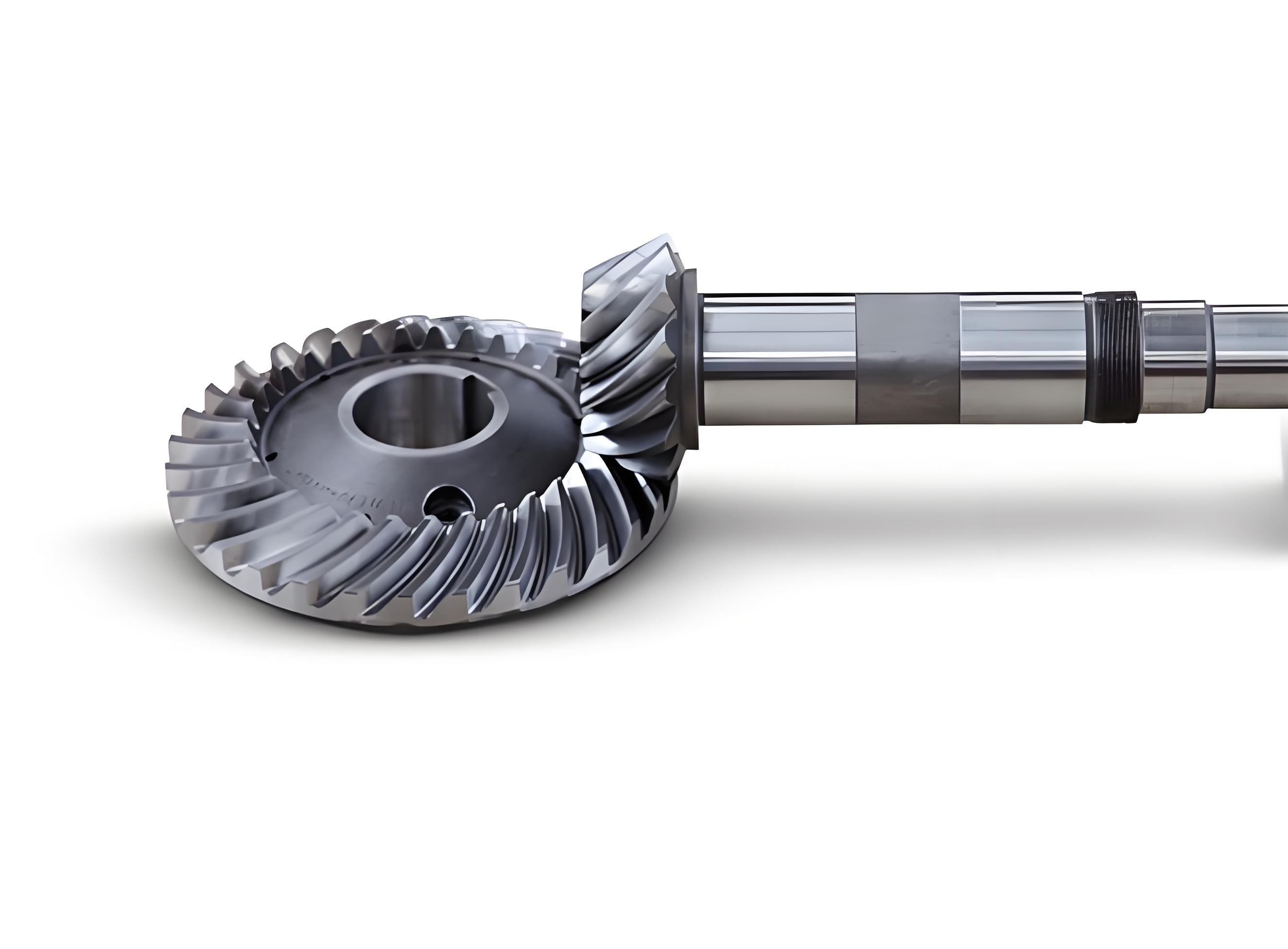
The complexity of spiral bevel gears stems from their curved tooth geometry, which is designed to provide gradual engagement and multiple points of contact. Unlike parallel axis gears, their tooth surfaces are complex spatial entities that cannot be easily described by simple geometric primitives. The most accurate approach to model these surfaces is to derive them mathematically from the actual manufacturing simulation, a process known as the generating or enveloping method. This method mirrors the physical cutting process, where a hypothetical generating gear (or crown gear), represented by the cutting tool, meshes with the gear blank to produce the desired tooth form. By leveraging gear meshing theory and coordinate transformation matrices, one can derive the exact mathematical equations for the tooth surfaces of both the gear and pinion. This approach ensures that the digital model faithfully represents the intended design, free from the approximations inherent in some geometric modeling techniques.
Fundamentals of the Generating Process for Spiral Bevel Gears
The manufacturing principle for spiral bevel gears is central to their geometric definition. In the generating process, the machine tool simulates the kinematics of a theoretical crown gear meshing with the workpiece. A cutting tool, typically a face-mill cutter with multiple inserted blades, is mounted on a cradle. This cutter represents a single tooth (or space) of the theoretical generating gear. As the cradle rotates, simulating the generating gear’s rotation, and the workpiece rotates in a precisely synchronized ratio, the cutter envelops the shape of the tooth surface onto the gear blank. For a standard process, the gear (often the larger wheel) is usually generated in a single continuous process. The pinion (the smaller wheel) undergoes a more complex generation, often involving modified roll motions and tool tilt to localize the bearing contact for optimal performance. Understanding this cradle-based generating mechanism is the cornerstone for deriving the universal mathematical model of the tooth surfaces for both members of a spiral bevel gear pair.
Mathematical Derivation of Tooth Surface Equations
The derivation process involves systematically moving from the simple geometry of the cutter blade to the complex spatial surface of the finished gear tooth through a series of coordinate transformations. The core of the methodology lies in applying gear meshing theory, which governs the contact condition between the generating surface (the cutter) and the generated surface (the gear tooth).
Cutter Surface Definition
The cutting edges of a face-mill cutter for spiral bevel gears are typically straight lines, forming a conical surface. A dual-sided cutter is used, with one side for cutting the concave (drive) side and the other for the convex (coast) side of the gear tooth space. The geometry of this cutter cone can be parameterized. Let a coordinate system \( S_d(X_d, Y_d, Z_d) \) be rigidly connected to the cutter, with its origin at the cutter center and the \( Z_d \)-axis along the cutter’s axis of rotation. The surface of a blade edge can be described by two parameters: \( u \), the distance along the blade from its tip, and \( \theta \), an angular parameter related to the rotation of the cutter. For a blade with pressure angle \( \alpha \), and considering the blade tip radius \( r_0 \) (which is the cutter radius adjusted by the blade offset), the vector equation of the cutter surface is:
$$
\mathbf{r}_d(u, \theta) =
\begin{bmatrix}
(r_0 – u \sin\alpha) \sin\theta \\
(r_0 – u \sin\alpha) \cos\theta \\
u \cos\alpha \\
1
\end{bmatrix}
$$
Here, \( (r_0 – u \sin\alpha) \) is the instantaneous radius of the cutting point. The sign convention for \( \alpha \) and the value of \( r_0 \) differ for the convex and concave sides of the tooth. For the gear’s concave side (cut by the outer blade), \( \alpha = \alpha_o \) and \( r_0 = r_c + w/2 \), where \( r_c \) is the nominal cutter radius and \( w \) is the point width. For the convex side (cut by the inner blade), \( \alpha = \alpha_i \) and \( r_0 = r_c – w/2 \).
Coordinate Transformation Chain
The transformation from the cutter surface to the final gear tooth surface involves several intermediate coordinate systems, each representing a component of the machine tool or the workpiece. The general strategy is to express the cutter point in the stationary “machine” coordinate system, and then account for the relative motion between the cradle (generating gear) and the workpiece.
The primary coordinate systems involved are:
- Cutter System (\( S_d \)): Fixed to the rotating cutter.
- Cradle System (\( S_c \)): Fixed to the rotating cradle which holds the cutter.
- Machine Fixed System (\( S_m \)): The stationary reference frame of the machine.
- Workpiece System (\( S_w \)): Fixed to the rotating gear blank.
The position of a point on the generated tooth surface in the workpiece coordinate system \( S_w \) is obtained through a chain of homogeneous coordinate transformations:
$$
\mathbf{r}_w(u, \theta, \phi_c, \phi_w) = \mathbf{M}_{w,m}(\phi_w) \cdot \mathbf{M}_{m,c}(\phi_c) \cdot \mathbf{M}_{c,d} \cdot \mathbf{r}_d(u, \theta)
$$
Where:
- \( \mathbf{M}_{c,d} \) is the constant transformation from the cutter system to the cradle system (accounting for the radial and angular setup of the cutter on the cradle).
- \( \mathbf{M}_{m,c}(\phi_c) \) is the transformation from the cradle system to the machine system, which is a function of the cradle rotation angle \( \phi_c \).
- \( \mathbf{M}_{w,m}(\phi_w) \) is the transformation from the machine system to the workpiece system, which is a function of the workpiece rotation angle \( \phi_w \).
- \( \phi_c \) and \( \phi_w \) are related by the generating ratio \( m_{gc} \): \( \phi_w = m_{gc} \phi_c \).
| Transformation | Description | Key Parameters |
|---|---|---|
| \( \mathbf{M}_{c,d} \) | Cutter to Cradle (Static) | Cutter Tilt (\( i \)), Swivel (\( j \)), Radial Setting (\( S_R \)), and Basic Cradle Angle (\( q \)). |
| \( \mathbf{M}_{m,c}(\phi_c) \) | Cradle to Machine (Dynamic) | Cradle Rotation Angle (\( \phi_c \)), which simulates the generating gear rotation. |
| \( \mathbf{M}_{w,m}(\phi_w) \) | Machine to Workpiece (Dynamic) | Workpiece Rotation Angle (\( \phi_w \)), Sliding Base Setting (\( \Delta X_B, \Delta Y_B, \Delta Z_B \)), and the machine root angle (\( \gamma_m \)). |
Application of the Meshing Equation
The equation \( \mathbf{r}_w(u, \theta, \phi_c) \) represents a family of surfaces, parameterized by the motion parameter \( \phi_c \). The actual generated tooth surface is the envelope of this family. According to the theory of gearing, a point on the cutter surface becomes a point on the generated gear surface if, at that instant, the relative velocity vector between the cutter and the workpiece is orthogonal to the common normal vector at the point of contact. This condition is expressed by the meshing equation:
$$
\mathbf{n}(u, \theta) \cdot \mathbf{v}^{(cw)}(u, \theta, \phi_c) = 0
$$
Here, \( \mathbf{n} \) is the unit normal vector to the cutter surface (expressed in the same coordinate system as the velocity), and \( \mathbf{v}^{(cw)} \) is the relative velocity of the cutter with respect to the workpiece. The normal vector can be derived from the partial derivatives of \( \mathbf{r}_d \):
$$
\mathbf{n}_d = \frac{\partial \mathbf{r}_d}{\partial u} \times \frac{\partial \mathbf{r}_d}{\partial \theta}, \quad \text{and then transformed via } \mathbf{M}_{c,d}.
$$
The relative velocity \( \mathbf{v}^{(cw)} \) is calculated based on the kinematics: \( \mathbf{v}^{(cw)} = \mathbf{v}^{(c)} – \mathbf{v}^{(w)} \), where \( \mathbf{v}^{(c)} \) and \( \mathbf{v}^{(w)} \) are the velocities of the cutter point and workpiece point, respectively, derived from the time derivatives of the transformation matrices.
Solving the meshing equation for one of the parameters (typically \( u \)) in terms of the others (\( \theta \) and \( \phi_c \)) yields a functional relationship: \( u = f(\theta, \phi_c) \). Substituting this back into the family of surfaces equation \( \mathbf{r}_w \) eliminates the parameter \( u \), resulting in the final tooth surface equation expressed solely by two independent parameters:
$$
\mathbf{r}_w = \mathbf{r}_w(\theta, \phi_c)
$$
Here, \( \phi_c \) (or a related parameter like the workpiece roll angle) effectively becomes the second surface parameter, often denoted as \( \psi \). This pair (\( \theta, \psi \)) fully defines any point on the generated tooth flank of the spiral bevel gear.
Pinion Generation Considerations
The derivation for the pinion member of a spiral bevel gear set follows the same fundamental logic but incorporates additional machine settings to achieve localized bearing contact and desired motion characteristics. The primary differences are encapsulated in modified kinematics. A universal mathematical model includes terms for:
- Modified Roll (Variable Ratio): The generating ratio \( m_{gc}(\phi_c) \) is not constant but a function of cradle angle to control tooth flank form.
- Cutter Tilt and Swivel: The orientation of the cutter axis relative to the cradle can be changed for the pinion to influence pressure angles and contact patterns.
- Feed Motions: Additional linear motions may be included to machine the lengthwise profile.
The meshing equation and the transformation chain become more complex but retain the same structural form. The final pinion tooth surface is also described by a vector function \( \mathbf{r}_w^{(pinion)}(\theta, \psi) \), though the relationship between the parameters and the surface geometry is distinct from that of the gear.
Determination of Solution Boundaries and Parameter Ranges
The mathematical surface \( \mathbf{r}_w(\theta, \psi) \) defined above is, in theory, unbounded. However, the actual tooth flank is a finite patch bounded by the gear’s tip cone, root cone, toe (inner end), and heel (outer end). Therefore, it is crucial to determine the valid ranges for the parameters \( \theta \) and \( \psi \) that correspond to this physical patch. This is achieved by intersecting the unbounded surface with the geometric boundaries of the gear blank.
The gear blank is defined by its key dimensions: outer pitch radius \( R \), face width \( F \), pitch angle \( \delta \), face angle \( \delta_a \) (tip), and root angle \( \delta_f \). The boundaries are planes and cones in the workpiece coordinate system. For example:
- Tip Cone: \( Z_w \cos\delta_a + \sqrt{X_w^2 + Y_w^2} \sin\delta_a = \text{constant} \).
- Root Cone: \( Z_w \cos\delta_f + \sqrt{X_w^2 + Y_w^2} \sin\delta_f = \text{constant} \).
- Heel Plane: A plane perpendicular to the axis at the outer end.
- Toe Plane: A plane perpendicular to the axis at the inner end.
By substituting the surface equation \( \mathbf{r}_w(\theta, \psi) \) into the equations of these boundary surfaces, we can solve for the parameter pairs \( (\theta, \psi) \) that lie exactly on the boundaries. This defines a closed region in the \( \theta-\psi \) parameter plane. For practical data point sampling, we define a rectangular grid in this parameter domain that comfortably encloses the actual tooth surface patch, with a small margin to facilitate subsequent solid modeling operations like Boolean trimming. The density of this grid determines the resolution and accuracy of the final discrete model.
Computation and Acquisition of Tooth Surface Data
With the tooth surface equations and parameter boundaries established, the next step is the numerical generation of discrete point clouds representing the concave and convex flanks of both the gear and pinion. A computational environment like MATLAB is ideal for this task due to its strong capabilities in handling matrices, symbolic math (if needed for derivation), and iterative numerical solvers.
The process is automated within a script:
- Define Constants: Input all machine tool settings, cutter geometry, and gear blank data. These parameters are typically sourced from the gear design report or machine setup sheets (e.g., an SGM adjustment card).
- Implement Functions: Code the transformation matrices \( \mathbf{M}_{c,d} \), \( \mathbf{M}_{m,c}(\phi_c) \), \( \mathbf{M}_{w,m}(\phi_w) \), the cutter surface function \( \mathbf{r}_d(u, \theta) \), its normal vector, and the relative velocity calculation.
- Solve the Meshing Equation: For a given pair \( (\theta_i, \psi_j) \) on the defined parameter grid, solve the nonlinear meshing equation \( f(u, \theta_i, \psi_j)=0 \) for the corresponding \( u \) value using a root-finding algorithm (e.g., Newton-Raphson).
- Compute Coordinates: Substitute the solved \( u \), \( \theta_i \), and \( \psi_j \) back into the transformation chain to calculate the final 3D coordinates \( (X_w, Y_w, Z_w) \) of the point on the tooth surface in the workpiece coordinate system.
- Data Export: Collect all calculated points for a given tooth flank into a structured data file, typically a plain text file with three columns for X, Y, and Z coordinates. Separate files are created for the gear convex, gear concave, pinion convex, and pinion concave surfaces.
| Parameter | Gear (Wheel) | Pinion |
|---|---|---|
| Number of Teeth (N) | 36 | 18 |
| Module (mm) | 6 | 6 |
| Shaft Angle (deg) | 90 | 90 |
| Hand of Spiral | Right Hand | Left Hand |
| Pressure Angle (deg) | 20 | 20 |
| Pitch Diameter (mm) | 216 | 108 |
| Cutter Radius (mm) | 76.2 | 76.2 |
| Blade Angle (Inner/Outer) | 18°/22° | 22°/18° |
Geometric Model Construction in CAD
The raw point cloud data, while precise, is not yet a usable CAD solid model. The final stage involves importing this data into a professional CAD system (e.g., PTC Creo/Pro-ENGINEER, Siemens NX, CATIA) and constructing a water-tight solid body. The workflow generally follows these steps:
- Data Import and Preliminary Surfacing: The point cloud file is imported. The CAD software can generate an initial “facet” or “mesh” feature from these points. This mesh is a tessellated surface made of small triangles. At this stage, the mesh often contains noise and irregularities from the numerical sampling. Built-in tools for mesh refinement, smoothing, and denoising are applied to improve the quality of this polygonal representation without distorting the underlying geometry.
- Curve and Surface Fitting: The refined point cloud is used as a reference for constructing high-quality, precise NURBS (Non-Uniform Rational B-Spline) surfaces. This is typically done by:
- Creating curve-from-points features. For example, by slicing the point cloud in the U and V directions (corresponding to parameters \( \theta \) and \( \psi \)), we can fit spline curves through the points of each slice. This results in a network of U-V curves that follow the shape of the tooth flank.
- Using a boundary blend or lofted surface tool to create a smooth, continuous parametric surface that fits precisely through this network of curves. This surface is an accurate mathematical representation (NURBS) of the generated tooth flank.
- Surface Trimming and Solid Creation: The unbounded NURBS surface created in the previous step is trimmed using the geometric boundaries of the gear blank (tip cone, root cone, heel, and toe surfaces). These boundary surfaces are created as standard CAD features (extrusions, revolutions) based on the gear blank dimensions. The intersection curves are computed, and the tooth flank surface is trimmed to these curves.
This process is repeated for both the convex and concave flanks of a single tooth space. The trimmed surfaces are then joined together at their edges and also stitched to the fillet surfaces (which can be approximated or derived from the cutter tip geometry) to form a closed, quilted surface body representing the volume of material to be removed from the gear blank to create one tooth gap.
- Solid Boolean Operations:
- A solid cylinder (or cone) representing the initial gear blank is created.
- The closed quilt representing one tooth gap volume is used as a “tool” to subtract from the blank solid, using a Boolean Cut operation. This creates the first tooth gap.
- This cut feature is then patterned circularly around the gear axis, using the number of teeth (\( N \)) to determine the instance count and angular spacing (\( 360/N \) degrees). This completes the solid model of the gear.
- The same procedure is followed for the pinion, using its specific blank dimensions and tooth gap surface quilts.
- Model Validation: The accuracy of the final solid model of the spiral bevel gears is verified using CAD analysis tools. Key checks include:
- Curvature Analysis: Displaying Gaussian or mean curvature on the tooth flanks. A smooth, continuous color transition indicates a high-quality, continuous surface without unintended wrinkles or flat spots. Abrupt changes in curvature can signal modeling artifacts.
- Geometric Dimension Verification: Measuring critical dimensions like tooth thickness at various points, face width, and outer diameter against the design specifications.
- Assembly and Clearance Check: Assembling the gear and pinion models according to their theoretical mounting positions (offset, shaft angle) and checking for proper meshing clearance and the absence of unintended interference outside the contact zone.
Conclusion
The methodology presented herein provides a rigorous and systematic pipeline for generating highly accurate three-dimensional geometric models of spiral bevel gears. By rooting the process in the fundamental physics and mathematics of the gear generating method—starting from the cutter geometry, applying coordinate transformations and the governing meshing equation, and numerically solving for the resulting envelope surface—we achieve a digital representation that is faithful to the intended design intent. This fidelity is superior to approximations made by some alternative modeling techniques.
The resulting CAD model is not merely a visual asset; it serves as the essential foundation for a wide array of advanced engineering analyses. The accurate model of spiral bevel gears can be directly used for:
- Detailed Finite Element Analysis (FEA): Importing the model into FEA software (e.g., ANSYS, ABAQUS) for static stress analysis, dynamic contact simulation, and root bending fatigue studies. An accurate geometry minimizes errors stemming from model idealization.
- Kinematic and Dynamic Simulation: Utilizing the model in multi-body dynamics (MBD) software to simulate the actual meshing process, calculate transmission error, and study system-level dynamics under load.
- Manufacturing Simulation & Verification: The model can serve as a reference for generating CNC toolpaths for modern 5-axis milling machines or for validating the output of virtual manufacturing software.
- Contact Pattern Prediction: Through controlled misalignment in the virtual assembly, engineers can predict the shift and shape of the contact pattern on the tooth flanks, aiding in design robustness assessment.
In summary, mastering the geometry modeling of spiral bevel gears from first principles is a cornerstone capability for modern gear engineering. It bridges the gap between theoretical design, manufacturing process, and performance validation. The workflow, integrating mathematical derivation, computational programming, and advanced CAD techniques, enables the creation of a reliable digital twin of the physical spiral bevel gears. This digital twin empowers engineers to perform virtual prototyping, optimization, and analysis, significantly reducing the time, cost, and risk associated with the development of high-performance spiral bevel gear drives. Future extensions of this work can seamlessly incorporate manufacturing errors, surface modifications (e.g., crowning, tip relief), and wear patterns into the model, further enhancing its utility for predictive maintenance and life-cycle analysis.